 Garden

Affiliate Disclosure
Some links on this page are affiliate links. As an Amazon Associate, we earn from qualifying purchases — at no extra cost to you. We do not buy, test, or physically handle the products we cover; our rankings come from aggregated owner reviews, ratings and expert consensus. Commissions never change our verdicts. How we rank · full disclosure.
Four methods work, in this order of usefulness: grow it out with heavy feeders, stop every nitrogen input including compost and manure, add high-carbon material like sawdust or wood chips to temporarily tie nitrogen up, and water deeply to leach nitrate below the root zone. None is instant — expect weeks for carbon amendments and a full season for growing it out. Before you do any of it, be aware that most suspected nitrogen excess is actually a phosphorus, potassium or light problem wearing a nitrogen costume.
We never buy or physically handle the products we rank; recommendations come from aggregated owner reviews and expert consensus, described in how we rank. More at the composting and soil hub.
First, Confirm It Is Actually Nitrogen
The symptoms attributed to excess nitrogen are dark green, lush foliage with few flowers or fruit; soft, floppy growth that flops and attracts aphids; tomatoes and peppers producing leaves indefinitely; root crops making tops instead of roots; and delayed maturity or poor fall color.
Every one of those has alternative explanations. Poor fruiting is at least as often caused by night temperatures above about 75 degrees F disrupting pollination, by too little light, or by phosphorus deficiency. Floppy growth also comes from crowding and low light. So:
- Get a soil test for pH, phosphorus, potassium and organic matter — the parameters that are stable enough to measure meaningfully. Most extension labs charge $10 to $35. Nitrate is usually a paid add-on and must be run on a fresh sample.
- Audit your inputs honestly. Lawn fertilizer drift onto a neighboring bed is the single most common source of accidental excess in home gardens. So is fresh manure and repeated heavy compost application.
- Check that it is not just too much water and shade, which produce very similar-looking lush weak growth.
Reading the report is covered in how to read a soil test, and what a test does and does not measure is at what a soil test tells you.

The Four Methods
1. Grow it out (slowest, best)
Plant heavy nitrogen feeders and remove their biomass from the site. Corn, brassicas (cabbage, broccoli, kale), squash, and leafy greens all pull nitrogen hard, and grasses are particularly effective. A cover crop of annual ryegrass or sorghum-sudangrass sown in an off-season and then cut and removed — removed, not tilled back in, or you return the nitrogen — is the cleanest way to draw down a bed.
Timeline: one full growing season. Cost: a few dollars of seed. This is the method with no side effects.
2. Stop all inputs
Obvious and frequently overlooked. Nitrogen is mobile and it depletes on its own through plant uptake, leaching and denitrification. Stop fertilizer, stop manure, stop compost applications, stop legume cover crops (peas, beans, clover, vetch fix nitrogen from the air and add to the problem), and keep lawn feed off the beds. In many gardens, doing nothing for a season resolves it.
3. Add high-carbon material (fastest useful lever)
Soil microbes decomposing carbon-rich material must build protein, and they scavenge nitrogen from the soil solution to do it. This is immobilization, and it is the reason gardeners are told not to dig fresh wood chips into a bed.
| Material | Approx. C:N ratio | Tie-up speed | Duration |
|---|---|---|---|
| Sawdust (untreated) | 325 to 500 : 1 | Fast — 1 to 2 weeks | 6 to 12 months |
| Wood chips, fine | 400 to 500 : 1 | Moderate — 2 to 4 weeks | 1 to 2 years |
| Shredded cardboard / paper | 170 to 500 : 1 | Moderate | 4 to 8 months |
| Straw | 75 to 100 : 1 | Moderate | 3 to 6 months |
| Dry fall leaves | 40 to 80 : 1 | Slow | 3 to 6 months |
Work sawdust or fine chips into the top 4 to 6 inches at roughly 1 to 2 inches depth of material for a noticeable effect. Two cautions. This is a loan, not a repayment — as the microbial population dies back, that nitrogen returns over the following six to twelve months, so expect a rebound. And do not do this in a bed you are about to plant with anything nitrogen-hungry, or you will swing straight into deficiency, which shows as uniformly yellow older leaves.
4. Leach with water (use sparingly)
Nitrate is highly water-soluble and moves with drainage. Deep, prolonged irrigation carries it below the root zone within days on sandy soil, and much more slowly on clay.
The reason to be cautious: leached nitrate goes into groundwater. The US Environmental Protection Agency sets a maximum contaminant level of 10 mg/L nitrate-nitrogen in drinking water, and agricultural and residential nitrate leaching is a well-documented contributor to groundwater exceedances, particularly in areas on shallow wells and sandy soils. Leaching also strips other soluble nutrients, so you will need to rebuild potassium and magnesium afterward. Treat it as a last resort for a small, badly over-fertilized bed rather than a routine tool.
Container and Raised-Bed Situations
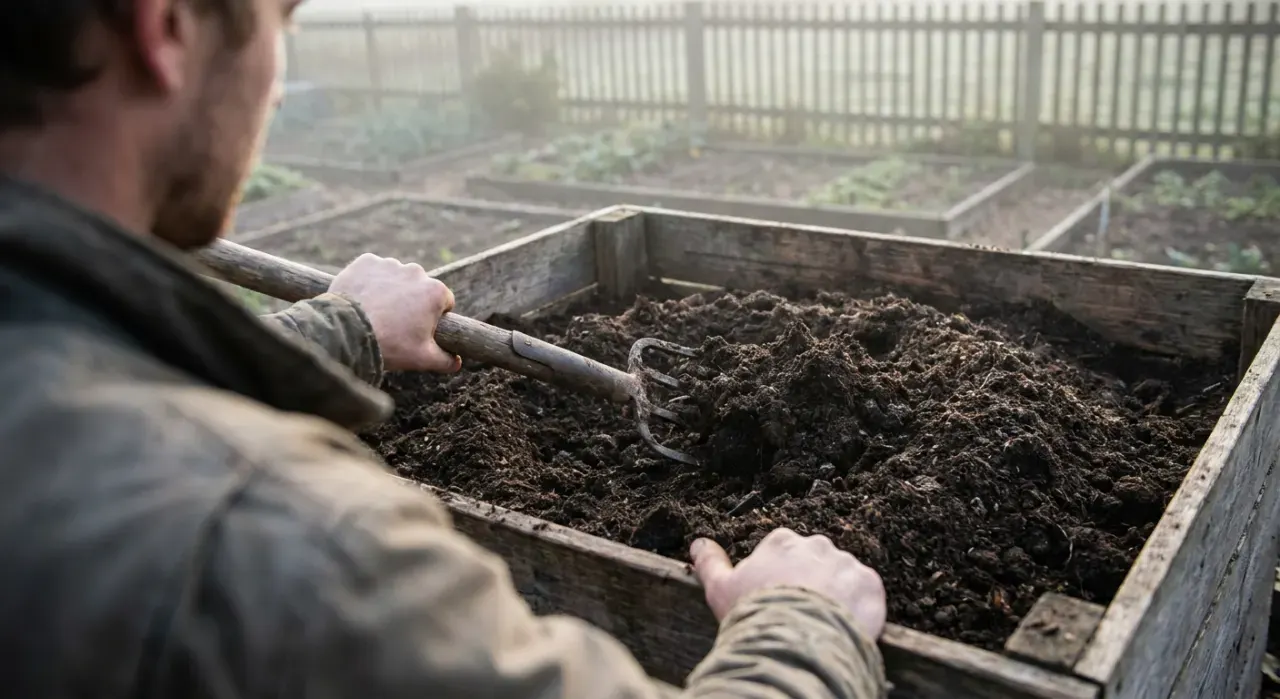
In a pot, the whole problem is tractable in an afternoon: flush the container with water equal to three or four times its volume, or simply repot into fresh mix. In a raised bed, the same flushing logic works but the volume is large, and mixing in a high-carbon amendment or diluting with fresh low-fertility soil mix is usually more practical. Beds that have received annual heavy manure for years are the classic case, and they often also test very high in phosphorus, which is a longer-term problem than nitrogen because phosphorus does not leach.

Do Not Overshoot
The failure mode people rarely anticipate is swinging into deficiency, which is a worse problem than mild excess because it costs you the season rather than just the fruit set.
| Excess nitrogen | Deficient nitrogen |
|---|---|
| Very dark green, oversized foliage | Pale green to yellow foliage overall |
| Few flowers, poor fruit set | Few flowers, small fruit, early drop |
| Soft, floppy growth; aphid pressure | Stunted, thin, hard growth |
| Delayed maturity, poor fall color | Early senescence, premature yellowing |
| Root crops make tops, not roots | Everything stalls uniformly |
The distinguishing detail is where the yellowing starts. Nitrogen is mobile within the plant, so a deficient plant scavenges nitrogen from its oldest leaves to feed new growth — yellowing begins at the bottom and works upward, evenly across the leaf including the veins. Yellowing that starts on new growth, or that leaves the veins green while the tissue between them fades, is not nitrogen; that pattern points to iron, manganese or a pH problem locking nutrients out.
Because of the rebound effect from carbon amendments, watch the following season closely. A bed treated with sawdust in spring commonly runs short of nitrogen that summer and then releases a flush the next year as the microbial biomass turns over.
Preventing It Next Time
- Test before feeding, not after symptoms. Every three years for an established garden.
- Use finished compost rather than fresh manure. Composting stabilizes the nitrogen and the release is slow. Fresh manure is both a nitrogen spike and a pathogen risk — see how to know when compost is finished.
- Match the fertilizer to the crop. Tomatoes and peppers want a lower first number once flowering starts; leafy greens want the opposite.
- Keep lawn fertilizer off beds. Use a drop spreader near borders rather than a broadcast one.
- Rotate legumes deliberately. They add nitrogen; follow them with heavy feeders rather than with more legumes.
Related: how to lower soil pH quickly, how to collect a soil sample for testing, when is the best time to test soil, and how to improve clay soil. For home testing between lab tests, our picks are at best soil test kit.