 Garden
Affiliate Disclosure
Some links on this page are affiliate links. As an Amazon Associate, we earn from qualifying purchases — at no extra cost to you. We do not buy, test, or physically handle the products we cover; our rankings come from aggregated owner reviews, ratings and expert consensus. Commissions never change our verdicts. How we rank · full disclosure.
The short version: the best battery backup sump pump is the WAYNE ESP25n, because it moves the most water per battery charge — around 10,000 gallons, at up to 2,700 gallons per hour — and that number is the entire point of the product. If you would rather have the system tell you it is healthy, the Basement Watchdog Special CONNECT monitors itself continuously and sends alerts. Whichever you choose, budget another $150 to $250 for a deep-cycle battery, because essentially none of these include one.
This roundup lives in the DIY plumbing hub. If the basement problem is drainage rather than pumping, our plumbing tools guide and drain snake picks cover the rest of the toolkit.
Why the Primary Pump Is Not Enough
The storms that flood basements are the storms that knock out power, and the clock afterwards is short — the EPA's guidance is that materials dried within 24 to 48 hours will usually not grow mold, and the two events arrive together often enough that treating them separately is a mistake. But power loss is only one of four ways a sump system fails, and a backup pump is the only measure that covers all of them.
| Failure | How common | Covered by a generator | Covered by a backup pump |
|---|---|---|---|
| Power outage during a storm | Very | Yes, if it is running | Yes, automatically |
| Primary pump motor burns out | Common — they last 7 to 10 years | No | Yes |
| Float switch sticks | Common | No | Yes |
| Inflow exceeds primary capacity | Occasional | No | Yes, both run together |
Two numbers matter when you compare pumps, and only one of them is usually advertised. Gallons per hour is the flow rate, but it is quoted at a specific lift — commonly 10 feet — and drops sharply as the discharge height increases, so a pump that looks strong on paper can be marginal if your basement is deep or the discharge runs a long way. The second, more useful number is total gallons per battery charge, because a backup pump that empties the battery in ninety minutes has not really solved anything.
Top Picks at a Glance
Our #1 Pick: WAYNE ESP25n
The ESP25n wins because it is built to keep going. At up to 2,700 gallons per hour it has the highest backup-only output here, and Wayne rates it at roughly 10,000 gallons on a single fully charged battery — the figure that actually decides whether you get through an overnight storm or wake up to two inches of water. Backup pumps are frequently specified as a token gesture; this one is specified as a pump.
Construction is cast iron and stainless rather than the thermoplastic used at the budget end, which matters for a component that may sit idle for two years and then be asked to run continuously for eight hours. It needs no weep hole drilled, fits any sump basin 14 inches in diameter or larger, and includes an audible alarm so a running backup announces itself rather than quietly telling you the primary has died. Owners consistently report it starting reliably after long periods of inactivity, which is the specific behavior this product exists to deliver.
The honest limitations: the battery is not included, and a suitable deep-cycle or AGM unit adds $150 to $250 to the real price — anyone comparing sticker prices across this list should add that to all of them. It also lacks the automatic self-testing and remote alerting that the Basement Watchdog and Zoeller Aquanot systems offer, so keeping it healthy is on you: a manual water test twice a year and a battery replaced every three to five.
Check price on Amazon → (paid link)
The Ranked Field

Best for the most water moved per amp-hour when the power is out
- Up to 2,700 gallons per hour — the highest backup-only output here
- Roughly 10,000 gallons on a single fully charged battery
- Cast iron and stainless construction, no weep hole to drill
- Fits 14-inch diameter or larger sump basins
Why buy it: a backup pump is judged on how much water it moves before the battery dies, and the ESP25n moves more of it than anything else in this class — around 10,000 gallons on one charge, which is a long storm rather than an hour.

Best for knowing the system is healthy before the storm, not during it
- 24-hour monitoring of pump, power and battery condition
- WiFi module available for text, email and push alerts
- Copper-wound motor, 2,890 GPH
- Audible alarm as well as remote notification
Why buy it: the way backup pumps fail is silently — a dead battery discovered the night it was needed. Continuous self-monitoring with remote alerts turns that from a disaster into an errand.
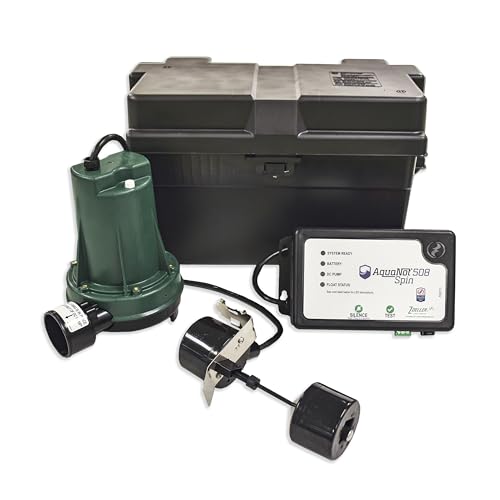
Best for a system that proves itself every couple of weeks unprompted
- Automatic self-test cycles the pump and reports faults
- Zoeller cast construction with a solid commercial reputation
- Charger and controller included
- Designed to sit alongside an existing primary pump
Why buy it: Zoeller builds pumps for people who cannot afford a failure, and the Aquanot’s automatic self-test is the feature that catches a tired battery or a stuck float months before the storm that would have exposed it.

Best for replacing an aging primary pump and adding backup at once
- 1/2 HP primary pump plus 12-volt backup in one assembly
- Up to 5,100 GPH on mains power
- Integrated vertical float switch — no tethered float to hang up
- Around 10,000 gallons on a single battery charge
Why buy it: if the primary pump is already ten years old, buying a combination unit means one hole in the basement floor, one discharge line and one weekend instead of two — and the two pumps are matched by design.

Best for Zoeller build quality at the lowest sensible price
- Around 1,840 gallons per hour of backup capacity
- Zoeller construction and service network
- Straightforward controller and charger
- Pairs with any existing primary pump
Why buy it: the least you can spend on a backup pump from a company that specializes in them — lower output than the Wayne, but enough for a typical residential basement and far better than the nothing most homes have.
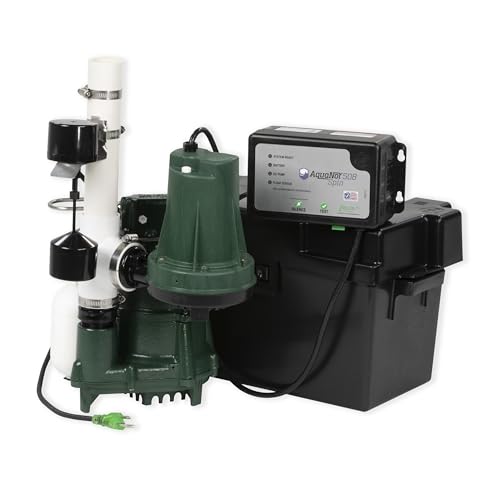
Best for a finished basement where a flood is a five-figure event
- M98 primary pump and 12-volt backup supplied together
- Self-testing controller with fault reporting
- Check valve and float switch included
- Arrives largely assembled for a plumber to fit
Why buy it: everything matched, tested together and supplied in one box — the option to choose when the basement below is carpeted and finished and you want a single manufacturer accountable for the whole system.
Quick Comparison
| Product | Best for | Rating | Price | Buy |
|---|---|---|---|---|
| WAYNE ESP25n 12 Volt Battery Back Up Sump Pump, Up to 2,700 Gallons Per Hour | Best Overall | — | Check (paid link) | |
| The Basement Watchdog Special CONNECT Battery Backup Sump Pump System, 2,890 GPH, WiFi-Capable | Best Monitoring | — | Check (paid link) | |
| Zoeller 508-0005 Aquanot 508 Battery Back-Up Sump Pump System | Best Self-Testing | — | Check (paid link) | |
| WAYNE 1/2 HP Sump Pump with Integrated Vertical Float Switch and 12 Volt Battery Back Up Capability, Up to 5,100 GPH | Best Combination Unit | — | Check (paid link) | |
| Zoeller 507-0005 Basement Sentry Battery Backup Sump Pump | Best Value | — | Check (paid link) | |
| Zoeller 508-0007 Aquanot Spin 508 ProPak Sump Pump System with M98 Primary Pump and 12V Battery Backup | Best Complete System | — | Check (paid link) |
Specifications Side by Side
| Pump | Type | Backup output | Self-test | Remote alerts | Battery included |
|---|---|---|---|---|---|
| WAYNE ESP25n | Backup only | Up to 2,700 GPH | No | No | No |
| Basement Watchdog CONNECT | Backup only | 2,890 GPH | Yes, continuous | Yes, with WiFi module | No |
| Zoeller Aquanot 508 | Backup only | Rated for residential lift | Yes, automatic | Alarm | No |
| WAYNE 1/2 HP combination | Primary plus backup | Up to 5,100 GPH on mains | No | No | No |
| Zoeller 507 Basement Sentry | Backup only | Around 1,840 GPH | No | Alarm | No |
| Zoeller 508 ProPak | Complete system | M98 primary plus backup | Yes | Alarm | No |
How We Rank
We never buy or install these pumps. For backup sump pumps the ranking priorities are: total gallons delivered per battery charge, which is the number that decides whether the basement stays dry, rather than headline flow rate at an optimistic lift; reliability after long idle periods, drawn from owner reports of pumps that did or did not start when finally needed; self-testing and alerting, since silent battery failure is the dominant failure mode; and total real cost including the battery. Aggregated owner ratings are weighted heavily toward reviews from owners who have actually had an outage. Prices were checked at the time of writing and exclude the battery. Full method: how we rank.
The Pumps, Reviewed
1. WAYNE ESP25n — Best Overall
Covered above. Owners praise: genuinely long runtime per charge, solid cast construction, and reliable starting after long dormancy. Owners gripe about: no battery in the box, and no self-test or remote alerting, so maintenance discipline is required. Check price (paid link).
2. Basement Watchdog Special CONNECT — Best Monitoring
Built around the observation that backup systems fail silently. The controller checks pump, power and battery condition around the clock, sounds an alarm locally, and — with the add-on WiFi module — sends text, email or push alerts, or ties into a home security system. If you travel, or if the basement is somewhere you rarely go, this is the feature that converts a theoretical backup into a real one.
Owners praise: catching a failing battery months before it mattered, useful remote alerts, and a copper-wound motor with strong output. Owners gripe about: the WiFi module being a separate purchase, an alarm sensitive enough to be occasionally irritating, and a controller that is fussier to set up than the Wayne. Check price (paid link).
3. Zoeller Aquanot 508 — Best Self-Testing
Zoeller's reputation is built on commercial and municipal pumps, and the Aquanot brings that engineering to a residential backup. The controller runs the pump automatically on a schedule and reports faults, which catches a stuck float or a tired battery without you doing anything. It is designed to sit alongside your existing primary pump rather than replace it.
Owners praise: the automatic self-test, Zoeller build quality, and a service network that supports the product for years. Owners gripe about: the price against the Wayne, and lower rated output than the top pick — self-testing is bought at some cost in raw capacity. Check price (paid link).
4. WAYNE 1/2 HP Combination — Best Combination Unit
Primary and backup in a single assembly. A half-horsepower primary moving up to 5,100 gallons per hour on mains power, with a 12-volt backup ready to take over, and roughly 10,000 gallons available on one battery charge. The integrated vertical float switch avoids the tethered-float problem of hanging up on the basin wall, which is a genuine cause of failure in older pits.
Owners praise: replacing an aging primary and adding backup in one job, high primary output, and a float design that does not stick. Owners gripe about: a bulky assembly that will not fit a narrow basin — measure yours — and, again, no battery included. Check price (paid link).
5. Zoeller 507 Basement Sentry — Best Value
The entry point into Zoeller. Around 1,840 gallons per hour of backup capacity is modest next to the Wayne, but it is enough for a typical residential basement with a working primary pump, and it is vastly better protection than the nothing most homes currently have. Pairs with any existing primary.
Owners praise: Zoeller build at the lowest price here, simple installation, and a straightforward controller. Owners gripe about: the lowest output in this list, which shortens the margin in a heavy-inflow basement, and no self-testing. Check price (paid link).
6. Zoeller Aquanot Spin 508 ProPak — Best Complete System
Primary pump, backup pump, controller, check valve and float switch supplied together and largely pre-assembled. The argument for it is accountability: one manufacturer, matched components, tested as a system. In a finished basement where a flood means replacing carpet, drywall and possibly a furnace, that is a reasonable thing to pay for.
Owners praise: arriving essentially ready to drop in, self-testing, and knowing every part is matched. Owners gripe about: the price, and needing a plumber for the discharge plumbing in most installations. Check price (paid link).
What Owners Actually Complain About
The battery is not included. The single most frequent complaint, on every brand. Add $150 to $250 for a deep-cycle marine or AGM battery to the price of any pump here, and factor in that it is a consumable you replace every three to five years.
Using a car battery. A common, expensive mistake. Automotive starting batteries are built to dump a large current briefly and are damaged by the deep, slow discharge a sump pump imposes. They fail early, and they fail without warning, which defeats the entire purpose. Buy deep-cycle.
The battery died and nobody knew. Backup systems fail silently, and owners discover it during the flood. This is precisely what the self-testing and monitoring systems address, and it is why they are worth their premium for anyone who does not enjoy a twice-yearly maintenance ritual.
The pump did not fit the basin. Sump pits vary, and a backup pump has to share the pit with the primary, both float switches and the discharge plumbing. Measure the basin diameter and the working depth before ordering, particularly for the combination units.
Discharge plumbing shortcuts. The backup needs its own check valve and, in most jurisdictions, its own discharge path or a properly configured tee — plumbing it carelessly into the primary line can let the primary's discharge push water back down the backup. It is also worth confirming that neither discharge line can freeze shut in winter, which turns a working pump into a flooded basement anyway.
Alarms that cannot be heard. A local audible alarm in a far basement is useless if the house is empty or everyone is asleep upstairs. If that describes your home, buy the version with remote alerting rather than relying on a buzzer.
How to Choose a Battery Backup Sump Pump
Start with total gallons per charge rather than peak flow rate, and check the flow figure against the actual lift in your basement — the vertical distance from the pit to the discharge, plus friction in a long horizontal run. If water has already been in once, work through the EPA's flood cleanup and indoor air guidance before finishing the basement again. Then decide whether you want the system to watch itself. If the basement is finished, if you travel, or if you know you will not test it twice a year, buy monitoring; it is cheaper than the alternative.
Measure the sump basin before ordering, budget for a deep-cycle battery in the same purchase, and consider whether the primary pump is old enough that a combination unit makes more sense than adding a backup to a pump that is itself close to failure. Finally, write the battery replacement date on the battery in marker — three to five years from installation — because that is the maintenance item everyone forgets.
A note on installation: this is 120-volt mains equipment and 12-volt battery equipment in a wet environment, plus pressurized discharge plumbing. Sump discharge must go somewhere legal — many jurisdictions prohibit discharging into a sanitary sewer — and requirements vary by municipality. If you are not confident about the electrical connections, the check valve arrangement, or where the water is allowed to go, have a licensed plumber or electrician do the installation and check the local code first.
The Verdict
The WAYNE ESP25n is the battery backup sump pump we would fit in most basements: it moves more water per charge than anything else here, it is built to sit idle and then work, and it costs less than the systems above it. Choose the Basement Watchdog Special CONNECT if you want the system to tell you it is healthy, the Zoeller Aquanot 508 for automatic self-testing, the WAYNE combination unit if the primary pump is already old, the Zoeller 507 for the lowest sensible price, and the Zoeller ProPak when a finished basement makes a flood a five-figure event. Add a deep-cycle battery to whichever you pick. Check price on Amazon → (paid link)
More from this hub: DIY plumbing · best plumbing tools · what psi should home water pressure be · how to thaw frozen pipes · how we rank.