 Garden

Affiliate Disclosure
Some links on this page are affiliate links. As an Amazon Associate, we earn from qualifying purchases — at no extra cost to you. We do not buy, test, or physically handle the products we cover; our rankings come from aggregated owner reviews, ratings and expert consensus. Commissions never change our verdicts. How we rank · full disclosure.
A sump pump is the only appliance in your house whose failure you discover by standing in water. That single fact should shape how you buy one. It is invisible, it is inaudible from upstairs, it runs hardest during the storms when you are least able to deal with a problem, and by the time it has your attention the drywall is already wet. So the specification that matters is not horsepower — it is whether the thing will still be working, unattended, in year eight.
Two conclusions follow from the ownership record, and both are unglamorous. Buy cast iron rather than thermoplastic, because a cast iron body conducts motor heat into the surrounding water and heat is what kills these pumps. And treat the float switch as the real weak point, because it is a mechanical part cycling in dirty water thousands of times a season, and it fails long before the motor does.
Top Picks at a Glance
Sizing: lift matters more than horsepower
Sump pumps are sold on horsepower and rated on gallons per hour, and the two are connected by a number nobody puts on the box: vertical lift, or head. Every pump's output collapses as it has to push water higher, and the difference between the headline figure and the figure at your actual lift is often close to half.
| Pump | HP | Approx. GPH at 5 ft | Approx. GPH at 10 ft | Right for |
|---|---|---|---|---|
| WAYNE CDU790 | 1/3 | ~3,900 | ~3,000 | A normal basement |
| Zoeller M53 | 1/3 | ~2,580 | ~2,040 | A normal basement, long service life |
| Zoeller M98 | 1/2 | ~4,320 | ~3,540 | Silty pits, higher volume |
| WAYNE CDU980E | 3/4 | ~5,700 | ~4,600 | High water table, tall discharge |
| Superior Pump 91250 | 1/4 | ~1,200 | ~600 | Manual utility work only |
Measure your lift before you shop: from the water level in the pit to the highest point of the discharge pipe, then add roughly one foot of equivalent lift for every 10 feet of horizontal run and for each elbow. A basement pit discharging through a rim joist and out to a splash block is usually 8 to 12 feet of effective head. A walk-out basement pumping up to a street-level storm connection can be twice that.
Bigger is not automatically better. An oversized pump empties the pit in seconds, then stops, then the pit refills and it starts again — short cycling, which is the single fastest way to kill a float switch. Match the pump to the pit rather than buying headroom for its own sake.
Our #1 Pick: Zoeller M53 Mighty-Mate
The M53 is the pump that comes up first when plumbers are asked what they put in their own basements, and the ownership record backs the reputation. It is not the highest-output unit here — a 3/4 HP WAYNE moves more than twice as much water — and that is not the point. The M53 is bought for the years when nothing happens.
The cast iron housing is the reason. A submersible pump motor sheds heat through its casing into the surrounding water, and cast iron conducts heat far better than the thermoplastic used in budget pumps. During a wet spring when a pit cycles hundreds of times a day, the thermoplastic pump runs hot and the cast iron one does not. Owners consistently report M53s still running after a decade, which in this category is the whole argument.
The vertical float switch is the other reason to prefer it. Tethered floats swing out sideways and need a wide basin — in a narrow or crowded pit they hang up on the pipe, which is the classic stuck-float flood. A vertical float rides up and down a rod in a fixed path and works in basins as narrow as 10 inches.
Honest limitations: at 1/3 HP it is genuinely modest on output, so a basement with a high water table and a tall discharge is asking too much of it. It is heavy. And like every AC pump here, it does nothing at all during a power cut, which is the argument for a backup system rather than a bigger primary.
Check price on Amazon → (paid link)
The Ranked Field
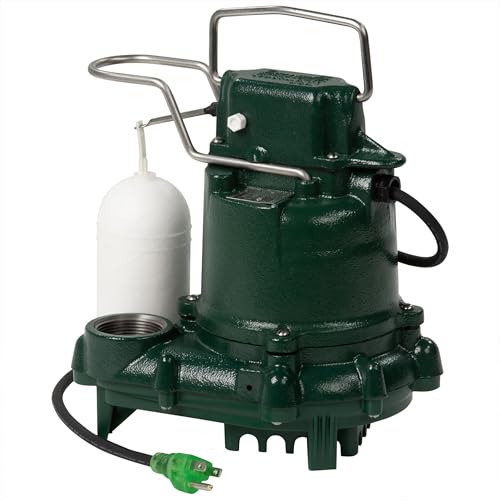
Best for the basement sump that has to work for ten years without being thought about
- Cast iron housing and motor casing that sheds heat into the water
- 1/3 HP, roughly 43 GPM at 5 feet of lift, 2,580 GPH
- Vertical float switch that works in basins as narrow as 10 inches
- Non-clogging vortex impeller passes 1/2-inch solids
Why buy it: the most recommended residential sump pump in the country among plumbers, and the reason is the cast iron body — it runs cooler than thermoplastic, and heat is what kills a pump that cycles all spring.

Best for basements that pump constantly, or a long vertical run to the discharge
- 3/4 HP — around 4,600 GPH at 10 feet of lift
- Cast iron body with a stainless steel cover and top suction design
- Vertical float switch rated for over a million cycles
- Top suction reduces the airlock and clogging problems of bottom-inlet pumps
Why buy it: the top suction design is the underrated feature — it keeps the intake out of the silt layer at the bottom of the basin, which is where most sump pump clogs actually start.

Best for a normal basement that needs a proper cast iron pump at a sensible price
- 1/3 HP delivering roughly 3,000 GPH at 10 feet of lift
- Cast iron and stainless construction rather than thermoplastic
- Integrated vertical float switch suited to narrow basins
- Top suction inlet and a 1-1/2 inch NPT discharge
Why buy it: nearly everything the Zoeller offers at a lower price, and the same cast iron logic — this is the pump to buy if the M53 is out of budget rather than dropping to plastic.

Best for high-volume sumps, sewage-adjacent duty and long discharge runs
- 1/2 HP with a vortex impeller that passes 3/4-inch spherical solids
- Cast iron pump housing, motor case and switch case
- Around 72 GPM at 5 feet of lift
- LED power indicator plug that shows the outlet is live at a glance
Why buy it: the vortex impeller is what separates this from a domestic pump — it passes solids that would jam a standard impeller, which matters in a silty or debris-prone basin.

Best for anywhere the power goes out during exactly the storms that flood basements
- Primary AC pump and a 12V DC backup pump preassembled on one discharge
- Controller monitors battery state, pump operation and water level with an audible alarm
- Backup runs from a deep-cycle battery when the grid is down
- Removes the guesswork of matching two separate pumps to one pit
Why buy it: the failure that actually floods basements is not a worn pump, it is a power cut during the storm — and no amount of horsepower on the primary pump helps with that.

Best for draining a flooded window well, a pool cover, a crawlspace or a hot tub
- 1/4 HP thermoplastic body, 1,800 GPH at zero lift
- Garden hose adapter plus 1-1/4 inch discharge
- Removes water down to about 1/8 inch from the floor
- Manual operation — no float switch, so it drains a surface completely
Why buy it: a genuinely useful pump for standing water anywhere in the house, but be clear about what it is: a manual utility pump, not a permanent sump pump, and it should never be installed as one.
Quick Comparison
| Product | Best for | Rating | Price | Buy |
|---|---|---|---|---|
| Zoeller M53 Mighty-Mate Submersible Sump Pump, 1/3 HP, Cast Iron | Best Overall | — | Check (paid link) | |
| WAYNE CDU980E 3/4 HP Submersible Sump Pump, Cast Iron and Stainless Steel, Vertical Float | Best for a High Water Table | — | Check (paid link) | |
| WAYNE CDU790 1/3 HP Submersible Sump Pump, Cast Iron and Stainless Steel, Integrated Vertical Float | Best Value | — | Check (paid link) | |
| Zoeller M98 Flow-Mate Submersible Sump Pump, 1/2 HP, Cast Iron, Vortex Impeller | Best High Flow | — | Check (paid link) | |
| The Basement Watchdog Combo Preassembled Primary and Battery Backup Sump Pump System with Monitoring | Best with Battery Backup | — | Check (paid link) | |
| Superior Pump 91250 Thermoplastic Submersible Utility Pump, 1/4 HP, 1800 GPH | Best Utility Pump | — | Check (paid link) |
How long do sump pumps last, and what actually fails
Plan on seven to ten years for a cast iron pump in a normal basement, and five to seven for a thermoplastic one in a pit that runs regularly. The failures, in the order they show up in owner reports:
- The float switch. By a wide margin the most common failure. It sticks, tangles on the discharge pipe, or the internal contacts wear out after a few hundred thousand cycles. A pump with a working motor and a jammed float is functionally a paperweight.
- The check valve. When it fails, the column of water in the discharge pipe falls back into the pit every time the pump stops, so the pit immediately refills and the pump restarts. This produces the short cycling that kills switches, and it is a $15 part.
- Impeller clogging. Silt, gravel and debris in the basin. Pits without a lid collect an astonishing amount. A vortex impeller and a top-suction inlet both help.
- The motor. Last on the list, and usually a consequence of one of the above — a pump that ran dry because the float stuck, or one that overheated from short cycling.
Because the failure mode is invisible, test the pump twice a year: pour a bucket of water into the pit and confirm it starts, pumps and stops cleanly. Do it in early spring and again in fall. And once a pump passes about eight years, replacing it on a schedule costs a couple of hundred dollars against a basement remediation that starts in the thousands — the EPA's guidance on mold, moisture and your home is a sobering read on what a single flooding event sets in motion.
Why a backup pump matters more than horsepower
Basements do not usually flood because a pump was too small. They flood because a storm brought the water table up and took the power out at the same time. Every AC pump on this page is inert during an outage.
There are two answers. A battery backup system adds a 12V DC pump on the same discharge, powered by a deep-cycle battery, with a controller that alarms when the battery is low or the primary has failed. Expect several hours of intermittent pumping from a charged battery — enough for a typical outage, not enough for a multi-day one. The alternative is a water-powered backup, which uses municipal supply pressure to drive an ejector and needs no electricity at all, but consumes roughly two gallons of city water for every gallon it evacuates and is not usable on a private well.
Our dedicated roundup is best battery backup sump pump, and Ready.gov's flood guidance covers the wider preparation.
Installation details that decide whether it works
- Fit a check valve on the discharge, a foot or two above the pump, oriented with the flow arrow pointing away from the pit. Without it the pump short cycles forever.
- Drill a 3/16-inch weep hole in the discharge pipe between the pump and the check valve, below the water line. It vents the air pocket that otherwise causes airlock, where the pump runs but moves nothing.
- Fit a lid. An open pit collects debris, evaporates radon and humidity into the basement, and is a genuine fall hazard for children.
- Discharge well away from the foundation — at least 10 feet, and not into a window well or against a neighbor's grade. Water dumped at the foundation returns to the pit, and the pump runs forever.
- Think about winter. A discharge line that freezes turns the pump into a dead short against an ice plug. A freeze-relief fitting or an air gap near the exit prevents it.
- Check the receptacle. Current electrical code requires GFCI protection for basement receptacles, and nuisance tripping on older pumps is a known complaint. A tripped GFCI you never noticed is a pump that is not running. Requirements are enforced locally — check with your building department.
How We Rank
We never buy or install these pumps. For sump pumps the ranking priorities are: housing material and heat handling, because motor heat is what ends a pump that cycles hard; switch design and reliability, since the switch is the part that actually fails; real output at realistic lift rather than the zero-head figure on the carton; and aggregated owner reports past the five-year mark, which is the only place a sump pump's true quality shows. Ratings come from verified Amazon listing data and refresh automatically. Prices were checked at the time of writing. Full method: how we rank.
The Field, Reviewed
1. Zoeller M53 Mighty-Mate — Best Overall
Covered above. Owners praise: the cast iron build, a decade of trouble-free service, quiet operation, and the vertical float that works in a narrow pit. Owners gripe about: modest output for the price, weight, and a short power cord that must reach a proper receptacle without an extension. Check price (paid link).
2. WAYNE CDU980E — Best for a High Water Table
Where the M53 is chosen for longevity, the CDU980E is chosen for capacity: 3/4 HP and roughly 4,600 gallons per hour at 10 feet of lift, which is genuine capability for a pit that never stops. The top suction inlet keeps the intake above the silt layer at the bottom of the basin, which is where clogging usually starts.
Owners praise: the volume it moves, the stainless and cast iron construction, and a vertical float rated for a very long cycle life. Owners gripe about: the price, the noise a 3/4 HP pump makes under a finished floor, and its tendency to short cycle in a small pit — this is a pump for a basin that suits it. Check price (paid link).
3. WAYNE CDU790 — Best Value
The pump to buy when the M53 is out of budget, because the alternative at that price is usually thermoplastic. Cast iron and stainless construction, an integrated vertical float and a genuinely useful 3,000 GPH at 10 feet.
Owners praise: cast iron at a mid-range price, easy installation, and reliable starting after months idle. Owners gripe about: a float assembly a few owners found needed adjustment out of the box, and a cord length that assumes a nearby outlet. Check price (paid link).
4. Zoeller M98 Flow-Mate — Best High Flow
A half-horsepower cast iron pump with a vortex impeller that passes 3/4-inch solids, which makes it the right answer for a silty or debris-prone pit where a standard impeller jams. The LED power indicator built into the plug is a small thing that solves a real problem — it tells you at a glance that the outlet is live.
Owners praise: the solids handling, the volume, and Zoeller's build quality throughout. Owners gripe about: price, weight, and a tethered-style float arrangement that needs a wide enough basin to swing freely. Check price (paid link).
5. Basement Watchdog Combo — Best with Battery Backup
A preassembled primary and backup on a single discharge, which removes the fiddly job of matching two pumps and two floats into one pit. The controller is the part that earns its place: it monitors battery condition, water level and pump operation, and alarms audibly rather than waiting for you to notice water.
Owners praise: the peace of mind during outages, the monitoring and alarms, and an install that is far simpler than assembling a combination system yourself. Owners gripe about: batteries that need replacing every three to five years and are not included, the audible alarm being genuinely loud, and a price that is two pumps' worth because it is two pumps. Check price (paid link).
6. Superior Pump 91250 — Best Utility Pump
Included with a caveat. This is one of the most-owned pumps in America and it is genuinely useful — it drains a flooded window well, a pool cover, a crawlspace or a hot tub down to about an eighth of an inch, and it costs a fraction of anything else here. It is not a sump pump. It is manual, thermoplastic and 1/4 HP, and installing one as a permanent basement pump is a mistake owners do make.
Owners praise: the price, how low it drains, the garden hose adapter, and how often it turns out to be the right tool. Owners gripe about: the thermoplastic body, no float switch, and modest output once there is any real lift. Check price (paid link).
What Owners Actually Complain About
The switch, always the switch. Across every brand and price point, the recurring complaint is a float that stuck, tangled or wore out. Vertical floats in narrow pits and tethered floats in wide ones — matching the switch type to the basin prevents most of it.
Short cycling. A pump that starts and stops every 30 seconds is usually telling you the check valve has failed or the pit is too small for the pump. Left alone it destroys the switch and then the motor.
Noise through a finished floor. A 3/4 HP pump in an uncovered pit under a family room is loud. A lid, and a short length of flexible connector in the discharge, both help considerably.
Airlock. The pump hums, nothing comes out. The cause is trapped air and the fix is a 3/16-inch weep hole in the discharge pipe below the water line — a two-minute job at installation that saves a mysterious failure later.
Discovering the failure by standing in water. The one that matters. Test twice a year with a bucket, and replace on age rather than on failure.
The Verdict
For most basements the Zoeller M53 Mighty-Mate is the pump to fit — cast iron, a vertical float that survives a narrow pit, and a decade of service is a realistic expectation rather than a hope. If your pit runs constantly or your discharge climbs a long way, the WAYNE CDU980E has the capacity for it, and the WAYNE CDU790 is the cast iron option at a lower price. Silty pits want the vortex impeller in the Zoeller M98. And if your basement is finished, spend the money on the Basement Watchdog Combo instead of on horsepower, because the flood you are actually insuring against arrives with the power already out. Check price on Amazon → (paid link)
More from this hub: DIY plumbing · best battery backup sump pump · best plumbing tools · what a plumber charges · how we rank.