 Garden
Affiliate Disclosure
Some links on this page are affiliate links. As an Amazon Associate, we earn from qualifying purchases — at no extra cost to you. We do not buy, test, or physically handle the products we cover; our rankings come from aggregated owner reviews, ratings and expert consensus. Commissions never change our verdicts. How we rank · full disclosure.
The short version: the best water filter pitcher for most American households is the Brita Everyday Elite — a 120-gallon certified filter, a fridge-friendly shape, and cartridges you can buy anywhere. If your water is high in dissolved solids, the ZeroWater is the only mainstream pitcher that drives TDS to near zero, and it ships with the meter to prove it. If you are on a private well, skip both and buy the LifeStraw Home, which is the only pitcher here with a membrane rated for bacteria and parasites.
One thing to be clear about before you spend anything: a filter is not a softener. No pitcher on this page will reduce your water hardness. If your real problem is scale on the faucets, spots on the glassware and a water heater that keeps failing, you want a softener, not a filter — see water softener vs water filter for the distinction, because it is the single most common mistake in this category.
First, Work Out What You Are Actually Filtering
The five pitchers below are not five versions of the same thing. They target genuinely different contaminants, and the wrong choice means paying for a technology that cannot touch your problem.
| Your complaint | What you need | Pitcher |
|---|---|---|
| Tastes and smells like a swimming pool | Activated carbon | Any of them — Brita Elite is the cheapest fix |
| Old pipes, lead service line, lead solder | Carbon block certified to NSF/ANSI 53 | Brita Elite, PUR PLUS, Epic Pure |
| High TDS, mineral aftertaste, spotting | Ion exchange | ZeroWater |
| Private well, cabin, boil-water advisory | Membrane microfilter | LifeStraw Home only |
| Fluoride | Bone char, activated alumina or reverse osmosis | Epic Pure, or an RO system |
| Hard water, limescale, spotted glassware | A water softener — not a filter | None of them |
Start with your utility's annual Consumer Confidence Report, which the EPA requires every community water system to publish. It tells you, for free, what is actually in the water arriving at your street. If you are on a well, no such report exists and the burden of testing is entirely yours — the EPA recommends annual testing of private wells for coliform bacteria, nitrates, total dissolved solids and pH.
Top Picks at a Glance
Our #1 Pick: Brita Everyday Elite
The Brita Elite wins the category on the two boring measures that decide whether you are still filtering water in a year: cartridge availability and cartridge life. The Elite filter is rated for 120 gallons — roughly six months for an average household, three times the old white Brita standard cartridge — and it carries certification for lead reduction, which the standard filter does not. Owners consistently report the same arc: they buy it for taste, discover they stop buying bottled water, and stay because replacing the cartridge is a supermarket errand rather than an online order.
Mechanically it is a pleated carbon block with an ion-exchange resin, seated in a 10-cup pitcher that lies flat on a fridge door shelf or stands on a middle shelf. The lid has a filter-life indicator that counts down. There is nothing clever here, and after reading through thousands of aggregated owner reviews across the category, that is the recommendation: the pitchers people abandon are the ones with proprietary cartridges that go out of stock.
The honest limitations: it will not reduce total dissolved solids, so if your complaint is a mineral aftertaste the ZeroWater is the better instrument. It does not reduce fluoride. And the lid indicator counts days rather than gallons, so a heavy-use household will exhaust the cartridge before the light says so.
Check price on Amazon → (paid link)
The Ranked Field

Best for the sensible default for treated city water
- Elite filter rated for 120 gallons — roughly six months, not two
- Certified to reduce lead, chlorine taste and odor, benzene and asbestos
- Fits a standard fridge door shelf on its side or upright
- Replacement filters stocked in every supermarket in the country
Why buy it: nothing here is exotic — and that is the point. The Elite filter lasts three times as long as the old white Brita cartridge, it is certified for lead, and you can buy a replacement at 9pm on a Sunday almost anywhere in America.
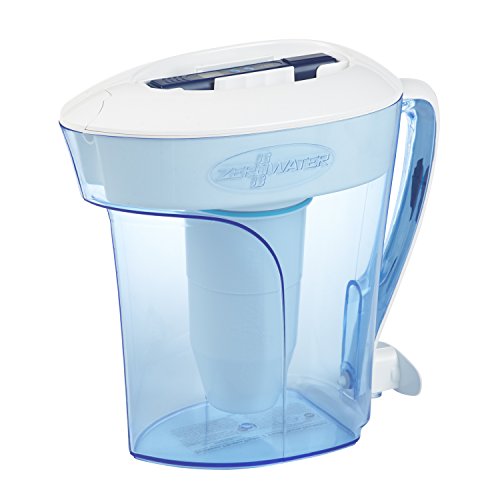
Best for high-mineral or high-TDS tap water, and anyone who wants to see the number
- Five-stage filter including an ion-exchange resin that pulls dissolved solids
- Ships with a handheld TDS meter so you can verify the result yourself
- Ready-Pour spout dispenses while the top reservoir is still draining
- Certified for lead, chromium and PFOA/PFOS reduction
Why buy it: it is the only mainstream pitcher that takes total dissolved solids to near zero, and the included meter turns a marketing claim into a reading you take at your own sink.

Best for households worried about lead and industrial chemicals rather than taste
- Lead-reducing filter certified to reduce a broad list of chemical contaminants
- 11-cup capacity in a slim profile built for a fridge shelf
- LED filter-change indicator on the lid
- Filter rated for 40 gallons, about two months of normal use
Why buy it: PUR built its reputation on chemical reduction rather than taste, and the certification list on this filter is the longest of any mainstream pitcher.

Best for water that might carry bacteria or parasites, not just chemicals
- Hollow-fiber membrane microfilter rated to remove bacteria, parasites and microplastics
- Second-stage carbon and ion exchange for lead, mercury, PFAS and chlorine
- Borosilicate glass body with a silicone base — no plastic taste
- Membrane rated for 264 gallons; carbon stage for 40 gallons
Why buy it: every other pitcher here assumes your water is microbiologically safe already. This one does not, which makes it the only sensible pitcher for a well, a cabin or a boil-water advisory.

Best for people who resent buying cartridges and want fluoride reduction
- 150-gallon filter life — roughly three to four months of family use
- Tested for reduction of fluoride, lead, chlorine, PFOA and PFOS
- Tritan BPA-free body with a countdown timer built into the lid
- Filters are made in the USA and sold on subscription
Why buy it: the long cartridge and the fluoride reduction are the two things people leave Brita for, and this is the pitcher that does both without moving to an under-sink system.

Best for families who empty a 10-cup pitcher twice a day
- 18-cup reservoir with a front spigot — sits on a fridge shelf, no lifting
- Takes the same Brita Standard or Elite cartridges as the pitchers
- Locking lid so the reservoir does not tip when it is full
- Also usable on a counter for parties or camping
Why buy it: the honest reason most people give up on pitcher filtration is refilling it six times a day. An 18-cup dispenser with a spigot removes the chore that kills the habit.
Quick Comparison
| Product | Best for | Rating | Price | Buy |
|---|---|---|---|---|
| Brita Everyday Elite Water Filter Pitcher, 10-Cup, with One Elite Filter | Best Overall | — | Check (paid link) | |
| ZeroWater 10-Cup Ready-Pour 5-Stage Water Filter Pitcher with TDS Meter | Best for Total Dissolved Solids | — | Check (paid link) | |
| PUR PLUS 11-Cup Water Filter Pitcher with Lead-Reducing Filter and Change Indicator | Best for Chemical Contaminants | — | Check (paid link) | |
| LifeStraw Home 7-Cup Glass Water Filter Pitcher with Membrane Microfilter | Best for Well Water and Travel | — | Check (paid link) | |
| Epic Pure Water Filter Pitcher, 10-Cup, 150-Gallon Long-Last Filter | Best Filter Life | — | Check (paid link) | |
| Brita UltraMax 18-Cup Water Filter Dispenser with Spigot | Best for Large Households | — | Check (paid link) |
Filter Life and Running Cost
Cartridge life is the number that decides what a pitcher costs to own. These are the manufacturers' own gallon ratings, which assume reasonably clean incoming water — sediment or very hard supplies will shorten every one of them.
| Pitcher | Capacity | Filter rated for | Removes TDS? | Rated for bacteria? |
|---|---|---|---|---|
| Brita Everyday Elite | 10 cups | 120 gallons / ~6 months | No | No |
| ZeroWater 10-Cup | 10 cups | ~15–40 gallons, TDS dependent | Yes, to near zero | No |
| PUR PLUS 11-Cup | 11 cups | 40 gallons / ~2 months | No | No |
| LifeStraw Home | 7 cups | 264 gal membrane / 40 gal carbon | No | Yes |
| Epic Pure | 10 cups | 150 gallons / ~3–4 months | Partially | No |
| Brita UltraMax | 18 cups | Standard 40 gal or Elite 120 gal | No | No |
ZeroWater's filter life is the outlier and it deserves an explanation rather than a footnote. Because it removes dissolved solids by ion exchange, its life depends entirely on how many solids are in your water. On a 100 ppm supply owners get a reasonable run; on a 400 ppm supply the same cartridge can be finished in a couple of weeks. This is not a defect, it is chemistry, but it does mean ZeroWater is expensive to run on hard, high-mineral water — which is exactly the water most likely to send people looking at it.
How We Rank
We never buy or use these pitchers. For filter pitchers the ranking priorities are: third-party certification — NSF/ANSI 42 for taste and odor, 53 for health contaminants, or an equivalent IAPMO or WQA listing — weighted far above unaudited marketing claims; real cost per gallon across a year of cartridges rather than the sticker price; cartridge availability, because a discontinued or perpetually out-of-stock filter turns a pitcher into a jug; and aggregated owner reports on flow rate, leaking lids and cracked reservoirs, which is where this category actually fails. Ratings are drawn from verified Amazon listing data and refreshed automatically. Prices were checked at the time of writing. Full method: how we rank.
The Pitchers, Reviewed
1. Brita Everyday Elite — Best Overall
Covered above. Owners praise: the long Elite cartridge, the immediate improvement in taste, and cartridges available in every supermarket. Owners gripe about: the lid indicator counting days rather than gallons, occasional dripping from the spout when the top reservoir is overfilled, and slow flow once the cartridge is loaded. Check price (paid link).
2. ZeroWater 10-Cup Ready-Pour — Best for Total Dissolved Solids
The only pitcher in general distribution that uses ion exchange rather than carbon alone, and the only one that will take a TDS meter reading to 000. The included meter is genuinely useful: it converts filtration from a matter of faith into a measurement, and it tells you exactly when the cartridge is finished — ZeroWater's own guidance is to change at 006 ppm.
Owners praise: the visible, verifiable TDS result, the Ready-Pour spout that lets you fill a glass while the reservoir is still draining, and a noticeably cleaner taste than carbon-only pitchers. Owners gripe about: cartridge cost on hard water, which is the dominant complaint by a wide margin, and a distinct sour or fishy smell some owners report as the resin nears exhaustion — that is the signal to change it, not a fault. Check price (paid link).
3. PUR PLUS 11-Cup — Best for Chemical Contaminants
PUR has always competed on the length of its certification list rather than on taste, and the PLUS lead-reducing filter is certified against a broader roster of chemical contaminants than the Brita standard cartridge. The 11-cup body is slimmer than its capacity suggests, which is why it fits shelves that a 10-cup Brita will not.
Owners praise: the certification breadth, the LED change indicator, and the dishwasher-safe reservoir. Owners gripe about: a 40-gallon cartridge that a family empties in weeks, and the lid seating — a recurring complaint is unfiltered water bypassing the cartridge when the filter is not fully seated and twisted home. Push and twist until it stops. Check price (paid link).
4. LifeStraw Home — Best for Well Water and Travel
This is the only pitcher on the page that treats your water as potentially unsafe rather than merely unpleasant. Its hollow-fiber membrane is rated to remove bacteria, parasites and microplastics, with a second carbon and ion-exchange stage for lead, mercury, PFAS and chlorine. The borosilicate glass body is the other reason people choose it — plastic pitchers pick up a taste over time and glass does not.
Owners praise: the membrane stage, the glass build, and the peace of mind on well water or during a boil-water notice. Owners gripe about: the price, the modest 7-cup capacity, a slow filtration rate compared with carbon-only pitchers, and the fragility that comes with glass. Check price (paid link).
5. Epic Pure — Best Filter Life
A 150-gallon cartridge and tested reduction of fluoride are the two claims that pull people away from Brita, and Epic is the pitcher built around both. Practically, 150 gallons is three to four months for a family, which turns cartridge replacement from a monthly chore into a quarterly one.
Owners praise: the long cartridge, the fluoride reduction, and a Tritan body that does not pick up a plastic taste. Owners gripe about: a slow fill rate — this is a pitcher you fill and walk away from — the cartridge price if you do not subscribe, and a lid timer that some owners find fiddly to reset. Check price (paid link).
6. Brita UltraMax 18-Cup Dispenser — Best for Large Households
Not a pitcher at all but the answer for households that keep abandoning pitchers. Eighteen cups behind a front spigot means nobody lifts anything, the fridge shelf does the holding, and the refill frequency drops enough that the habit survives. It takes the same Standard or Elite cartridges, so put the Elite in it.
Owners praise: the capacity, the spigot, and how well it works for parties and camping. Owners gripe about: the footprint — measure your shelf before ordering, since this is a common return reason — and spigot drips if the unit is not level. Check price (paid link).
What Owners Actually Complain About
Flow slowing to a trickle. The single most common gripe across every brand, and it is usually sediment blinding the carbon block rather than a bad cartridge. If your supply is cloudy or your house is on a well, a sediment pre-filter upstream — see our whole house water filter picks — will roughly double the life of every filter downstream, including these.
Water bypassing the filter. Reported across all the twist-in designs. If the cartridge is not pushed down and rotated until it stops, unfiltered water runs around the seal and you are drinking tap water out of an expensive jug. Soak a new cartridge, seat it firmly, and discard the first two pitchers.
Cartridge cost being the real price. Buyers focus on the $35 pitcher and are surprised by $60 to $120 a year in filters. ZeroWater is the extreme case on hard water. Work out your cost per gallon before you commit — and if you are drinking a lot of filtered water, an under sink filter is usually cheaper over three years.
Mold in the reservoir. A wet plastic tank in a warm kitchen grows things. Owners who report this almost always leave water sitting for weeks. Wash the reservoir with warm soapy water monthly, dry the lid, and keep it in the fridge.
Expecting soft water. A recurring and completely understandable mistake. People with limescale on the kettle buy a pitcher, and the limescale stays, because nothing in a carbon pitcher removes calcium and magnesium. Hardness is a separate problem with a separate machine — see best water softener.
How to Choose
Read the certification, not the marketing. NSF/ANSI 42 means taste and odor. NSF/ANSI 53 means health-related contaminants such as lead and cysts. A filter making a lead claim without a 53 listing — or an equivalent IAPMO or WQA certification — is making a claim nobody independently checked.
Then match the capacity to your actual habit. A household that goes through two gallons a day will resent a 7-cup pitcher within a week, and resentment is what puts filters in the back of the cupboard. Finally, price the cartridges for a year, not the pitcher. That number is the real cost of the decision, and it is the one that eventually pushes heavy users toward a plumbed-in system.
If limescale is your true complaint, the money is better spent elsewhere entirely: scale is what shortens water heater life, and our repair or replace calculator is a blunt but useful way to see what that is costing you.
The Verdict
The Brita Everyday Elite is the water filter pitcher to buy if you are on treated city water and simply want it to taste right and to be certified for lead. The ZeroWater is the instrument to buy if your problem is dissolved solids and you want to see the number. The LifeStraw Home is the only correct answer for a private well. The PUR PLUS covers the widest chemical list, the Epic Pure lasts the longest between changes and handles fluoride, and the Brita UltraMax is the one that survives contact with a family of five. Check price on Amazon → (paid link)
More from this hub: DIY plumbing · best under sink water filter · best countertop water filter · reverse osmosis vs carbon filter · water softener vs water filter · how we rank.