 Garden

Affiliate Disclosure
Some links on this page are affiliate links. As an Amazon Associate, we earn from qualifying purchases — at no extra cost to you. We do not buy, test, or physically handle the products we cover; our rankings come from aggregated owner reviews, ratings and expert consensus. Commissions never change our verdicts. How we rank · full disclosure.
Before you buy one, do the five-second test. Put your palm flat against the side of the tank. If it feels noticeably warm, heat is escaping into the room and a blanket will pay for itself quickly. If it feels the same temperature as the wall behind it, your tank already has good factory insulation and a blanket will save you a rounding error. That single check matters more than anything else on this page.
The reason is a change in federal efficiency standards. Tanks manufactured from April 2015 carry substantially thicker foam than their predecessors, commonly reaching R-16 or better, which is why post-2015 tanks are physically fatter than the ones they replace. Adding R-10 outside R-16 helps far less than adding R-10 outside the R-6 that a 1990s tank shipped with. A blanket is an excellent buy on an older tank in a cold garage and a poor one on a new tank in a heated basement — and nobody selling blankets says so.
When a blanket is worth it
| Your situation | Worth it? | Why |
|---|---|---|
| Pre-2015 tank in an unheated garage or crawl space | Yes, clearly | Thin factory insulation plus a cold surrounding space |
| Any tank that feels warm to the touch | Yes | Warm skin means heat is leaving through it |
| 80 gallon tank anywhere unconditioned | Yes | Much more surface area losing heat |
| Post-2015 tank in a conditioned basement | Marginal | Thick factory foam, and lost heat partly warms the house |
| Tankless unit | No | No stored water means essentially no standby loss |
| Heat pump / hybrid tank | No — check the manual | Wrapping can interfere with airflow and controls |
Two related jobs usually beat the blanket on value. Turning the thermostat down to 120°F reduces standby loss every hour of every day and costs nothing — see what temperature a water heater should be set to. And insulating the first six feet of hot and cold pipe at the tank costs a few dollars. Certified equipment and efficiency ratings are listed at Energy Star.
Top Picks at a Glance
Our #1 Pick: Frost King SP57/11C, R-10
Frost King is the default in this category for a straightforward reason: at 3 inches thick and R-10 it delivers roughly double the thermal resistance of the thin reflective wraps that dominate the search results, and R-value is essentially the entire product. Foil-faced fiberglass at 48 by 75 inches wraps most 40 to 60 gallon tanks with material to spare for trimming around panels.
Owners consistently report the tank surface going cold to the touch after fitting and, on older units in garages, a noticeable reduction in how often the burner or element cycles overnight. The complaints are equally consistent and equally predictable: it is fiberglass, so cutting it sheds fibers and you want gloves, long sleeves and a dust mask; and the supplied tape is adequate rather than good, so many owners add foil HVAC tape.
Check your clearance before ordering. Three inches of blanket needs three inches of space, and a tank wedged into a utility closet frequently does not have it. That is what the thin foam options further down the list are for.
Check price on Amazon → (paid link)
The Ranked Field
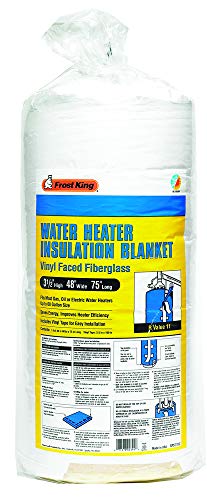
Best for a standard 40 to 60 gallon tank in a garage or unheated basement
- R-10 at 3 inches thick — the highest common rating in this category
- Foil-faced fiberglass, 48 by 75 inches, wraps most 40 to 60 gallon tanks
- Includes tape; trims with a utility knife for access panels
- Fits both gas and electric tanks when cut back correctly
Why buy it: R-10 is roughly double what the thin reflective wraps deliver, and on a pre-2015 tank in a cold garage that difference is the whole reason to fit one.

Best for anyone who does not want fiberglass in a space they work in
- Closed-cell foam and foil construction — no glass fiber, no itch
- Sized to fit 40, 50, 60 and 80 gallon tanks from one roll
- Wipes clean and does not absorb moisture the way fiberglass does
- Cuts cleanly with scissors rather than shedding when trimmed
Why buy it: fiberglass sheds when you cut it, and you will be cutting it — around panels, the drain valve and the relief pipe — which is exactly why owners keep choosing foam instead.
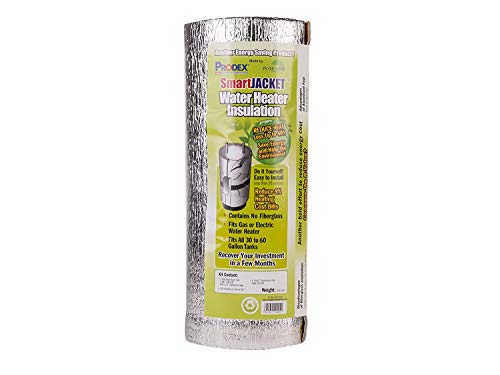
Best for tight closets where a 3-inch blanket physically will not fit
- 5mm closed-cell polyethylene with a reflective foil facing
- Thin enough for tanks with only an inch or two of clearance
- Fits 20 to 80 gallon tanks; trims easily to size
- Energy Star qualified reflective insulation
Why buy it: a thin blanket is worth far more than no blanket when the tank sits in a closet with two inches of clearance, and this is the format that actually fits those installs.

Best for 60, 75 and 80 gallon tanks that a standard blanket will not reach around
- 60 by 90 inches — enough material for tall 60 to 80 gallon tanks
- Same R-10 at 3 inches as the standard Frost King
- Foil facing with a fiberglass core
- Surplus material can be used on the top of an electric tank
Why buy it: the standard 48 by 75 blanket leaves a bare stripe down the back of a tall tank, and a bare stripe is where the heat leaves.
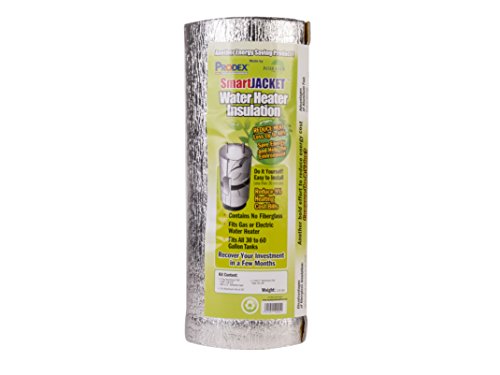
Best for utility rebate programs that ask for a certified product
- Energy Star certified with a documented R-7.1 rating
- Reflective faced system with straps rather than tape alone
- Sized for common 40 and 50 gallon residential tanks
- Clear cut lines marked for panels and the relief valve
Why buy it: if your utility offers a rebate on tank insulation, the certification is the point — an uncertified wrap with a better R-value may not qualify.

Best for oversized and commercial-style tanks in unconditioned space
- Non-fiberglass reflective construction, no itch and no shedding
- Enough material for tanks up to 80 gallons
- Double-sided foil facing for radiant heat reflection
- Includes tape and cutting guidance
Why buy it: an 80 gallon tank has far more surface area losing heat than a 40, so it is the size where a blanket pays back fastest — and the size most blankets are too small for.
Quick Comparison
| Product | Best for | Rating | Price | Buy |
|---|---|---|---|---|
| Frost King SP57/11C All Season Water Heater Insulation Blanket, 3 in. Thick, 48 x 75 in., R10 | Best Overall | — | Check (paid link) | |
| AES Industries Water Heater Blanket Jacket Insulation, Non Fiberglass, Fits 40 50 60 and 80 Gallon Tanks | Best Non-Fiberglass | — | Check (paid link) | |
| SJ-80 5mm Polyethylene Water Heater Blanket Insulation, Fits 20 to 80 Gallon Tanks | Best Foil Foam | — | Check (paid link) | |
| Frost King SP60 All Season Water Heater Insulation Blanket, 3 in. Thick, 60 x 90 in., R10 | Best for Large Tanks | — | Check (paid link) | |
| Water Heater Blanket Insulation System, Energy Star Certified, R Value 7.1 | Best Certified | — | Check (paid link) | |
| US Energy Products Water Heater Blanket Insulation, Non Fiberglass, Fits up to 80 Gallons | Best for 80 Gallon Tanks | — | Check (paid link) |
The safety rules — read these before you cut anything
On a gas water heater, never cover any of these:
- The top of the tank, the draft hood or the flue. That is the exhaust path. Blocking it pushes combustion gases into the room.
- The burner access panel and the air inlet at the base. That is the combustion air supply. Starving it produces carbon monoxide.
- The gas control valve and thermostat. They must remain visible and operable.
- The temperature and pressure relief valve or its discharge pipe. That valve is the last line of defense against a runaway thermostat.
- The rating plate and warning labels. Cut around them.
Carbon monoxide is odorless and the symptoms are easily mistaken for flu. Every home with a fuel-burning appliance needs working CO alarms — see the NFPA guidance. Several water heater manufacturers advise against insulation blankets on their gas units outright, and fitting one can void the warranty. Read your manual first. If you are unsure how your unit vents, do not wrap it — ask a licensed plumber or gas fitter.
On an electric water heater the risk is lower but the rules still apply: leave the thermostat access panels, the element access panels, the rating plate and the relief valve and its discharge pipe uncovered. You can insulate the top of an electric tank, which is where a surprising amount of heat leaves; never insulate the top of a gas one.
Fitting one properly
- Turn the thermostat down to its lowest setting, or set a gas control to PILOT, before you start working around the tank.
- Measure the tank height and circumference and cut the blanket to length with a few inches of overlap. Foil side out.
- Mark the cut-outs before cutting — access panels, controls, the drain valve, the relief valve and its pipe, and on a gas unit the entire top and the burner intake at the base.
- Wrap and tape the vertical seam, then tape around every cut-out so the edges are sealed and fibers stay contained. Foil HVAC tape holds far better than the tape in the box.
- Leave a clear gap at the floor on a gas unit so combustion air can reach the burner freely.
- Restore the thermostat to 120°F and check after an hour that the unit is cycling normally and, on a gas unit, that the draft hood is drawing correctly.
While you have the tools out, this is the natural moment to also flush the tank and check the anode rod, since both determine how long the heater lasts far more than insulation does — see how long water heaters last for the procedure and the scalding precautions.
How We Rank
We never buy or fit these products. For water heater blankets the criteria are: documented R-value, since that is essentially the entire function; material, because fiberglass sheds when cut and many owners would rather have foam; coverage, since a blanket that leaves a bare stripe down the back of a tall tank is leaving the heat exactly where it was; ease of trimming and taping around panels and valves; and aggregated owner reports on fit and on tape adhesion, which is where most complaints land. Star ratings and review counts come from verified Amazon listing data and refresh automatically. Prices were checked at the time of writing. Full method: how we rank.
The Field, Reviewed
1. Frost King SP57/11C — Best Overall
Covered above. Owners praise: the R-10 rating, a cold tank surface after fitting, and generous material. Owners gripe about: fiberglass itch when cutting, and tape that many replace with foil HVAC tape. Check price (paid link).
2. AES Industries Non-Fiberglass — Best Non-Fiberglass
Closed-cell foam with foil facing, sized to cover 40 through 80 gallon tanks. Lower R-value than 3-inch fiberglass, but no shedding, no itch, and it cuts cleanly with scissors — which matters because this is a product you will definitely be cutting.
Owners praise: clean handling with no glass fibers, a tidy finished appearance, and enough length for large tanks. Owners gripe about: lower thermal resistance than a thick fiberglass blanket, and a stiffness that makes it fight you on the first wrap. Check price (paid link).
3. SJ-80 5mm Polyethylene — Best Foil Foam
Five millimeters of closed-cell polyethylene behind a reflective foil face. This is not a high-R product and does not pretend to be; it is the answer for the very common install where the tank sits in a closet with a couple of inches of clearance and a 3-inch blanket physically cannot go on.
Owners praise: fitting where nothing thicker would, easy handling, and a neat result. Owners gripe about: modest thermal performance compared with fiberglass, and reflective insulation only performing as advertised with an air gap, which a tight wrap does not always provide. Check price (paid link).
4. Frost King SP60 — Best for Large Tanks
The same R-10 fiberglass construction in a 60 by 90 inch sheet. If you have a tall 60, 75 or 80 gallon tank, the standard 48 by 75 blanket leaves an uncovered strip, and an uncovered strip is where the heat goes. This is simply the version with enough material.
Owners praise: full coverage on tall tanks and enough surplus to insulate the top of an electric unit. Owners gripe about: the same fiberglass handling issues, and bulk that makes it awkward to maneuver in a tight utility room alone. Check price (paid link).
5. Energy Star Certified R-7.1 System — Best Certified
A certified reflective system with a documented R-7.1 and straps rather than tape alone. The certification is the reason to choose it: some utility rebate programs require a certified product, and an uncertified wrap with a nominally higher R-value may not qualify. Check your utility program before buying anything in this category if a rebate is in play.
Owners praise: the documented rating, clearly marked cut lines, and straps that hold better than tape on a damp tank. Owners gripe about: lower R-value than 3-inch fiberglass, and sizing that suits standard 40 and 50 gallon tanks rather than oversized ones. Check price (paid link).
6. US Energy Products Non-Fiberglass — Best for 80 Gallon Tanks
A double-sided foil reflective wrap with enough material for tanks up to 80 gallons, and no fiberglass. Large tanks are where insulation pays back fastest, simply because there is far more surface area losing heat, and most blankets are cut for 40 and 50 gallon bodies.
Owners praise: genuine coverage on oversized tanks, clean cutting, and a durable foil face. Owners gripe about: the price relative to a fiberglass roll, and reflective R-values that are modest next to 3 inches of glass wool. Check price (paid link).
What owners actually complain about
Fiberglass itch. Cutting glass wool sheds fibers. Gloves, long sleeves, eye protection and a dust mask, and tape every cut edge afterward. This is the single most common complaint in the category and it is entirely manageable.
The supplied tape. Almost universally described as adequate at best. Buy a roll of foil HVAC tape at the same time.
Not enough material. The 48 by 75 size is right for a 40 or 50 gallon tank and short for a tall 75 or 80. Measure the circumference and the height first.
Expecting a dramatic bill change. The savings are real but modest, and on a modern tank they are small. Owners who fitted a blanket to a post-2015 tank in a heated basement and then looked for a visible change in their bill were always going to be disappointed.
Covering something they should not have. This is the one that matters. Re-read the safety box above before cutting, and if you cannot identify your gas unit's air inlet and flue path with confidence, do not wrap it.
The verdict
Do the touch test first. If the tank is warm, the Frost King SP57/11C at R-10 is the most thermal resistance per dollar in the category and the one to buy — unless you would rather not deal with fiberglass, in which case the AES Industries non-fiberglass jacket is the straightforward alternative. Tight closet, take the thin SJ-80 foam; big tank, take the Frost King SP60 or the US Energy Products wrap. And if the tank is cold to the touch, skip all of it, turn the thermostat to 120°F, and put the thirty-five dollars toward an anode rod instead — that one buys years, not dollars. Check price on Amazon → (paid link)
More from this hub: DIY plumbing · how long do water heaters last · water heater temperature · best water heater · at what temperature do pipes freeze · how we rank.