 Garden

Affiliate Disclosure
Some links on this page are affiliate links. As an Amazon Associate, we earn from qualifying purchases — at no extra cost to you. We do not buy, test, or physically handle the products we cover; our rankings come from aggregated owner reviews, ratings and expert consensus. Commissions never change our verdicts. How we rank · full disclosure.
The short answer: for chlorinated city water, the iSpring WGB32B is the best whole house water filter for most homes — three big 20-inch cartridges, 1-inch ports that do not strangle your flow, and a cartridge set that costs a fraction of what a premium media tank does. On a well with iron or sulfur, buy the Home Master HMF3SDGFEC instead. Want a decade of hands-off service? The Aquasana Rhino EQ-1000. Testing the waters on a budget? The GE GXWH40L.
We do not buy, install or physically handle any of these systems. These rankings come from aggregated owner reviews, star ratings, review volume, published certifications and expert consensus — the full method is on how we rank. Broader plumbing guidance lives in our DIY plumbing hub.
Top Picks at a Glance
First: What Is Actually Wrong With Your Water?
Whole house filters get returned more often than almost anything else in plumbing, and the reason is nearly always the same — the buyer solved a problem they did not have. These are four separate jobs, done by four separate technologies, and no single cartridge does all of them. The certification marks map onto them: NSF/ANSI 42 covers aesthetic effects such as chlorine taste and particulate, while NSF/ANSI 53 covers contaminants with a health effect.
| Symptom | What it actually is | What fixes it | Relevant standard |
|---|---|---|---|
| Grit, cloudiness, clogged aerators | Suspended particulate | Sediment filter (spun or pleated, 5–50 micron) | NSF/ANSI 42 (particulate) |
| Pool smell, flat taste, dry skin | Chlorine or chloramine | Carbon block, GAC or catalytic carbon | NSF/ANSI 42 (chlorine, taste, odor) |
| White scale on kettles, spotty glasses, soap that will not lather | Dissolved calcium and magnesium — hardness | Ion-exchange softener, not a filter | NSF/ANSI 44 |
| Orange staining, metallic taste, rotten-egg smell | Iron, manganese, hydrogen sulfide (typically well water) | Oxidising or greensand-type media, then carbon | Manufacturer-rated ppm limits |
| Lead, nitrate, fluoride, PFAS concerns | Dissolved contaminants | Point-of-use reverse osmosis, or a specifically certified filter | NSF/ANSI 53, 58, 401 |
The practical move is to test before you buy. If you are on a municipal supply, your utility publishes an annual Consumer Confidence Report that lists what is actually in the water leaving the plant — the EPA requires it, and it is free. If you are on a well, a $30 to $60 lab panel for hardness, iron, manganese, pH and bacteria costs less than one wrong filter. Then buy for the result, not for the marketing photograph of a mountain stream.
Our #1 Pick: iSpring WGB32B 3-Stage Whole House Filter
The WGB32B is the pick because it gets the boring engineering right. The three housings take full-size 20 x 4.5-inch cartridges rather than the 10-inch ones on cheaper systems, which roughly doubles the media surface and therefore both the service life and the flow you can pull through it before pressure sags. The ports are 1-inch NPT, which matters more than most buyers realize — a 3/4-inch head on a 1-inch main is a manufactured restriction that no amount of media quality fixes.
The stage order is correct too, and it is worth understanding why. Stage one is a 5-micron polypropylene sediment cartridge, and its whole purpose is to die so the carbon does not: grit that would blind an expensive carbon block gets caught by a $12 spun filter instead. Stages two and three are coconut-shell carbon blocks, which handle the chlorine, the taste and the odor. iSpring states the carbon blocks are third-party tested against NSF/ANSI standards for chlorine reduction, and the system is rated to about 100,000 gallons — roughly a year for a family of four.
What owners consistently report is that the taste change is immediate and obvious, that the pressure drop is small enough not to notice on a normal 3/4-inch or 1-inch service, and that annual cartridge cost lands in the region of a nice dinner rather than a car payment. The consensus in the review record clearly favors this system over the 10-inch big-blue units it competes with.
The honest cons: it is heavy and physically large — plan on roughly 25 inches of vertical clearance below the housings just to drop a cartridge out, which catches people installing in a crawl space. The plastic housings need the supplied wrench and a firm hand, and reviewers who over-tighten report split housings or weeping O-rings. And it does nothing whatsoever for hardness, iron or lead, which is the single most common source of disappointed reviews on every product in this category.
Consensus Score ██████████░░ 9.0
Check price on Amazon → (paid link)
The Ranked Field

Best for city water with chlorine, sediment and a taste problem
- Three 20 x 4.5-inch cartridges — 5-micron sediment then two coconut-shell carbon blocks
- Rated to roughly 15 GPM with 1-inch NPT ports, so pressure loss stays small
- 100,000-gallon rated capacity, about a year for a family of four
- Carbon blocks third-party tested to NSF/ANSI standards for chlorine reduction
Why buy it: the housings and porting are big enough that the filter does not become the bottleneck in your plumbing — the single most common regret with cheaper units.

Best for set-and-forget municipal filtration for a decade
- Upflow dual-tank design with carbon and KDF media, rated 1,000,000 gallons or 10 years
- Independently tested to NSF/ANSI 42 for up to 97% chlorine reduction
- Tank is WQA certified to NSF/ANSI/CAN 61 for material safety
- Ships with pre-filter, post-filter, shut-off and drain valve and PVC assembly kit
Why buy it: the media tank runs a decade before it is swapped, so the only routine chore is a $30 pre-filter a couple of times a year.

Best for a first filter, well-water grit or a rental you do not want to over-invest in
- Single 10 x 4.5-inch big-blue housing takes FXHTC carbon or FXHSC sediment cartridges
- Includes mounting bracket, wrench and hardware for a straight in-line install
- Electronic filter-change indicator light
- Bypass-style valve head lets you shut the filter off without cutting water to the house
Why buy it: the cheapest honest way to find out whether filtration actually fixes what is bothering you before spending four figures.
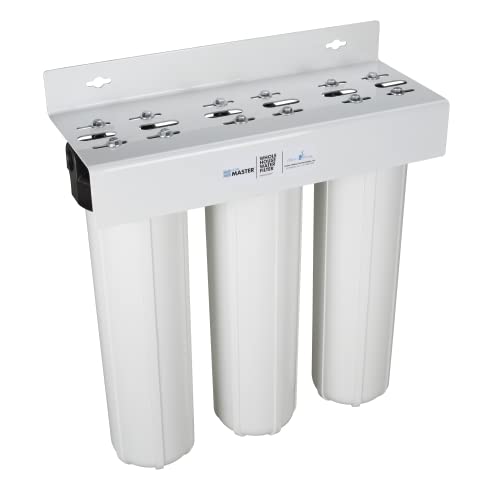
Best for non-chlorinated well water with iron, manganese or a rotten-egg smell
- Multi-gradient sediment, iron and manganese media, then a radial-flow carbon stage
- Handles iron, manganese and hydrogen sulfide up to about 3 ppm combined
- Oversized housings and 1-inch ports for up to 15 GPM
- Designed specifically for well water rather than adapted from a city-water unit
Why buy it: iron and sulfur are a different job from chlorine, and this is one of the few off-the-shelf systems built for that job rather than sold into it.

Best for people who hate wrestling a filter wrench over a wet floor
- Sanitary Quick Change cartridge — twist out, twist in, no wrench and no contact with the media
- Rated for 100,000 gallons or one year of service
- Integral shut-off in the head so the line stays live during a change
- Chlorine taste and odor plus 5-micron particulate reduction
Why buy it: the whole reason people stop changing their filter is the mess and the seized housing — this design removes both.
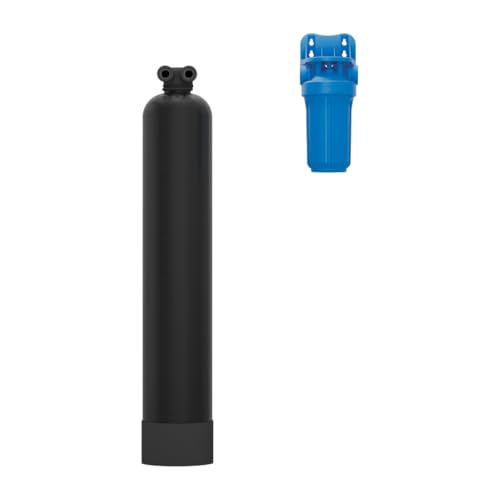
Best for high-demand homes and households worried about PFAS
- Four-stage media bed sized for homes with seven or more bathrooms
- Targets chlorine, chloramine, PFOA and PFOS, taste and odor
- Roughly 10-year media life with a washable sediment pre-filter
- DIY install kit with bypass valve included
Why buy it: the only system here with the flow headroom for a big house running two showers and a dishwasher without a pressure complaint.
Quick Comparison
| Product | Best for | Rating | Price | Buy |
|---|---|---|---|---|
| iSpring WGB32B 3-Stage Whole House Water Filter System, 20x4.5-inch Cartridges, 1-inch Ports | Best Overall | — | Check (paid link) | |
| Aquasana Rhino EQ-1000 Whole House Water Filter, 1,000,000 Gallon Carbon and KDF System | Best Premium | — | Check (paid link) | |
| GE GXWH40L Whole House Water Filtration System with Install Kit and Filter Change Light | Best Budget | — | Check (paid link) | |
| Home Master HMF3SDGFEC 3-Stage Whole House Filter for Iron, Manganese and Sediment | Best for Well Water | — | Check (paid link) | |
| 3M Aqua-Pure AP903 Whole House Sanitary Quick Change Water Filter System | Best Easy Maintenance | — | Check (paid link) | |
| SpringWell CF+ Whole House Water Filter System, 4-Stage, 7+ Bathrooms | Best for Large Homes | — | Check (paid link) |
The Systems, Reviewed
1. iSpring WGB32B — Best Overall
Covered above. Owners praise: an obvious improvement in taste and smell, negligible pressure loss on a properly sized service, cheap and widely available cartridges, and clear enough instructions that a competent DIYer finishes in an afternoon. Owners complain about: the clearance the housings demand, O-ring leaks traced to over-tightening or a dry seal, the weight when full, and the recurring disappointment of buyers who expected it to soften hard water.
2. Aquasana Rhino EQ-1000 — Best Premium
The Rhino sells convenience rather than performance you can taste. Its upflow dual-tank design pushes water up through carbon and KDF media, increasing contact time and resisting the channelling that ruins packed carbon beds, and the tank is rated for a million gallons or ten years. Aquasana states independent testing to NSF/ANSI 42 for up to 97% chlorine reduction, and the tank carries WQA certification to NSF/ANSI/CAN 61 for material safety. Owners praise: genuinely hands-off ownership, strong chlorine removal, no measurable pressure penalty, and a kit complete enough that you are not making three hardware-store trips. Owners complain about: the price, an installation footprint that needs real wall or floor space, fittings that several reviewers describe as needing extra sealant, and pre-filter housings that are the fiddliest part of an otherwise polished product.
3. GE GXWH40L — Best Budget
A single big-blue housing with a valve-in-head bypass, and by a wide margin the most sensible way to find out whether filtration solves your problem. Run an FXHTC carbon cartridge if the complaint is taste and smell, or an FXHSC sediment cartridge if it is grit. The change-reminder light is a small thing that measurably improves how often people actually service the filter. Owners praise: price, simple installation, the bypass valve, and a real improvement in taste with the carbon cartridge. Owners complain about: a 10-inch cartridge that loads up in months rather than a year, a more noticeable pressure drop than the 20-inch systems, and plastic head threads that will not forgive a wrench.
4. Home Master HMF3SDGFEC — Best for Well Water
Buy this one for a specific chemistry. Well water problems are usually iron, manganese and hydrogen sulfide, and none of those are what a chlorine-focused carbon system is designed to catch. The HMF3SDGFEC runs a multi-gradient sediment stage, then iron and manganese media, then radial-flow carbon, and is rated for up to about 3 ppm combined contaminant load with 1-inch ports and oversized housings for up to 15 GPM. Owners praise: orange staining and sulfur smell that genuinely go away, high flow with no pressure complaint, and a clearly explained stage sequence. Owners complain about: the price relative to a city-water system, media that loads fast if your iron level is above the rated ceiling, and the fact that it is explicitly not for chlorinated supplies — chlorine shortens the media life.
5. 3M Aqua-Pure AP903 — Best Easy Maintenance
The AP903 addresses the failure mode nobody puts on a spec sheet: filters do not get changed because changing them is horrible. Its Sanitary Quick Change cartridge twists out as a sealed unit with no wrench, no spilled water and no contact with used media, and the head has an integral shut-off. It is rated at 100,000 gallons or a year, handling chlorine taste and odor plus 5-micron particulate. Owners praise: a cartridge change measured in seconds, solid build quality, and no mess. Owners complain about: proprietary cartridges that cost noticeably more than generic 20-inch blocks, single-stage filtration where the iSpring gives three, and a price that only makes sense if you value your time on filter day.
6. SpringWell CF+ — Best for Large Homes
Sized for the house that actually runs out of flow: seven or more bathrooms, multiple simultaneous fixtures, and no tolerance for a pressure drop when the dishwasher and two showers coincide. The four-stage bed targets chlorine, chloramine, taste, odor and — unusually for a whole-house unit — PFOA and PFOS, with roughly a decade of media life and a washable sediment pre-filter. Owners praise: no perceptible pressure change even on high demand, chloramine handling that ordinary carbon struggles with, and a genuinely DIY-friendly bypass kit. Owners complain about: the price, the space it occupies, and a support experience that reviewers describe as variable when a fitting arrives missing.
What Owners Actually Complain About
Read enough one- and two-star reviews across this whole category and five patterns dominate. Pressure loss leads, and it is usually self-inflicted: a 10-inch cartridge or a 3/4-inch head on a 1-inch main will restrict flow no matter whose name is on the box, and a filter that is overdue restricts it further. Leaks at the housing O-ring come second, and reviewers who describe the fix almost always say the same thing — the O-ring needs a smear of silicone grease and the housing needs to be hand-tight plus a nudge, not cranked. Disappointment about hardness is third and is a buying error rather than a product fault; a carbon filter has never softened water and never will. Cartridge cost and availability is fourth, and it is the strongest argument for standard 10 or 20-inch housings over proprietary quick-change designs. And installation clearance is fifth: people mount the unit tight to a joist and then discover they cannot drop the sump to change the cartridge.

Installation, Codes and When to Stop
A whole house filter installs on the main line at the point of entry — after the main shut-off, after the meter, and before the water heater so the heater gets filtered water too. Leave the outside hose bibb upstream if you can, so you are not filtering the water for your lawn. Always fit a three-valve bypass loop: it lets you isolate the filter for a cartridge change without cutting water to the house, and it is the difference between a ten-minute job and a household emergency.
Then be honest about scope. Cutting into a potable main is the point where a straightforward job becomes a code question, and the answer is jurisdiction-specific. Permit requirements, who may cut a service line, and backflow or cross-connection rules are set locally — call your building department before you buy fittings, not after. Stop and call a licensed plumber if the main is galvanised steel, if the shut-off will not close fully, if the pipe is inside a finished wall, or if you would be soldering near framing. None of that is a reflection on your ability; it is a reflection on what a burst 1-inch main does to a basement at 2am.
Tools-wise you want a tubing cutter, the manufacturer sump wrench, plumber's tape, silicone O-ring grease, a bucket and a flashlight. Our plumbing tools guide covers the kit worth owning, and it is worth knowing what pressure your house should be running at before you add anything restrictive to the line — if you are already at 40 psi, a filter is not your first purchase.
Consensus Scores
Each score is our weighted read of the owner-review record and published certifications for that system — never a lab figure, and never a number typed onto a rating we did not verify.
- iSpring WGB32B ██████████░░ 9.0
- Aquasana Rhino EQ-1000 █████████░░░ 8.7
- 3M Aqua-Pure AP903 █████████░░░ 8.6
- Home Master HMF3SDGFEC █████████░░░ 8.5
- SpringWell CF+ █████████░░░ 8.4
- GE GXWH40L ████████░░░░ 8.0
How We Rank Whole House Water Filters
We never buy or physically handle the products on this site — we read the review record at scale and cross-check it against published specifications. Four things carried the most weight here. Certification specifics, because "NSF certified" on a listing means nothing until you know which standard: 42 is aesthetics, 53 is health contaminants, 58 is reverse osmosis, 61 is material safety. Flow and porting, taken from published GPM ratings and port sizes, because pressure complaints dominate the negative reviews. Total cost of ownership over five years including cartridges, since a cheap head with expensive proprietary filters loses to a pricier head with $15 standard cartridges by year two. And reviews written after the first year, because the things that actually decide whether you like a filter — service life, housing leaks, cartridge availability — never show up in an unboxing.
Star ratings, review counts and prices were current at the time of writing and all move. The complaint patterns move far less, and those are what we weight hardest.
The Verdict
For most American homes on treated municipal water, the iSpring WGB32B is the whole house filter the evidence backs: correct stage sequence, full-size cartridges, honest porting and running costs you will still tolerate in year five. Well owners with iron or sulfur should buy the Home Master HMF3SDGFEC, big houses the SpringWell CF+, filter-hating pragmatists the 3M AP903, and anyone testing the idea should start with the GE GXWH40L and spend the savings on a water test.
Next: for drinking water specifically, a point-of-use system does things a whole-house filter cannot — see our best under sink water filters and the step-by-step in how to install an under sink water filter. If hard water is the real problem, our hard-water faucet picks deal with the fixture side of it. Or head back to the DIY plumbing hub.