 Garden

Affiliate Disclosure
Some links on this page are affiliate links. As an Amazon Associate, we earn from qualifying purchases — at no extra cost to you. We do not buy, test, or physically handle the products we cover; our rankings come from aggregated owner reviews, ratings and expert consensus. Commissions never change our verdicts. How we rank · full disclosure.
Water hammer is a pressure surge created when moving water is stopped suddenly. The column of water has momentum, and when a fast-closing valve halts it, that momentum converts into a pressure wave that travels back up the pipe and slams against fittings. The rule of thumb engineers use: roughly 60 psi of surge for every 1 foot per second of velocity arrested in rigid pipe — so water moving at 8 feet per second can spike close to 500 psi. Fast-acting appliance valves, high pressure, waterlogged air chambers and unsecured pipes are the usual causes.
We never buy, test or physically handle the products we rank; recommendations come from aggregated owner reviews and expert consensus, described in how we rank. More at the DIY plumbing hub.
What actually triggers it in a house?
Five causes account for nearly all residential water hammer, and they compound each other:
| Cause | What it sounds like | Fix |
|---|---|---|
| Fast-closing solenoid valve (washer, dishwasher, ice maker, irrigation) | One sharp bang as the appliance stops filling | Water hammer arrestor at that fixture |
| Waterlogged air chambers | Hammering that appeared gradually in an older house | Drain the system to recharge, or fit arrestors |
| Static pressure above 80 psi | Loud bangs at several fixtures | Pressure-reducing valve set to 50–60 psi |
| Undersized or overlong pipe runs | Bangs on any quick shutoff | Reduce velocity; usually a repipe question |
| Unsecured pipes in joist bays | Rattle or thump after the bang | Cushioned pipe clamps every 6–8 ft |
Why do the air chambers in an older house stop working?
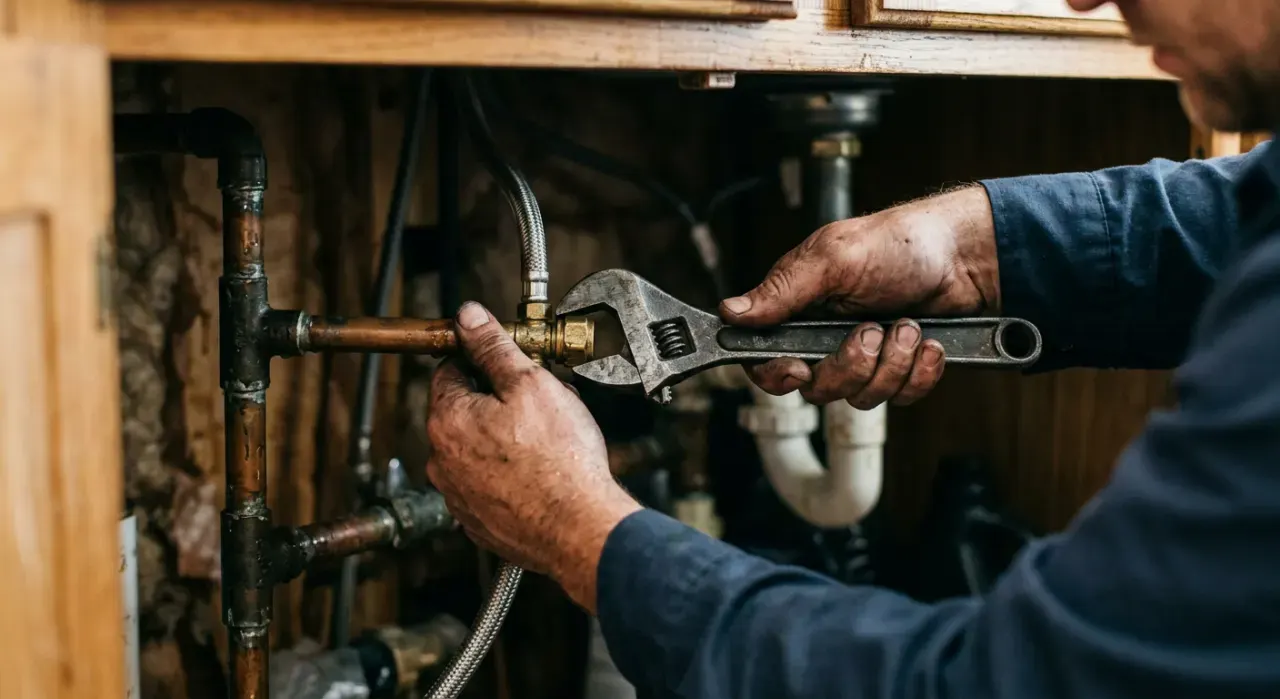
Because air dissolves into water. Homes plumbed before arrestors became common used a capped vertical stub of pipe above each fixture supply, trapping a pocket of air that compressed to absorb the surge. Over months, that air slowly dissolves into the water passing beneath it and the chamber fills — waterlogged, and now just a dead leg of pipe. This is why a house that was quiet for a decade starts banging.
The traditional recharge is free and worth trying first: shut the main, open the highest and lowest faucets in the house, let everything drain fully so air re-enters the chambers, then close the low faucet and turn the main back on. If the noise returns within weeks, the chambers are the wrong geometry or too short, and the durable answer is arrestors.
What is a water hammer arrestor and where does it go?
An arrestor is a small sealed cylinder containing a piston or bellows with a permanently charged gas cushion behind it, so unlike an air chamber it cannot waterlog. Devices are certified to PDI standard WH-201, published by the Plumbing and Drainage Institute, which sizes them by the number of fixture units they protect — sizes A through F. Most residential applications use size A or AA.
Placement matters more than quantity. An arrestor must go as close as practical to the quick-closing valve causing the problem, on both hot and cold lines where both are involved. The high-value locations in a typical house:
- Washing machine box — screw-on arrestors that thread between the hose bib and the hose are the easiest retrofit, around $15 to $30 a pair, no pipe cutting.
- Under the dishwasher, on the hot supply at the shutoff.
- Ice maker line behind the refrigerator.
- Irrigation zone valves, which are often the loudest offender in an otherwise quiet house.
In-line arrestors that solder or push-fit into the pipe are more effective but require cutting into the line — a reasonable DIY job with push-to-connect fittings, or an hour of a plumber's time.
Should you check pressure first?
Yes, because it is free and it might be the whole answer. A $12 gauge on a hose bib tells you the static pressure in 30 seconds. Anything over 80 psi is above the ceiling in most adopted plumbing codes and makes every hammer event harder; bringing the house down to 50 to 60 psi with a pressure-reducing valve often reduces the banging enough that no arrestor is needed. The detail is in what psi home water pressure should be.
Two things worth ruling out because they mimic hammer: a failing faucet cartridge or toilet fill valve, which chatters rather than bangs, and thermal expansion on a closed system, which produces creaks and ticks from the water heater rather than a sharp report. If the noise happens only when the water heater fires, read about expansion tanks in do you need a permit to replace a water heater, where they are usually a code requirement.
Related: why a drain gurgles when the washing machine drains — a different laundry noise with a completely different cause — and best plumbing tools for the gauge and wrenches.