 Garden
Affiliate Disclosure
Some links on this page are affiliate links. As an Amazon Associate, we earn from qualifying purchases — at no extra cost to you. We do not buy, test, or physically handle the products we cover; our rankings come from aggregated owner reviews, ratings and expert consensus. Commissions never change our verdicts. How we rank · full disclosure.
"Blackout" is not a regulated term. There is no standard a panel has to pass, no test it has to survive and no number it has to hit before a seller can print the word on the package. The result is a category where a fabric that dims a room by 85% and a genuinely opaque lined drape sit next to each other on the same search page, both described as blackout, and the cheaper one usually has more reviews.
The second thing worth knowing is that even the good panels rarely deliver darkness, and it is not their fault. In a normal installation, the light in the room is not coming through the curtain. It is coming over the top of the rod, down the couple of inches on each side where the panel stops short of the wall, and under the hem. That perimeter gap passes far more light than any weave does — which is why a wraparound rod costing twenty dollars will do more for your sleep than spending twice as much on fabric.
Top Picks at a Glance

Dimming, Room-Darkening, Blackout: What the Words Mean
Manufacturers use three descriptions fairly consistently even though none of them is enforced. Knowing which one you are actually buying prevents most of the disappointment in this category.
| Label | Construction | Realistic result | Good for |
|---|---|---|---|
| Light filtering / sheer | Single layer, open weave | Softens light, no darkening | Privacy in daytime, layering |
| Room darkening | Tighter single or double weave, no dark core | Noticeably dimmer, objects still visible | Living rooms, glare on a TV |
| Blackout (triple weave) | Three layers with a dark yarn core | Very dark through the fabric; perimeter still leaks | Most bedrooms |
| Lined blackout | Face fabric plus a separate blackout lining | Opaque through the fabric, heavier drape, better fold | Bedrooms where looks matter too |
| Coated / foam-backed | Fabric with a sprayed or laminated back | Opaque at first; the coating cracks and flakes over years of sun | Short-term or low-sun windows |
The practical shortlist: for a bedroom, buy triple-weave or lined. Avoid a heavy foam coating on a window that gets hard afternoon sun, because that is the construction owners come back to complain about after eighteen months.
Our #1 Pick: NICETOWN Thermal Insulated Blackout Panels
These are the default blackout curtain in the United States, and the ownership record behind them is the reason to start here rather than with something cleverer. What that record shows is a triple-weave panel that darkens a bedroom convincingly, survives washing, and has no coating to crack — which is the failure mode that quietly ruins cheaper opaque curtains on a south or west window.
They are not the most attractive panels in this list. The face is a flat polyester that reads as functional rather than decorative, and in the darker colors it can look slightly plasticky in direct sun. Owners repeatedly mention two other things: the panels arrive with hard fold creases that take several days to hang out (a steamer fixes it in minutes), and there is a fabric smell out of the packet that airs off in a day or two.
Buy them wide. The single most common mistake is ordering two 52-inch panels for a 52-inch window, which leaves nothing to overlap and nothing to wrap. For a 52-inch window, 104 inches of total panel width on a rod extended 10 inches past each side is what actually makes a room dark.
Check price on Amazon → (paid link)
The Ranked Field
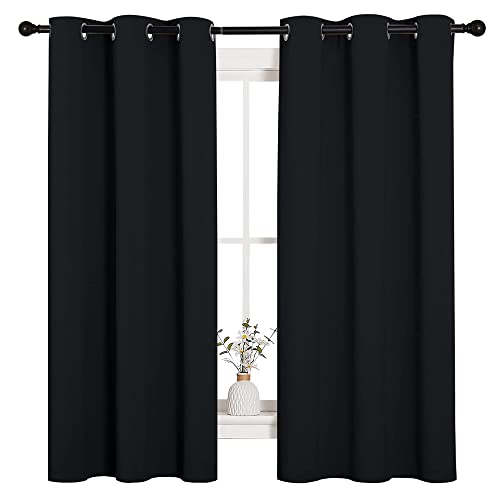
Best for the bedroom window that needs to go dark tonight without a remodel
- Triple-weave polyester with a dark core layer — light stops in the fabric, not at a coating
- Grommet top slides on a standard rod and stacks tightly to the side
- Sold in widths from 42 to 52 inches per panel so you can overlap generously
- Machine washable cold, which the coated blackout panels are not
Why buy it: the most-owned blackout panel in America, and the reason to start here: a woven light-blocking core does not crack, flake or crease-mark the way a foam-backed panel does after a year on a sunny window.

Best for a room where you want it genuinely dark, not dim
- Separate blackout liner behind a linen-look face fabric
- Back-tab option hangs the panel flat against the wall instead of standing off it
- Also takes a rod pocket if you want a gathered look
- Available to 84 and 96 inches for floor-to-ceiling coverage
Why buy it: the back-tab construction is the whole point. It pulls the panel edge in toward the wall, which is where nearly all the light in a "blackout" room is actually coming from.
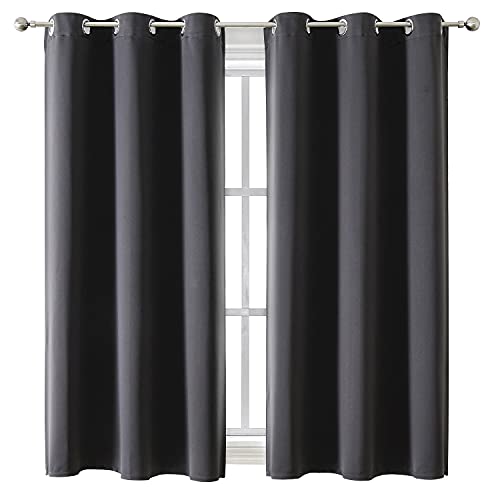
Best for darkening several windows on a budget
- Three-layer weave with a light-blocking middle
- Grommet top, 63 and 84 inch drops
- Wide color range including light neutrals that still darken
- Frequently the cheapest genuinely dark panel on the listing page
Why buy it: the sensible buy when you have four windows and not much budget — closer to the NICETOWN in performance than the price gap suggests.

Best for a living room where the curtains have to look like curtains
- Linen-textured face fabric over a separate blackout lining
- Reads as a mid-weight drape rather than a slab of shiny polyester
- Heavier hand, so it hangs with a proper fold
- Available in several muted neutrals
Why buy it: the panel that solves the real objection to blackout curtains, which is that most of them look like hotel-room hardware bolted onto a home.
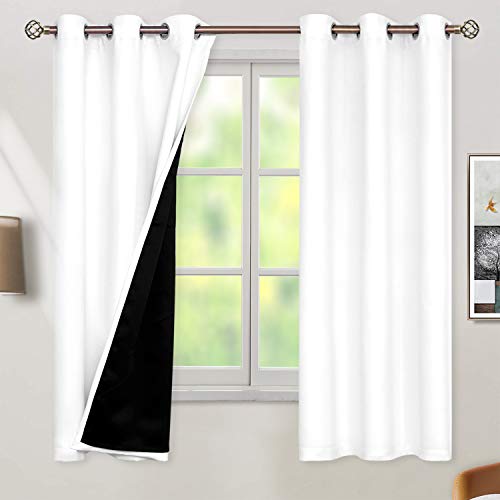
Best for a bright room you do not want to make gloomy in the daytime
- Pale face fabric with a dark inner layer doing the blocking
- Grommet top, 63 and 84 inch drops
- Reflects rather than absorbs afternoon sun on the outward face
- Rates among the highest in the category on owner satisfaction
Why buy it: white blackout panels are usually a compromise, and this is the one owners consistently say actually darkens — because the blocking layer is inside, not on the visible face.
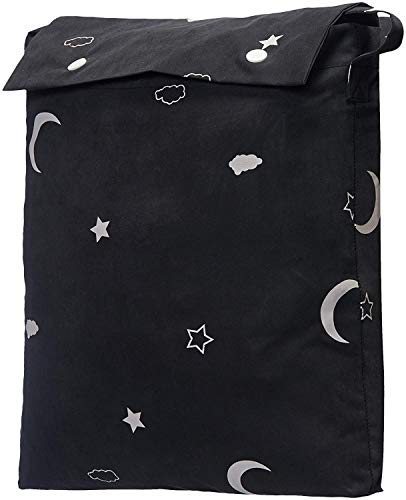
Best for hotel rooms, dorms, nurseries and anywhere you cannot drill
- Suction cups fix straight to the glass — no rod, no bracket, no holes
- 50 by 78 inches, folds into a supplied bag
- Seals to the pane itself, which removes the side-gap problem entirely
- Room-darkening rather than lined blackout construction
Why buy it: it is not as dark as a lined panel on a proper rod, but by sealing against the glass it beats plenty of "100% blackout" curtains that leave a two-inch gap down each side.

Quick Comparison
| Product | Best for | Rating | Price | Buy |
|---|---|---|---|---|
| NICETOWN Thermal Insulated Grommet Blackout Curtains, 2 Panels | Best Overall | — | Check (paid link) | |
| Joydeco 100% Blackout Curtains, Nature Linen, Rod Pocket and Back Tab | Closest to Actual Blackout | — | Check (paid link) | |
| ChrisDowa Blackout Curtains, Thermal Insulated, 2 Panel Set | Best Value | — | Check (paid link) | |
| MIULEE 100% Blackout Linen Curtains, Natural Beige, 52 × 84 in | Best Looking | — | Check (paid link) | |
| BGment White Blackout Curtains, Thermal Insulated, 63 in | Best Light Color That Still Darkens | — | Check (paid link) | |
| Amazon Basics Portable Room Darkening Blackout Curtain with Suction Cups | Best for Renters and Travel | — | Check (paid link) |
The Install That Actually Makes a Room Dark
This section matters more than the ranking above it. You can buy the best panel in the category and still wake up at 5:40am in June, because darkness is a coverage problem before it is a fabric problem.
- Use a wraparound rod. A bend-back or wraparound rod curves the last few inches of the track toward the wall, so the panel ends flush against it rather than floating two inches off. This closes the side gap, which is the largest single light path in most rooms.
- Go wider than the window. Extend the rod 8 to 12 inches past the frame on each side. The panel then stacks off the glass when open and still covers the wall when closed.
- Go higher than the frame. Mount 4 to 6 inches above the top of the window, or straight into the ceiling. A ceiling-mounted track plus a floor-length panel is the closest a curtain gets to a sealed opening.
- Buy 2× the window width in total panel. Two panels that merely meet in the middle will part at the center as soon as the air conditioning kicks on. You want several inches of overlap.
- Run the hem long. Floor-length, or at least 4 to 6 inches below the sill. A hem that lands exactly on the sill leaves a bright bar of light across the floor.
- Close the top. Grommet tops leave scallops of light above the rod. If the room still is not dark after the above, a valance, a cornice board, or a ceiling-mounted track is the fix.
If you are hanging new hardware anyway, our curtain rod installation guide covers bracket spacing and anchoring into drywall, and how to hang curtains covers the height and width math in more detail.
The Energy Claim, Kept Honest
Heavy lined curtains do measurably reduce heat transfer at a window, and the effect is worth having — but the marketing routinely oversells it into the territory of insulation, which it is not.
The Department of Energy's Building America Solution Center summarizes field studies showing "whole home summertime cooling savings ranging from 15% to 25% from the optimized use of high-efficiency shades," and "wintertime heating savings of about 12% to 14%." The same review reports something more striking about extreme heat: modeling a 2021 heat wave in a home without air conditioning, interior roller shades reduced dangerous indoor hours by about 18%, insulating interior shades by about 23%, and exterior shades by about 55%.
Two honest caveats. First, "optimized use" is doing a lot of work in that sentence — the savings assume the coverings are closed before the sun reaches the glass and opened when they should be, which is not how most households behave. Second, those figures describe high-efficiency shades, including cellular and exterior products, not a $30 pair of polyester panels. A blackout curtain sits at the modest end of that range. It helps at the margin. It does not replace air sealing, attic insulation or better glazing, and any listing that implies otherwise is selling you a story.
Where curtains punch above their weight is the west-facing window in August. Blocking direct sun before it lands on the floor and furniture is genuinely effective, because you are stopping radiant gain at the point of entry rather than removing heat after it has arrived. For more on that, see do blackout curtains help with heat.
The Noise Claim, Kept Honest
A large share of these listings mention noise reduction, and it is the weakest claim in the category. Blocking sound requires mass and an airtight seal. A curtain has very little of the first and none of the second — sound simply travels around the panel edges the same way light does, except sound diffracts far more readily.
What heavy drapes genuinely do is absorb reflections inside the room, so speech and footsteps sound softer and the room feels less echoey. They also take a little edge off high-frequency sound, which is why a velvet panel can make birdsong or a distant siren slightly less intrusive. What they do not touch is low-frequency energy: traffic rumble, a highway drone, a truck idling, bass through a shared wall. That is the noise most people are actually trying to block, and no curtain will move it. We go into this properly in do blackout curtains reduce noise.
How We Rank
We do not buy, hang or physically handle these curtains. Rankings come from aggregated owner ratings across the most-owned blackout panels in the US market, weighted toward long-ownership reviews where sun damage, coating failure and shrinkage after washing show up, and cross-checked against each listing's stated construction. Four things carry the weight: real opacity, judged from owner reports of a dark room rather than the word on the package; durability, especially whether the light-blocking layer is woven in or coated on; how the panel hangs, since a back-tab or pinch-pleat top closes the side gap that grommets leave open; and value at the width you actually need, because a cheap narrow panel is not cheap once you buy four of them. Prices were checked at the time of writing. Full method: how we rank.
The Field, Reviewed
1. NICETOWN Thermal Insulated Grommet Blackout Curtains — Best Overall
Covered above. Owners praise: how much darker the room gets than expected, that the fabric washes without falling apart, the sheer number of sizes, and the price. Owners gripe about: deep packaging creases, a fabric smell for the first day or two, light over the grommets, and a face fabric that looks utilitarian in the darker colors. Check price (paid link).
2. Joydeco 100% Blackout Linen-Look, Rod Pocket and Back Tab — Closest to Actual Blackout
A separate blackout liner behind a linen-textured face, and crucially a back-tab top. Back tabs sit the panel flat against the wall rather than standing it off on rings, which pulls the vertical edges in toward the frame — the single most useful construction detail in this whole category.
Owners praise: genuine darkness, the weight and fold of the fabric, and that it looks like a real drape. Owners gripe about: back tabs are slower to open and close than grommets, the panels are heavy enough to need a properly anchored rod, and the linen look reads slightly more gray in person than in the listing photos. Check price (paid link).
3. ChrisDowa Blackout Curtains — Best Value
The panel to buy when you are darkening several windows at once. Three-layer construction, a wide range of colors including light neutrals, and a price that regularly undercuts everything comparable on the page.
Owners praise: the darkening for the money, the color range, and that the light shades still block. Owners gripe about: the fabric is thinner in the hand than the NICETOWN, the hems can arrive slightly uneven, and creases take longer to drop out. Check price (paid link).
4. MIULEE 100% Blackout Linen, Natural Beige — Best Looking
The answer for a room where the curtains are part of the decor rather than a sleep accessory. A linen-textured face over a proper blackout lining, heavy enough to hang in real folds instead of flat sheets.
Owners praise: the texture and drape, that it darkens without looking clinical, and the muted color range. Owners gripe about: the price against the plain polyester panels, the weight (a light tension rod will sag), and that "natural beige" varies between production runs. Check price (paid link).
5. BGment White Blackout Curtains — Best Light Color That Still Darkens
White and cream blackout panels usually disappoint, because the blocking layer has to be dark and a pale panel often just is not. This one puts the dark layer inside and keeps the visible face light, which is why it rates as highly as it does.
Owners praise: a bright, non-gloomy room during the day and a genuinely dark one at night, and that it does not yellow quickly. Owners gripe about: pale fabric shows every mark, so it needs washing more often than a dark panel, and the inner layer can be faintly visible as a shadow at the seams in strong sun. Check price (paid link).
6. Amazon Basics Portable Room Darkening Blackout Curtain — Best for Renters and Travel
Suction cups onto the glass, no hardware, folds into a bag. It is room-darkening rather than lined blackout construction, so on paper it is the weakest fabric here — and in practice it often outperforms panels that cost more, because sealing to the pane removes the perimeter gap that defeats everything else.
Owners praise: hotel rooms and night-shift sleep, no holes in a rental wall, and how small it packs. Owners gripe about: suction cups letting go in heat or on textured glass, condensation behind the panel on cold mornings, and a size that only suits smaller windows. Check price (paid link).
What Owners Actually Complain About
Light around the edges, not through the fabric. This is the number one complaint in the category and it is almost always a hardware problem. If the panel itself is opaque when you hold it to a window, the leak is the rod, the width or the hem.
Creases that take a week to hang out. Blackout fabrics are folded tightly for shipping and hold the fold hard. A steamer, or a low-heat tumble with a damp cloth, fixes in ten minutes what gravity takes a fortnight to do.
The smell out of the packet. Common, harmless in most reports, and gone in a day or two of airing. If it persists after a wash, that is a reason to return it.
Fading and coating failure on hot windows. Dark colors fade on a south or west exposure, and foam-backed panels crack along the folds. A woven light-blocking core is the more durable construction and the reason we rank triple-weave panels above coated ones.
Weight versus hardware. A lined blackout pair over a wide window is heavy. Tension rods sag, and drywall anchors pull out. Anchor into studs where you can.
The Verdict
For most bedrooms the NICETOWN thermal insulated panels remain the sensible buy — best-understood, woven rather than coated, and cheap enough to buy in the generous width the job actually needs. Step up to the Joydeco lined panels if you want genuine darkness and are willing to hang them back-tab against the wall, take the MIULEE linen if the room has to look good, and use the Amazon Basics portable panel where you cannot drill. Whatever you buy, spend the extra on a wraparound rod, order twice the window width, and hang it high and long. That is what makes a room dark. Check price on Amazon → (paid link)
More from this hub: furniture & decor · best thermal curtains · best blackout blinds · how to hang curtains · how we rank.