 Garden

Affiliate Disclosure
Some links on this page are affiliate links. As an Amazon Associate, we earn from qualifying purchases — at no extra cost to you. We do not buy, test, or physically handle the products we cover; our rankings come from aggregated owner reviews, ratings and expert consensus. Commissions never change our verdicts. How we rank · full disclosure.
The short answer: the best squirrel proof bird feeder is the Squirrel Buster Plus. Whichever you buy, plan on cleaning it: Clemson Extension advises washing feeders at least every two weeks, and Project FeederWatch reports that a soak in dilute bleach beats soap and water for cutting Salmonella on feeders. It suits almost every yard because its weight-activated shroud is the most reliable mechanism in the category — a squirrel's weight pulls a sleeve down over the ports, and it reopens the instant the squirrel leaves. What lifts it above rivals using the same idea is adjustable spring tension, so you can tune it to shut out grackles and starlings too. Want the same mechanism for half the money? The Squirrel Buster Standard.
But before you spend $100, know this: where you hang the feeder matters more than which feeder you buy. A perfect squirrel-proof feeder hung four feet from a fence will be raided, because the squirrel simply lands on top. The placement rule is below and it is free.
The 5-7-9 Rule — Do This First
A gray squirrel can leap roughly 10 feet horizontally and 4 to 5 feet vertically from a standing start, and can drop considerably further than it can climb. Every successful feeder setup respects those numbers.
| Dimension | Minimum | Why |
|---|---|---|
| Height above ground | 5 ft | Beyond a standing vertical jump |
| Distance from any launch point | 7–10 ft | Fences, rails, trunks, sheds, woodpiles, patio furniture |
| Clearance below overhanging branches | 9 ft | Squirrels drop from above far more than they jump up |
| Pole baffle top height | 4–5 ft | A baffle mounted lower is simply jumped over |
| Dome baffle diameter | 15 in or more | Narrower and they reach around it |
Two things people forget. Launch points move. A patio chair left near the feeder, a stacked woodpile, a snowdrift in February — all of these temporarily shorten the seven feet, and squirrels notice within a day. And squirrels are not the only raiders: a feeder correctly sited for squirrels is usually also correctly sited against raccoons, which are heavier and better climbers.
Get placement right and even a basic feeder survives. Get it wrong and a $160 motorised feeder becomes a squirrel amusement.

Top Picks at a Glance
Our #1 Pick: Squirrel Buster Plus
Brome's Squirrel Buster line is the reference point in this category, and the Plus is the full-size version.
The mechanism is elegantly simple. The feeder's outer sleeve is suspended on a spring. Bird weight is not enough to move it; squirrel weight is. When a squirrel climbs on, the sleeve slides down and its solid section covers the feeding ports. The squirrel gets nothing, gives up, and the sleeve springs back the moment it leaves. There is nothing to reset, nothing to power, and nothing that traps an animal.
What makes the Plus better than every imitation is the adjustable spring tension. A dial in the base lets you set the closing weight, which means you can also exclude grackles, starlings and blue jays — the three birds that dominate a feeder and empty it in a morning. Nothing else here offers that, and for anyone whose actual complaint is nuisance birds rather than squirrels, it is the deciding feature.
Practically, it holds 5.1 pounds of seed, has six ports plus a cardinal ring for the larger perching birds, is built from chew-proof materials on a metal frame, and dismantles completely without tools for cleaning. That last point matters more than it sounds — feeders are a genuine disease vector for songbirds — the CDC traced a multi-state Salmonella outbreak to contact with wild birds and bird feeders — and one that cannot be taken apart does not get cleaned properly.
Honest limitations: at around $100 it is expensive; the spring mechanism has moving parts that can gum up with seed dust and wet weather if it is never cleaned; and it is a tube feeder, so ground-feeding species like doves and juncos will only get what is spilled.
Check price on Amazon → (paid link)
The Ranked Field

Best for almost every yard — the weight-activated shroud that actually works
- Weight-activated shroud closes the ports under a squirrel
- Adjustable spring tension to exclude larger birds too
- Six feeding ports plus a cardinal ring
- 5.1 lb seed capacity, chew-proof, fully dismantles for cleaning
Why buy it: the adjustable tension is the feature nothing else has — you can tune it to exclude grackles and starlings as well as squirrels.
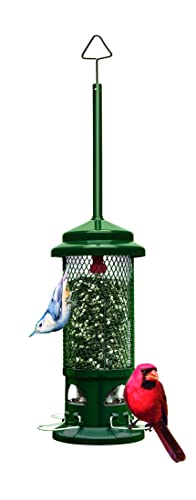
Best for a smaller yard or a second feeder
- Same weight-activated closing shroud, smaller body
- 1.3 lb seed capacity, four metal perches
- UV-resistant, chew-proof construction
- Easy-clean design with no tools
Why buy it: the same mechanism as the Plus at roughly half the price, and the smaller capacity means seed does not sit long enough to spoil.
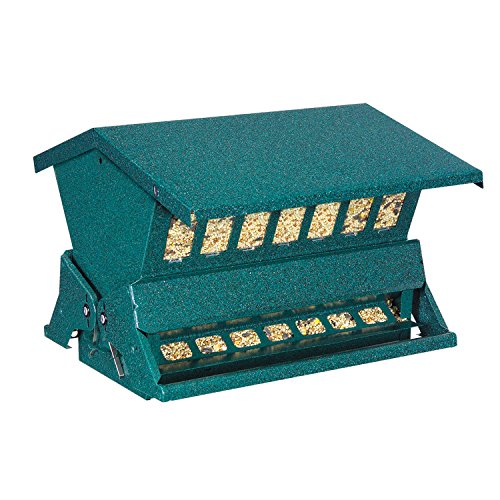
Best for feeding a lot of birds, including ground feeders like cardinals
- 12 lb capacity — refills measured in weeks, not days
- Weight-activated perch bar closes the seed slot
- All-steel body squirrels cannot chew through
- Feeds from both sides
Why buy it: a 12 lb hopper is the answer if you are tired of refilling, and the steel body ends the chewing problem permanently.

Best for a persistent squirrel problem, and a sense of humor
- Weight-activated motorised perch ring spins the squirrel off
- Rechargeable battery in the base
- 5 lb seed capacity, UV-stabilised tube
- Metal base and ports
Why buy it: it does not just deny access — it teaches the squirrel that this feeder is not worth the trip, which nothing passive achieves.

Best for small songbirds and cardinals, without a motor to maintain
- Four individually sprung perches collapse under about 2 oz
- Curved perches suit cardinals and small songbirds
- 17-inch tube, 5 lb seed capacity
- Four seed ports
Why buy it: each perch is calibrated separately, so a squirrel drops off one port while birds keep feeding at the other three.

Best for excluding larger nuisance birds as well as squirrels
- Weight-activated cage drops to cover the ports
- Metal construction resists chewing
- 2 lb seed capacity
- Decorative leaf detailing
Why buy it: a cage keeps out grackles, starlings and jays as well as squirrels, which no shroud-style feeder manages.

Quick Comparison
| Product | Best for | Rating | Price | Buy |
|---|---|---|---|---|
| Squirrel Buster Plus Squirrel-proof Bird Feeder with Cardinal Ring | Best Overall | — | Check (paid link) | |
| Squirrel Buster Standard Squirrel-proof Bird Feeder with 4 Metal Perches | Best Value | — | Check (paid link) | |
| Woodlink Absolute II Squirrel Resistant Bird Feeder Model 7536 | Best Hopper | — | Check (paid link) | |
| Droll Yankees Yankee Flipper Squirrel Proof Bird Feeder | Best Motorized | — | Check (paid link) | |
| Droll Yankees Yankee Whipper Squirrel Proof Bird Feeder | Best Collapsible Perch | — | Check (paid link) | |
| Perky-Pet 336-1SR Squirrel-Be-Gone Squirrel Proof Bird Feeder | Best Caged | — | Check (paid link) |
How We Rank
We do not buy or hang bird feeders. We read the owner-review record at volume, weighting reviews written after a full season because squirrels are persistent and a mechanism that works in week one may not in month six. Four things carry the most weight. Mechanism reliability over time, tracked through reviews describing whether the feeder still excludes squirrels after a winter of seed dust and rain. Chew resistance, since a squirrel denied the ports will attack the housing, and plastic loses. Cleanability, because feeders spread disease between birds and one that cannot be dismantled will not be cleaned. And bird acceptance, meaning whether the design actually suits the species people want to attract. Prices were checked at time of writing. Full method on how we rank.
The Feeders, Reviewed
1. Squirrel Buster Plus — Best Overall
Covered above. What owners consistently praise: that it simply works, the adjustable tension for excluding nuisance birds, tool-free dismantling for cleaning, and Brome's warranty service. Recurring complaints: the price; the spring mechanism sticking if it is never cleaned, especially after a wet winter; seed bridging in the tube with finer seed mixes; and the cardinal ring being a slightly awkward fit for the largest cardinals. A minority report the shroud staying down after heavy rain until it dries. Check price (paid link).
2. Squirrel Buster Standard — Best Value
The same weight-activated shroud in a smaller body at roughly half the price. Capacity drops to 1.3 pounds with four metal perches, which sounds like a downgrade and is partly an advantage — a smaller feeder empties faster, so seed does not sit long enough to go stale, clump or grow mold in humid weather.
Recurring complaints: refilling every few days in a busy yard is genuinely tedious; there is no adjustable tension, so it excludes squirrels but not nuisance birds; and there is no cardinal ring, so the larger perching birds struggle. Best as a second feeder or for a small yard. Check price (paid link).
3. Woodlink Absolute II Model 7536 — Best Hopper
A different format for a different problem. This is a 12-pound hopper feeder in all steel, with a weight-activated perch bar running the length of each side — a squirrel's weight tips the bar and closes the seed slot. Twelve pounds means refills measured in weeks rather than days, and the double-sided design plus a long perch bar means a lot of birds feed at once, including cardinals and other larger species that struggle at tube ports.
Recurring complaints: it is heavy when full, so it needs a genuinely solid pole or bracket; the steel body can rust at scratches after several seasons; and it is bulky and less attractive than a tube feeder. Several owners note the perch bar can be defeated by a very light young squirrel. Check price (paid link).
4. Droll Yankees Yankee Flipper — Best Motorized
The famous one. A weight-activated motorised perch ring spins when a squirrel puts its weight on it, and the squirrel is carried off. Powered by a rechargeable battery in the base. Its real advantage over passive designs is behavioural: a shroud denies access, but the squirrel comes back tomorrow to check. A spinning ring teaches the animal that this particular feeder is not worth the trip, and owners consistently report squirrels giving up on the yard entirely after a week or two.
Recurring complaints: at around $160 it is the most expensive here; the battery needs recharging every few weeks and that is the dominant gripe; it must be brought in during heavy rain and winter in some climates; and the motor is the failure point, with reports clustering in year two to three. Not everyone is comfortable with a mechanism that moves the animal rather than simply blocking it. Check price (paid link).
5. Droll Yankees Yankee Whipper — Best Collapsible Perch
The passive Droll Yankees design, and a clever one. Instead of one mechanism for the whole feeder, each of the four perches is individually sprung and calibrated to collapse at around two ounces. A squirrel reaching one port drops off it while birds continue feeding at the other three — the feeder never shuts down entirely, which a shroud-style feeder does. The curved perch shape is designed for cardinals and small songbirds.
Recurring complaints: the springs weaken over several seasons and eventually need replacing; a determined squirrel can sometimes hang from the top and reach a port without loading a perch; and the 17-inch tube holds 5 pounds, which is generous but bridges with finer seed. Check price (paid link).
6. Perky-Pet 336-1SR Squirrel-Be-Gone — Best Caged
The budget entry, and the only one here that solves a second problem. A weight-activated metal cage drops to cover the ports under a squirrel, but the cage itself also excludes anything larger than a small songbird — grackles, starlings, blue jays and doves. If your feeder is being emptied by a flock of starlings rather than a squirrel, this is the design that fixes it.
Recurring complaints: the cage excludes cardinals too, which many people specifically want; capacity is only 2 pounds; the decorative leaf detailing is polarising; and the metal is thinner than the Woodlink, so a determined squirrel can bend it over time. At around $40 it is the cheapest credible option. Check price (paid link).

Change the Seed, Change the Problem
The cheapest squirrel deterrent is not a feeder at all. Squirrels have strong seed preferences, and so do birds, and the two lists differ usefully.
| Seed | Squirrels | Birds it attracts |
|---|---|---|
| Black oil sunflower | Love it | Almost everything |
| Striped sunflower | Like it | Cardinals, jays, grosbeaks |
| Cracked corn | Love it | Doves, sparrows, and every mammal in the yard |
| Safflower | Generally avoid it | Cardinals, chickadees, titmice, house finches |
| Nyjer (thistle) | Ignore it | Goldfinches, siskins, redpolls |
Switching from a cheap mixed seed containing cracked corn to straight safflower is frequently enough on its own, and it also removes the milo and wheat filler that most birds discard onto the ground — which is what attracts the squirrels in the first place. If your feeder is surrounded by a carpet of rejected seed, that is the actual invitation.
What Owners Actually Complain About
"It worked for a month." Almost always placement, not the feeder. A new launch point appeared — furniture, a woodpile, snow accumulation, a growing shrub. Re-measure the seven feet.
Mechanisms gumming up. Seed dust plus rain plus a spring. Every weight-activated feeder needs dismantling and cleaning a few times a season, which is also necessary for bird health.
Seed bridging in the tube. Finer mixes and humid weather cause seed to arch over the ports and stop feeding. Tap the tube; use straight sunflower or safflower rather than a fine mix.
Chewed housings. A frustrated squirrel attacks the feeder itself. Metal-bodied and chew-proof-rated feeders resist it; plastic tubes do not.
Battery maintenance on the Flipper. Real and recurring. Budget for recharging every few weeks in season.
The Verdict
For a feeder that reliably keeps squirrels out and lets you tune out nuisance birds as well, the Squirrel Buster Plus is what the owner-review record supports most strongly. Smaller yard or a second feeder? The Squirrel Buster Standard. Tired of refilling? The 12-pound Woodlink Absolute II. Truly persistent squirrels? The Yankee Flipper, if you will keep the battery charged. Starlings and grackles the real problem? The caged Perky-Pet Squirrel-Be-Gone. And whichever you buy, hang it five feet up, seven feet from anything, and nine feet below the branches. Check price on Amazon → (paid link)
Next: the full garden decor hub · best birdbaths · how often to change birdbath water · decorating a small yard · how we rank.