 Garden

Affiliate Disclosure
Some links on this page are affiliate links. As an Amazon Associate, we earn from qualifying purchases — at no extra cost to you. We do not buy, test, or physically handle the products we cover; our rankings come from aggregated owner reviews, ratings and expert consensus. Commissions never change our verdicts. How we rank · full disclosure.
The short answer: in a small yard, fewer and larger beats more and smaller, every time. Choose one focal point per view, repeat a limited palette of pots and plants rather than collecting variety, keep at least half the floor clear, and push everything you can onto the walls and the boundaries. A courtyard with three big pots and one wall fountain feels generous; the same space with fifteen small ornaments feels like a storage unit.
Small spaces are unforgiving because every object is seen up close and all at once. There is no distance to soften a mistake, no depth to hide a mismatch. The upside is that a small yard rewards spending on quality, because you need so much less of it.
We never buy or physically handle the products we rank; recommendations come from aggregated owner reviews, star ratings and review volume, described in how we rank. The wider subject lives at the garden decor and water features hub.
Why Big Objects Make Small Spaces Feel Bigger
This is the least intuitive rule in small-space design and the most useful. A single large planter reads as one confident gesture; six small ones read as visual noise, and noise fills a space in a way a solid object does not. The eye counts objects, not volume, so reducing the count while increasing the size makes a yard feel calmer and larger at the same time.
It applies across the board. Paving: large-format slabs with few joints read as more floor than small pavers or brick, which chop the ground into pieces. Pots: three 18 to 24 inch containers beat a dozen 8 inch ones, and they also need watering far less often, which is the practical argument on a hot deck. Ornament: one 30 inch piece against a wall beats four small figures scattered around. Furniture: one properly sized table beats a table plus a bench plus two side tables plus a plant stand.
The corollary is a rule about the floor. Keep at least half the ground plane open, and preserve a clear route at least 36 inches wide from the door to wherever you sit. Nothing makes a courtyard feel smaller than having to sidestep a pot on the way to a chair.
The Numbers That Decide the Layout
| Use | Space needed |
|---|---|
| Bistro table, 2 chairs | 7 × 7 ft pad |
| Dining table, 4 chairs | 10 × 10 ft |
| Dining table, 6 chairs | 12 × 12 ft |
| Two lounge chairs and a side table | 8 × 8 ft |
| Clearance behind a chair to stand up | 30–36 in |
| Comfortable walking route | 36 in wide minimum |
| Grill, with safe working clearance | 4 × 4 ft, 3 ft from anything combustible |
| Wall fountain projection from the wall | 6–10 in |
| Self-contained bubbling urn footprint | ~2 × 2 ft |
| Narrow border along a fence | 18–24 in deep to be useful |
Measure your yard and lay these out on paper before buying anything. A typical urban back yard of 20 by 30 feet has 600 square feet, which sounds ample and evaporates fast: a 10 by 10 dining area, a 36-inch path and two 2-foot borders already account for a third of it. A townhouse courtyard at 12 by 16 has room for one seating group and very little else, and the design decision is which one thing it is going to be.
Go Up, and Use the Boundaries
In a small yard the walls and fences are the largest surfaces you own, and they are usually the most wasted.
Stain the boundary dark. Charcoal, deep green or near-black makes a fence visually recede; pale orange-brown fence stain advances and makes a yard feel like a box. This is the cheapest high-impact change available — a gallon of stain and an afternoon — and planting reads far better against a dark background than a light one.
Plant vertically. Climbers on wires or a trellis add greenery with a footprint of a few inches. Espaliered fruit trees against a warm wall take under a foot of depth. Wall planters, mounted troughs and tiered shelving stack growing space where there is no ground. The plant selection side of this is covered at the small space gardening hub.
Screen selectively, not completely. A slatted screen that partly hides a neighbor's window works better than a solid one, because you can see through it in places and the eye reads depth beyond. Solid boundaries all the way around create a lid.
Break the box with a diagonal. The longest line in a rectangle runs corner to corner, and laying paving, a path or the main seating axis on that diagonal genuinely adds perceived distance. It also stops the yard reading as a corridor.
One Focal Point, and Sound
Stand at the door or the kitchen window — wherever you actually look at the yard from — and give that view exactly one strong object. A specimen tree in a large pot, a piece of ornament against the dark fence, a fire bowl, or a water feature. Two competing focal points in a 20-foot space cancel each other out.
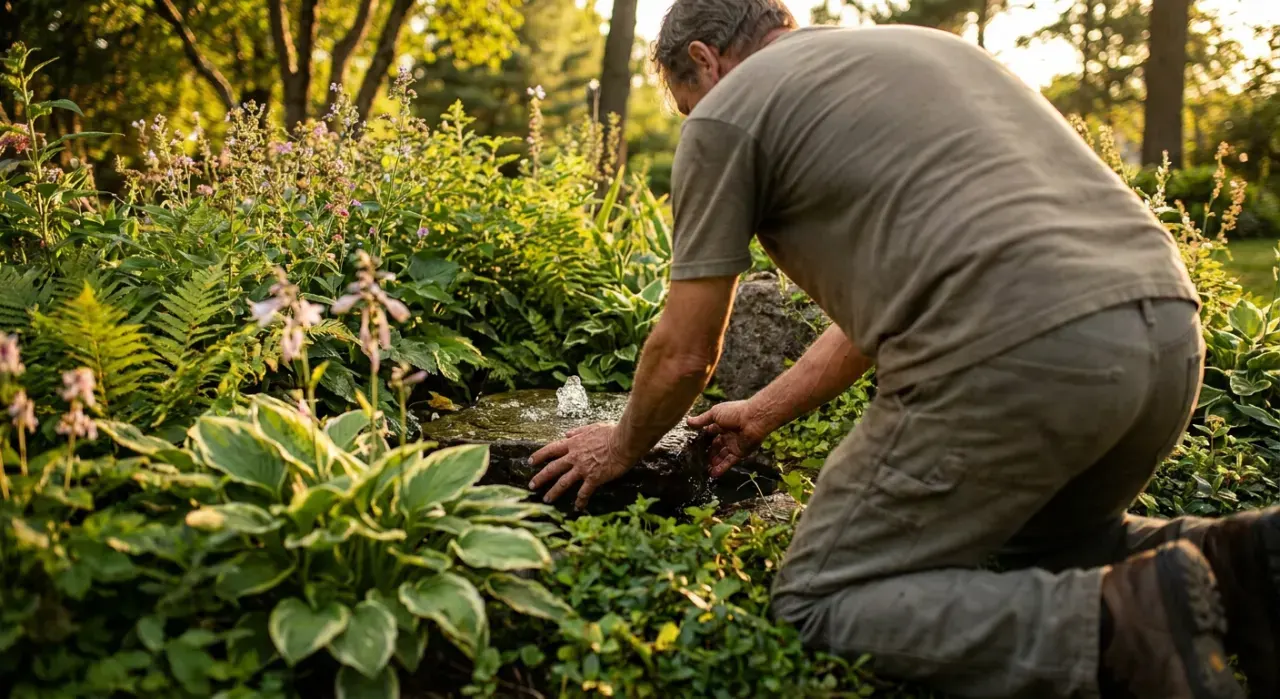
Water deserves special mention in small yards because it does something no other element does: it adds sound, and in a tight urban lot sound is often the actual problem. Moving water masks traffic, air conditioning units and neighbors far more effectively than a fence blocks them, and the effect starts at a very modest scale.
The right formats for a courtyard, in order of how little space they take: a wall fountain, projecting only 6 to 10 inches; a self-contained bubbling urn or millstone at around 2 feet square with no open water for a toddler to reach; and a bowl or birdbath with a small pump dropped in, which is the cheapest entry of all. A large tiered floor fountain is usually the wrong answer here — it consumes floor and tends to be out of scale with the boundary behind it.
If there is no outdoor outlet, which is common in rentals and older townhouses, a solar pump removes the wiring question entirely, with the trade-offs set out in solar vs plug-in fountains and the units themselves ranked in best solar fountain pump. Where power is available, the wall-mounted and self-contained options are covered in best outdoor fountain. Whichever you choose, size the pump for the actual lift rather than the box figure — the math is in fountain pump sizing.

Repeat, Do Not Collect
Repetition is the mechanism that makes a small space read as designed rather than accumulated, and it costs nothing to apply.
- One pot material, two or three sizes. Matte black, aged terracotta, galvanized steel — pick a lane. Mixed materials in a small space read as leftovers.
- Three or four plant species, repeated, instead of fifteen singletons. A courtyard with the same fern in five spots and the same grass in four looks intentional; the same space with fourteen different plants looks like a nursery holding area.
- One accent color across cushions, pots and any painted surface. Two at most.
- Odd-numbered groups with varied heights. Three pots of different sizes clustered read better than three matched ones in a row, and use a plant stand or an upturned pot to lift one of them.
The corresponding list of what crowds a small yard: a narrow border running around all four sides, which frames the space as a small box; more than one style of ornament; a collection of small figures; too many hard materials meeting in one view; and furniture bought for its price rather than its dimensions.
Lighting, Storage and the Practical Layer
Lighting. Small yards need remarkably little. Two or three fixtures — one uplight on the focal point, a low wash on a path, and something warm and soft at the seating area — do more than a dozen path lights marching down both sides, which is the most common over-lighting mistake. Warm color temperature around 2700K flatters planting; cool white makes a garden look like a parking lot. Fixture choices and wiring are at the garden lighting hub.
Storage. In a courtyard there is nowhere to hide anything, so storage has to be furniture. A bench with a hinged lid, a slim vertical cabinet against the fence, or a deck box that doubles as a side table all buy back floor that would otherwise be lost to a pile of cushions and tools. Nothing wrecks a small yard faster than visible clutter, because there is no distance to lose it in.
Shade. A cantilever umbrella with the pole out of the way, a sail across a corner, or a slim pergola against the house gives usable hours in July without a structure standing in the middle of the space. Check the swing radius before buying a cantilever — several feet of clearance behind the base is needed to rotate it.
Restraint at the end. The most common improvement to a finished small yard is subtraction. Once everything is in, stand at the door, look for the one object that is competing with the focal point, and take it out. If the ornament question is where the crowding starts, the material and placement rules that apply are in choosing garden statuary.