 Garden

Affiliate Disclosure
Some links on this page are affiliate links. As an Amazon Associate, we earn from qualifying purchases — at no extra cost to you. We do not buy, test, or physically handle the products we cover; our rankings come from aggregated owner reviews, ratings and expert consensus. Commissions never change our verdicts. How we rank · full disclosure.
The short answer: buy larger than feels comfortable — at least a third the height of whatever stands behind it — pick the material for your winter rather than for the price, and place it at the end of a sight line or a turn in a path, against a plain backdrop, never mid-lawn. Cast stone lasts decades and cracks if it holds water in a freeze. Resin lasts three to five seasons before it chalks. Metal outlives both and costs accordingly.
Garden ornament is the part of a yard where taste gets blamed for what are really three technical mistakes: the wrong size, the wrong material for the climate, and the wrong position. Fix those and even inexpensive pieces look deliberate.
We never buy or physically handle the products we rank; recommendations come from aggregated owner reviews, star ratings and review volume, described in how we rank. The wider subject lives at the garden decor and water features hub.
How Each Material Actually Weathers
| Material | Weight, 24 in piece | Life outdoors | Ages by | Fails by |
|---|---|---|---|---|
| Cast stone / concrete | 60–200 lb | 20+ years | Moss, lichen, softening detail | Freeze cracking where water collects; surface spalling |
| Resin / fiberglass | 5–20 lb | 3–7 years | Fading, chalking | UV degradation; blowing over; brittleness with age |
| Cast iron | 80–250 lb | Decades | Rust patina | Splitting where trapped water freezes in a hollow |
| Weathering (corten) steel | 30–80 lb | Decades | Deep orange oxide layer | Rust runoff staining stone and paving beneath it |
| Powder-coated aluminum | 10–30 lb | 10+ years | Very little | Coating chips, then pitting; light enough to move in wind |
| Copper / bronze | 20–100 lb | Generations | Green verdigris | Cost, and it is a theft target |
| Glazed ceramic / terracotta | 20–60 lb | 5–15 years | Crazing in the glaze | Freeze shattering — the most fragile option outdoors |
| Carved natural stone | 150–400 lb | Lifetimes | Genuine patina | Price, and the logistics of moving it |
| Cedar / teak | 15–40 lb | 7–15 years | Silvering | Rot at ground contact; always set it on a stone or a foot |
Two material notes carry more practical weight than the rest. Cast stone is not a single thing. Quality varies enormously with the mix and the mold, and dense, well-cured pieces with crisp detail survive freeze-thaw cycles far better than cheap, chalky castings that were pulled from the mold too early. In owner reviews the tell is consistent: pieces described as arriving with soft, blurred detail and a sandy surface are the same ones reported crumbling at the edges after two winters.
Weathering steel bleeds. The orange oxide layer that makes corten attractive washes down in rain and permanently stains light-colored paving, cast stone and concrete beneath it. Site it over gravel, mulch or planting rather than over a patio, and expect a rust halo in the soil around its base.
Getting the Size Right
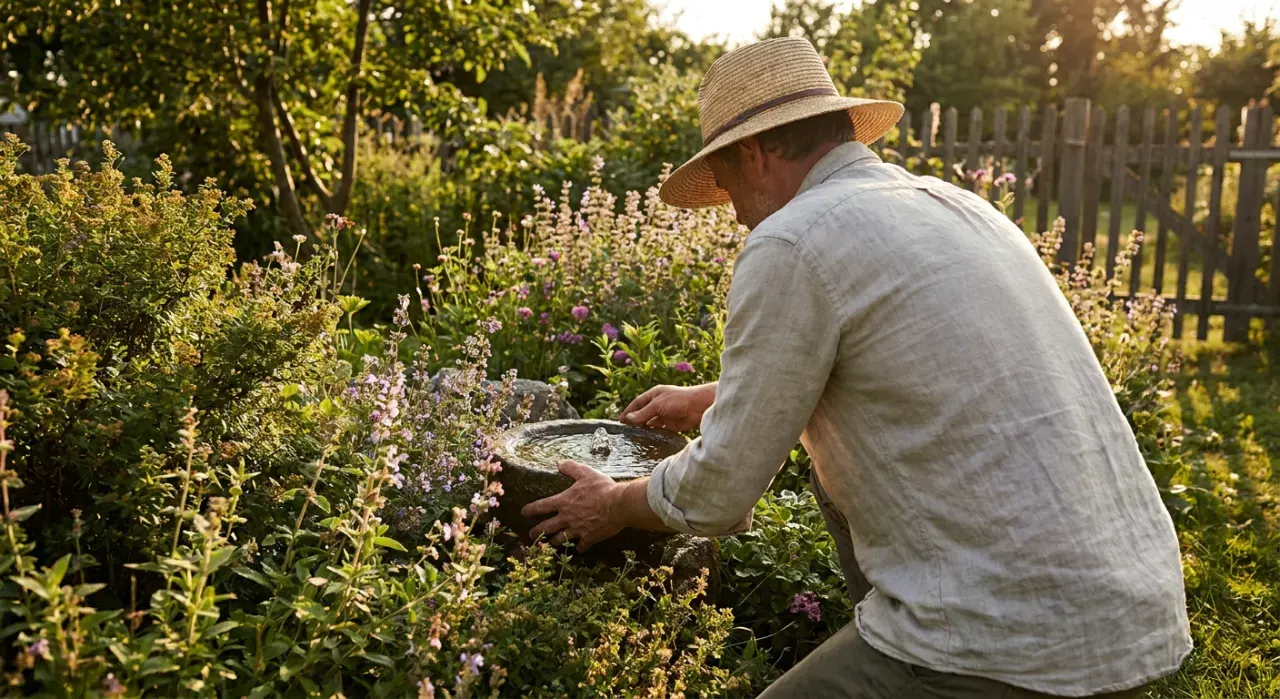
Objects lose apparent size outdoors because they lose their frame of reference. Indoors a 20-inch figure sits in a room whose ceiling is 8 feet away; outdoors it competes with a 30-foot maple and an open sky, and it simply disappears.
Three rules that consistently work:
- A third of the backdrop. A piece intended as a focal point should be at least a third the height of the hedge, wall or fence directly behind it. Against a 6-foot hedge, that means 24 inches minimum, and 30 to 36 inches is better.
- An inch of height per foot of viewing distance, as a rough floor. Seen from a patio 30 feet away, a piece under 30 inches will not register as an object; it registers as clutter.
- Use a pedestal to buy height cheaply. A 24-inch figure on a 20-inch plinth reads as a 44-inch focal point, and plinths cost a fraction of what the equivalent extra size in the piece itself would. Stacked bluestone, a section of concrete pipe stood on end, a salvaged column base or a simple cast plinth all work.
Before buying, do the cardboard test. Cut a rectangle to the exact dimensions in the listing, stake it where the piece would go, and look at it from the window and the seat you actually use. It takes five minutes and it is the single most useful thing in this article, because dimensions in a product listing convey almost nothing about how something will read in a real yard.
Placement: Five Positions That Work
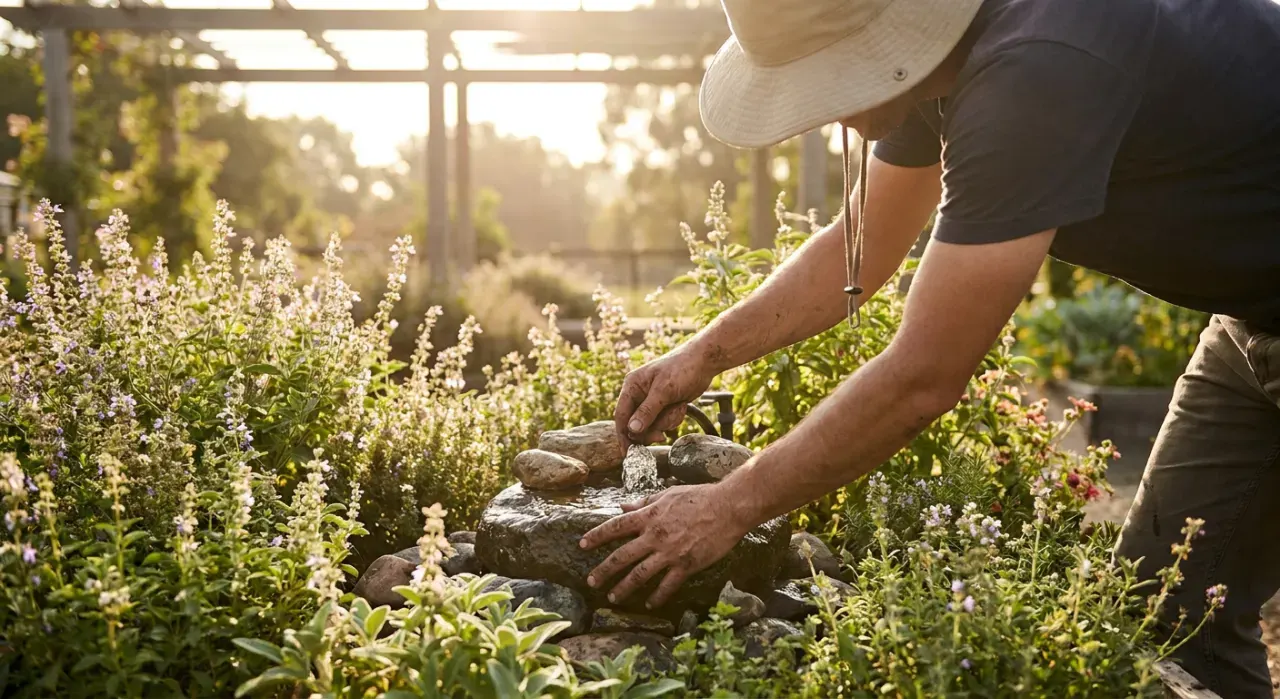
1. The end of a sight line. Look down a path, an allée, a mown strip through longer grass, or simply the axis of a rectangular yard, and put the piece where the eye already stops. This is the strongest position there is and it requires no other justification.
2. At a turn. Where a path changes direction, an object explains the turn and stops it feeling arbitrary. It also gets seen twice — approaching, and again from the new direction.
3. Half-revealed in planting. A figure emerging from ferns or hostas, or glimpsed through the stems of a shrub, reads as discovered rather than displayed. This position is forgiving of imperfect pieces because it never shows the whole thing at once.
4. Against a plain backdrop. Dark evergreens, a hedge, a wall, a fence. Silhouette is what makes a shape legible, and a piece set against a busy mixed border simply dissolves into it.
5. In deliberate repetition. Three identical obelisks down a border, or a matched pair flanking steps, is the oldest trick in garden design and still the most reliable. Repetition reads as intent; collection reads as accumulation.
The position that consistently fails is the middle of an open lawn, where there is no backdrop, no relationship to anything and no reason for the object to be there. The other common failure is quantity: more than one focal point in a single view means the eye cannot settle, and each piece cancels the others out. Stand at the kitchen window, count what competes for attention, and remove until one thing wins.
Anchoring, Ballast and Theft
Anything tall, light or valuable needs securing, and this is where a lot of ornament is lost.
Wind. Resin and hollow aluminum pieces blow over in a summer storm and crack when they land. Fill the hollow base with dry sand, gravel or expanding foam, or set the piece on a paver and pin it. Anything over about 4 feet tall wants a proper footing.
Pinning. For heavy stacked pieces — a figure on a plinth, a birdbath bowl on a pedestal — drill both halves and set a short length of stainless rebar or threaded rod into the joint, bedded with construction adhesive or masonry epoxy. This stops the classic failure where a child, a dog or a wind gust topples the top half onto a foot.
Level and settled base. Set stone and concrete pieces on a compacted, level pad of paver base or a buried paver rather than directly on soil. Soil heaves and settles unevenly with frost and rain, and a leaning statue looks worse than no statue.
Theft. Bronze, copper and antique cast iron are stolen from front gardens regularly. Keep the valuable pieces behind the house, out of view from the street, and pin them into a concrete footing rather than relying on weight alone.
Winter and Long-Term Care
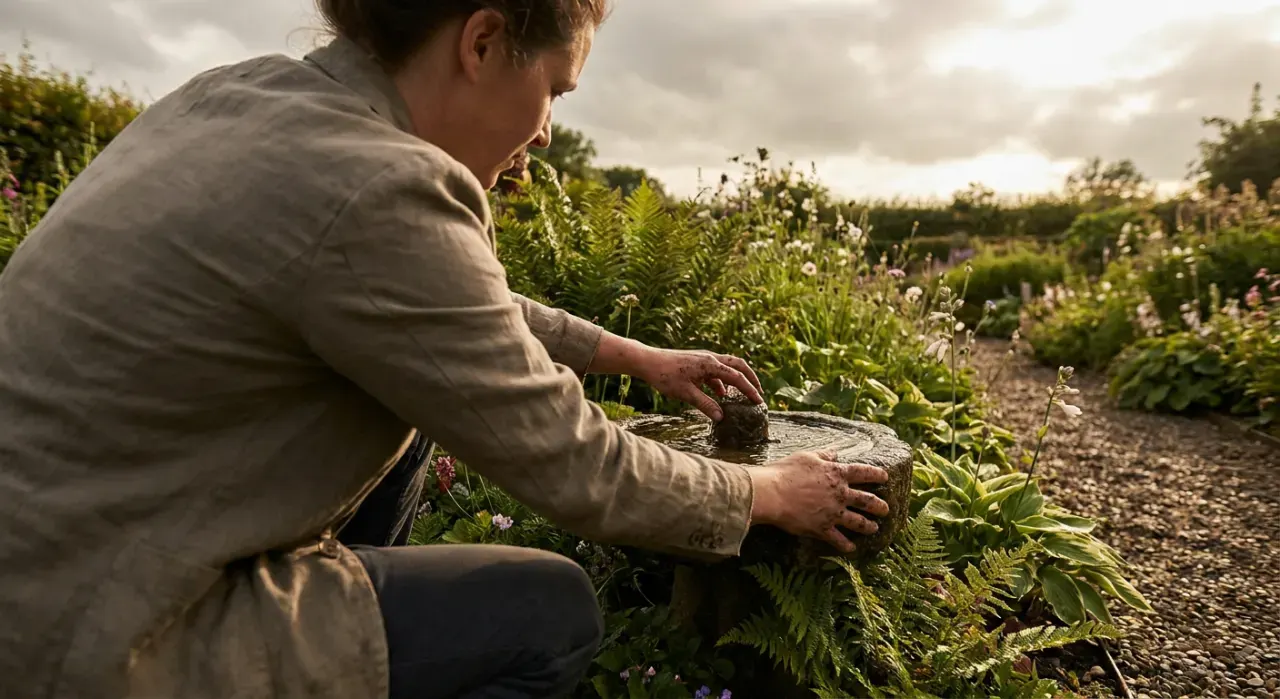
Freeze damage to statuary works exactly the way it works on fountains: water collects in a hollow or soaks into porous material, freezes, expands about nine percent and splits the piece. The specific risks are cupped hands, folded drapery, basin-shaped tops, and any seam where two castings meet.
- Eliminate standing water. Tip small pieces so they drain, or drill a discreet quarter-inch hole at the low point of any cup or basin.
- Seal porous cast stone with a breathable masonry sealer every two to three years, applied dry, in fall, above 50°F — unless you specifically want moss, in which case skip it.
- Raise it off the ground on shims or a paver so it does not wick moisture from frozen soil all winter.
- Cover or bring in the fragile. Glazed ceramic and terracotta should come inside in any zone that freezes hard. Breathable covers work for larger cast stone; plastic tarps trap condensation and cause their own damage.
- Wash annually. A soft brush and plain water, or a dilute vinegar solution for mineral scale. Do not pressure wash cast stone — it strips the surface and opens the pores, which accelerates the freeze-thaw cycle.
The same reasoning drives the whole fall shutdown for water features, and if you have both in the yard it is one job — see how to winterize a fountain.
Making It Look Intentional
Pick a register and stay inside it. Classical figures, modern abstract forms, folk art, wildlife and Asian-inspired lanterns are five different languages, and a garden speaking all of them at once looks like a showroom. One vocabulary, repeated, beats five one-offs every time.
Let the planting do half the work. Ornament looks best when something soft grows against it — a low mound of catmint at the base, a fern breaking the outline, ivy or moss creeping onto the plinth. A statue standing alone on bare mulch always looks like it was recently delivered, because it looks like it could be picked up and taken away.
Finally, consider what happens after dark. A single uplight at the base of a focal piece roughly doubles the hours you get from it and turns a daytime object into an evening one — the fixtures and the wiring choices are covered at the garden lighting hub. And if the aim is a focal point with sound as well as shape, a water feature does both jobs at once; the ranked field is at best outdoor fountain, with the simplest and cheapest version of the idea — a pedestal bowl that also brings birds into the view — at best birdbath. For a small yard where all of this has to happen in a tight space, the scale rules change, and those are set out in decorating a small yard.