 Garden

Affiliate Disclosure
Some links on this page are affiliate links. As an Amazon Associate, we earn from qualifying purchases — at no extra cost to you. We do not buy, test, or physically handle the products we cover; our rankings come from aggregated owner reviews, ratings and expert consensus. Commissions never change our verdicts. How we rank · full disclosure.
The short version: across six popular hand pruners weighed on owner ratings, review volume and the complaints that keep repeating, our #1 pick is the Felco F-2 — not because it cuts better than everything else, but because every part that wears is a part you can replace. Most gardeners are better served by the Fiskars bypass pruner at a quarter of the price, and anyone whose hands ache should look straight at the ratchet anvil pruner instead of trying to muscle through.
We do not buy, prune with, or physically handle any of these tools. These rankings come from aggregated owner reviews, star ratings, review volume and expert consensus — the full method is on how we rank. This page is about hand pruners for small stems; for anything thicker than a broom handle see best loppers and best pruning saws.
Top Picks at a Glance

Our #1 Pick: Felco F-2 Classic Bypass Pruner
The case for the Felco has nothing to do with how well it cuts on day one. Plenty of twenty-dollar pruners cut beautifully on day one. The case is that in year eight, when the blade is tired and the spring has taken a set and the pivot has worn, you buy three small parts and the tool is new again. Blade, spring, cushion stop, nut, bolt, hook — all of it is available, and the standard Felco key that comes in the box adjusts the blade-to-hook alignment as the tool wears. That is why the pruner turns up so persistently in reviews written by orchardists, vineyard workers and gardeners describing a pair they inherited.
The design itself is straightforward and has barely changed in decades. Forged aluminum handles keep the weight down, the hardened steel blade takes and holds a keen edge, and a red rubber shock absorber takes the jolt out of the closing stroke — a genuinely underrated feature over an afternoon of pruning. The rated capacity is about an inch on green wood, and it makes that cut without the twisting and levering that destroys lesser pruners.
The honest cons: the price is four times a perfectly good Fiskars, and if you prune twice a year you will never see the value. The handles are a fixed size that suits medium to large hands — smaller-handed gardeners often prefer the narrower Felco models or a different brand entirely. And there is no ratcheting assistance, so this is a tool for hands that still have strength in them.
Consensus Score ██████████░░ 9.4
Check price on Amazon → (paid link)
The Ranked Field

Best for anyone who prunes weekly and wants one pair for life
- Hardened steel blade, replaceable — as is every other part
- Forged aluminum handles with a red rubber cushion stop
- Adjustable blade-and-anvil alignment with the supplied key
- Cuts green stems up to about 1 inch
Why buy it: every wearing part is a spare part, which is why professionals still use pairs bought decades ago.
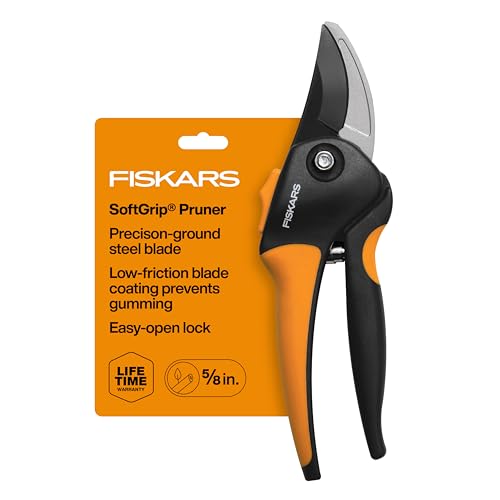
Best for general garden pruning without spending Felco money
- Rust-resistant steel blade with a self-cleaning sap groove
- Non-slip handle with a one-hand safety lock
- Cuts green stems to about 5/8 inch
- Light enough for a full afternoon of deadheading
Why buy it: the pruner most gardeners should actually buy — it does 90% of what a Felco does for a quarter of the price.
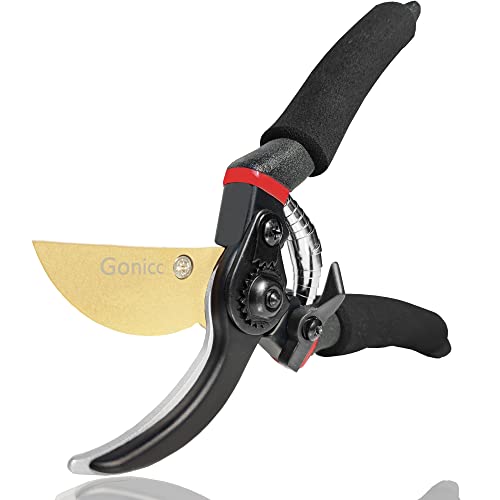
Best for a heavier, more substantial pruner at a low price
- Titanium-coated steel blade with a sap groove
- Shock-absorbing spring and a locking latch
- Non-slip handles with a heavier, tool-like feel
- Cuts to roughly 3/4 inch on green wood
Why buy it: it feels twice its price in the hand, which is exactly why it dominates the mid-range recommendation threads.

Best for woody stems at the top of hand-pruner range
- MAXFORGED resharpenable steel blade, full 1-inch capacity
- Full steel-core handles rather than pressed sheet
- Slant-ground narrow hook for close, clean cuts
- Replaceable blade, spring and bumper
Why buy it: a genuinely forged pruner at a mid-range price, and the only one here that takes a real 1-inch cut without complaint.

Best for deadheading, herbs, houseplants and flower arranging
- Fine stainless blades that cut cleanly right to the tip
- Curved profile reaches into congested growth
- Easy-action spring with a squeeze lock
- Comes with a blade sheath for safe storage
Why buy it: the tool that stops you using loppers on a rose bud — precise cuts on anything thinner than a pencil.

Best for arthritis, weak grip and cutting above your own strength
- Ratchet mechanism splits a cut into three easy squeezes
- Anvil design — best on dead and woody stems
- Non-stick coated steel blade
- Cuts to about 1 inch depending on the wood
Why buy it: the ratchet turns a cut you cannot make into three you can, which is why it dominates arthritis recommendations.
Quick Comparison
| Product | Best for | Rating | Price | Buy |
|---|---|---|---|---|
| Felco F-2 Classic Bypass Hand Pruner | Best Overall | — | Check (paid link) | |
| Fiskars Bypass Pruning Shears with 5/8" Cut Capacity | Best Value | — | Check (paid link) | |
| gonicc 8" Titanium-Coated Bypass Pruning Shears | Best Budget Premium Feel | — | Check (paid link) | |
| Corona BP 3180D ClassicCUT Forged Bypass Pruner | Best Heavy Duty | — | Check (paid link) | |
| Fiskars Curved Micro-Tip Pruning Snips with Sheath | Best for Small Stems | — | Check (paid link) | |
| The Gardener’s Friend Ratchet Anvil Pruning Shears | Best for Weak Hands | — | Check (paid link) |
How We Rank Pruning Shears
We never buy or physically handle the products on this site — we read the review record at scale instead. Four things carried the most weight here. Pivot behavior over time: the defining failure of a hand pruner is a pivot that loosens until the blades pass with a gap and start crushing, so reviews that mention alignment after a season count far more than first impressions. Whether parts are available, because a pruner with replaceable blades and springs has a fundamentally different lifespan from one that is disposable. Honest cut capacity — we weight reviews describing what the tool actually managed over what the packaging claims, and there is often a gap. Hand comfort and closing effort, drawn especially from reviews by gardeners with arthritis, small hands or long working sessions — the same principle behind OSHA's general advice to use only as much grip force as necessary to control a hand tool.
Star ratings, review counts and prices were current at the time of writing and all move. The complaint patterns move far less, and those are what we weight hardest.
Consensus Scores
Each score is our weighted read of the owner-review record for that tool — never a lab figure, and never a number we typed onto a rating we did not verify.
- Felco F-2 Classic ██████████░░ 9.4
- Fiskars Bypass Pruning Shears █████████░░░ 8.9
- gonicc 8" Titanium Bypass █████████░░░ 8.6
- Corona BP 3180D ClassicCUT █████████░░░ 8.7
- Fiskars Micro-Tip Snips █████████░░░ 8.8
- Gardener’s Friend Ratchet Pruner ████████░░░░ 8.1
The Pruners, Reviewed
1. Felco F-2 Classic Bypass Hand Pruner — Best Overall
Covered above. Owners praise: a cut that stays clean for years, full parts availability, the shock-absorbing stop, and a service life that shows up in review after review from professional users. Owners complain about: the price relative to the alternatives, handles that are large for smaller hands, no ratcheting help for weak grips, and — a real issue — enough counterfeits in circulation that reviewers advise buying from a source you trust and checking the stamping.
2. Fiskars Bypass Pruning Shears — Best Value
The pruner most gardeners should actually buy. Green stems to about 5/8 inch, a sap groove that keeps the blade from gumming up on resinous growth, a safety lock you can work one-handed, and a weight that disappears over an afternoon of deadheading. It is also cheap enough that the standard advice — buy two, keep one indoors for houseplants and flowers — is realistic. Owners praise: a genuinely sharp blade out of the box, comfortable grips, the sap groove, and value that is hard to argue with. Owners complain about: a pivot that loosens over a season or two and needs nipping up, a blade that is harder to bring back once it has dulled properly, and a capacity that is optimistic on hardwood — treat 5/8 inch as a green-wood figure.
3. gonicc 8" Titanium-Coated Bypass Pruning Shears — Best Budget Premium Feel
The reason this pruner has such an outsized presence in recommendation threads is that it feels far more expensive than it is. Heavier in the hand than the Fiskars, with a substantial spring, a solid latch and a titanium-coated blade that stays slick against sap. It occupies a useful middle ground: more tool than the budget options, none of the Felco outlay. Owners praise: the build feel at the price, smooth action, blades that arrive sharp, and comfortable handles for medium hands. Owners complain about: a coating that wears at the cutting edge over time and cannot be restored, more weight than some gardeners want for extended deadheading, and quality that reviewers describe as slightly variable between units.
4. Corona BP 3180D ClassicCUT Forged Bypass Pruner — Best Heavy Duty
The only pruner here with a genuinely forged blade and full steel-core handles at a mid-range price, and the only one most reviewers trust with a real one-inch cut. The narrow slant-ground hook lets you get in close to a branch collar, which matters if you care about how a shrub heals rather than just getting the stem off. Blade, spring and bumper are all replaceable. Owners praise: serious capacity, a blade that takes a file well and comes back sharp, steel-core handles that do not flex, and long service records. Owners complain about: a size and weight built for larger hands, a stiffer action than lightweight pruners, and a spring that a minority report needing replacement earlier than expected.
5. Fiskars Curved Micro-Tip Pruning Snips — Best for Small Stems
Strictly speaking these are snips rather than secateurs, and that is the point — most gardeners reach for full-size pruners on jobs that want a scalpel. Fine stainless blades that cut right to the tip, a curved profile that reaches into congested growth, and a spring light enough to work one-handed all afternoon. For deadheading, harvesting herbs, tidying houseplants and cutting flowers, this is simply the right tool. Owners praise: precision on thin stems, low effort, the sheath, and how quickly they become the most-used cutting tool in the house. Owners complain about: a capacity that stops abruptly — force them on anything woody and the tips spring apart — blades that are fiddly to sharpen, and a lock that a few reviewers find easy to knock open in a pocket.
6. The Gardener’s Friend Ratchet Anvil Pruning Shears — Best for Weak Hands
A ratchet pruner does not close in one squeeze. You squeeze, the mechanism holds the progress, you release and squeeze again, and the cut completes in two or three stages — which means a stem you physically cannot cut becomes one you can. For gardeners with arthritis, tendon problems or reduced grip strength, that is not a convenience, it is the difference between pruning and not pruning. It is an anvil design, so it belongs on dead and woody stems rather than soft green growth. Owners praise: cutting well above their unassisted strength, comfortable handles, and being able to keep gardening at all — a phrase that appears in these reviews with unusual frequency. Owners complain about: a slower cut than a straight bypass, an anvil that crushes green stems and so is wrong for roses and live shrub work, and a mechanism that needs cleaning to keep ratcheting smoothly.

What Owners Actually Complain About
Read enough one- and two-star pruner reviews and five patterns emerge, and they hold across every price point. Loose pivots lead by a distance: once the bolt backs off, the blade and hook stop passing closely and the tool crushes instead of cutting, and most owners never realize the fix is a quarter turn of a nut. Blades sticking with sap is second, particularly on conifers and anything resinous, and it is why the sap groove on the Fiskars and gonicc is worth having. Springs failing or pinging out is third, and it is the most common reason a cheap pruner is thrown away — a two-dollar part killing a twenty-dollar tool. Rust is fourth, driven almost entirely by wet greenery left on the blade overnight rather than by the weather. It is also worth wiping the blade down between plants after cutting anything diseased — University of Missouri Extension notes that pruning shears can spread disease from an infected plant to a healthy one if they are not sanitized. And capacity disappointment is fifth, which is usually a reading problem: the stated figure is for soft green wood, and dry hardwood cuts substantially smaller.
One more pattern worth naming: a large share of "broken" pruners in the review record were broken by twisting. Hand pruners are designed to close in a straight plane. The instant you rotate the handles to force a cut through a stem that is too thick, you spring the pivot and bend the blade. The fix is not a stronger pruner — it is loppers.
How to Choose Pruning Shears
Start with what you cut, then with your hands. Living stems on shrubs, roses and perennials? Bypass, always — the clean slice matters for how the plant heals. Dead wood and dry stems? Anvil is fine and gives you more leverage for the same squeeze. Anything thinner than a pencil — deadheading, herbs, flowers? Micro-tip snips, which do it far better and faster than full pruners. Grip pain or reduced strength? Go straight to a ratchet pruner rather than buying a sharper conventional one.
Then check three practical things. Handle size against your hand: a pruner too big forces your fingers open at the start of the stroke, which is where most hand fatigue comes from. Whether spares exist — if the brand sells blades and springs, the tool has a future. And the lock design, because a lock that stiffens with dried sap is a daily irritation.
Know where the tool stops. Bypass pruners are honest to roughly three-quarters of an inch of green wood; loppers take you to about an inch and a half; beyond that you want a saw. Forcing that boundary is the single largest cause of pruner failure in the review record. Our pruning and hedges hub covers the whole ladder, with the ranked picks in best loppers for thicker branches and best pruning saws above that.
The Verdict
The Felco F-2 is the pruner the long-term owner record supports most strongly, because it is the only one here designed to be rebuilt rather than replaced. For most gardens the Fiskars bypass pruner is the smarter purchase and will not be missed when it is lost in a hedge. Add micro-tip snips for anything delicate — they will end up being the pair you reach for most — and buy a ratchet pruner if strength rather than sharpness is the limiting factor.
Next: keep whatever you buy cutting with how to sharpen garden tools, complete the kit from our ranked garden tool sets, or head back to the garden hand tools hub.