 Garden


Affiliate Disclosure
Some links on this page are affiliate links. As an Amazon Associate, we earn from qualifying purchases — at no extra cost to you. We do not buy, test, or physically handle the products we cover; our rankings come from aggregated owner reviews, ratings and expert consensus. Commissions never change our verdicts. How we rank · full disclosure.
The short version: the best pruning shears for arthritic hands are the Fiskars PowerGear2. Its patented gear mechanism multiplies your leverage, so a thick branch takes a fraction of the grip strength an ordinary pruner demands — and it carries the Arthritis Foundation’s ease-of-use recognition, which is not a marketing line but an assessment of how usable it is for limited hands. For the absolute lowest effort on tough or dead wood, a ratchet pruner like The Gardener’s Friend cuts in several easy stages instead of one hard squeeze, and for deadheading, the spring-action Fiskars Softouch snip reopens itself after every cut so you only ever squeeze gently.
For painful hands the mechanism matters more than anything — geared or ratchet action, a spring that reopens the blades, and a sharp low-friction edge all cut the force each snip requires. For the full range of pruners see our best pruning shears roundup and ergonomic garden tools, and if kneeling is also hard, our garden kneelers for bad knees pair naturally. The garden hand tools hub covers the rest.
Top Picks at a Glance
Our #1 Pick: Fiskars PowerGear2
The PowerGear2 is the pruner we recommend first for arthritic or weak hands, because it attacks the core problem directly: grip strength. A standard bypass pruner asks your hand to supply all the force to close the blades through a branch, and for painful joints that single hard squeeze is the barrier. The PowerGear2 sits a set of modified gears and a cam between your hand and the blade, multiplying your leverage so the same branch closes with markedly less effort — and it does it in one smooth motion, so you keep the speed of an ordinary pruner.
The contoured handle uses a rolling design that follows the natural motion of your hand as it closes, spreading the load rather than concentrating it, and the SoftGrip touchpoints cushion the pressure. It cuts green branches up to 3/4 inch, and it earned the Arthritis Foundation’s Ease-of-Use commendation for exactly this design. At around $25 it is inexpensive insurance against a day of sore hands.
Consensus Score █████████░░ 9.0 — built from an average of 4.3 stars across 2,205 verified owner ratings.
The honest weaknesses: the gear mechanism makes it a little bulkier than a slim classic pruner, and for the very hardest dead wood a ratchet still needs less force per squeeze. For fast, low-effort cutting across a garden, it is the best all-rounder.
Check price on Amazon → (paid link)
The Ranked Field

Best for cutting thick branches with far less hand force
- Patented gear multiplies cutting leverage
- Rolling handle reduces hand fatigue
- 3/4-inch bypass cut capacity
- Arthritis Foundation ease-of-use recognition
Why buy it: the gear mechanism multiplies your leverage so a thick branch takes a fraction of the grip strength, and it carries the Arthritis Foundation’s ease-of-use commendation.

Best for the lowest possible effort on tough or dry wood
- Ratchet cuts a branch in stages
- No need to power through in one squeeze
- Anvil blade for hard and dead wood
- Lightweight ergonomic handles
Why buy it: the ratchet lets you cut a thick branch in several easy squeezes instead of one hard one, which is the gentlest mechanism there is for weak or painful hands.
Best for deadheading and light stems with minimal grip
- Easy Action spring reopens the blades
- Soft, cushioned grip
- Fine micro-tip for precise cuts
- Very light in the hand
Why buy it: the spring reopens the blades for you after every cut, so light pruning and deadheading need only a gentle squeeze rather than repeated gripping.
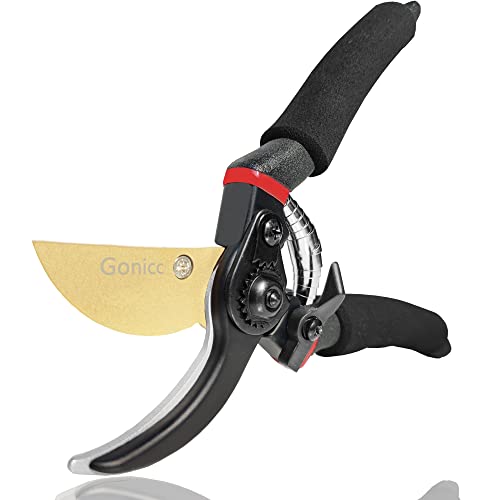
Best for a comfortable everyday bypass pruner that is easy to hold
- Non-slip ergonomic handle
- Shock-absorbing spring
- Titanium-coated blade cuts cleanly
- Sap groove and safety lock
Why buy it: the cushioned, shock-absorbing handle and smooth blade make repeated cuts far kinder to sore joints than a stiff, basic pruner.
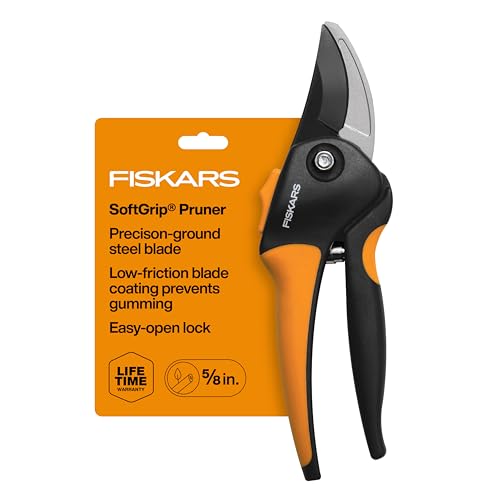
Best for a light, reliable low-cost pruner
- Low-friction coated blade cuts easily
- Self-cleaning sap groove
- Lightweight, easy-hold body
- 5/8-inch bypass cut
Why buy it: its low-friction blade slices through green stems with little effort, and the light body is easy to control when your grip is limited.

Best for a precise, rebuildable pruner that lasts decades
- Precision bypass cut, very sharp
- Fully serviceable, replaceable parts
- Shock-absorbing cushion
- Trusted by professionals
Why buy it: a razor-sharp, perfectly maintained blade cuts with less force than any dull tool, and every part is replaceable so it stays effortless for life.

Quick Comparison
| Product | Best for | Rating | Price | Buy |
|---|---|---|---|---|
| Fiskars PowerGear2 Pruning Shears | Best Overall for Arthritis | — | Check (paid link) | |
| The Gardener’s Friend Ratchet Anvil Pruning Shears | Best Ratchet (Least Force) | — | Check (paid link) | |
| Fiskars Softouch Micro-Tip Pruning Snip | Best Spring-Action Light Pruning | — | Check (paid link) | |
| gonicc 8″ Titanium-Coated Bypass Pruning Shears | Best Lightweight Bypass | — | Check (paid link) | |
| Fiskars Bypass Pruning Shears with 5/8" Cut Capacity | Best Everyday Value | — | Check (paid link) | |
| Felco F-2 Classic Bypass Hand Pruner | Best Heirloom Serviceable | — | Check (paid link) |
How We Rank
We do not buy, test or physically handle these tools. For arthritic hands we weight the cutting mechanism and how much force it saves (geared, ratchet, spring-action), handle comfort and shock absorption, blade sharpness and low-friction coatings, and weight, plus aggregated owner ratings weighted by review volume and recurring complaints such as stiff springs, weak locks and blades that dull fast. Prices were current at the time of writing. Full method on how we rank.
The Arthritis-Friendly Pruners, Reviewed
1. Fiskars PowerGear2 — Best Overall for Arthritis
Covered above. What owners praise: how much easier thick branches are, the rolling handle, and the Arthritis Foundation recognition. What owners complain about: a slightly bulkier body and that dead wood still favors a ratchet. The best all-round low-force pruner.
2. The Gardener’s Friend Ratchet Anvil — Best Ratchet (Least Force)
The ratchet cuts a branch in several easy squeezes rather than one hard one, the gentlest mechanism there is for weak or painful hands, and the anvil blade suits hard and dead wood. What owners praise: the tiny effort per cut, the light handles, and confidence on tough wood. What owners complain about: the staged cut is slower and the anvil crushes green stems slightly more than a bypass. The pick when minimizing force matters most.
3. Fiskars Softouch Micro-Tip Snip — Best Spring-Action Light Pruning
The Easy Action spring reopens the blades after each cut, so deadheading and light stems need only a gentle squeeze, and the cushioned grip is kind to sore joints. What owners praise: the effortless spring action, the precise tip, and the light weight. What owners complain about: it is for thin stems only, not branches. Perfect for the fine, repetitive work that wears hands out.
4. gonicc 8″ Titanium Bypass — Best Lightweight Bypass
A comfortable everyday pruner with a shock-absorbing spring and a non-slip ergonomic handle that make repeated cuts far kinder to sore joints than a stiff basic tool. What owners praise: the cushioned handle, clean cutting, and the safety lock. What owners complain about: no leverage assist for the thickest branches. A gentle, well-priced daily bypass.
5. Fiskars Bypass 5/8″ — Best Everyday Value
A light, reliable low-cost pruner whose low-friction coated blade slices green stems with little effort, and the easy-hold body is controllable with a limited grip. What owners praise: the low effort on green wood, the price, and the light weight. What owners complain about: it lacks a leverage or ratchet mechanism for hard wood. Great value for softer pruning.
6. Felco F-2 — Best Heirloom Serviceable
The professional standard, and relevant here because a razor-sharp, perfectly maintained blade cuts with less force than any dull tool — and every part is replaceable so it stays effortless for decades. What owners praise: the precision, the sharpness, and full serviceability. What owners complain about: it has no gearing, so it relies on keeping the blade keen. The lifetime choice if you maintain it.

What Owners Actually Complain About
A few issues recur among gardeners with hand pain. Stiff springs and hard-to-release locks defeat the purpose, so look for a smooth spring and a lock you can work one-handed — the spring-action and geared picks here score well. Blades dulling quickly is a bigger problem for arthritic users than most, because a dull blade demands more force; keeping the edge sharp is essential, and our guide on how to sharpen garden tools covers it. It is also worth wiping the blade clean between plants if you have just cut into diseased wood — University of Missouri Extension notes that pruning shears can carry disease from an infected plant to a healthy one if they are not sanitized in between. Anvil pruners crushing green stems disappoints those who bought one for softwood; use bypass or geared bypass for living growth and save the anvil for dead wood. And overreaching a hand pruner on thick branches strains the hand — switch to loppers or a saw past the rated capacity.
Matching the Mechanism to Your Hands
Choose by how your hands behave and what you cut. If your grip is limited but functional and you make lots of cuts, a geared pruner like the PowerGear2 gives the best blend of low force and speed. If even a single firm squeeze is painful, or you cut hard and dead wood, a ratchet pruner gives the lowest force per squeeze by splitting the cut into stages. For deadheading and thin stems all afternoon, a spring-action snip that reopens itself removes the repeated gripping that quietly exhausts a hand. And whatever you choose, understand that a sharp blade is itself an arthritis aid — the difference in force between a keen and a dull edge is large. The bypass-versus-anvil distinction is explained in bypass vs anvil pruners.
Two habits borrowed from outside the garden help as well. OSHA’s guidance on hand-intensive tool use recommends using only as much grip force as necessary to keep control of a tool, which is worth remembering every time you close a pair of shears. And on a long pruning session, work in short stretches rather than one marathon sitting — the same OSHA guidance suggests limiting continuous, hand-intensive work to 10 to 15 minutes at a time, with no more than about two hours of it across a day.
The Verdict
For arthritic hands, the Fiskars PowerGear2 is our pick, because its geared leverage cuts thick branches with far less grip strength and it is recognized by the Arthritis Foundation for ease of use. Choose The Gardener’s Friend ratchet for the lowest possible effort on tough wood, and the spring-action Fiskars Softouch snip for painless deadheading. Keep whatever you buy sharp, match the tool to the branch, and take breaks — the mechanism and a keen blade do the work your hands used to. Check price on Amazon → (paid link)