 Garden

Affiliate Disclosure
Some links on this page are affiliate links. As an Amazon Associate, we earn from qualifying purchases — at no extra cost to you. We do not buy, test, or physically handle the products we cover; our rankings come from aggregated owner reviews, ratings and expert consensus. Commissions never change our verdicts. How we rank · full disclosure.
The short version: after weighing six popular ceiling fans on owner star ratings, review volume, published CFM figures and the complaints that keep repeating in long-term reviews, our #1 pick is the Hunter Dempsey 52″. It moves close to 4,950 cubic feet of air per minute, its WhisperWind motor draws almost no noise complaints, and the low-profile mount solves the problem most American homes actually have — an eight-foot ceiling. If the budget is tighter, the Honeywell Carnegie 52″ delivers a similar job with a better-looking fixture, and for a bedroom where silence is the whole point the DC-motor Minka-Aire Light Wave is the upgrade owners say they would make again.
Fans do not cool air; they cool people — ENERGY STAR puts it as "ceiling fans cool people, not rooms", which is why you should switch one off in an empty room. If your problem is a genuinely hot room rather than a stuffy one, read fan vs air conditioner before you buy anything. The wider picture on home comfort lives in the heating and cooling hub.
Top Picks at a Glance
Our #1 Pick: Hunter Dempsey 52″
Three things put the Dempsey at the top of the owner-review record. First, it actually moves air. At roughly 4,950 CFM on high it sits comfortably above the 4,000 CFM line that separates a working fan from a decorative one, and reviewers describe the difference in the specific way that matters — you feel it standing at the edge of the room, not only directly underneath.
Second, the motor is quiet. Hunter’s WhisperWind motor is the single most-praised feature across thousands of owner reviews, and the complaint that sinks most cheap fans — a hum or a click at medium speed that you cannot unhear at 2am — barely appears here. Third, the low-profile mount. Most US homes have eight-foot ceilings, and a standard downrod fan hangs low enough to feel intrusive. The Dempsey hugs the ceiling while still leaving enough gap for the blades to breathe.
Consensus Score █████████░ 9.0 — drawn from the aggregated owner-review record
It is not perfect. The integrated LED is not replaceable as a bulb, which means a light failure eventually becomes a fixture problem rather than a five-dollar fix. Assembly takes most people around an hour and the instructions attract steady grumbling. And the remote is receiver-paired, so if you lose it you are buying a Hunter replacement rather than any universal handset. None of that outweighs a quiet motor moving real air at this price.
Check price on Amazon → (paid link)
Best Ceiling Fans 2026: The Ranked Field

Best for a standard 12x15 ft bedroom or living room with an 8 ft ceiling
- 52-inch blade span, four blades
- WhisperWind motor — roughly 4,950 CFM on high
- Low-profile mount for 8 ft ceilings
- Handheld remote, reversible for winter
Why buy it: the airflow-per-dollar benchmark in ceiling fans, and one of the quietest motors owners report at any price.
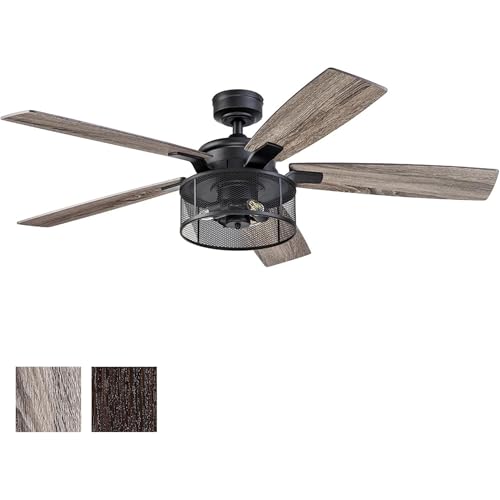
Best for a den, dining room or farmhouse-style living space up to 400 sq ft
- 52-inch span, five reversible dual-finish blades
- Cage-style LED light, 1,350 lumens at 2700K
- Remote control included, dual mounting options
- Reversible motor for winter updraft
Why buy it: a genuinely good-looking fixture with real airflow at a price that undercuts most designer fans by half.

Best for a bedroom where silence matters more than the price tag
- DC motor — roughly 70 percent less power draw than AC
- Three speeds plus dimmable integrated LED
- Flush-mount profile, 3.5-inch downrod
- Hand-carved distressed koa blade finish
Why buy it: the DC motor is the single biggest upgrade in ceiling fans, and this is the model owners keep naming.

Best for a spare room, home office or rental where price leads the decision
- 52-inch span, five dual-finish blades
- Frosted dimmable LED, 3000K
- Tri-mount — standard, flush or angled
- Remote with wall cradle included
Why buy it: flush-mount capability and a remote at a price where most fans still ship with a pull chain.
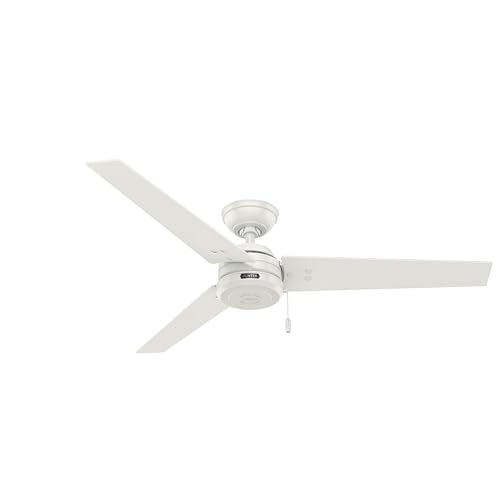
Best for a covered porch, sunroom, garage or screened patio
- ETL damp-rated for covered outdoor spaces
- Three blades, roughly 4,030 CFM on high
- WhisperWind motor, pull-chain control
- Includes 3-inch and 5-inch downrods
Why buy it: a damp rating and Hunter’s motor for the price most brands charge for an indoor-only fan.

Best for replacing an old fan on existing wiring with no remote to lose
- 52-inch span, five dual-finish blades
- Integrated LED with frosted shade
- Pull-chain speed and light control
- Three mounting options including flush
Why buy it: nothing to pair, nothing to charge and nothing to hunt for down the back of the couch.
Quick Comparison
| Product | Best for | Rating | Price | Buy |
|---|---|---|---|---|
| Hunter Dempsey 52″ Ceiling Fan with LED Light and Remote (59242) | Best Overall | — | Check (paid link) | |
| Honeywell Carnegie 52″ Industrial Ceiling Fan with Light (50614-01) | Best Value | — | Check (paid link) | |
| Minka-Aire F844-DK Light Wave 52″ LED Ceiling Fan | Best Premium DC Motor | — | Check (paid link) | |
| Prominence Home Ashby 52″ Ceiling Fan with Dimmable LED (80094-01) | Best Budget Buy | — | Check (paid link) | |
| Hunter Cassius 52″ Indoor/Outdoor Ceiling Fan (59263) | Best for Porches and Patios | — | Check (paid link) | |
| Honeywell Ventnor 52″ Farmhouse LED Ceiling Fan (50606-01) | Best Pull-Chain Simplicity | — | Check (paid link) |
How We Rank Ceiling Fans
We never buy, install or physically handle the fans on this site. What we do instead is read the field the way a careful shopper would with a month to spare: aggregate star ratings across the full owner-review record, weight recent reviews more heavily than launch-window ones, cross-check published CFM and CFM-per-watt against the manufacturer’s Energy Guide data rather than marketing copy, and read the one- and two-star reviews closely, because that is where the failure patterns of year two live.
Four factors drive the ranking. Airflow, measured in CFM, because a fan that does not move air is a light fixture with moving parts. Noise, weighted heavily, since a ceiling fan runs for hours in a room where people sleep and talk, and motor hum is the number one reason fans get replaced early. Owner satisfaction, meaning the star average weighted by how many people it represents — a 4.6 across thousands of ratings beats a 4.9 across forty. And installation and control quality: downrod options, whether it flush-mounts, whether the remote is any good, and how much swearing the instructions cause. Prices were checked at the time of writing and move constantly.
The Fans, Reviewed
1. Hunter Dempsey 52″ — Best Overall
Covered above. Owners praise: quiet WhisperWind motor, real airflow at the edges of the room, low-profile mount that suits an 8 ft ceiling, clean modern look that disappears into most rooms, and a limited lifetime motor warranty. Recurring complaints: the integrated LED cannot be swapped like a bulb; assembly instructions are widely called confusing; the remote is proprietary; and a minority report a wobble that traces back to an unbalanced blade needing the included balancing kit.
2. Honeywell Carnegie 52″ — Best Value
The Carnegie is the fan people buy when they want the room to look considered rather than just cooled. Five reversible dual-finish blades let you flip between two wood tones, and the caged LED reads as farmhouse or industrial depending on what is around it. At roughly 1,350 lumens the light is genuinely useful as a room’s main fixture, which is more than most fan lights manage.
Consensus Score ████████░░ 8.7 — drawn from a large owner-review base averaging 4.5 stars
Recurring complaints: the light is not dimmable on all versions and the 2700K color reads warmer than some buyers expect; the remote is small and easily misplaced; and reviewers consistently note the fan needs the angled-mount downrod, sold separately, for vaulted ceilings. Airflow is solid but a step below the Dempsey on high.
3. Minka-Aire F844-DK Light Wave 52″ — Best Premium DC Motor
This is the one to buy if the fan is going over a bed. The DC motor is the reason — and the efficiency gap is real: ENERGY STAR certified fans are up to 44 percent more efficient than conventional models: it draws a fraction of the power an AC motor needs for the same airflow, it offers finer speed control, and — the part owners actually write about — it is effectively silent at the low settings you sleep with. The Light Wave also flush-mounts on a 3.5-inch downrod, so it works in rooms where a hanging fan would be in the way.
Consensus Score ████████░░ 8.8 — drawn from the owner-review record averaging 4.3 stars
Recurring complaints: the price, first and loudest — this costs what three budget fans cost. The integrated LED is fixed and its color temperature divides opinion. And the electronics are the weak point: a handful of long-term reviewers report the receiver module failing outside warranty, which is a proprietary part rather than a generic capacitor. Wi-Fi control needs a separate Bond module, which surprises buyers who assumed a fan at this price would be smart out of the box.
4. Prominence Home Ashby 52″ — Best Budget Buy
The Ashby is the honest budget answer: a 52-inch five-blade fan with a dimmable frosted LED, a remote and three mounting options for roughly a hundred dollars. Nothing here is exceptional, but nothing is missing either, and the tri-mount design means it will fit a flat ceiling, a vaulted one or a flush installation without a second shopping trip.
Consensus Score ████████░░ 8.3 — drawn from a broad owner-review base averaging 4.5 stars
Recurring complaints: airflow is adequate rather than strong, and owners moving from a higher-CFM fan notice. The motor is audible at the top speed in a quiet room. Several reviewers report the light module being the first thing to fail. Judged against its price rather than against the Hunter, satisfaction stays high.
5. Hunter Cassius 52″ — Best for Porches and Patios
Damp-rated fans are their own category, and buying an indoor fan for a covered porch is a mistake that shows up as a seized motor after two humid summers. The Cassius is ETL rated for damp locations — porches, sunrooms, garages, screened patios — which means it tolerates humidity and moisture in the air, though not direct rain. Three blades and around 4,030 CFM make it a genuine breeze machine outdoors, where you want more air movement than you would tolerate indoors.
Consensus Score ████████░░ 8.5 — drawn from the owner-review record averaging 4.5 stars
Recurring complaints: pull-chain only, so there is no remote and no wall control without wiring one in; no light kit, which some buyers do not notice until it arrives; and the three-blade design produces a more pronounced pulse of air than a five-blade fan, which a minority find distracting indoors.
6. Honeywell Ventnor 52″ — Best Pull-Chain Simplicity
Not every fan needs a remote. If you are replacing an old fixture on existing switched wiring, a pull-chain fan is simpler to install, cheaper, and has one fewer thing to fail or lose. The Ventnor gives you a 52-inch five-blade farmhouse fixture with an integrated LED and three mounting options, controlled entirely by two chains.
Consensus Score ████████░░ 8.2 — drawn from the owner-review record averaging 4.5 stars
Recurring complaints: the obvious one — no remote, so speed and light changes mean standing under the fan. The chains themselves attract complaints for feeling light. And with no remote receiver, a smart-switch retrofit is the only path to app control, which requires the light and fan to share a single switched circuit.
Sizing: The Part Most People Get Wrong
Two numbers decide whether a fan works in a room, and neither is on the front of the box in big type.
Blade span should match the room, not the ceiling. Up to 75 square feet, use 29 to 36 inches. From 76 to 175 square feet, 42 to 48 inches. From 176 to 350 square feet — the size of most American living rooms — 52 inches, which is why that size dominates every retailer. Beyond 350 square feet, either move to a 56 to 60 inch fan or install two smaller ones, because a single big fan produces a windy zone directly beneath it and stagnant air at the walls.
Hanging height matters just as much. Blades should sit at least seven feet above the floor and, ideally, eight to nine inches below the ceiling so the fan can draw air from above the blades. On a standard eight-foot ceiling that arithmetic only works with a flush or low-profile mount, which is exactly why the Dempsey and the Ashby earn their places here. On a nine-foot ceiling use a six-inch downrod; on a ten-foot ceiling, twelve inches; and add roughly six inches of rod for every additional foot after that. Also keep at least 18 inches of clearance from blade tip to the nearest wall.
What Owners Actually Complain About
Read enough one- and two-star ceiling fan reviews and five gripes surface across every brand and price point. Wobble leads by a distance, and it is almost never a defective fan — it is an unbalanced blade, a loose downrod set screw or a ceiling box that is not fan-rated. Every fan here ships with a balancing kit, and using it takes ten minutes. A standard plastic electrical box will not safely carry a fan; that job needs a fan-rated brace box, and skipping it is genuinely dangerous.
Motor hum is second, and it is the complaint that determines whether a fan survives its first year in a bedroom. Non-replaceable LEDs come third: the industry moved to integrated LED modules, which look better and last a long time, but when one fails you are replacing a module or the whole fixture rather than a bulb. Remote pairing is fourth — receiver-paired handsets that cannot be replaced generically, and two fans in one house that respond to each other’s remote until you change the dip switches. And assembly instructions are fifth, universally. Budget an hour, work with a second person to lift the motor housing, and do the wiring with the breaker off.
How to Choose a Ceiling Fan
Eight-foot ceiling? Buy a low-profile or flush-mount fan and stop looking at anything with a long downrod. Bedroom? Prioritize noise over everything, which points to the Minka-Aire if the budget allows and the Hunter Dempsey if it does not. Living room with a TV? Airflow and looks matter more than the last decibel — the Carnegie is the value sweet spot. Covered porch, sunroom or garage? You need a damp rating, full stop, and the Cassius is the cheapest credible way to get one. Replacing an old fan on a tight budget? The Ashby or the Ventnor, depending on whether you want a remote.
Two questions settle the close calls. Is there a wall switch you can use, or does the fan need to be entirely remote-controlled? And does the room already have a fan-rated ceiling box? If the answer to the second is no, add the cost of a brace box and an electrician’s hour to whatever fan you are considering, because that part is not optional.
The Verdict
For most homes, the Hunter Dempsey 52″ is the fan to buy — quiet, genuinely high airflow, and built for the eight-foot ceilings most of us actually have. Want the same job done with a better-looking fixture for less? The Honeywell Carnegie. Putting a fan over a bed and willing to pay for silence? The Minka-Aire Light Wave. Covered porch? The Hunter Cassius, and nothing that lacks a damp rating.
Check price on Amazon → (paid link)
Next: flip the switch the right way each season with ceiling fan direction by season, compare the portable option in best tower fan, work out whether you need cooling or just air movement in best portable air conditioner, or handle the other half of the year with our best space heater rankings.