 Garden

Affiliate Disclosure
Some links on this page are affiliate links. As an Amazon Associate, we earn from qualifying purchases — at no extra cost to you. We do not buy, test, or physically handle the products we cover; our rankings come from aggregated owner reviews, ratings and expert consensus. Commissions never change our verdicts. How we rank · full disclosure.
Two things decide whether a portable evaporative cooler will satisfy you, and neither of them is on the front of the box. The first is your climate: these machines cool by evaporating water into the airstream, so they work brilliantly in dry air and not at all in humid air — and in humid air they add moisture to a room they are failing to cool. The second is airflow, because a unit that cannot replace a room's air often enough will simply humidify it.
Everything else — tank size, ice compartments, modes, remotes — is secondary. This page sizes the field honestly against both, and says plainly where a small unit stops being a room cooler and becomes a personal one.
Top Picks at a Glance
The Sizing Math, Which the Listings Skip
Evaporative cooling depends on air changes per hour. Most manufacturers design around 20 to 40 ACH, and at an 8-foot ceiling that translates to roughly 0.25 to 0.375 square feet of floor area per CFM of airflow. Run that on the airflow figures actually sold in this category and the picture gets clear fast.
| Airflow | Realistic room size (30 ACH) | Generous room size (20 ACH) | Relief opening needed | What it really is |
|---|---|---|---|---|
| 300–600 CFM | 75–150 sq ft | 110–225 sq ft | ~1 sq ft | Personal cooler — sit in front of it |
| 1,300 CFM | ~325 sq ft | ~490 sq ft | ~2.6 sq ft | One bedroom or a two-car garage |
| 1,800 CFM | ~450 sq ft | ~675 sq ft | ~3.6 sq ft | A large room or open kitchen-living space |
| 2,800 CFM | ~700 sq ft | ~1,050 sq ft | ~5.6 sq ft | Open-plan area or workshop |
| 3,100 CFM | ~775 sq ft | ~1,160 sq ft | ~6.2 sq ft | Shop, garage, covered patio |
The relief-opening column comes from Department of Energy guidance summarized by the Building America Solution Center, which specifies that "for every 1,000 CFM of air delivery, 2 ft² of unrestricted air relief is required." That column is the one that catches people out: even a small unit needs a window genuinely open, not cracked.
Being Straight About How Thin This Field Is
We would rather say this than pad the page. Outside the two Hessaire models, the small portable evaporative cooler market is dominated by recent entries with modest review counts, ratings clustered around 4.0, and very little long-term ownership evidence. Several of them are the same chassis under different brand names.
That means two things for a buyer. First, judge them on specification — airflow, pad type, tank size, whether the pump and pads are replaceable — rather than on a review average built over a single season. Second, if long-term reliability matters more to you than the exact form factor, buy the Hessaire and accept that it looks like shop equipment, because it is the only product here with a track record you can actually lean on.
Our #1 Pick: Hessaire MC18M, 1,300 CFM
The MC18M is the size most buyers should be looking at, and it is the rare unit in this category whose coverage claim stands up to the airflow math: 1,300 CFM lines up with about 400 to 500 square feet at a sensible air-change rate, which is what the maker claims. It uses a rigid media pad rather than a thin fabric curtain, which is where the depth of cooling comes from, and it takes a garden hose with a float valve so the reservoir refills itself.
It is also the quietest unit here at a measured 53.4 dB, which matters more than it sounds. The most common reason an evaporative cooler ends up unused is not that it failed to cool — it is that the owner could not stand the noise in a room they were sitting in.
The complaints in the ownership record are consistent and fair: the tank is small if you fill by hand, the pads need replacing after a hard season, hard water leaves scale, and the plastic housing is lighter-duty than the larger MC37M. None of those are surprises, which is exactly the value of a long ownership record.
Check price on Amazon → (paid link)
The Ranked Field
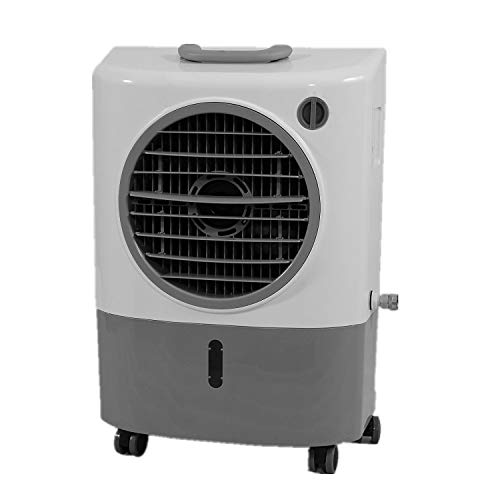
Best for one room or a two-car garage in dry air, roughly 400 to 500 sq ft
- 1,300 CFM two-speed fan, rated by the maker to about 500 sq ft
- Measured at 53.4 dB — the quietest unit in this field
- Garden hose inlet with a float valve, or fill the tank by hand
- Rigid media pad rather than a thin fabric curtain
Why buy it: the only portable evaporative cooler in this size class with a long ownership record, and honestly sized — 1,300 CFM is close to what a 500 sq ft room genuinely needs.

Best for a bedroom, home office or workshop corner
- Compact chassis with a 2-gallon reservoir
- Four modes including plain fan with the pump switched off
- Three speeds, ice compartment, remote
- Light enough to carry between rooms one-handed
Why buy it: the fan-only mode matters more than the marketing suggests — on a humid day you want the air moving without the machine adding water to the room.
Best for a living room or bedroom where a boxy cabinet would not be tolerated
- Tall slim tower format with a small footprint
- 80-degree oscillation and a fan-only mode
- Ice compartment and remote control
- Outlet height puts air at seated and standing level
Why buy it: the format most people actually want indoors, because it stands like a tower fan rather than like shop equipment.

Best for a garage bay or bedroom where you want more than one fill per day
- 1,800 CFM — meaningfully more air than the small compact units
- 5.3-gallon reservoir for longer unattended running
- Six ice packs included plus a remote
- Three-in-one cooler, fan and humidifier modes
Why buy it: the sensible middle of this category — enough airflow to matter in a real room and enough water to run most of a day without a refill.

Best for a home workshop or a covered porch
- 3.5-gallon reservoir in a compact cabinet
- Four wind modes, three speeds, 120-degree swing
- Removable pad and washable filter
- Casters for moving between rooms
Why buy it: a bigger tank than the truly small units in a body that still fits through a doorway easily, which is the practical compromise for a shop.

Best for a garage, shop or covered patio too big for a small unit
- 3,100 CFM three-speed blower with a deep rigid media pad
- Hose inlet and float valve for continuous running
- Steel cabinet on casters
- Drainable pan for daily dry-down
Why buy it: still portable in the sense that it rolls, and the point at which an evaporative cooler stops being a personal comfort device and starts cooling a space.

Quick Comparison
| Product | Best for | Rating | Price | Buy |
|---|---|---|---|---|
| Hessaire MC18M Portable Evaporative Cooler, 1,300 CFM | Best Overall | — | Check (paid link) | |
| 4-in-1 Evaporative Air Cooler, 3 Speeds, 4 Modes, 2-Gallon Tank | Best Small Room | — | Check (paid link) | |
| DREO 43 in Evaporative Air Swamp Cooler, Oscillating Floor Unit | Best Slim Tower | — | Check (paid link) | |
| Uthfy 1,800 CFM 3-in-1 Evaporative Air Cooler, 5.3-Gallon Tank | Best Mid-Size Tank | — | Check (paid link) | |
| Portable Evaporative Air Cooler, 4 Wind Modes, 3.5-Gallon Tank | Best Compact Cabinet | — | Check (paid link) | |
| Hessaire MC37M Portable Evaporative Cooler, 3,100 CFM | Best Large Portable | — | Check (paid link) |
The Ice Compartment, Explained Properly
Nearly every unit in this category advertises an ice tray, and it is worth understanding what it does and does not do, because it influences a lot of purchases and should not.
What it does: chilling the reservoir water means the pad surface is colder, so the air leaving the pad is a degree or two cooler than it otherwise would be. That is real and you can feel it standing in front of the unit.
What it does not do: change the physics. The cooling in an evaporative cooler comes from the phase change of water into vapor, and the limit on how cold the supply air can get is the wet-bulb temperature of the incoming air — a property of the room's temperature and humidity, not of the water. Ice does not move the wet-bulb. Melting ice also absorbs a fixed and fairly modest amount of heat, so the boost fades as the ice goes, typically within 30 to 90 minutes.
Buy on airflow, pad depth and tank size. Treat the ice tray as a nice extra for the hottest hour of the afternoon.
Why Fan-Only Mode Is the Feature to Look For
A genuinely useful feature that gets buried in the bullet lists: a mode that runs the fan with the water pump switched off. Humidity in dry climates is not constant — a monsoon week in Arizona, a rainy spell in Colorado, a humid morning anywhere — and on those days you want air movement without a machine adding water vapor to a room it can no longer cool.
A unit that cannot turn its pump off is a unit you will unplug on those days. Every model on this page except the plain cabinet coolers offers a fan mode; check for it before you buy.
Water Hygiene on a Portable Unit
Small units get neglected more than big ones, because they live indoors and the reservoir is out of sight. The DOE source above is blunt about the risk: "standing water left in the pan can become a breeding ground for mosquitos and bacteria, including Legionella (the cause of Legionnaires' Disease)."
- Empty the tank whenever the unit will sit unused for more than a day or two, and leave it open to dry.
- Rinse the tank weekly in heavy use and check the pad for slime or a sour smell.
- Full clean at the start and end of every season — DOE guidance is maintenance at least twice a year. Pull the pad, scrub the pan, and clear the pump inlet.
- Descale in hard water. Evaporation concentrates minerals; a white crust on the pad means it is time to descale or replace it.
- Do not add scented additives or bleach unless the manufacturer specifies it. Whatever is in the pan gets aerosolized into the room you are sitting in.
A unit that smells musty is telling you the water has been standing too long. The answer is to drain, scrub and replace the pad, not to mask it.
How We Rank
We do not buy, run or physically handle these machines. Rankings come from aggregated owner ratings across the portable evaporative coolers with meaningful review volume in the US market, read with attention to which negative reviews reflect a climate mismatch rather than a fault, and cross-checked against published airflow, pad and reservoir specifications. Four things carry the weight: airflow measured against realistic room size, because that is where most disappointment originates; pad type, since rigid media outperforms a thin curtain substantially; tank size and refill method, which determines whether the unit gets used; and noise and form factor, because an indoor cooler you find unpleasant to sit near will end up in a closet. Prices were checked at the time of writing. Full method: how we rank.
The Field, Reviewed
1. Hessaire MC18M, 1,300 CFM — Best Overall
Covered above. Owners praise: genuinely quieter than the rest of the category, easy to move through doorways, effective in a garage, and the hose feed. Owners gripe about: a small tank for hand filling, pads needing replacement, mineral scale in hard water, and lighter-duty plastic than the bigger Hessaire. Check price (paid link).
2. 4-in-1 Evaporative Air Cooler, 2-Gallon — Best Small Room
The best-rated compact unit here and the right scale for a bedroom or home office. The four modes include plain fan operation, which is the feature that keeps it useful on humid days.
Owners praise: the size, the fan-only mode, the price, and that it is genuinely light to carry. Owners gripe about: a 2-gallon tank needing frequent refills, limited reach beyond a small room, and a modest temperature drop next to the cabinet units. Check price (paid link).
3. DREO 43 in Evaporative Cooler — Best Slim Tower
A tower shape rather than a box, which is what makes it acceptable in a living room. The tall outlet also puts the air at seated and standing height rather than along the floor.
Owners praise: the footprint, tower-fan appearance, oscillation, and quiet running on low. Owners gripe about: a smaller reservoir than a cabinet unit, less airflow, and a recent design with a short ownership record. Check price (paid link).
4. Uthfy 1,800 CFM 3-in-1, 5.3-Gallon — Best Mid-Size Tank
The sensible middle: 1,800 CFM is enough air to change a real room's temperature rather than just your immediate surroundings, and 5.3 gallons runs most of a day.
Owners praise: airflow for the price, run time between fills, included ice packs, and remote control. Owners gripe about: plastic build, noise at the top speed, and a limited ownership record. Check price (paid link).
5. Portable Evaporative Air Cooler, 3.5-Gallon — Best Compact Cabinet
A bigger tank than the truly small units in a body that still fits easily through a doorway. Aimed at a workshop or a covered porch rather than a bedroom.
Owners praise: tank size for the footprint, the wide swing, and a removable washable pad. Owners gripe about: modest airflow for the size, plastic panels, and a short review history. Check price (paid link).
6. Hessaire MC37M, 3,100 CFM — Best Large Portable
Still portable in the sense that it rolls, and the point at which an evaporative cooler stops being a comfort appliance and starts cooling a space. Deep rigid pad, hose feed, steel cabinet. Remember that 3,100 CFM needs over 6 square feet of open window.
Owners praise: serious airflow, a real drop in dry heat, the float-valve hose feed, and a cabinet that survives a shop. Owners gripe about: noise on high, pump failure in year two or three, scale on the pads, and weight on rough ground. Check price (paid link).
What Owners Actually Complain About
"It only cools right in front of it." Usually an airflow mismatch — a 500 CFM unit in a 400 square foot room is a personal cooler by the numbers, whatever the box says.
"It made the room humid." Either a humid climate or a closed room, and both are the physics rather than the product.
Refilling. The small tanks are genuinely tiresome in hot weather. A hose inlet is worth paying for if the unit can sit near a spigot.
Pump failure and pump noise. The pump is the weak point across the whole category, and on the small units it is also the noise you hear at night.
Musty smell. Standing water. Drain it when the unit is idle and the problem does not start.
The Verdict
If your air is dry and you can leave a window open, buy the Hessaire MC18M for a room and the MC37M for a garage or shop — they are the only units here with a track record, and the MC18M is the quietest of the lot. For a small bedroom or office where a cabinet cooler is too much, the compact 4-in-1 or the DREO tower both make sense, with the caveat that the small end of this category is new and lightly reviewed.
And in humid air, none of them. That is not a hedge — an evaporative cooler in Gulf Coast or Southeast summer weather adds moisture to a room it cannot cool, and a portable air conditioner is the honest recommendation instead. Check price on Amazon → (paid link)
More from this hub: heating & cooling · best evaporative coolers · best swamp coolers · evaporative cooler vs air conditioner · how we rank.