 Garden
Affiliate Disclosure
Some links on this page are affiliate links. As an Amazon Associate, we earn from qualifying purchases — at no extra cost to you. We do not buy, test, or physically handle the products we cover; our rankings come from aggregated owner reviews, ratings and expert consensus. Commissions never change our verdicts. How we rank · full disclosure.
The short answer: the best indoor plant fertilizer for most collections is Miracle-Gro Indoor Plant Food. Its balanced 1-1-1 formula is dilute enough that overfeeding is genuinely difficult, and that matters more than any nutrient claim — because fertilizer burn kills far more houseplants than underfeeding — Penn State Extension warns that the restricted roots of a potted plant are easily burned by too much fertilizer at once, and that liquid feed should never go onto a wilted plant ever does. Want organic? Espoma Indoor! adds kelp and humic acids that feed soil biology as well as the plant. Large collection? Jack’s Classic 20-20-20 costs a fraction per feeding. Forget to fertilize? Osmocote granules run for about six months from one application.
The principle to hold onto: a potted plant has no other source of nutrients. In a garden bed, rain, soil life and decaying organic matter constantly replenish what a plant takes up. In a pot on a windowsill, the only nutrients that exist are the ones in the mix when you potted it, and once that starter charge is exhausted — usually two to three months in — the plant is living on what you give it. That is why houseplants decline slowly over a year or two with no obvious cause. Start at the houseplants and indoor greenery hub for the rest of the care picture.
Top Picks at a Glance
Our #1 Pick: Miracle-Gro Indoor Plant Food
Choosing a houseplant fertilizer is less about finding the most powerful product than about finding the one you will not hurt anything with. Fertilizer damage indoors is common, it is often mistaken for underwatering or pests, and it is entirely avoidable — the salts build up in a pot that never gets flushed by rain, which is why Penn State Extension recommends feeding at a fraction of label strength and leaching pots periodically, they pull moisture back out of the roots, and the plant develops brown crispy tips while sitting in visibly damp soil.
Consensus Score ████████░░ 8.7 — one of the highest-rated houseplant products on the market, with simplicity the recurring praise
The 1-1-1 balanced formula is the reason this one leads. It is deliberately mild, which means the margin for error is wide: an extra pump does nothing terrible, and a plant fed weekly at the labeled rate stays comfortably inside safe territory. Balanced NPK also suits the reality of a mixed collection — pothos, monstera, snake plants, ferns and peace lilies all want broadly the same thing, and buying separate formulas for each is a solution to a problem most people do not have.
The pump dispenser is more useful than it sounds. One pump for a small pot, two for a large one, applied straight onto the soil — no measuring spoon, no dilution ratio, no watering can to fill and carry. In practice the fertilizer that gets used is the one that takes fifteen seconds, and this is that fertilizer. You can still mix it into a watering can, at four pumps per quart, if you prefer to feed everything at once.
It is also labeled as safe for edibles, so the same bottle covers a kitchen herb pot and a windowsill of ornamentals. That is not a small convenience.
Check price on Amazon → (paid link)
Best Indoor Plant Fertilizers 2026: The Ranked Field

Best for the everyday houseplant collection, foliage and flowering alike
- Balanced 1-1-1 NPK, gentle enough for weekly feeding
- Pump dispenser — 1 pump for small pots, 2 for large
- Can be applied directly to soil or mixed into a watering can
- Safe for edibles as well as ornamentals
Why buy it: the balanced, very dilute formula is almost impossible to burn a plant with, which is the single most common way houseplants get killed by fertilizer.
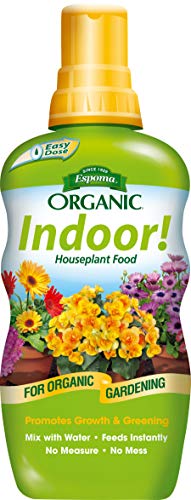
Best for organic growers and anyone with pets around the plants
- Natural proteins with kelp extract, humic acids and beneficial microbes
- Easy Dose cap pours a measured amount with no mixing
- Approved for organic gardening
- Feeds the soil biology as well as the plant
Why buy it: the kelp and humic acid content feeds soil microbes rather than just the plant, which matters in a pot that never gets replenished from outside.

Best for a large collection, or anyone who feeds seriously
- 20-20-20 NPK with a full micronutrient package
- Water soluble powder — mixes to any strength you want
- Feeds through both roots and leaves
- Measuring spoon included; 1.5 lb makes many gallons
Why buy it: the professional greenhouse standard, and by a wide margin the cheapest cost per feeding once you dilute it.

Best for anyone who forgets to fertilize
- 15-9-12 granules with 11 essential nutrients
- Coated prills release over roughly six months
- Scratch into the surface of the pot once and forget it
- Works indoors and in containers outside
Why buy it: one application in spring feeds until fall, which removes the leading cause of underfed houseplants — remembering to do it.

Best for African violets, anthuriums, peace lilies and anything you want to bloom
- Bloom-weighted formula higher in phosphorus
- Liquid concentrate for use in a watering can
- Formulated for indoor flowering houseplants
- Instant availability — no waiting for release
Why buy it: the higher phosphorus ratio genuinely pushes bud set on plants that are throwing leaves instead of flowers.
Best for a handful of plants and the simplest possible routine
- Ready-to-use liquid — no mixing or measuring
- Feeds instantly through the roots
- Suitable for all common houseplants
- Compact bottle that stores under a sink
Why buy it: no measuring spoon, no dilution ratio and no arithmetic, which is why it is the bottle most people actually keep using.
Quick Comparison
| Product | Best for | Rating | Price | Buy |
|---|---|---|---|---|
| Miracle-Gro Indoor Plant Food, Liquid Plant Food for Houseplants, 8 oz. | Best Overall | — | Check (paid link) | |
| Espoma Organic Indoor! Liquid Plant Food, Natural and Organic Houseplant Food, 8 fl oz | Best Organic | — | Check (paid link) | |
| Jack’s Classic All Purpose 20-20-20 Water Soluble Plant Food, 1.5 lbs | Best Value Concentrate | — | Check (paid link) | |
| Osmocote Smart-Release Plant Food Plus Outdoor and Indoor, 1 lb. | Best Slow-Release | — | Check (paid link) | |
| Miracle-Gro Blooming Houseplant Food, Fertilizer for Indoor Plants, 8 fl. oz. | Best for Flowering Plants | — | Check (paid link) | |
| Miracle-Gro Liquid Houseplant Food | Best Simple Liquid | — | Check (paid link) |
How We Rank
We do not buy or physically use these fertilizers. Rankings come from aggregating star ratings and review volume across thousands of verified owner reviews, weighting recent reviews above launch-window ones, checking published NPK ratios, micronutrient content, application rates and organic certifications against manufacturer labels, and reading negative reviews for the problems that show up over a growing season rather than in the first week.
Four factors set the order. Burn risk at the labeled rate, because the safest effective product is the right default for a mixed collection. Nutrient completeness — whether micronutrients are included, since a pot has no other source of them. Cost per feeding once diluted, which varies by more than tenfold across this field. And owner satisfaction weighted by review volume, with attention to reports over a full year of use. Prices were checked at time of writing. Full method: how we rank.
The Fertilizers, Reviewed
1. Miracle-Gro Indoor Plant Food — Best Overall
Covered above. Consensus Score ████████░░ 8.7. Strengths: a very forgiving balanced formula, a pump dispenser that makes feeding trivially quick, direct-to-soil or watering-can application, safe for edibles, and a price low enough to be irrelevant. Recurring complaints: the pump is the weak point — owners report it clogging or losing prime, particularly if the bottle sits unused over winter. The formula is mild enough that heavy feeders and fast-growing plants under grow lights may want something stronger. Several reviewers note the 8 oz bottle empties quickly on a large collection. And a minority report leaking caps in shipping.
2. Espoma Organic Indoor! — Best Organic
The organic option that is actually pleasant to use. Natural proteins with kelp extract, humic acids and beneficial microbes, in an Easy Dose bottle whose cap chamber pours a measured amount without any mixing or mess. Approved for organic gardening, and the microbe and humic content genuinely does something a synthetic salt fertilizer does not — it supports the soil biology in a pot that otherwise slowly goes inert.
Consensus Score ████████░░ 8.5 — excellent ratings, with smell and speed the recurring notes
Recurring complaints: it smells, and owners say so consistently — organic inputs are organic matter, and a fish-and-kelp aroma in a living room is a real consideration for some people. Results are slower and subtler than a synthetic feed, which reviewers expecting a visible growth surge find underwhelming. It costs more per ounce. And the Easy Dose chamber is reported as fiddly to pour cleanly on the first few attempts.
3. Jack’s Classic All Purpose 20-20-20 — Best Value Concentrate
This is what commercial greenhouses use, and it is the reason serious plant people have a tub of blue powder in the cupboard. A balanced 20-20-20 with a full micronutrient package, water soluble so you mix it to whatever strength you want, and absorbed through both roots and leaves. A 1.5-pound tub makes an enormous number of gallons, which puts the cost per feeding an order of magnitude below the ready-to-use bottles.
Consensus Score ████████░░ 8.8 — the highest ratings on this page, from an audience that clearly knows what it is doing
Recurring complaints: it requires measuring and mixing, which is exactly the friction that stops casual owners using it. At full label strength it is far stronger than a houseplant needs, and burn reports come almost entirely from people who did not dilute enough — half strength is the sensible houseplant rate. The powder cakes if the tub gets damp. And it contains urea nitrogen, which some growers avoid for sensitive plants.
4. Osmocote Smart-Release — Best Slow-Release
The answer to the real reason houseplants go hungry, which is not ignorance but forgetfulness. Coated 15-9-12 prills release nutrients gradually as soil temperature and moisture allow, over roughly six months. You scratch a measured amount into the surface of the pot in spring and the plant is fed until fall.
Consensus Score ████████░░ 8.6 — very strong ratings across an enormous review base
Recurring complaints: you cannot adjust the dose after applying, so a heavy hand in March is a problem you live with until September. Release rate depends on temperature and moisture, which indoors means it is slower and less predictable than the label implies. Owners report the prills washing to the surface and being unsightly, or ending up in the drainage saucer. And it does nothing for a plant that needs help immediately — it is prevention, not treatment.
5. Miracle-Gro Blooming Houseplant Food — Best for Flowering Plants
Balanced fertilizer grows leaves. If you have an African violet, an anthurium, a peace lily or a Christmas cactus that is throwing foliage and refusing to set buds, a phosphorus-weighted bloom formula is the appropriate tool. This is the ready-to-use version, formulated specifically for indoor flowering plants and instantly available rather than slow-release.
Consensus Score ████████░░ 8.4 — strong ratings from flowering-plant owners specifically
Recurring complaints: it is a specialist product and owners who use it on foliage plants report leggy, weak growth — phosphorus does not substitute for nitrogen. Results depend far more on light than on fertilizer, and a plant not blooming in a dark corner will not bloom because you fed it. Several reviewers describe the effect as modest. And the bottle is small for the price.
6. Miracle-Gro Liquid Houseplant Food — Best Simple Liquid
The lowest-friction option on the page. A ready-to-use liquid, no mixing, no measuring, no dilution arithmetic — feed and put it back under the sink. For someone with five or six plants who wants them fed without a hobby attached, it is exactly right.
Consensus Score ████████░░ 8.3 — well rated, with value the main reservation
Recurring complaints: ready-to-use means you are paying to ship water, and owners with larger collections work out quickly that a concentrate is far cheaper. The formula is mild, so heavy feeders may need more frequent application. Several reviewers note the bottle design makes it awkward to pour into a narrow watering can. And, as with all ready-to-use liquids, shelf life once opened is finite.

How to Choose an Indoor Plant Fertilizer
Match the product to your habits, not to a nutrient chart. If you will realistically feed every couple of weeks, a dilute liquid is the best tool — it lets you adjust as the plant responds and as seasons change. If you will not, buy slow-release granules and apply them once in spring; a fed plant beats a perfectly formulated fertilizer that stays in the cupboard.
Read NPK as a ratio, not a score. Nitrogen drives leaves, phosphorus supports roots and flowers, potassium supports overall vigor. A balanced ratio suits nearly every foliage houseplant. A bloom formula weighted to phosphorus is for plants you want flowers from, and using it on a pothos will give you weak, stretched growth. Higher numbers just mean more concentrated, which means diluting further — a 20-20-20 and a 1-1-1 can deliver identical nutrition at the pot.
Check for micronutrients. Iron, magnesium, manganese, zinc and boron are needed in tiny amounts and are entirely absent from a pot once the mix is exhausted. Deficiencies show as interveinal yellowing on new growth — yellow leaf with green veins — and they are frequently misdiagnosed as overwatering. Any fertilizer describing itself as complete or listing micronutrients on the label covers this.
Feed on the plant's schedule, not the calendar's. Most houseplants grow from roughly March to September and slow dramatically in the low light of winter. Feed during growth, taper in fall, and largely stop in winter — with the exception of plants under grow lights on a long photoperiod, which keep growing and keep needing food.
And when in doubt, dilute. Half the labeled strength at the labeled frequency is a sound default for almost every houseplant, and it makes fertilizer burn essentially impossible. Almost nothing indoors suffers from being slightly underfed; a great deal suffers from the opposite.
What Owners Actually Complain About
Four themes recur across every product in this category.
Fertilizer burn is the most serious, and it is almost always a dilution error rather than a product fault. Salt accumulates in a pot that never gets rain, pulls water back out of the roots, and produces brown crispy leaf tips and margins plus a white crust on the soil surface or pot rim. The fix is flushing — run water slowly through the pot for several minutes until it drains freely, repeat, and pause feeding for a month.
No visible result is the second, and it is usually a light problem being blamed on nutrition. A plant in a dim corner is limited by photons, not by nitrogen, and feeding it more will produce weak stretched growth rather than a fuller plant. If a plant is not thriving, check light first — our guide on how much light houseplants need is the more useful starting point.
Smell is third and it is limited to the organic products. Fish, kelp and protein meals smell like what they are, and in an enclosed room that lingers for a day or two after feeding. It is the honest cost of feeding soil biology rather than dosing salts.
And dispenser and packaging failures are the fourth — pumps that clog, caps that leak in shipping, and powder that cakes in a damp cupboard. These are minor but they appear across every brand, and storing fertilizer somewhere dry and using it within a season avoids most of them.
The Verdict
Buy Miracle-Gro Indoor Plant Food for a general collection — it is forgiving, fast to use, cheap, and safe on edibles, which covers what most people actually need. Prefer organic, or want to build soil biology in pots that never get refreshed? Espoma Indoor!, and accept the smell. Serious collection or a greenhouse habit? Jack’s Classic 20-20-20 at half strength is the professional answer and by far the cheapest per feeding. Know you will forget? Osmocote once in spring. Trying to get an African violet or anthurium to bloom? Miracle-Gro Blooming Houseplant Food. And for the simplest possible routine on a handful of plants, the ready-to-use Miracle-Gro Liquid Houseplant Food.
Check price on Amazon → (paid link)
Next: get the growing medium right in the best potting mix for houseplants, fix the real limiting factor with the best grow lights for indoor plants, diagnose problems in why houseplant leaves turn yellow, or feed blooms specifically with the best orchid fertilizers.