 Garden

Affiliate Disclosure
Some links on this page are affiliate links. As an Amazon Associate, we earn from qualifying purchases — at no extra cost to you. We do not buy, test, or physically handle the products we cover; our rankings come from aggregated owner reviews, ratings and expert consensus. Commissions never change our verdicts. How we rank · full disclosure.
The short answer: the five-tube desktop station with a wooden stand is the propagation station to buy for most people, because it roots a handful of cuttings, lets you watch the roots form through clear glass, and looks good enough to leave out — all at pocket-money money. Buy a bulb-vase set instead for chunkier cuttings that need more water, and the Mkono three-tier wall station to free up desk space and turn propagation into wall decor.
A propagation station is a simple thing — glass vessels in a stand that hold cuttings in water while they root — and it is bought for two reasons at once: to root new plants for free from cuttings, and to look good doing it on a sill, desk or wall. So the decision comes down to capacity, the shape of the glass, where it sits, and the quality of the stand and vessels. This page ranks six on exactly that. A quick note first: whether a cutting roots depends on the plant and your conditions, not the station, and none of this is plant-health advice.
What Actually Matters in a Propagation Station
Four things decide whether a station earns its spot:
- Capacity matched to your habit. A few cuttings at a time wants three to five vessels; a serious batch wants twenty-plus. Buy for how much you actually propagate.
- Vessel shape. Narrow test tubes suit slim cuttings and look neat; wider bulb vases hold more water and take chunkier stems with fewer refills.
- Desktop or wall-mounted. Desktop stations sit on a sill; wall-mounted ones free that surface and become decor. Pick by how much space you can spare.
- Glass and stand quality. The glass has to stay clear and the stand has to hold the vessels securely. This is a display object as much as a tool, so finish matters.

The Propagation Stations at a Glance
Our #1 Pick: 5 Test-Tube Desktop Propagation Station
The five-tube desktop station wins because it hits the sweet spot every propagation station is aiming for: enough capacity for real use, a clean look that earns its place on a sill, and a price low enough to be an easy yes.
What it does better than the others. Balance. Five glass test tubes is the right number for how most people actually propagate — a handful of cuttings on the go at once, not a nursery-scale batch — and the solid wooden stand holds them steady on a desk or windowsill. The clear tubes are the whole point: you watch roots creep down through the water, which is both the practical check on progress and the reason the thing looks good sitting out. At its price, it is the definition of an easy recommendation, and its rating reflects owners agreeing.
Consensus Score █████████░ 9.0 — a strong, consistent owner consensus centered on looks and value.
Where it is weak. Narrow test tubes hold less water than bulb vases, so they need topping up and changing a little more often, and they suit slimmer cuttings better than a thick pothos node — for those, the bulb-vase set is the better shape. It is a desktop unit, so it uses sill or desk space that a wall-mounted station would free. And five tubes is not the tool for a big propagation run; that is the 21-tube XXXFLOWER’s job.
Check price on Amazon → (paid link)
The Propagation Stations, Ranked

Best for rooting a handful of cuttings on a desk or windowsill while they look good doing it
- Five glass test tubes in a solid wooden stand
- Desktop terrarium size for a sill or shelf
- Clear tubes let you watch roots develop
- Amazon’s Choice with a strong rating
Why buy it: A propagation station has to do two jobs — root cuttings and look good doing it — and this five-tube desktop unit nails both at pocket-money money. The clear tubes turn root-watching into the display itself.

Best for wider bulb vases that suit chunkier cuttings and hold more water
- Five rounded glass bulb vases on a wooden stand
- Wider openings suit thicker stems and cuttings
- Larger water volume means fewer top-ups
- Doubles as desk or office decor
Why buy it: Bulb vases hold more water and take chunkier cuttings than narrow test tubes, so this set suits pothos and philodendron nodes better. More water per vessel also means fewer refills between root checks.

Best for freeing up desk space by rooting cuttings on a wall as living decor
- Three tiers of glass test tubes on a wall-mounted frame
- Brown wood backing in a boho style
- Wall placement saves desk and sill space
- Highest owner rating of any station here
Why buy it: Mounting cuttings on the wall turns propagation into a piece of living decor and frees the windowsill for pots. Three tiers hold a real batch, and it carries the top rating in this group.

Best for arranging individual wall vases wherever you like rather than in a fixed rack
- Four oblate glass wall-hanging vases
- Mount individually in any layout you choose
- Rounded vessels suit flowers and cuttings alike
- Bathroom, living room or office decor
Why buy it: Four separate wall vases give you the freedom to space and arrange them however the wall wants, rather than a fixed rack. The oblate shape suits single cuttings or a stem of flowers equally.
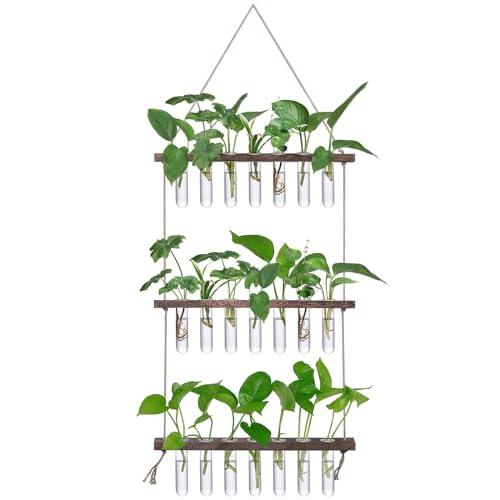
Best for propagating a serious batch of cuttings at once on one wall frame
- Twenty-one glass test tubes across three tiers
- Wall-mounted frame for a big propagation run
- Highest owner rating tier in the group
- Also works as a striking flower-vase wall
Why buy it: Twenty-one tubes make this the volume choice — a whole propagation project on one wall frame. For a plant swap, a classroom or an owner who takes many cuttings at once, capacity is the whole point.

Best for a small retro three-bulb station for a desk, sill or a couple of cuttings
- Three bulb-shape glass jars on a wooden stand
- Compact desktop or wall-mounted design
- Retro styling for home or office
- Trusted Mkono build and finish
Why buy it: A compact three-bulb station for the owner rooting just a couple of cuttings at a time. The retro glass-and-wood look makes it a desk object as much as a tool, in a footprint that fits anywhere.
Quick Comparison
| Product | Best for | Rating | Price | Buy |
|---|---|---|---|---|
| Plant Propagation Station with Wooden Stand (5 Test Tubes) | Best Overall — 5 Test-Tube Desktop Station | — | Check (paid link) | |
| Propagation Station with Wooden Stand & 5 Bulb Vases | Best Bulb-Vase Set — 5 Glass Bulbs | — | Check (paid link) | |
| Mkono 3-Tier Wall-Hanging Propagation Station | Best Wall-Mounted — Mkono 3-Tier | — | Check (paid link) | |
| Mkono Wall Propagation Planters (4-Pack) | Best Wall Planter Set — Mkono 4-Pack Vases | — | Check (paid link) | |
| XXXFLOWER 3-Tier Wall Propagation Station (21 Tubes) | Best Large-Capacity — XXXFLOWER 21-Tube | — | Check (paid link) | |
| Mkono Hanging Desktop Propagation Station (3 Vases) | Best Retro Desktop — Mkono 3-Vase Bulb | — | Check (paid link) |
How to Choose Between Them
Start with how much you propagate. A couple of cuttings at a time is happy with the compact three-vase Mkono or the five-tube desktop station. A steady handful suits the five-bulb set. A big, batch-at-once habit — a plant swap, a classroom, an enthusiast — wants the 21-tube XXXFLOWER, which turns a whole project into one wall display.
Then decide desktop or wall. If sill and desk space is tight, a wall-mounted station like the Mkono three-tier or the four separate wall vases frees the surface and doubles as decor. If you would rather keep it on a table where you can lift tubes out easily, the desktop stations are simpler to tend.
Finally, match the glass to your cuttings. Slim tubes look neat and suit thin stems; wider bulb vases hold more water and take chunkier nodes with fewer refills. Whichever you choose, set it in bright indirect light and change the water every few days. Once roots reach an inch or two, pot the cutting on — our guides to the best self-watering pots and, for the finished plants, best hanging planters cover where they go next.
How We Rank Propagation Stations
We do not buy, fill or physically handle these stations. Our ranking is built from the consensus of people who own them. We read aggregated star ratings across the full review base rather than a flattering handful, and we weight long-tail reviews — those written months in — more heavily, because a station’s real test is whether the glass stays clear, the stand stays sturdy and the wall mount holds after months of use. We check published specifications directly: number and shape of vessels, desktop or wall-mounted design, stand material and overall size. Whether a cutting actually roots depends on the plant and conditions, not the station, and we say so. Prices were current at the time of writing. Full method on how we rank.
Which One Is Right for You
A handful of cuttings, on a desk, looking good? The five-tube desktop station. Chunkier cuttings that need more water? The five-bulb vase set. Freeing up desk space? Mkono three-tier wall station. Arranging vases freely on a wall? Mkono four-pack wall vases. A big batch at once? XXXFLOWER 21-tube. Just a couple of cuttings in a retro look? Mkono three-vase. Set any of them in bright indirect light and change the water every few days.
The Verdict
The five-tube desktop propagation station is the one we would recommend to most people, because it balances real capacity, a clean look and a trivial price better than anything else here. Choose a bulb-vase set for chunkier cuttings, the Mkono three-tier wall station to save space, and the XXXFLOWER 21-tube for a serious batch. When your cuttings are ready to pot on, the best macrame plant hangers guide, the wider houseplants hub and our full resource library cover what comes next. Check the current price on Amazon → (paid link)