 Garden
Affiliate Disclosure
Some links on this page are affiliate links. As an Amazon Associate, we earn from qualifying purchases — at no extra cost to you. We do not buy, test, or physically handle the products we cover; our rankings come from aggregated owner reviews, ratings and expert consensus. Commissions never change our verdicts. How we rank · full disclosure.
The short version: the best sun lamp on published specifications and the owner-review record is the Carex Day-Light Classic Plus — a large diffusing panel on an adjustable pedestal stand, specified at 10,000 lux at 12 inches, with UV filtered out. If you want to sit further back, the Northern Light Technologies Boxelite states the same figure at 14 inches. If you want the smallest sensible outlay to find out whether you will use one daily, the Verilux HappyLight Lucent is around $45.
These devices all do the same physical thing: emit a broad, diffuse, ultraviolet-filtered white light at a manufacturer-specified intensity. What differs between them is panel size, the distance at which the stated output is measured, how adjustable the position is, and whether there is a timer. Those are the things you can actually compare, and they are what this page compares. Whether bright light is right for your situation, and how you would use it if so, is a conversation with a clinician — not something a review site should be answering.
Top Picks at a Glance
Our #1 Pick: Carex Day-Light Classic Plus
Two specifications separate serious light therapy lamps from the small desk lamps sold alongside them, and this one gets both right.
The first is panel size. A large diffusing surface produces a broad, even field rather than a concentrated point, which means your exact head position matters much less. With a small panel, moving six inches to one side changes the light reaching your eyes dramatically; with a large one it barely matters. In practice that is the difference between a lamp you use properly and a lamp you use approximately.
The second is lux at a stated distance. Carex specifies 10,000 lux at 12 inches, and the stated distance is the part most listings quietly omit. Illuminance falls off with distance — move to twice the distance and you receive roughly a quarter of the light — so a lux figure without a distance attached is close to meaningless. Comparing lamps means comparing both numbers together.
The rest is practical design. The panel is angled downward on an adjustable-height pedestal, which is the geometry the format is built around — light entering the eyes indirectly from above rather than shining flat at your face. The lens filters ultraviolet. There are two output modes, so it can be used as a bright task light as well. And the single-column stand is more stable than the two-leg designs that preceded it, which sounds trivial until you knock one on a breakfast table.
Honest caveats: it is physically large and does not disappear on a small desk; it is not portable in any meaningful sense; and it uses replaceable tubes rather than sealed LEDs, which is a maintenance item some buyers dislike and others consider an advantage. It is also, at around $140, more than the compact LED panels below. Check price on Amazon → (paid link)
The Ranked Field

Best for a large panel on a stand, used at a desk or breakfast table
- Manufacturer specifies 10,000 lux at 12 inches
- Large diffusing panel angled downward toward the eyes
- Adjustable height on a single pedestal stand
- Two output modes and a UV-filtered lens
Why buy it: a big panel on an adjustable stand is the format most clinical discussions of light therapy describe, and this is the accessible version of it.

Best for sitting further back while still meeting the stated output
- Manufacturer specifies 10,000 lux at 14 inches
- Large light box built in North America
- Draws around 72 watts
- Long manufacturer warranty
Why buy it: the stated distance is further than most, which means you can sit at a comfortable working position rather than leaning in.

Best for a lamp you can tune to the room and the time of day
- Four brightness levels and three color settings
- Countdown timer in five-minute increments
- UV-free LED panel
- Detachable stand, sits upright or flat
Why buy it: the timer and the brightness steps make it easy to follow whatever routine your clinician suggests without watching a clock.
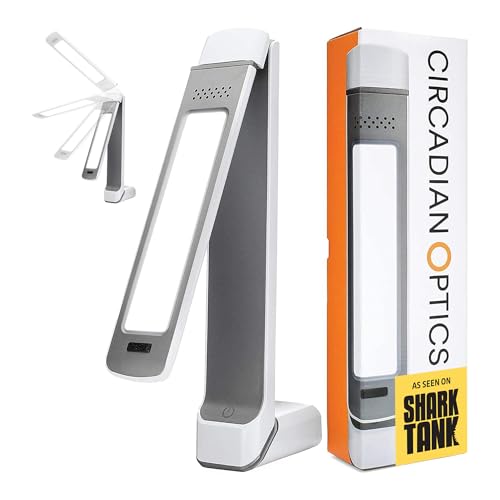
Best for a small desk where a full light box will not fit
- Compact panel with a 270-degree rotating head
- UV-free, full-spectrum LEDs at 5500K
- Weighted base that stays put
- Simple two-brightness control
Why buy it: the rotating panel is what lets a small lamp be positioned correctly, which matters more than its footprint.
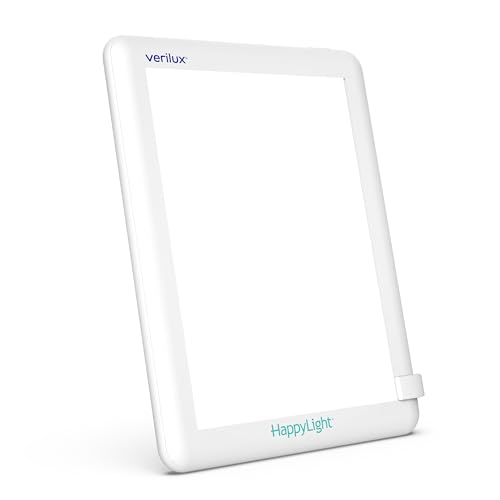
Best for trying the format without a large outlay
- Single-button operation, no menus
- UV-free LED panel
- Detachable stand for desk or shelf
- Small enough for a nightstand
Why buy it: one button and a stand — the cheapest honest way to find out whether you will actually use one every morning.

Best for travel, a second office, or moving between rooms
- Folds flat for a bag or a drawer
- Manufacturer specifies 10,000 lux output
- Built by a long-established light therapy maker
- Stands unassisted on a desk
Why buy it: a routine only works if it survives travel, and this is the one you can actually take with you.
Quick Comparison
| Product | Best for | Rating | Price | Buy |
|---|---|---|---|---|
| Carex Day-Light Classic Plus Sunlight Therapy Lamp | Best Overall | — | Check (paid link) | |
| Northern Light Technologies Boxelite 10000 Lux Light Therapy Lamp | Best Large Panel | — | Check (paid link) | |
| Verilux HappyLight Luxe Light Therapy Lamp with 10,000 Lux | Best Adjustable | — | Check (paid link) | |
| Circadian Optics Lumos 10,000 Lux Light Therapy Lamp | Best for a Desk | — | Check (paid link) | |
| Verilux HappyLight Lucent One-Touch Light Therapy Lamp | Best Budget | — | Check (paid link) | |
| Northern Light Technology Travelite Portable Light Box | Best Portable | — | Check (paid link) |
The Four Specifications That Actually Differ
Lux, and the distance it is measured at. Every lamp here quotes 10,000 lux; they do not all quote the same distance. The Boxelite states 14 inches, the Carex 12 inches, and several compact panels state considerably less. A larger stated distance means you can sit at a normal working position rather than leaning toward the lamp, and that is a genuine usability difference rather than a marketing one.
Panel area. Bigger panels are more forgiving of head movement and produce a softer field. Small panels are easier to fit on a desk and easier to travel with. This is the main trade-off in the category.
Adjustability. A tilting head or an adjustable-height stand is how you get the light aimed correctly for your seated height. A fixed panel on a fixed base leaves you stacking it on books, which most owners eventually do.
Timer and controls. A countdown timer removes the need to watch a clock, and simple controls remove the friction that stops a daily routine sticking. Neither changes what the light does; both change whether you keep using it.
One more thing to check on any listing regardless of brand: an explicit statement that the light is UV-free or UV-filtered. Every model on this page states it. A lamp that does not is not one to consider.
The Lamps, Reviewed
1. Carex Day-Light Classic Plus — Best Overall
Covered above. What owners consistently praise: the size and evenness of the panel, the adjustable stand, the downward angle, and build quality that feels like equipment rather than an accessory. Recurring complaints: its footprint on a desk; assembly that is fiddlier than expected; replaceable tubes rather than LEDs; and no timer built in. Check price (paid link).
2. Northern Light Technologies Boxelite — Best Large Panel
The Boxelite’s distinguishing claim is the stated distance: 10,000 lux at 14 inches, further back than most competitors quote. Combined with a large box format, that means you can sit at a normal desk position rather than adjusting your posture around the lamp. It is built in North America and carries an unusually long manufacturer warranty, which is reflected in a review record that skews strongly positive on durability.
Recurring complaints: price, at roughly $220; a large, plain, distinctly clinical-looking box that some owners find hard to accommodate in a living space; and around 72 watts of draw, which is more than the LED panels here. Check price (paid link).
3. Verilux HappyLight Luxe — Best Adjustable
The Luxe is the most configurable lamp here: four brightness levels, three color settings, and a countdown timer adjustable in five-minute increments up to an hour. The timer is the genuinely useful part — a routine you have to time yourself is a routine you abandon. The panel is UV-free LED, it sits on a detachable stand or lies flat, and it is small enough to live on a desk permanently.
Recurring complaints: a smaller panel than the Carex or the Boxelite, so head position matters more; the touch controls are sensitive; and the stated lux figure is measured at a shorter distance than the large light boxes, which is the trade you make for the size. Check price (paid link).
4. Circadian Optics Lumos — Best for a Desk
The Lumos is built around a 270-degree rotating panel on a small weighted base, and that rotation is the reason it works on a cramped desk: you can angle the light toward your face from wherever the lamp happens to fit, instead of needing to place the lamp in exactly the right spot. UV-free LEDs at 5500K, a neutral daylight-white, and a control scheme with essentially one decision in it.
Recurring complaints: the panel is small, which makes positioning matter more than on a light box; there is no timer; and the stated distance for full output is short, so it needs to sit close. As a desk lamp that also serves this purpose, it is well judged. Check price (paid link).
5. Verilux HappyLight Lucent — Best Budget
One button, a detachable stand, a UV-free LED panel, and around $45. The honest case for it is that the most common failure in this category is not buying the wrong lamp but buying any lamp and not using it — a daily routine is hard to establish, and finding that out for $45 rather than $220 is worth something. If it becomes a habit, upgrading to a larger panel later is a reasonable path.
Recurring complaints: the smallest useful panel here; no brightness adjustment; no timer; and a light stand that tips if the cord is pulled. It is a starting point, not an endpoint. Check price (paid link).
6. Northern Light Technology Travelite — Best Portable
A folding light box from a manufacturer that has been making them for decades. It stands unassisted on a desk, folds flat enough for a bag, and states the same 10,000 lux output as its full-size siblings. If your winter involves travel, a second office, or moving between rooms, portability is the specification that decides whether a routine survives.
Recurring complaints: expensive for its size; the folding hinge is the part owners worry about long term; and the beige, functional styling is dated. Buy it specifically because you need to move it. Check price (paid link).
What Owners Actually Complain About
The negative reviews in this category are unusual, because a good share of them are about the person rather than the product. Four themes dominate.
I stopped using it. By some distance the most common outcome behind a low rating. The National Institute of Mental Health describes a typical light therapy routine as sitting in front of a 10,000-lux light box for about 30 to 45 minutes daily, usually first thing in the morning from fall to spring — a consistent daily habit that is genuinely hard to sustain. Owners who put the lamp somewhere they already sit still — a desk, a breakfast table — report using it far more consistently than owners who put it on a shelf.
It is not as bright as I expected. Nearly always a distance problem. The quoted lux figure applies at the manufacturer’s stated distance, and sitting at three feet instead of twelve inches reduces what reaches you dramatically. Check the stated distance before you buy, and set the lamp up to match it.
It gives me a headache or eye strain. A real and reasonably common report, and the reason this page keeps pointing at a clinician. Manufacturers’ instructions cover positioning and duration; a doctor covers whether you should be using one at all, and NIMH notes that people with certain eye diseases or who take medications that increase sensitivity to light may need to use light therapy under medical supervision. If a lamp makes you feel worse, stop and ask.
Too big / too small. The central trade-off of the category, and worth deciding deliberately. A large box is more forgiving to use and harder to live with; a compact panel is easy to place and demands more precision from you.
The Verdict
On published specifications and the owner-review record, the Carex Day-Light Classic Plus is the lamp we would point most people toward — a large, even panel on an adjustable stand, with its output stated at a distance you can actually sit at. The Northern Light Technologies Boxelite is the more solidly built alternative if you want to sit further back and do not mind the price or the appearance. And the Verilux HappyLight Lucent at around $45 is the honest way to find out whether a daily routine is something you will keep up.
Whatever you choose, please have the conversation with a doctor first. Seasonal affective disorder is a medical condition, this page is a comparison of appliances, and those are two different things. Check price on Amazon → (paid link)
Related: best desk lamps for eye strain · best monitor light bars · 2700K vs 3000K explained · the full desk lamp roundup · the indoor lighting hub · how we rank.