 Garden

Affiliate Disclosure
Some links on this page are affiliate links. As an Amazon Associate, we earn from qualifying purchases — at no extra cost to you. We do not buy, test, or physically handle the products we cover; our rankings come from aggregated owner reviews, ratings and expert consensus. Commissions never change our verdicts. How we rank · full disclosure.
The short answer: the Baratza Encore ESP is the best espresso grinder for most home setups — real espresso resolution, steel conical burrs, and every part sold individually so it is repairable. If you want stepless adjustment and near-silence, the Eureka Mignon Specialita. If you brew four ways in one kitchen, the Breville Smart Grinder Pro. And if your budget is tight, buy a hand grinder — the TIMEMORE C3 ESP at around eighty dollars grinds finer and more evenly than any electric grinder at the same price.
The uncomfortable truth in this category: the grinder matters more than the machine. A $400 espresso machine with a $200 grinder makes better coffee than an $800 machine with a $50 grinder, and it is not close.
Top Picks at a Glance
Our #1 Pick: Baratza Encore ESP
The Encore ESP solves a problem most grinders under $300 quietly have: not enough resolution in the espresso range. General-purpose grinders spread forty settings across everything from Turkish to cold brew, which leaves maybe three or four that land anywhere near espresso — and since one step can move a shot from 22 seconds to 35, that is not enough to dial anything in.
Baratza's answer was to split the range. Settings 1 to 20 are micro-steps covering espresso; 21 to 40 are macro-steps covering filter methods. You get the fine adjustment where you actually need it. The burrs are 40 mm hardened alloy steel, and the machine ships with both a portafilter holder and a grounds bin.
The second reason it wins is repairability. Baratza sells every internal component — burrs, gearbox, motor, hopper — and publishes teardown guides. That converts the grinder from a five-year appliance into something you keep.
Honest limitations: retention in the chute means the first gram or two of a dose is yesterday's coffee unless you purge, it is not quiet, and the plastic hopper feels cheaper than the price suggests. None of that changes the grind.
Check price on Amazon → (paid link)
The Ranked Field

Best for the cheapest electric grinder that is genuinely espresso-capable
- 40 mm hardened alloy steel conical burrs
- Micro-steps 1–20 tuned for espresso, macro-steps 21–40 for filter
- Portafilter holder plus grounds bin
- Every part sold individually and user-replaceable
Why buy it: the dual-range adjustment gives real espresso resolution at a price where most grinders only claim it, and Baratza sells every internal part.

Best for stepless adjustment, quiet operation and a grinder for life
- 55 mm flat burrs with stepless adjustment
- Sound-insulated case with rubber mounts
- Programmable touchscreen dosing
- Adjustment below the motor for easy cleaning
Why buy it: stepless adjustment means you can land between two settings instead of choosing the lesser of two wrong ones — the single biggest quality-of-life upgrade in espresso grinding.
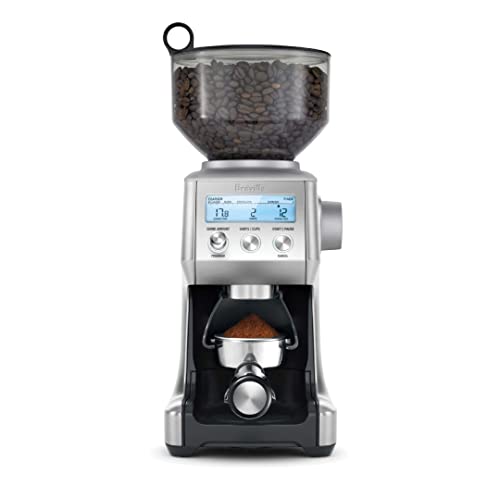
Best for a household brewing espresso, drip, pour-over and press from one grinder
- 60 grind settings, stainless steel conical burrs
- Digital timer adjustable in 0.2-second steps
- Grinds into portafilter, container, gold filter or paper
- 18-oz hopper with a lockable lid
Why buy it: sixty settings and a timed dose make it the most flexible single grinder in the house, even if it is not the sharpest at either extreme.
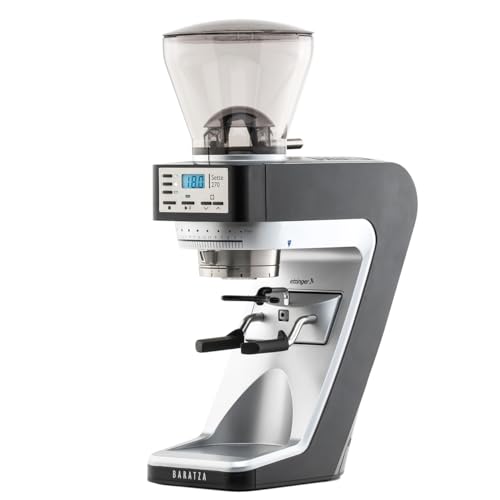
Best for near-zero retention and grinding straight into the portafilter
- 40 mm conical burrs with a vertical, gravity-fed grind path
- 270 settings via macro and micro adjustment
- Three programmable dose buttons
- Grinds a double dose in roughly 5 seconds
Why buy it: the vertical grind path drops grounds straight through, so almost nothing is retained and yesterday’s coffee never ends up in today’s shot.

Best for burr quality that would cost three times as much in an electric grinder
- 48 mm conical burrs, factory calibrated
- External top dial, roughly 8 microns per click
- Foldable handle, magnetic 40 g catch cup
- No power, no retention chamber, travels anywhere
Why buy it: eight microns per click is finer resolution than most $600 electric grinders offer, because none of your money went into a motor.

Best for espresso-grade grinding on the smallest budget that works
- S2C stainless conical burrs cut at an espresso pitch
- Internal stepped adjustment, about 30 clicks per rotation
- All-metal body, double bearing shaft
- Grinds a double dose in roughly 40 seconds
Why buy it: about eighty dollars for a grinder that reaches true espresso fineness, which no electric grinder at this price manages.
Quick Comparison
| Product | Best for | Rating | Price | Buy |
|---|---|---|---|---|
| Baratza Encore ESP Conical Burr Coffee Grinder | Best Overall | — | Check (paid link) | |
| Eureka Mignon Specialita Espresso Grinder | Premium Pick | — | Check (paid link) | |
| Breville Smart Grinder Pro (BCG820BSS) | Best All-Purpose | — | Check (paid link) | |
| Baratza Sette 270 Conical Burr Coffee Grinder | Fastest Electric | — | Check (paid link) | |
| 1Zpresso J-Ultra Manual Coffee Grinder | Best Hand Grinder | — | Check (paid link) | |
| TIMEMORE Chestnut C3 ESP Manual Coffee Grinder | Best Budget | — | Check (paid link) |
Why the Grinder Decides the Shot
Espresso pushes water through a compressed bed of coffee at roughly 9 bar for 25 to 30 seconds. Under that pressure, water goes wherever resistance is lowest. If your grounds are a mix of dust and chunks, the dust packs into dense patches and the chunks leave gaps, and water carves a channel straight through the gap — channeling. The shot pours fast, tastes sour and thin, and no amount of tamping repairs it.
A good burr grinder narrows the particle-size distribution enough that resistance is even across the whole puck. That is all it does, and it is the difference between espresso and disappointment. A blade grinder cannot do it at any price — see burr vs blade grinder.
Conical vs Flat Burrs
| Conical burrs | Flat burrs | |
|---|---|---|
| Shape | A cone inside a ring | Two parallel rings facing each other |
| Particle spread | Slightly wider | Tighter, more uniform |
| Cup character | Rounder, heavier body, forgiving | More clarity and flavor separation |
| Retention | Lower — gravity helps | Higher — grounds sit in the chamber |
| Noise and heat | Lower | Higher |
| Typical price | $80–$450 | $400 and up |
Neither is objectively better. Most home grinders under $400 are conical because conical burrs are cheaper to manufacture and easier to clean; most cafe grinders are flat because the tighter distribution suits light roasts and high volume. If you drink dark and medium roasts in milk, conical is fine and cheaper. If you chase light-roast single origins black, flat burrs are worth the money.
Hand Grinders Are the Value Story
An electric grinder has to pay for a motor, a gearbox, a housing, a hopper and electronics before a single dollar goes into the burrs. A hand grinder pays for burrs, a shaft, two bearings and a body. That is why a $200 hand grinder like the 1Zpresso J-Ultra carries 48 mm burrs with eight-micron adjustment steps — resolution that costs $600 or more in electric form.
The price is your arm: roughly 30 to 45 seconds of cranking per double shot. For one or two drinks a day that is nothing. For four drinks before work, it gets old, and that is when an electric grinder earns its money.
Hand grinders also solve retention almost entirely — there is no chute, and the catch cup empties completely — and they travel, which pairs naturally with a manual espresso maker.
How We Rank
We do not buy these grinders or grind on them. We weight rating quality against review volume; adjustment resolution in the espresso range specifically, since that is where general-purpose grinders fail; burr size and material, which are documented, verifiable specifications; retention and workflow, because a grinder you fight every morning gets replaced; parts availability, the strongest predictor of a ten-year grinder; and durability signals from reviews a year or more into ownership, where gearbox failures, burr alignment and static problems surface. Full method: how we rank.
The Espresso Grinders, Reviewed
1. Baratza Encore ESP — Best Overall
Covered above. Owner feedback consistently identifies the same two things: the espresso micro-range makes dialing in genuinely possible at this price, and Baratza's parts-and-repair support is the reason people recommend the brand rather than the model.
Owners praise: espresso resolution, build for the price, repairability, portafilter holder. Owners gripe about: retention in the chute, static on dry days, noise, and a plastic hopper that feels below the price point. Check price (paid link).
2. Eureka Mignon Specialita — Premium Pick
The Specialita is what a serious home espresso grinder looks like: 55 mm flat burrs, stepless adjustment through a dial that sits below the motor, and a sound-insulated case with rubber mounts that makes it dramatically quieter than anything else here. The programmable touchscreen doses by time, and the adjustment mechanism is designed to be disassembled for cleaning without losing your setting.
Stepless is the feature that matters. On a stepped grinder there are days when the setting you want falls between two clicks; stepless removes that entirely, which is why this design dominates the enthusiast market.
Owners praise: stepless adjustment, quietness, build, flat-burr clarity, easy cleaning access. Owners gripe about: price, retention typical of flat burrs, a timer-based dose rather than by weight, and a footprint taller than it looks. Check price (paid link).
3. Breville Smart Grinder Pro — Best All-Purpose
Sixty settings from espresso to French press, a digital timer adjustable in 0.2-second increments, and outlets for a portafilter, a container, a gold filter or a paper cone. If one grinder has to serve an espresso machine, a drip brewer and a press pot, this is the sensible answer.
The compromise is that spreading sixty settings across every method leaves fewer of them in the espresso range than a dedicated espresso grinder provides. It works — many thousands of owners make espresso with it daily — but the dialing-in is coarser.
Owners praise: versatility, the timed dose, grinding straight into the portafilter, hopper capacity. Owners gripe about: limited espresso resolution against dedicated grinders, static and retention, noise, and burrs that need periodic cleaning to stay consistent. Check price (paid link).
4. Baratza Sette 270 — Fastest Electric
The Sette's distinguishing feature is its vertical grind path: the burrs sit above the exit, so grounds fall straight through under gravity instead of being swept along a chute. Retention is close to zero, a double dose grinds in about five seconds, and three programmable buttons make the workflow fast. 270 settings come from combining macro and micro rings.
It is loud — genuinely loud — and the owner record includes more mechanical complaints than the rest of Baratza's range, particularly around the plastic gearbox components. Baratza's parts support softens that, but it belongs in the honest column.
Owners praise: near-zero retention, grind speed, dose programming, workflow. Owners gripe about: noise, gearbox and adjustment-ring durability reports, price, and a hopper that must be removed to change macro settings. Check price (paid link).
5. 1Zpresso J-Ultra — Best Hand Grinder
Forty-eight millimeter conical burrs, factory calibrated, with a top-mounted external dial giving roughly eight microns per click — finer resolution than most electric grinders at three times the price. The handle folds, the catch cup is magnetic and holds 40 grams, and there is essentially no retention because there is nowhere for grounds to hide.
It grinds a double espresso dose in well under a minute and it goes in a suitcase. For a one or two drink a day household it is arguably the best value in this entire category.
Owners praise: grind quality, adjustment resolution, build, portability, zero retention. Owners gripe about: the effort for multiple drinks, no way to grind hands-free, a price that surprises people expecting hand grinders to be cheap, and a learning curve on reading the dial. Check price (paid link).
6. TIMEMORE Chestnut C3 ESP — Best Budget
Around eighty dollars for S2C stainless conical burrs cut at an espresso-specific pitch, an all-metal body, and a double-bearing shaft that keeps the burrs from wobbling. It reaches genuine espresso fineness, which is the thing no $80 electric grinder does. Adjustment is internal and stepped, roughly thirty clicks per rotation, so you unscrew the catch cup to change it.
Owners praise: price, build, espresso-capable fineness, no plastic in the grind path. Owners gripe about: internal adjustment that means unscrewing the cup, roughly 40 seconds of cranking per double, and more effort on dark oily beans. Check price (paid link).
What Owners Actually Complain About
Static and grounds everywhere. Dry air plus fast-moving coffee makes static. The fix costs nothing: spray a single fine mist of water on the beans, or stir them with a wet spoon handle, before grinding. This is known as the Ross Droplet Technique and it works.
Retention. Grounds left in the chute join the next dose as stale coffee and make your dosing unpredictable. Purge two grams, or tap the grinder, or buy a low-retention design.
Noise. A burr grinder at 6am is louder than people expect. Sound-insulated grinders and hand grinders are the answer.
Clumping. Fine espresso grounds clump as they exit. Break them up before tamping with a needle-based distribution tool, or the shot will channel through the gaps between clumps.
Losing the setting. Cleaning many stepless grinders means disassembling the adjustment. Mark your setting before you start.
The Verdict
Buy the Baratza Encore ESP if you want one electric grinder that genuinely does espresso and can be repaired for a decade. Buy the Eureka Mignon Specialita if you want stepless adjustment, silence, and a grinder you will never need to replace. Buy the 1Zpresso J-Ultra or TIMEMORE C3 ESP if you make one or two drinks a day and would rather spend the money on burrs than on a motor — for value, that is the smartest choice on this page. Check price on Amazon → (paid link)
More from this hub: small kitchen appliances · best burr grinder for espresso · burr vs blade grinder · how to dial in espresso grind · how we rank.