 Garden

Affiliate Disclosure
Some links on this page are affiliate links. As an Amazon Associate, we earn from qualifying purchases — at no extra cost to you. We do not buy, test, or physically handle the products we cover; our rankings come from aggregated owner reviews, ratings and expert consensus. Commissions never change our verdicts. How we rank · full disclosure.
A burr grinder crushes beans between two shaped surfaces set a fixed distance apart, so the particles come out close to the same size. A blade grinder spins a propeller that smashes beans at random, producing dust and boulders in the same batch. That single mechanical difference drives everything: burr grinders let you choose a grind size, blade grinders do not; burr coffee extracts evenly, blade coffee extracts unevenly and tastes bitter and sour at once. For drip you will notice it. For espresso, a burr grinder is not optional.
What is the actual difference?
A blade grinder is a small motor with a two-pronged blade in a chamber. It does not grind — it chops, repeatedly, and how fine the result is depends entirely on how long you hold the button. Beans nearest the blade get hit dozens of times and turn to powder; beans thrown against the wall get hit once and stay in chunks. There is no setting, no repeatability, and no way to make a coarse grind for a French press that is not full of fines.
A burr grinder passes beans through a gap between two abrasive surfaces — either two cones (conical burrs) or two rings (flat burrs). Nothing exits until it is small enough to fit through that gap, so the output is governed by a physical dimension rather than by time. Change the gap and you change the grind, exactly and repeatably.
The technical term for what a blade grinder produces is a bimodal distribution: two clusters of particle sizes rather than one. A burr grinder produces a tighter, more unimodal distribution — never perfect, because some fines are always created, but far narrower.
Burr vs blade grinder at a glance
| Burr grinder | Blade grinder | |
|---|---|---|
| Mechanism | Crushes between two surfaces at a set gap | Chops with a spinning propeller |
| Particle consistency | Narrow, mostly uniform | Bimodal — dust plus boulders |
| Grind settings | Discrete or stepless, repeatable | None; controlled by how long you hold it |
| Espresso capable | Yes, above roughly $150 hand / $200 electric | No |
| Heat generated | Low at domestic speeds | Higher — friction plus long run times |
| Noise | Lower pitch, 2–4 seconds per dose | High pitched, 20–40 seconds per dose |
| Retention | Some grounds held in the chute | Almost none |
| Typical price | $40–$700+ | $15–$40 |
| Repairable | Often, on better brands | Rarely |
What it actually does to the coffee
Extraction is a race. Fine particles have enormous surface area for their mass, so water strips their soluble compounds fast — first the acids, then the sugars, then the bitter, astringent compounds nobody wants. Coarse particles give up their acids and never get to the sugars in the time available.
Put both in the same brew and you get both outcomes at once: the fines over-extract into bitterness and dryness while the boulders under-extract into sourness and thinness. This is why blade-ground coffee so often gets described as "harsh but weak", and why people conclude their beans are bad or their machine is broken.
A burr grinder does not eliminate fines — no grinder does — but it narrows the spread enough that most of the coffee extracts in the same window. That is the whole game. If you want to hear it described in the cup, read why espresso tastes bitter and why espresso tastes sour; a bad grinder produces both symptoms simultaneously, which is the giveaway.

Why espresso makes this non-negotiable
Espresso gives water 25 to 30 seconds and pushes it at roughly 9 bar through a compressed puck. That pressure is looking for the easiest path. If part of the bed is packed with dust and part is loose chunks, water finds the loose part and blasts a channel straight through — channeling — so the shot pours fast, tastes sour and thin, and no amount of tamping fixes it.
There is one exception worth knowing. Pressurised (dual-wall) baskets, which ship with most beginner machines, have a tiny restriction hole behind the coffee that creates back-pressure independently of the grind. They will produce a slow pour and thick foam even from blade-ground supermarket coffee. That is what they are for, and it is why an inexpensive machine can seem to work fine without a grinder. Switch to a non-pressurised basket and the truth arrives immediately. See the best espresso machines for beginners for how machines handle this.
The honest price threshold
"Burr grinder" is not a guarantee. A $30 electric burr grinder often cannot adjust fine enough to reach espresso range at all, and its burrs may sit on a shaft with enough play that consistency is barely better than a blade. The rough thresholds owners and experts converge on:
| Budget | What it buys | Good for |
|---|---|---|
| $15–$40 | Blade grinder | Spices. Not coffee. |
| $40–$100 | Entry burr, electric or hand | Drip, french press, pour-over |
| $80–$180 | Espresso-capable hand grinder | Espresso, and everything else |
| $180–$300 | Espresso-capable electric | Daily espresso without cranking |
| $300+ | Flat burrs, stepless, low retention | Light roasts, single dosing, precision |
The value story in this whole category is the hand grinder. Because there is no motor, gearbox or housing to pay for, a $100 hand grinder can carry burrs that would cost $300 in an electric machine. The price is a minute of cranking per shot. Our burr grinder picks for espresso and the wider espresso grinder ranking cover both.
Three grinders worth the money

Best for the entry point where a burr grinder becomes genuinely espresso-capable
- 40 mm hardened alloy steel conical burrs
- Micro-steps 1–20 for espresso, macro-steps 21–40 for filter
- Portafilter holder and grounds bin included
- Parts sold individually and user-serviceable
Why buy it: the dual-range adjustment gives real espresso resolution at a price where most grinders only pretend to do espresso.

Best for espresso-grade grinding for less than the price of a bad electric grinder
- S2C stainless conical burrs with an espresso-pitch cut
- Internal stepped adjustment, roughly 30 clicks per rotation
- All-metal body, no plastic in the grind path
- No power needed
Why buy it: burr quality per dollar is far higher in a hand grinder, and this one grinds fine enough for espresso where $150 electric grinders do not.
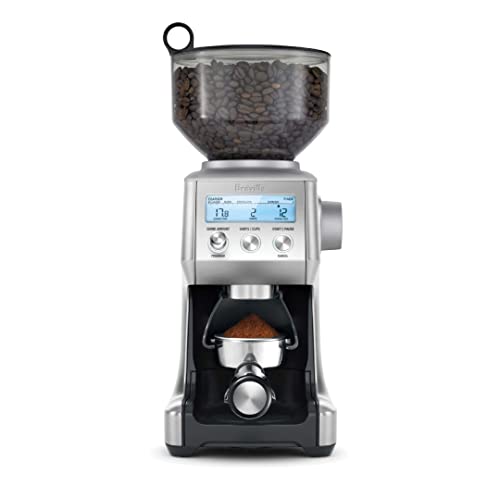
Best for one grinder covering espresso, drip, pour-over and french press
- 60 grind settings, stainless conical burrs
- Digital timer adjustable in 0.2-second increments
- Grinds into portafilter, container, or paper filter
- 18 oz bean hopper with a lockable lid
Why buy it: sixty settings and a timed dose make it the most flexible single grinder for a household brewing several ways.
Our rankings come from aggregated owner reviews, star ratings and published expert consensus rather than first-hand use — the method is on how we rank.
When a blade grinder is actually fine
It is a decent tool doing the wrong job. A blade grinder is genuinely good for whole spices, flax and chia seeds, dried herbs, and breadcrumbs, where an uneven grind does no harm. Keep one for that and it earns its drawer space.
For coffee, the only reasonable case is a pressurised-basket espresso machine or a drip brewer where cost rules everything — and even then, a $40 hand burr grinder will beat it. If you own a blade grinder and are not ready to replace it, two things help slightly: pulse in short bursts rather than holding the button, and shake the grinder between pulses to move the chunks toward the blade. Neither fixes the distribution; both reduce the worst of it.
Which should you buy?
- You make espresso. A burr grinder, above the espresso threshold. There is no workaround.
- You make drip or pour-over. Any decent burr grinder. The improvement over a blade is immediate and larger than a new brewer would deliver.
- You make french press or cold brew. A burr grinder, because fines are what make press coffee muddy and bitter.
- Your budget is under $60. A hand burr grinder, not an electric blade grinder.
- You want one grinder for everything. An all-purpose electric with a wide setting range, like the Smart Grinder Pro.
Where to go next
Ready to shop? The best espresso grinders and the best burr grinders for espresso. Learning to use one? How to dial in espresso grind and how to pull an espresso shot. Choosing a machine to pair it with? The best espresso machines, inside the small kitchen appliances hub.