 Garden

Affiliate Disclosure
Some links on this page are affiliate links. As an Amazon Associate, we earn from qualifying purchases — at no extra cost to you. We do not buy, test, or physically handle the products we cover; our rankings come from aggregated owner reviews, ratings and expert consensus. Commissions never change our verdicts. How we rank · full disclosure.
The short version: a stand mixer is one of the few kitchen appliances people genuinely keep for twenty years, which makes it worth buying properly once. After weighing six of the most-owned stand mixers in the US on aggregated ratings, drivetrain construction and what owners report a decade in, our #1 pick is the KitchenAid Artisan 5-quart. It is not the cheapest and it is not the most powerful, but it has an all-metal gearbox, an accessory hub nothing else matches, and the longest record of still working after fifteen years of use.
If you bake occasionally, the Classic Plus is the same machine with a smaller bowl for less. If you bake bread seriously, no tilt-head is the right answer — go to the Professional 600 or the Bosch Universal Plus. And before you buy anything, measure the gap under your upper cabinets: it is the constraint that decides more stand mixer purchases than motor wattage does. Counter planning is covered in counter space planning.
Top Picks at a Glance

Our #1 Pick: KitchenAid Artisan 5 Quart Tilt-Head
The Artisan is the default American stand mixer and the reasons are structural rather than sentimental. The housing and gearbox are metal, not plastic, so the machine tolerates decades of use rather than years. Over that kind of horizon the paperwork matters: the FTC notes a written warranty must be available to read before you buy, and that implied warranties exist in every state whether or not one is written. The planetary action moves the beater around the bowl while the beater itself spins, which mixes far more thoroughly than a pair of twin beaters. And the power hub on the front takes an enormous range of attachments — grinders, pasta rollers, spiralizers, ice cream bowls — that turn a mixer into a whole workshop.
What owners describe most consistently is longevity: mixers bought for a wedding still running for grandchildren, and a repair path that exists because parts are widely available. The limitations are real. It is heavy — heavy enough that almost everyone leaves it on the counter permanently. It is expensive against a basic hand mixer. Bread dough beyond the rated flour quantity will make the head rock and the motor labor, and that is the one way people damage them. And the coated beater chips over time; a stainless replacement is the common fix.
Check price on Amazon → (paid link)
The Ranked Field

Best for the mixer most kitchens should buy and never replace
- 5 quart stainless bowl, tilt-head design
- 10 speeds with planetary mixing action
- Power hub takes grinders, pasta rollers and more
- All-metal gearbox and housing
Why buy it: the deepest attachment ecosystem of any home mixer, on a machine people routinely hand down to their children.

Best for everything the Artisan does, in a slightly smaller bowl
- 4.5 quart bowl — about six dozen cookies per batch
- 10 speeds, same planetary action
- Same power hub and attachment compatibility
- Coated flat beater and dough hook included
Why buy it: the same drivetrain and the same attachment hub as the Artisan for meaningfully less — the bowl is the main difference.
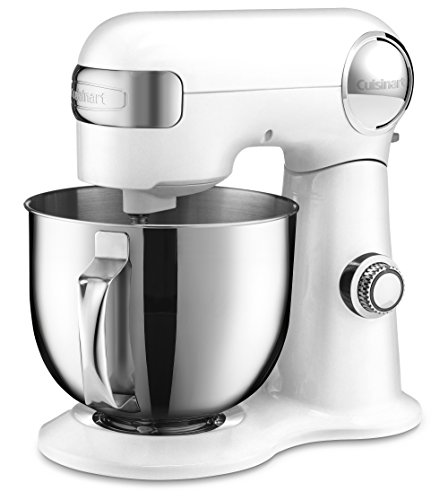
Best for a larger bowl and more speeds for less money
- 5.5 quart stainless bowl, larger than the Artisan
- 12 speeds and a 500-watt motor
- Die-cast metal construction
- Whisk, paddle, dough hook and splash guard included
Why buy it: more bowl and more speed control at a lower price — the trade is a far smaller accessory ecosystem.
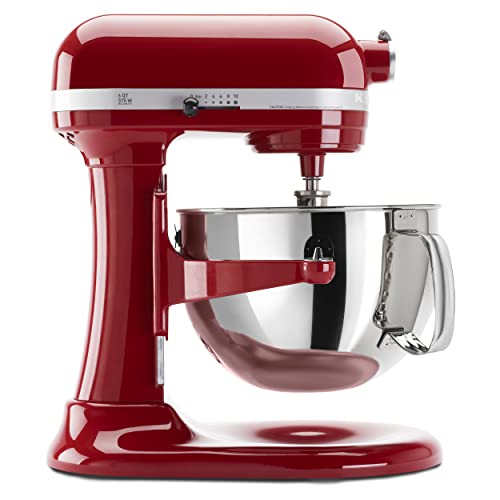
Best for double batches and heavy, dense mixtures
- 6 quart bowl on a bowl-lift frame
- Stronger motor than the tilt-head models
- Bowl-lift design is more stable under heavy load
- Same power hub attachment compatibility
Why buy it: a bowl-lift frame does not flex the way a tilt-head does, which is what you feel the moment you put stiff dough in it.

Best for serious bread bakers making multiple loaves at a time
- Motor sits below the bowl, not above it
- Handles very large dough batches
- Bowl-driven design rather than planetary
- Lighter and more compact than its capacity suggests
Why buy it: the bottom-drive design puts the load on the base rather than a cantilevered head, which is why bread bakers keep choosing it.

Best for occasional baking, small kitchens and first apartments
- 4 quart stainless bowl with handles
- 7 speeds with a 300-watt motor
- Planetary mixing action
- Dishwasher-safe whisk, beater and dough hook
Why buy it: planetary mixing at a fifth of the price — enough for cookies and cakes, honest about not being a bread machine.
Quick Comparison
| Product | Best for | Rating | Price | Buy |
|---|---|---|---|---|
| KitchenAid Artisan Series 5 Quart Tilt-Head Stand Mixer, KSM150PS | Best Overall | — | Check (paid link) | |
| KitchenAid Classic Plus 4.5 Quart Tilt-Head Stand Mixer, KSM75WH | Best Value | — | Check (paid link) | |
| Cuisinart Precision Master 5.5 Quart 12-Speed Stand Mixer, SM-50 | Best Alternative to KitchenAid | — | Check (paid link) | |
| KitchenAid Professional 600 Series 6 Quart Bowl-Lift Stand Mixer, KP26M1X | Premium Pick | — | Check (paid link) | |
| Bosch Universal Plus Stand Mixer, 6.5 Quart, 500 Watt | Best for Bread Dough | — | Check (paid link) | |
| Hamilton Beach Electric Stand Mixer, 4 Quart, 7 Speeds, 63391 | Best Budget | — | Check (paid link) |
Specifications Side by Side
| Mixer | Bowl | Design | Speeds | Attachment hub |
|---|---|---|---|---|
| KitchenAid Artisan | 5 qt | Tilt-head | 10 | Yes, full range |
| KitchenAid Classic Plus | 4.5 qt | Tilt-head | 10 | Yes, full range |
| Cuisinart Precision Master | 5.5 qt | Tilt-head | 12 | Limited |
| KitchenAid Professional 600 | 6 qt | Bowl-lift | 10 | Yes, full range |
| Bosch Universal Plus | 6.5 qt | Bottom-drive | Variable | Bosch-specific range |
| Hamilton Beach 63391 | 4 qt | Tilt-head | 7 | No |
How We Rank
We never bake with these mixers, and we would rather tell you that than pretend to a test kitchen. The ranking is built from aggregated owner ratings across the six machines here, weighted heavily toward reviews written years after purchase — because a stand mixer is bought once and judged over a decade, and the failures that matter are gearbox wear and motor burnout rather than anything visible in week one. Four factors carry the weight. Drivetrain construction: metal gears and housings versus plastic, and whether parts and repair paths exist — noting that the FTC notes a manufacturer cannot require you to use branded parts or services to keep coverage unless it supplies them free. Capacity against real recipes, using the published maximum flour quantity rather than bowl volume alone. Rating strength against review volume. And the accessory ecosystem, since a mixer that also grinds meat and rolls pasta is a different value proposition from one that only mixes. Prices were checked at the time of writing. Full method: how we rank.
The Stand Mixers, Reviewed
1. KitchenAid Artisan 5 Quart — Best Overall
Covered above. Owners praise: extraordinary longevity, thorough planetary mixing, the attachment hub, and a machine that looks good enough to leave out. Owners gripe about: weight, price, struggling with large bread batches, beater coatings chipping, and a beater-to-bowl clearance that sometimes needs adjusting out of the box. Check price (paid link).
2. KitchenAid Classic Plus 4.5 Quart — Best Value
The Classic Plus is the same fundamental machine as the Artisan with a smaller bowl and a slightly less powerful motor. For a household that bakes cookies, cakes and the occasional pizza dough, that difference is close to academic — 4.5 quarts still handles around six dozen cookies in a batch — and it uses the identical power hub, so every attachment fits. Owners consistently report it as the sensible purchase for anyone who is not already a serious baker.
Owners praise: the price gap against the Artisan, the same attachment compatibility, solid build, and a bowl that suits normal household batches. Owners gripe about: a smaller bowl that limits doubling recipes, a bowl without a handle on some versions, and the same dough-capacity ceiling as any tilt-head. Check price (paid link).
3. Cuisinart Precision Master 5.5 Quart — Best Alternative to KitchenAid
The Cuisinart is the strongest non-KitchenAid option in the mainstream market, and on paper it wins several comparisons: a larger bowl than the Artisan, twelve speeds instead of ten, a 500-watt motor and die-cast metal construction, all at a lower price. Owners consistently report it as capable and well built, and the extra low speeds are genuinely useful for folding without flinging flour.
The gap is the ecosystem. KitchenAid attachments do not fit, and the range of Cuisinart accessories is far narrower. If you only want a mixer, that costs you nothing. If you were quietly hoping to grind meat or roll pasta later, it matters a lot.
Owners praise: a large bowl, smooth speed control, strong value, and included whisk, paddle, dough hook and splash guard. Owners gripe about: a much smaller accessory range, more head movement under heavy dough than a KitchenAid, and a louder motor. Check price (paid link).
4. KitchenAid Professional 600 6 Quart — Premium Pick
The Professional 600 is the answer when a tilt-head starts rocking. Bowl-lift mixers clamp the bowl into two arms and raise it into the beater, producing a far more rigid assembly, and the motor is stronger than any tilt-head in the range. For double batches, stiff doughs and large quantities of frosting, the difference is immediately obvious.
Owners praise: handling dough that stalls smaller mixers, a stable bowl-lift frame, large capacity, and the same attachment hub. Owners gripe about: height that defeats standard upper cabinets, considerable weight, price, and a bowl-lift workflow that is slower for scraping and swapping beaters. Check price (paid link).
5. Bosch Universal Plus 6.5 Quart — Best for Bread Dough
The Bosch works differently from everything else here. The motor sits underneath the bowl and drives it from below, rather than hanging over the top on a cantilevered head. That geometry puts the load into the base, which is why bread bakers report it handling dough quantities that make planetary mixers rock and labor. It is also lighter and less bulky than its 6.5-quart capacity suggests.
The trade-offs are practical. The bowl-drive design is unfamiliar, the plastic bowl looks less impressive on a counter than a stainless one, and it is not the machine to buy if your main jobs are whipping cream and creaming butter — a planetary mixer does those better.
Owners praise: exceptional dough handling, large batch capacity, a stable low-slung design, and long service lives reported by regular bread bakers. Owners gripe about: the price, a plastic bowl, a learning curve for anyone used to KitchenAid, and less impressive performance on small light mixes. Check price (paid link).
6. Hamilton Beach 63391 4 Quart — Best Budget
At around a fifth of the price of the Artisan, the Hamilton Beach is honest about what it is. You get genuine planetary mixing, a 4-quart stainless bowl with handles, seven speeds and dishwasher-safe attachments — everything needed for cookies, cakes, frosting and light doughs. Owners consistently describe it as far better than a hand mixer and clearly not a KitchenAid, which is exactly the right expectation.
Owners praise: the price, planetary mixing at that price, light weight, and a bowl with handles. Owners gripe about: a 300-watt motor that struggles with stiff bread dough, more plastic in the construction, noise, and no attachment ecosystem. Check price (paid link).
What Owners Actually Complain About
The beater not reaching the bottom of the bowl is the single most common complaint and the easiest to fix. Tilt-head KitchenAids have an adjustment screw at the hinge; a small turn raises or lowers the beater. The standard check is the dime test — a dime placed in the bowl should be nudged around by the beater without the beater striking the bowl. Two minutes of adjustment resolves years of frustration.
Motors struggling on bread dough is the failure that ends mixers. Every manufacturer publishes a maximum flour weight per batch, and it is lower than most people assume. Warning signs are the head rocking, the motor bogging, a hot electrical smell and the machine walking across the counter. Halve the batch, use a lower speed, and let the motor rest — or buy a bowl-lift or a Bosch.
Weight and footprint shape how a mixer actually gets used. A metal stand mixer is heavy enough that most owners never put it away, which means it needs permanent counter space and clearance under the upper cabinets. Bowl-lift models are taller than tilt-heads, and plenty of owners discover that after delivery.
Beater coatings chipping is a long-running complaint on coated flat beaters. It is cosmetic rather than dangerous, but it looks bad and it worries people, and the common resolution is buying a stainless steel beater as a replacement. Warranty coverage varies by model — appliance warranties decoded explains what these promises actually cover.
How to Choose a Stand Mixer
Start with what you actually bake. Cookies, cakes and frosting need a 4.5 to 5 quart tilt-head and nothing more. Regular bread, pizza dough and doubled recipes need a bowl-lift or a Bosch. Occasional baking three times a year needs the Hamilton Beach and the money saved.
Then measure the counter and the cabinet gap. Height under the upper cabinets is the constraint people forget, and tilt-head mixers also need clearance to tip the head back. A bowl-lift mixer that does not fit under a cabinet has to live somewhere else, and mixers that live in cupboards do not get used.
Then think about attachments honestly. The KitchenAid power hub is a genuine long-term advantage if you will use it, and completely irrelevant if you will not. Meat grinders, pasta rollers and spiralizers are the ones owners actually buy; most of the rest sit in a drawer.
Finally, check the wattage against your kitchen circuit if it will share an outlet with other appliances — two high-draw machines on one circuit is a recurring cause of tripped breakers, and appliance wattage and kitchen circuits explains how to plan around it.
The Verdict
The KitchenAid Artisan 5-quart remains the stand mixer we would recommend to most kitchens: metal drivetrain, the widest attachment ecosystem in the category, and a track record of still working two decades later. Occasional bakers should save the money and take the Classic Plus. Anyone who wants more bowl for less should look hard at the Cuisinart Precision Master. And if bread is the point, buy a Professional 600 or a Bosch Universal Plus and stop asking a tilt-head to do a job it was never rated for. Check price on Amazon → (paid link)
More from this hub: small kitchen appliances · best air fryer · best blender · best toaster oven · how we rank.