 Garden

Affiliate Disclosure
Some links on this page are affiliate links. As an Amazon Associate, we earn from qualifying purchases — at no extra cost to you. We do not buy, test, or physically handle the products we cover; our rankings come from aggregated owner reviews, ratings and expert consensus. Commissions never change our verdicts. How we rank · full disclosure.
Yes. Slow cookers are designed for eight to ten hours of unattended operation and that is the normal way to use one. They draw only 70 to 250 watts, have no exposed flame, and are certified for extended running. Ten hours on low costs roughly 20 to 25 cents. The precautions that matter are setup rather than supervision: a heat-resistant surface with clearance from the wall and from anything flammable, a direct wall outlet rather than an extension cord, thawed ingredients, and a crock filled between one-half and two-thirds.
Why is it safe to leave running?
Because of how little energy is involved and how the heat is applied. A slow cooker holds its contents at roughly 190 to 200 degrees Fahrenheit on low using resistance elements wrapped around the outside of the housing, at a power draw comparable to a couple of light bulbs. There is no open flame, no glowing element exposed to the room, and no surface hot enough to ignite what it sits on. That is a fundamentally different risk profile from an oven, a stovetop or a countertop appliance running at 1,500 watts.
The food safety side works in your favor too. The USDA Food Safety and Inspection Service identifies 40 to 140 degrees Fahrenheit as the danger zone where bacteria multiply fastest. A slow cooker on low passes through that band in the first hour or two and then sits well above it for the rest of the cook, which is why an eight-hour braise is safe while the same ingredients left on the counter for eight hours would not be.
What setup actually matters?
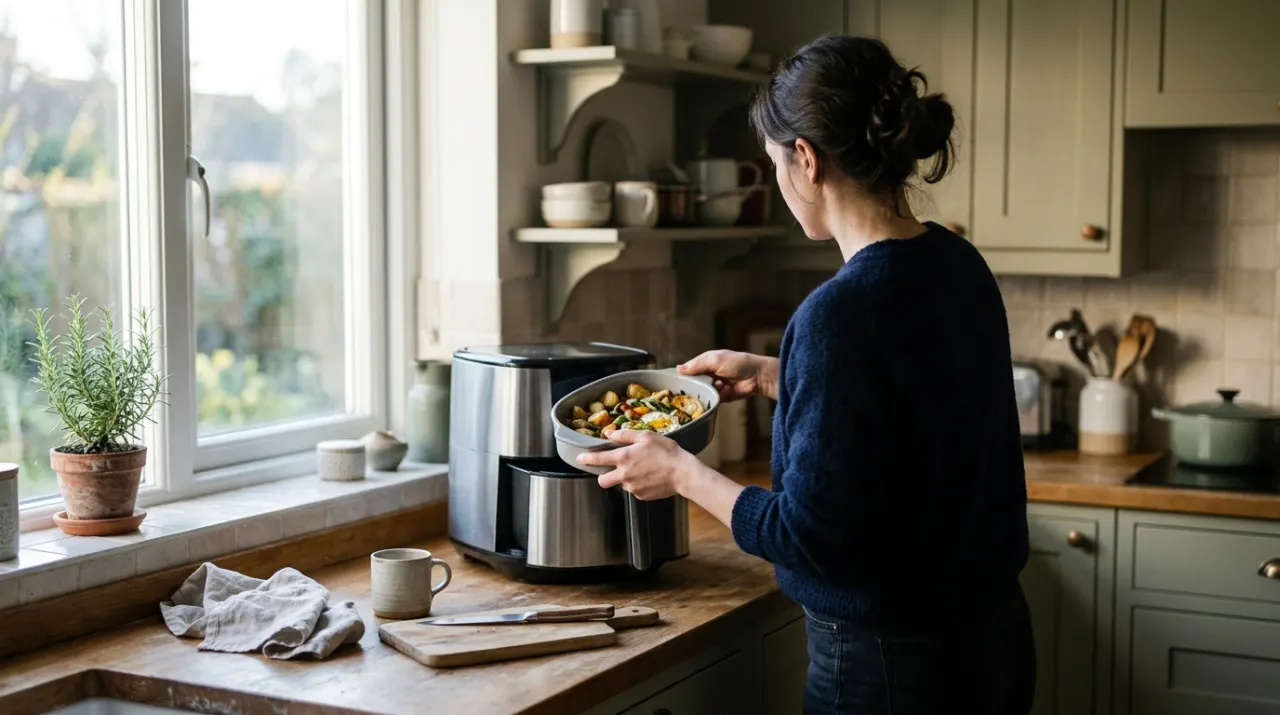
- Surface and clearance. Put it on a heat-resistant counter, not on wood without protection, and keep it several inches from the wall and from any upper cabinet. The steam that vents from under the lid is what damages cabinetry over time.
- Direct wall outlet. Never an extension cord or light-duty power strip. The draw is low, but a heating appliance on a marginal cord is an avoidable risk and the cord should be inspected for damage before each long cook.
- Cord routing. Keep it out of reach of children, pets and anything that could pull the unit off the counter.
- Thawed ingredients. The USDA advises against putting frozen meat in a slow cooker, because it lengthens the time the contents spend in the danger zone.
- Fill level. Half to two-thirds full. Underfilled, the food sits below the heated side walls and scorches. Overfilled, the center never gets safely hot and the lid seal fails.
- No thermal shock. Do not put a cold ceramic crock straight from the refrigerator into a preheated base, which can crack it.
How long is too long for the food?
The appliance can run longer than most food should cook. This is where all-day plans actually go wrong — not with safety, but with texture.
| Ingredient | Good on low | Suits a 10-hour day? |
|---|---|---|
| Pork shoulder, beef chuck | 8 to 10 hours | Yes |
| Beef short ribs, shank | 8 to 10 hours | Yes |
| Dried beans, root vegetables | 8 to 10 hours | Yes |
| Chicken thighs | 5 to 6 hours | Only with keep-warm |
| Chicken breast | 3 to 4 hours | No |
| Pork loin | 4 to 5 hours | No |
| Fish, shellfish | 30 to 60 minutes | No |
The practical solution for a long workday is a programmable cooker that switches to keep-warm when the timer expires. Keep-warm typically holds around 165 degrees Fahrenheit, safely above the danger zone but low enough that the food stops actively cooking. Choosing a cut that suits a ten-hour window is the other half of the answer.
What about a power outage while you are out?
This is the one genuine risk of an all-day cook, and it is worth thinking through rather than dismissing. If power fails and returns while you are away, the food may have sat in the 40 to 140 degree range for hours, and there is no way to reconstruct how long. The USDA position is unambiguous: discard perishable food that has been between 40 and 140 degrees Fahrenheit for more than two hours.
Two things help. A cooker with a digital display that resets to a default state after an outage gives you a visible signal that power was interrupted — an analog dial tells you nothing. And a cheap plug-in outage indicator, or simply checking whether the kitchen clock is flashing, answers the question in seconds. When in doubt, throw it out; the meal is worth less than the risk.
Where to go next
Overnight is the same question with different lighting — see leaving a slow cooker on overnight. On results, whether you can overcook meat and what temperature a slow cooker reaches on low cover the timing side, and slow cooker electricity use the cost. If your machine has no timer, programmable versus manual is the upgrade to consider, and the best slow cookers ranks models on aggregated owner ratings, inside the small kitchen appliances hub.
We never buy or physically handle the products we rank — our picks come from aggregated owner reviews and expert consensus, explained on how we rank. Follow your own appliance manual for placement and clearance.