 Garden

Affiliate Disclosure
Some links on this page are affiliate links. As an Amazon Associate, we earn from qualifying purchases — at no extra cost to you. We do not buy, test, or physically handle the products we cover; our rankings come from aggregated owner reviews, ratings and expert consensus. Commissions never change our verdicts. How we rank · full disclosure.
The verdict: the Cosori 1.7-liter stainless kettle is the buy for anyone who wants boiling water without it sitting against plastic on the way. It earns 4.5 stars on a simple proposition — a stainless water path, a wide opening that makes descaling easy, and 1,500 watts of the maximum a US outlet allows — at around $40. Descaling is not optional in most of the country: the USGS classifies water above 180 mg/L of dissolved calcium and magnesium as very hard. Skip it if you drink green tea or brew pour-over coffee and need temperature control, or if a hot metal exterior is a problem in your kitchen.
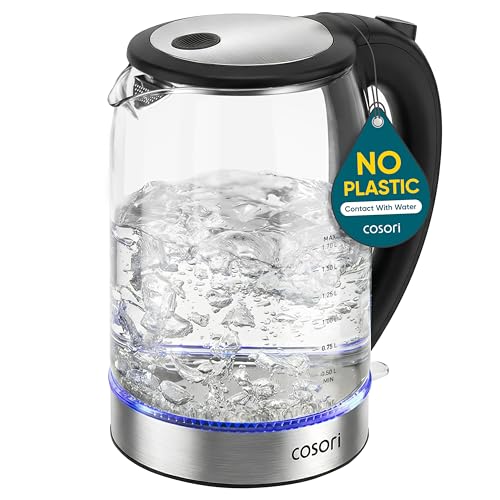
Best for anyone who wants boiling water fast with no plastic touching it
- Food-grade stainless interior — no plastic contacts the water
- 1,500 watts, boils a full 1.7 liters in roughly 5 to 7 minutes
- Wide opening for hand-cleaning and descaling
- Auto shut-off, boil-dry protection and a 360-degree cordless base
Why buy it: the cheapest credible way to stop drinking water that has been boiled inside a plastic tank.
What owners consistently praise
The plastic-free water path is why people buy it, and it is the thing they stay happy about. A conventional plastic-tank kettle holds water at 212°F against a polymer wall several times a day, and owners who switched consistently report that the taste difference is noticeable — not subtle chemical taste, just the absence of the faint flatness they had stopped noticing. Whether the concern is taste or materials, this is a $40 solution to it, which is the whole appeal.
The wide opening is quietly the best feature. Most kettles have a lid aperture too narrow to get a hand or a sponge through, which means limescale accumulates where you cannot reach it and cleaning becomes a vinegar-only proposition forever. This one opens wide enough to wipe out the interior properly, and owners who have fought with narrow-necked kettles mention it repeatedly.
Speed and the safety basics are handled. Full 1.7 liters in roughly five to seven minutes, a single mug in under two, a 360-degree cordless base you can lift the kettle from at any angle, auto shut-off at boil, and boil-dry protection that cuts the element if you switch it on empty. None of that is exotic; all of it is present, which at this price is not guaranteed. Owners also note the boil is quieter than the cheap plastic kettles they replaced.

What owners actually complain about
The exterior gets hot — properly hot. Single-wall stainless conducts, so the body is at close to water temperature while it boils and for some minutes after. People who assumed a metal kettle would be cool-touch are surprised, and it is a genuine consideration in a household with small children. The handle is fine; the body is not something to grab. This is the most common substantive complaint in the record and it is a design characteristic rather than a fault.
The lid draws mixed reports. Some owners find the release awkward one-handed, some report it opening more forcefully than expected when the button is pressed, and a minority report steam escaping around the seam. Refilling therefore usually needs two hands, and the steam issue is worth watching for in the first week — if it is venting from the seam rather than the spout, that is a return, not a quirk.
There is no water-level window. With an opaque stainless body you either open the lid to look or you learn to judge by weight. There are interior fill markings, but you have to open the kettle to read them. Minor, but a daily minor.
Limescale is visible and inevitable on stainless. On hard water a white crust builds on the element plate within weeks, and while it is harmless it looks worse on shiny steel than it does hidden inside a plastic tank. Monthly descaling with a 1:1 vinegar solution keeps it in check — see how to descale an electric kettle with vinegar. Owners who skip it report slower boils and a rattling element, which is the standard path to an early failure — the USGS notes that heating hard water forms solid calcium carbonate deposits that cut efficiency and shorten equipment life. Speaking of which: the failure mode owners do report, usually somewhere in years two to four, is the element or the switch giving out rather than anything leaking.
One more thing worth flagging: the spout can dribble if you pour slowly. Pour with intent and it is fine.

Who should buy something else
If you drink green, white or oolong tea, or brew pour-over coffee, buy a variable-temperature kettle instead. Green tea scorches above roughly 175°F and produces a bitter cup; pour-over coffee wants about 200°F, not a rolling boil. The Cuisinart CPK-17 PerfecTemp gives you six presets and a keep-warm function for roughly double the price — our Cuisinart electric kettle review covers it in full. Serious pour-over people should go further and buy a gooseneck.
If a hot exterior is a dealbreaker, look for a double-wall or cool-touch model; you give up some of the stainless simplicity and pay a little more. If you boil only one mug at a time, a 1-liter kettle takes less counter space and heats faster. The full field, ranked on the same owner-review basis, is in our best electric kettle roundup.

Specifications
| Capacity | 1.7 liters (approx. 7 cups) |
| Power | 1,500 watts |
| Water path | Food-grade stainless steel, no plastic contact |
| Full-kettle boil time | Approx. 5 to 7 minutes |
| Temperature control | None — boil only |
| Safety | Auto shut-off, boil-dry protection |
| Base | 360-degree cordless |
| Owner rating | 4.5 stars (verified, see card above) |
How we reached this verdict
We do not boil water in these kettles. This review is drawn from the aggregated owner-review record, weighted toward reviews written six months or more after purchase, where scaling, element failures and lid problems actually surface. The star rating and review count on the card above come from licensed Amazon listing data and refresh automatically, so nothing on this page is a hand-typed statistic. Full method: how we rank.
Check price on Amazon → (paid link)
More from this hub: small kitchen appliances · best electric kettle · how long does an electric kettle last · how many watts does an electric kettle use · how we rank.