 Garden

Affiliate Disclosure
Some links on this page are affiliate links. As an Amazon Associate, we earn from qualifying purchases — at no extra cost to you. We do not buy, test, or physically handle the products we cover; our rankings come from aggregated owner reviews, ratings and expert consensus. Commissions never change our verdicts. How we rank · full disclosure.
The verdict: the Cuisinart CPK-17 is the kettle to buy if you drink green or white tea, or brew pour-over coffee, and are tired of guessing. It earns 4.5 stars on six well-chosen presets and a keep-warm function at a price where most kettles offer a single on switch. Skip it if you want zero plastic contact with your water, if you only ever make black tea or instant coffee, or if you want a kettle that lasts a decade.
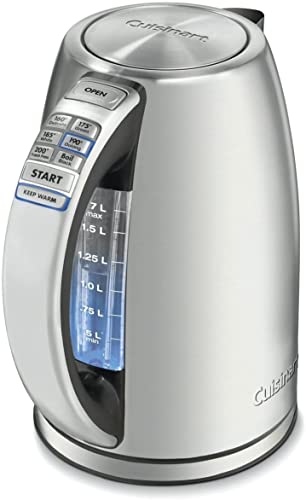
Best for tea drinkers who need 175°F for green tea and 212°F for everything else
- Six preset temperatures from 160°F to a full boil
- 1,500 watts, 1.7-liter capacity, cordless 360-degree base
- 30-minute keep-warm function
- Removable scale filter and boil-dry protection
Why buy it: six presets covering every tea style, at a price where most kettles give you one button marked on.
What owners consistently praise
The presets are chosen well and labeled usefully. Rather than an abstract dial, you get six buttons mapped to what people actually brew: delicate green at around 160°F, green at 175°F, white at 185°F, oolong at 190°F, French press at 200°F, and a full boil at 212°F. Green tea brewed at boiling turns astringent because the leaf gives up its bitter compounds too quickly — that is a genuine, tasteable difference, and owners who switched from a boil-only kettle describe it as the reason they stopped drinking bad green tea at home.
It is fast and it is quiet. Fifteen hundred watts is the practical ceiling on a US 120-volt circuit, and this kettle uses all of it: a mug in well under two minutes, the full 1.7 liters in roughly five to seven. Owners consistently note it is quieter in operation than the cheap plastic kettles they replaced.
The details are considered. A 360-degree cordless base you can lift the kettle from at any angle, a blue backlit water window, a removable scale filter in the spout, boil-dry protection, a two-minute memory that lets you lift the kettle to pour and return it without losing the cycle, and a 30-minute keep-warm. Together they explain why this model has been a category default for many years rather than a recent arrival.
What owners actually complain about
Plastic touches the water. The body is stainless, but the lid assembly and interior fittings are not, and the water gauge is plastic. For a meaningful group of buyers this is the whole issue — they wanted stainless specifically to avoid hot water sitting against polymer, and the marketing photography does not make the distinction obvious. It is the most-repeated substantive criticism in the record, and it is a legitimate one. If it matters to you, the fully stainless boil-only route is the answer.
Longevity is average. The pattern in reviews written two to four years out is control-board or element failure, which puts the coverage document in play: the FTC notes a written warranty must be available to read before you buy, and that implied warranties exist in every state whether or not one is written. That is not unusual for an electric kettle, but it is disappointing at a price roughly double a basic model. Descaling is the biggest lever an owner controls: scale insulates the element, the element runs hotter to compensate, and it fails sooner. The USGS notes that heating hard water forms solid calcium carbonate deposits that cut efficiency and shorten equipment life, which is exactly that mechanism. Monthly on hard water, quarterly on soft — see how to descale an electric kettle with vinegar.
Keep-warm is fixed at 30 minutes. Not adjustable, not extendable. Owners who wanted an hour say so often. Given the kettle re-boils a mug in under two minutes, this is a mild irritation rather than a failure, but it should not be a limitation at this price.
Temperature accuracy drifts on some units. A minority of owners report presets landing several degrees off the marked figure, and scale build-up makes it worse over time. For tea this is within tolerance; for anyone chasing a precise pour-over temperature, a kettle with a digital readout and a variable set point is the better tool.
Smaller notes: the lid opens with some force and releases a burst of steam, so keep your hand clear; and the beeper at the end of the cycle is loud enough that owners in open-plan homes mention it.
Who should buy something else
If you want no plastic touching the water, buy a fully stainless boil-only kettle. Our Cosori electric kettle review covers the obvious candidate — around $40, stainless water path, wide opening for cleaning — with the trade being no temperature control at all.
If you brew pour-over coffee seriously, a gooseneck kettle with a digital set point is the right tool: the narrow spout controls the pour rate, which affects extraction as much as temperature does. If you only drink black tea or instant coffee, temperature presets are money spent on a feature you will never touch — buy the cheapest well-rated boil-only kettle and put the savings into better tea. The full ranked field is in our best electric kettle roundup.
Specifications
| Model | Cuisinart CPK-17 PerfecTemp |
| Capacity | 1.7 liters |
| Power | 1,500 watts |
| Presets | 6, approx. 160°F / 175°F / 185°F / 190°F / 200°F / boil |
| Keep warm | 30 minutes, fixed |
| Body | Stainless exterior; some plastic in the water path |
| Safety | Boil-dry protection, auto shut-off |
| Extras | Removable scale filter, 360-degree cordless base |
| Owner rating | 4.5 stars (verified, see card above) |
Which preset for which drink
The presets only pay for themselves if you use the right one, and most owners settle into two or three. Green tea is the one that changes most: brewed at a rolling boil it turns astringent within a minute, while 175°F produces a sweeter, rounder cup from the same leaf. White tea sits slightly higher at 185°F, oolong at 190°F. Black tea and herbal infusions genuinely want a full boil — using a lower setting there produces a weak, flat cup, which is the opposite mistake and just as common.
| Drink | Setting | Why |
|---|---|---|
| Delicate green, gyokuro | ~160°F | Prevents the leaf scorching and turning bitter |
| Green, sencha | ~175°F | The standard green tea window |
| White tea | ~185°F | Enough heat to extract without harshness |
| Oolong | ~190°F | Partial oxidation takes more heat than green |
| Pour-over, French press | ~200°F | Just off boil, the coffee extraction target |
| Black tea, herbal, instant | 212°F | Needs a full boil to extract properly |
One practical note that saves a lot of frustration: the kettle measures the water, not the cup. Pouring 200°F water into a cold ceramic mug drops the brewing temperature by several degrees immediately, so pre-warming the vessel matters as much as the preset does for anything you are being precise about.
How we reached this verdict
We do not boil water in these kettles. This review is assembled from the aggregated owner-review record, weighted toward reviews written a year or more after purchase, where scale-related failures, temperature drift and board faults actually surface. The star rating and review count on the card above are pulled from licensed Amazon listing data and refresh automatically, so nothing here is a hand-typed statistic. Full method: how we rank.
Check price on Amazon → (paid link)
More from this hub: small kitchen appliances · best electric kettle · how long does an electric kettle last · how much electricity does an electric kettle use · how we rank.