 Garden

Affiliate Disclosure
Some links on this page are affiliate links. As an Amazon Associate, we earn from qualifying purchases — at no extra cost to you. We do not buy, test, or physically handle the products we cover; our rankings come from aggregated owner reviews, ratings and expert consensus. Commissions never change our verdicts. How we rank · full disclosure.
There is no single best concrete crack filler, because there is no single kind of crack. A hairline in a garage floor, a half-inch gap across a driveway that opens every January, a spalled step edge and a leaking basement wall are four different repairs needing four different chemistries. Buy the wrong one and it fails within a year — usually by reopening right beside the patch, which owners reasonably read as the product not sticking when it is actually the product being too rigid for a crack that moves.
So the useful question is not "what is the best filler" but "what kind of crack is this". Get that right and any of the products below will hold for years.
Top Picks at a Glance
Match the Product to the Crack
| Crack | Product type | Our pick | Why |
|---|---|---|---|
| Hairline to 1/4 in, flat slab | Pourable self-leveling | DAP Liquid Cement Crack Filler | Flows to the bottom; a trowel just bridges it |
| 1/4 to 1/2 in, stable | Pre-mixed trowelable patch | Red Devil 0641 | Fills volume, matches weathered gray |
| Reopens every winter | Flexible polyurethane | Sikaflex Crack Flex | Stretches with seasonal movement |
| Spalled edge or chipped step | Shapeable acrylic patch | Sikacryl ready-mix | Feathers and holds a formed edge |
| Leaking basement wall | Urethane injection kit | RadonSeal kit | Fills through the wall, not just the face |
| Wider than 1 in, or slab rocking | Neither — get an opinion | — | Symptom of base failure below the slab |
Our #1 Pick: Red Devil 0641
The gallon tub of pre-mixed Red Devil patch is the default for a reason that has nothing to do with performance ceilings: it removes the two steps most DIY concrete repairs fail at. There is no water-to-powder ratio to guess, and there is no tinting decision, because it cures to a gray close enough to weathered concrete that a repair on a driveway is unremarkable from standing height.
It handles the range most people actually face — cracks from roughly an eighth of an inch to half an inch, shallow spalls, and the ragged edge where a driveway meets a garage apron. Owners consistently report that it goes on like thick paste, tools easily with a putty knife, and holds for years on stable cracks.
The honest limits are worth stating. It is a cement-based product and it is essentially rigid, so it is the wrong choice for a crack that has reopened before — buy the Sikaflex for that. It does not fill a hairline crack, because it cannot flow into one; use the pourable DAP. And a gallon skins over once opened, so for a single small repair the squeeze tube version is the sensible buy.
Check price on Amazon → (paid link)
The Ranked Field

Best for general driveway, walkway and patio cracks up to about 1/2 inch
- Pre-mixed — no water, no ratio to get wrong
- Gallon tub with a trowelable consistency
- Gray finish close to weathered concrete
- Paintable once fully cured
Why buy it: the most-owned pre-mixed concrete patch in the country, and the reason is that it removes the two steps people get wrong — mixing and matching color — for the price of a takeout meal.
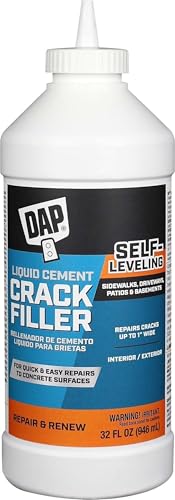
Best for hairline to 1/4-inch cracks in a flat slab
- Self-leveling liquid that flows into narrow cracks
- Squeeze bottle applicator — no tools needed
- Textured gray that blends on broom-finish concrete
- Sets in a few hours in warm weather
Why buy it: thin cracks are the ones a trowelable patch bridges rather than fills, and a pourable filler is the only thing that actually reaches the bottom of a 1/8-inch crack.

Best for cracks that open and close through the freeze-thaw cycle
- Polyurethane, so it stays permanently flexible
- Self-leveling in a horizontal crack
- Textured gray finish rather than smooth caulk gloss
- Bonds to concrete, masonry and stone
Why buy it: a rigid cement patch in a crack that moves seasonally will simply crack again beside the repair; polyurethane flexes with it, which is why this is the product to use on anything that has reopened before.

Best for spalled edges, chipped steps and shallow surface damage
- Acrylic-modified ready-mixed patch, no mixing required
- Feathers to a thin edge without crumbling
- Sandable and paintable when cured
- Interior and exterior rated
Why buy it: the product for damage that is a missing chunk rather than a line — spalled step nosings and broken edges need something you can shape, not something that pours.

Best for a leaking poured-concrete basement wall crack
- Injection kit with surface ports, paste and urethane cartridges
- Low-viscosity urethane travels the full depth of the wall
- Expands on contact with moisture to seal a wet crack
- Covers about 10 feet of crack
Why buy it: a surface patch on a leaking foundation crack fails because water pressure is behind it; injection fills the crack through the wall thickness, which is the only DIY approach that actually addresses the mechanism.

Best for one crack, one afternoon, no leftover tub going hard in the garage
- Squeeze tube sized for a single small repair
- Same pre-mixed formula as the gallon version
- No tools beyond a putty knife
- Gray finish, paintable when cured
Why buy it: the honest answer for a single crack in a garage floor — buying a gallon for a two-foot repair means throwing most of it away when it skins over.
Quick Comparison
| Product | Best for | Rating | Price | Buy |
|---|---|---|---|---|
| Red Devil 0641 Concrete Repair Patch and Cement Crack Filler, Pre-Mixed, 1 Gallon, Gray | Best Overall | — | Check (paid link) | |
| DAP Liquid Cement Crack Filler, Ready to Use, Gray, 32 Ounces | Best Pourable | — | Check (paid link) | |
| SIKA Sikaflex Crack Flex Sealant, Gray, Textured Self-Leveling Polyurethane, Waterproof | Best for Moving Cracks | — | Check (paid link) | |
| Sika Sikacryl Ready-Mix Concrete Patch for Repairing Spalls and Cracks in Concrete and Masonry | Best Trowelable Patch | — | Check (paid link) | |
| RadonSeal Complete DIY Foundation Crack Repair Kit, 10 Feet, Low-Viscosity Urethane Injection | Best for Foundation Cracks | — | Check (paid link) | |
| Red Devil 0645 Concrete Repair Patch and Cement Crack Filler, 5.5 Ounce Squeeze Tube, Gray | Best Small Repair | — | Check (paid link) |
Preparation Is Most of the Repair
Crack fillers fail on dirty cracks far more often than on bad chemistry. The sequence that works:
- Open the crack. Widen very narrow cracks slightly with a cold chisel or a crack-chasing wheel on an angle grinder, and undercut the edges so the repair is wider at the bottom than the top — a keyed repair cannot lift out.
- Remove everything loose. A wire brush, then a shop vac. Any crumb left behind becomes a bond breaker.
- Wash and dry. Oil and efflorescence stop adhesion cold. Degrease oil stains, rinse, and let the concrete dry fully — most fillers want a dry substrate, and a damp slab is a common cause of a repair lifting.
- Backer rod deep cracks. Push foam backer rod in to leave roughly a half-inch depth of filler. Depth is not strength here; it is shrinkage waiting to happen.
- Fill in passes. Two or three thin applications with cure time between them beat one deep pour, which shrinks and dishes as it sets.
- Match the texture. On broom-finish concrete, drag a dry brush across the filler as it starts to set. It is a thirty-second step and it is the difference between a repair you notice and one you do not.
- Mind the weather. Most products want 50°F and rising, no rain for 24 hours, and shade rather than blazing sun.
How We Rank
We do not buy or apply these fillers. Rankings come from aggregated owner ratings across the most-owned concrete repair products on the US market, weighted toward reviews written a year or more after the repair — because in this category the only review that matters is whether the crack came back. Four things carry the weight: fitness for a defined crack type, since the same product can be excellent and useless depending on width; flexibility, because seasonal movement is the dominant failure mechanism; color and texture match on cured concrete, which drives more dissatisfaction than performance does; and application forgiveness, meaning how badly the product punishes an imperfect crack or a marginal weather window. Prices were checked at the time of writing. Full method: how we rank.
The Field, Reviewed
1. Red Devil 0641 — Best Overall
Covered above. Owners praise: pre-mixed convenience, a workable gray, and durability on stable driveway and walkway cracks. Owners gripe about: color drifting lighter than surrounding concrete as it dries, shrinkage in deep cracks filled in one pass, and the tub skinning over once opened. Check price (paid link).
2. DAP Liquid Cement Crack Filler — Best Pourable
The right tool for narrow cracks, which is where most people reach for the wrong product. It pours from the bottle, self-levels, and reaches the bottom of a crack a trowel would simply span.
Owners praise: how quickly a long hairline crack disappears, no tools required, and a texture that blends on broom-finished slabs. Owners gripe about: settling below the surface as it cures so a second pass is usually needed, and running away into wide or deep cracks it was never meant for. Check price (paid link).
3. Sikaflex Crack Flex Sealant — Best for Moving Cracks
The product to buy when a repair has already failed once. Polyurethane stays elastic for its whole service life, so a crack that opens a sixteenth of an inch every January stretches the sealant instead of splitting it.
Owners praise: repairs that survive multiple winters, a textured finish that does not read as caulk, and genuine waterproofing. Owners gripe about: cost per foot compared with a tub of patch, a working time that punishes hesitation, and difficulty tooling it neatly in cold weather. Check price (paid link).
4. Sika Sikacryl Ready-Mix Patch — Best Trowelable Patch
For damage that is a missing piece rather than a line. Spalled step nosings, chipped edges and shallow surface loss need a material you can shape and feather, and this holds an edge without crumbling as it dries.
Owners praise: feathering to a thin edge, sanding and painting cleanly, and no mixing. Owners gripe about: a smoother finish than surrounding broom-finish concrete unless textured deliberately, and shrinkage on deep fills. Check price (paid link).
5. RadonSeal Foundation Crack Repair Kit — Best for Foundation Cracks
A different category of repair. Patching the face of a leaking basement crack fails because groundwater pressure is behind it; injection drives low-viscosity urethane through the full wall thickness, where it expands on contact with moisture and seals the crack along its length.
Owners praise: leaks stopping outright, complete kits with everything included, and clear instructions for a job most people have never done. Owners gripe about: the price against a tube of sealant, a fiddly port-setting stage, and cartridges curing fast once opened. Note that a structural crack — one that is widening, or offset — is an engineering question, not a sealing one. Check price (paid link).
6. Red Devil 0645 Squeeze Tube — Best Small Repair
Same formula as the gallon, in the quantity most single repairs actually need. Buying a gallon for a two-foot crack means paying to store hardened patch in your garage.
Owners praise: the price, no waste, and needing nothing but a putty knife. Owners gripe about: running out mid-repair on anything longer than a few feet, and the same color-lightening as the gallon version. Check price (paid link).
What Owners Actually Complain About
Color mismatch. The most frequent complaint in the category and the least mentioned before purchase. Cement-based fillers dry lighter than aged concrete, and the difference is most visible on a driveway seen at a distance. Texturing the surface as it sets helps more than tinting does.
The crack coming back. Almost always a rigid product in a crack that moves. Diagnose the movement before choosing the material.
Shrinkage and dishing. Caused by filling deep in one pass. Backer rod and multiple passes eliminate it.
Poor adhesion. Dirty, oily or damp cracks. Preparation is most of this job and is where the time goes.
The Verdict
Diagnose first, buy second. Narrow cracks in a sound slab: DAP Liquid Cement Crack Filler. General driveway and walkway cracks: Red Devil 0641. Anything that has reopened before: Sikaflex Crack Flex. Broken edges and spalls: Sikacryl. A leaking basement wall: the RadonSeal injection kit, and an engineer if the crack is growing. Then seal the slab, because water getting in and freezing is what made the crack in the first place. Check price on Amazon → (paid link)
More from this hub: Landscaping & Hardscaping · How to fill cracks in a driveway · Best driveway sealer · How to lay a paver patio · How we rank.