 Garden

Affiliate Disclosure
Some links on this page are affiliate links. As an Amazon Associate, we earn from qualifying purchases — at no extra cost to you. We do not buy, test, or physically handle the products we cover; our rankings come from aggregated owner reviews, ratings and expert consensus. Commissions never change our verdicts. How we rank · full disclosure.
Solid stain lasts the longest of any deck finish, and it is the one decision on a deck you cannot easily undo. Expect four to six years on a deck floor and six to eight on railings and fences — roughly double a semi-transparent. That comes from pigment, because pigment blocks the ultraviolet light that destroys the wood surface, and a solid stain is essentially all pigment.
The price is that you will never see the grain again. A solid stain is an opaque film sitting on top of the boards. Semi-transparent stain cannot be applied over it later, because there is nothing for it to soak into. The only route back to visible wood is stripping and sanding every square inch, spindles and board gaps included. That is the one-way door, and it is the single most important thing to understand before you open a can.
An Honest Note on This Category
Solid deck stain has a thinner online review record than any other opacity, and that is worth saying plainly rather than papering over. Most solid stain is bought in a store and tinted at the counter from a base, so the well-reviewed, ready-mixed, ship-to-your-door options are genuinely limited — a handful of pre-tinted colors from a few brands, with review counts in the hundreds rather than the thousands you see on semi-transparent stains. We have ranked six products that clear our bar for owner rating and volume, but the field is smaller than it looks, and if you want a specific color you may well be better served at a paint counter than online. We would rather tell you that than pad the list with products nobody has reviewed.
Top Picks at a Glance
When Solid Is the Right Answer
Solid stain has a real job and it does it well. Choose it when:
- The boards are gray, blotchy and mismatched. An old deck that has been patched with new lumber will never look uniform under a transparent finish. Solid stain makes a repaired deck read as one surface.
- The deck was previously painted or solid-stained. If a film is already there and sound, staying solid is the only sane option — see the compatibility rules below.
- You want a specific color rather than a wood tone. Gray, taupe, deep brown, barn red. Transparent finishes can only tint the wood you have.
- You are finishing a fence or siding. This is where solid stain is genuinely at its best: vertical surfaces shed water, take glancing sun and see no foot traffic, so a solid film there commonly runs six to eight years.
- You do not want to think about it for five years. A legitimate reason. Solid is the lowest-maintenance-frequency option available.
And choose something else when the wood is sound and attractive, when you might want to change your mind, or when the deck is dense tropical hardwood like ipe — a film will not stay on it. Our deck stain picks cover every opacity side by side, and best semi-transparent deck stain covers the usual middle ground.
Service Life by Opacity and Surface
The USDA Forest Service's Wood Handbook chapter on finishing wood is the standard reference for exterior finish performance, and the pattern it documents — pigmented film-formers substantially outlasting unpigmented penetrating finishes — matches what owners report.
| Opacity | Deck floor | Rails, fence, siding | Failure mode | Reversible? |
|---|---|---|---|---|
| Clear water repellent | 1–2 years | 2–3 years | Simply stops repelling; wood grays | Yes |
| Semi-transparent | 2–3 years | 3–5 years | Fades and wears thin | Mostly |
| Semi-solid | 2–4 years | 4–6 years | Fades, some flaking | With effort |
| Solid color | 4–6 years | 6–8 years | Peels where moisture gets under | No, not practically |
The Compatibility Rules That Decide Everything
- Solid over bare, clean, dry wood: fine. This is the ideal case. Clean, brighten, dry, coat.
- Solid over a sound existing solid stain of the same type: fine. Clean it, spot-scrape anything loose, prime bare patches if the label says to, then coat.
- Solid over a failing solid stain: this is how people get peeling. You are bonding a new film to a layer that has already let go of the wood, and it will lift as one sheet, usually within a year. Every peeling area has to be stripped and scraped back to sound material first. This is the mistake, more than any other, that generates one-star reviews in this category.
- Solid over semi-transparent: usually workable if the old stain is worn and the surface is cleaned, but check the label — some solids want a bare or primed surface.
- Semi-transparent over solid: does not work. Ever. There is nothing to penetrate.
- Solid on ipe or other dense tropical hardwood: does not work. The wood is too dense and too oily to hold a film, which flakes off in months. Use a hardwood penetrating oil instead.
Our #1 Pick: Olympic Maximum Solid Color
In a category where most products carry a few dozen reviews, Olympic Maximum Solid has a genuinely large and long ownership record — and on a finish you are committing to for five years, that is worth more than a marginal spec advantage. You can see what owners say at year three and year four rather than year one, and you can walk into a store and buy the same color again when a rail needs a touch-up.
Practically, it does the solid-stain job well: high hide over mismatched and replaced boards, a finish that settles into the wood texture rather than sitting on it like paint, and a formulation that tolerates being applied to slightly damp wood, which widens the weather window more than owners expect.
The honest caveats are the category's caveats rather than this product's. Traffic paths on a deck floor show wear before the rest does. Any spot where water gets under the film — a shaded corner, a board that stays wet, an unfinished underside — will eventually peel there. And it is permanent: you are not going back to visible grain without a strip.
Check price on Amazon → (paid link)
The Ranked Field

Best for a weathered, patched or previously painted deck that needs everything hidden
- Opaque acrylic film — hides grain, color variation and replaced boards
- Rated for decks, fences and siding
- Tolerates application to damp wood, which widens the weather window
- Widely stocked, so color matching for a touch-up is easy years later
Why buy it: the solid stain with the largest and longest ownership record of anything in this field, which matters more than a marginal spec difference: you can see how it behaves in year four and buy the same color again.

Best for fences, railings and vertical surfaces more than deck floors
- Water-based opaque stain and sealer in one
- Low odor and low VOC — legal in restricted jurisdictions
- Soap-and-water cleanup
- Can be applied to damp wood
Why buy it: the easiest solid stain to live with while applying it — no solvent smell, no rag fire risk, and a finish that holds color well on the vertical surfaces where solid stains do their best work.

Best for large runs of fence and siding where coverage per gallon decides the budget
- Opaque acrylic aimed at vertical exterior wood
- High hide over mismatched and previously coated boards
- Good build in a single coat on fence pickets
- Long-standing brand with predictable color
Why buy it: solid stain earns its keep fastest on vertical wood, where it commonly runs six to eight years, and this is a straightforward high-hide product for exactly that job.

Best for keeping a deck cooler underfoot than a dark solid would
- Opaque water-based finish in a light cedar tone
- Lighter colors run measurably cooler in direct sun than dark browns
- Low odor, water cleanup
- Same chemistry as the Chestnut Brown version
Why buy it: a genuinely practical reason to choose color rather than taste — a dark solid stain on a south-facing deck gets hot enough to be unpleasant barefoot, and a light one does not.

Best for high-UV climates where cheap solids chalk and fade
- Water-based opaque acrylic with a strong UV package
- Aimed at fade and chalk resistance rather than lowest cost
- Low VOC and low odor
- Recoats over itself without stripping
Why buy it: solid stains fail cosmetically by chalking and fading long before they fail structurally, and paying up for the UV package is the one upgrade in this category that shows.
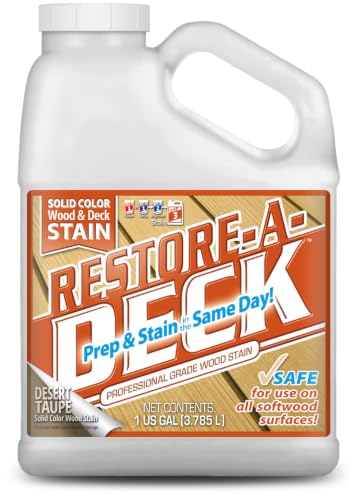
Best for a restoration project where prep products and stain come from one system
- Water-based opaque stain from a wood-restoration product line
- Designed to pair with the same brand’s cleaner and brightener
- Muted, low-sheen colors rather than glossy hide
- Small brand — thinner review record than the majors
Why buy it: if you are stripping and restoring an old deck, using a cleaner, brightener and stain designed as one system removes a genuine source of incompatibility.
Quick Comparison
| Product | Best for | Rating | Price | Buy |
|---|---|---|---|---|
| Olympic Maximum Solid Color Wood Stain & Sealer in One, Oxford Brown, 1 Gallon | Best Overall | — | Check (paid link) | |
| Thompson’s WaterSeal Solid Color Waterproofing Wood Stain and Sealer, Chestnut Brown, 1 Gallon | Best Water-Based | — | Check (paid link) | |
| Flood Solid Pro Exterior Wood Stain, Cedar, 1 Gallon | Best for Fences and Siding | — | Check (paid link) | |
| Thompson’s WaterSeal Solid Color Waterproofing Wood Stain and Sealer, Natural Cedar, 1 Gallon | Best Light Color | — | Check (paid link) | |
| DEFY Solid Color Wood Stain, UV Resistant Opaque Exterior Deck and Fence Finish, 1 Gallon | Best Premium | — | Check (paid link) | |
| Restore-A-Deck Solid Color Stain for Decks & Exterior Wood, Desert Taupe, 1 Gallon | Best Small-Batch Specialist | — | Check (paid link) |
Application: Where Solid Stains Go Wrong
- Never coat a damp board. A film over trapped moisture is the number one cause of peeling. Give the deck 24 to 48 hours of dry weather after washing, then sprinkle a tablespoon of water on it — if it soaks in and darkens within a minute, you are ready.
- Never coat in direct sun. Above roughly 90°F on the board surface, the carrier flashes off before the film levels and bonds. Work in shade, early or late.
- Two thin coats, not one heavy one. A heavy coat traps solvent or water underneath, stays soft, and peels sooner. Respect the recoat interval on the label.
- Finish the board ends and the gaps. End grain drinks water and it is where film failure starts. A brush along the gaps and ends is worth the extra half hour.
- Do the railings before the floor. Top-down means drips land on boards you have not coated yet.
- If the deck is new, wait. Mill glaze and factory moisture in fresh pressure-treated lumber both prevent adhesion. See when to stain a new deck, and note that a solid stain over unweathered treated lumber is one of the most reliable ways to produce a peeling deck.
Full sequence with cleaning and brightening steps in how to stain a deck.
Safety: Oil-Based Products and Rag Fires
Most modern solid stains are water-based acrylics, which do not carry this risk. But if you use an oil-based solid stain, an oil-based primer, or a teak or linseed oil anywhere in the job, the rags matter. Oil-soaked rags generate heat as the oil oxidizes, and if that heat cannot escape — balled up, piled, or in a closed plastic bin — the temperature climbs on its own until the rag ignites. No spark, no flame, nobody in the room.
Following the NFPA oily rags safety tip sheet: lay each rag out flat and separated on a non-combustible surface outdoors until bone dry and stiff, or submerge them in water in a sealed metal container, or use a listed metal oily-waste can with a self-closing lid. Never bunch them, never bag them, never leave them in a garage or basement overnight. Rollers, pads and drop cloths count too.
Also check your local rules before buying a solvent-based product. VOC content in architectural coatings is regulated federally under the Clean Air Act — the EPA's architectural coatings compliance guide is the reference — and many states and air districts set tighter limits, with Northeast states coordinating stricter model rules via the Ozone Transport Commission. Water-based solid stains sidestep the whole question.
How We Rank
We do not buy, brush or spray these stains. Rankings come from aggregated owner ratings across the solid-color exterior wood stains with meaningful review volume on the US market, weighted toward reviews written after at least one full summer and winter, because film failure is seasonal. Four things carry the weight: adhesion and peel resistance, which is the failure mode that defines this category; fade and chalk resistance, since solid stains almost always look bad before they perform badly; availability of the exact color, because a five-year finish will need a touch-up and a discontinued tone is a real problem; and honesty about surface suitability, particularly whether a product admits it is happier on fences than on deck floors. Prices were checked at the time of writing. Full method: how we rank.
The Field, Reviewed
1. Olympic Maximum Solid Color — Best Overall
Covered above. Owners praise: total coverage of mismatched and replaced boards, a long run on rails and vertical surfaces, easy color matching later, and tolerance of slightly damp wood. Owners gripe about: visible traffic wear paths on deck floors, peeling anywhere moisture gets under the film, and — the recurring one — that there is no going back. Check price (paid link).
2. Thompson’s WaterSeal Solid, Chestnut Brown — Best Water-Based
The easiest solid stain here to actually live with during the job: no solvent smell, no rag hazard, soap-and-water cleanup, and it can go on damp wood. It rates best in reviews describing fences, railings and siding rather than deck floors, which is consistent with how solid films behave.
Owners praise: low odor, easy cleanup, good hide in one coat on fence pickets, and a wide weather window. Owners gripe about: a thinner build than premium solids so deck floors need recoating sooner, and color that reads darker in place than on the swatch. Check price (paid link).
3. Flood Solid Pro, Cedar — Best for Fences and Siding
Solid stain earns its keep fastest on vertical wood, and this is a straightforward high-hide product aimed there. On a long fence run, coverage per gallon is what determines the bill.
Owners praise: hide over previously coated and mismatched boards, predictable color, and coverage on rough-sawn fence lumber. Owners gripe about: a thinner review record than the Olympic and Thompson's products, and availability that varies by region. Check price (paid link).
4. Thompson’s WaterSeal Solid, Natural Cedar — Best Light Color
The same product as the Chestnut Brown in a light tone, and the reason to consider it is thermal rather than aesthetic. A dark solid stain on a south-facing deck absorbs heat and gets genuinely unpleasant barefoot on an August afternoon; a light one does not. If your deck is in full sun and gets used with bare feet, color is a comfort decision.
Owners praise: a cooler surface than dark solids, easy application, low odor. Owners gripe about: that light colors show dirt, pollen and grill grease far more obviously, and a slightly lower rating overall than the darker version in the same line. Check price (paid link).
5. DEFY Solid Color Wood Stain — Best Premium
Solid stains almost always look tired before they stop working — the failure you notice at year three is chalking and fade, not peeling. DEFY's solid line is built around the UV package rather than around the lowest price per gallon, and that is the one upgrade in this category that visibly shows.
Owners praise: color retention in high-sun states, low odor, and clean recoating over itself. Owners gripe about: the price per gallon, a small pre-mixed color range, and a much thinner review record than the mass-market brands. Check price (paid link).
6. Restore-A-Deck Solid Color, Desert Taupe — Best Small-Batch Specialist
Worth knowing about if you are stripping and restoring an old deck rather than finishing a sound one. The cleaner, brightener, stripper and stain are designed as one system, which removes a genuine source of chemical incompatibility between prep and finish.
Owners praise: muted low-sheen colors that look like stained wood rather than paint, and prep products that work with the stain rather than against it. Owners gripe about: price, a small brand with a thin review record, and limited retail availability if you need more mid-job. Check price (paid link).
What Owners Actually Complain About
Peeling on deck floors. The defining complaint. Nearly every story starts with one of four things: a damp board, an unfinished underside letting the wood absorb from below, a second coat applied too soon, or a new film over an old failing one.
Traffic paths. An opaque film wears where feet go, and a worn path across a solid-stained deck looks worse than the general fading of a semi-transparent finish does. This is the honest cosmetic cost of the longer service life.
"I didn't know I couldn't go back." A recurring and genuinely sad theme in reviews. Nothing about the can makes clear that a solid film forecloses every transparent option in the future.
Dark colors get hot. A predictable and avoidable complaint. On a full-sun deck used barefoot, choose a light color.
Thin review records. Across the whole category, and worth factoring into your own risk. A product with 40 reviews may be excellent; it just cannot tell you what year four looks like.
The Verdict
If your deck is weathered, patched, previously painted, or you simply want a color rather than a wood tone, solid stain is the right product and it will outlast every alternative. Olympic Maximum Solid is the pick for a deck floor, on the strength of the longest ownership record in the field. Thompson's WaterSeal Solid is the easier product for fences and rails and the sensible choice in low-VOC jurisdictions. DEFY Solid is worth the premium in a high-UV climate. But go in clear-eyed: this is a permanent decision, moisture under the film is the enemy, and a solid stain over damp or unweathered wood is the fastest route to a peeling deck. Check price on Amazon → (paid link)
More from this hub: Landscaping & Hardscaping · Best deck stain · Best semi-transparent deck stain · How to stain a deck · How long deck stain lasts · How we rank.