 Garden

Affiliate Disclosure
Some links on this page are affiliate links. As an Amazon Associate, we earn from qualifying purchases — at no extra cost to you. We do not buy, test, or physically handle the products we cover; our rankings come from aggregated owner reviews, ratings and expert consensus. Commissions never change our verdicts. How we rank · full disclosure.
The short answer: the best fall lawn fertilizer for a cool-season lawn is Scotts Turf Builder WinterGuard Fall Lawn Food — formulated for the specific job fall feeding does, which is building roots and storing reserves rather than pushing leaf growth. Apply it roughly six weeks before your first hard frost. If you want soil improvement alongside the feed, The Andersons PGF Complete adds humic content that works through winter, and on sandy soil or a warm-season lawn, Milorganite releases slowly as soil temperatures fall.
We do not buy, apply, or physically handle any product. These rankings come from aggregated owner reviews, star ratings, review volume and expert consensus — see how we rank. For the general field, see best lawn fertilizer, and for the other end of the year, best spring lawn fertilizer.
Top Picks at a Glance

Why the Fall Feed Matters More Than the Spring One
This is the part most homeowners have backwards, and it is worth understanding before you choose a product.
In spring, a cool-season grass is coming out of dormancy with a full tank of stored carbohydrate. Nitrogen applied then goes almost entirely into leaf growth. The lawn looks wonderful for six weeks, you mow it twice as often, and the plant spends reserves it will need in July. This is why a heavily spring-fed lawn often struggles in summer heat.
In fall, the sequence reverses. Air temperatures drop first while soil stays warm for weeks afterwards, so top growth slows while roots keep growing actively. Nitrogen applied now goes into root mass and carbohydrate storage rather than leaf tissue. That stored reserve is what fuels early green-up next spring without any spring fertilizer at all, and what carries the lawn through the following summer.
Extension programs across the northern United States consistently identify the fall application as the highest-value feed of the year for cool-season grass — University of Wisconsin Extension puts early September as an ideal window. If you only fertilize once, do it in fall.
Our #1 Pick: Scotts Turf Builder WinterGuard
WinterGuard exists for exactly the job described above, and the owner-review record is unusually consistent about the result: the difference shows up the following spring rather than the week after application. Reviewers repeatedly describe a lawn that greened up two to three weeks earlier than neighboring yards, and that held color deeper into the following summer.
The formulation is built around fall uptake rather than fast green-up, and a 12.5 lb bag covers 5,000 sq ft, which is a typical suburban lawn. It suits all cool-season grasses — tall fescue, Kentucky bluegrass, perennial rye and fine fescue — which covers most of the northern half of the country.
The complaints are worth reading before you buy. It is not a fast-acting product, and a meaningful share of the negative reviews are from owners expecting an immediate color change in October; that is not what fall feeding does. Granule size varies, and coarse particles show streaking if the spreader is not calibrated — apply at half rate in two crossing passes. It must be watered in if rain does not follow within a couple of days. And a genuine limitation: this is a cool-season product. Applying it to Bermuda or Zoysia late in the year pushes tender growth into frost and reduces winter survival, which is the opposite of what you want.
Consensus Score █████████░░░ 8.8
Check price on Amazon → (paid link)
The Ranked Field

Best for the single most important cool-season feed of the year
- Formulated specifically for fall root building
- Covers 5,000 sq ft
- Builds deep roots ahead of winter dormancy
- Suits all cool-season grass types
Why buy it: the fall application is the one feed that changes how a cool-season lawn looks next spring, and this is the product built for it.

Best for early fall feeding where color and soil improvement both matter
- 16-4-8 NPK with 7% Humic DG
- Fine DG particles spread evenly with no striping
- High iron for late-season color
- Covers 5,000 sq ft
Why buy it: the humic component works on the soil over winter, which is exactly when soil biology has time to use it.

Best for early fall feeding on warm-season lawns and sandy soils
- Slow-release organic nitrogen — near-zero burn risk
- 2.5% non-staining iron for color
- Zero phosphorus for ordinance compliance
- Releases gradually as soil temperatures drop
Why buy it: slow release means nitrogen is still available weeks after application, which suits a cooling soil where uptake slows.
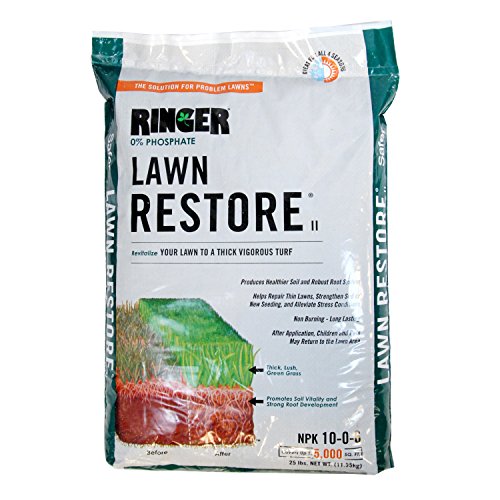
Best for organic programs and lawns being rebuilt from poor soil
- 100% organic granular fertilizer
- No manure, no sludge, no synthetic salts
- Feeds soil microbes as well as the grass
- Covers roughly 5,000 sq ft
Why buy it: fall is when soil biology matters most, and an organic feed put down in September works through the winter.

Best for a simple fall feed on a normal suburban lawn
- Suitable for all grass types
- Covers 5,000 sq ft
- Widely stocked and inexpensive
- Strengthens turf against stress
Why buy it: if you only feed once a year, doing it in fall with a cheap reliable product beats doing it in spring with an expensive one.

Best for half-acre lawns on a structured feeding program
- 24-0-6 with 24% slow-release nitrogen
- 6% potassium for cold hardiness
- 3% iron and micronutrients
- Covers 15,000 sq ft per bag
Why buy it: the potassium content is the part that matters in fall — it drives cold hardiness and disease resistance over winter.
Quick Comparison
| Product | Best for | Rating | Price | Buy |
|---|---|---|---|---|
| Scotts Turf Builder WinterGuard Fall Lawn Food (12.5 lb) | Best Overall | — | Check (paid link) | |
| The Andersons PGF Complete 16-4-8 with Humic DG (5,000 sq ft) | Best Premium Granular | — | Check (paid link) | |
| Milorganite 6-4-0 Slow-Release Nitrogen Fertilizer (32 lb) | Best Slow-Release | — | Check (paid link) | |
| Safer Brand Ringer Lawn Restore Fertilizer (25 lb) | Best Organic Choice | — | Check (paid link) | |
| Scotts Turf Builder Lawn Food (12.5 lb, 5,000 sq ft) | Best Value | — | Check (paid link) | |
| Yard Mastery 24-0-6 Flagship Granular Lawn Fertilizer with Bio-Nite (45 lb) | Best Large-Lawn Feed | — | Check (paid link) |
Fall Fertilizer Timing by Region
The right date is set by your first hard frost, not by the calendar. Work backwards roughly six weeks from it for the key application.
| Region | Grass type | Fall feeding window |
|---|---|---|
| Upper Midwest, New England, Mountain West | Cool-season | Late August – mid September, plus a late feed in October |
| Mid-Atlantic, Ohio Valley, Pacific Northwest | Cool-season | Mid September – mid October |
| Transition zone (KY, TN, NC, MO, KS) | Cool-season | Late September – late October |
| Transition zone | Warm-season (Bermuda, Zoysia) | Early September only, then stop |
| Deep South, Gulf Coast, Southern CA | Warm-season | Early September, at least 6 weeks before first frost |
The rule that catches people out: warm-season grasses should not get late-fall nitrogen. Bermuda and Zoysia fed in October produce soft growth that frost kills and that leaves the lawn thinner in spring. Cool-season grasses are the ones that benefit from a late feed.
The Fertilizers, Reviewed
1. Scotts Turf Builder WinterGuard — Best Overall
Covered above. Owners praise: earlier spring green-up, visible improvement in density the following year, sensible coverage, wide availability. Owners complain about: no dramatic immediate response, granule striping if the spreader is uncalibrated, needing to be watered in, and being unsuitable for warm-season grasses late in the year.
2. The Andersons PGF Complete 16-4-8 — Best Premium Granular
The enthusiast option, and fall is arguably the best time to use it. The 7% humic DG content is a soil amendment rather than a nutrient, and soil biology has all winter to work on it while nothing is being asked of the lawn. The fine particle size makes striping close to impossible. Owners praise: even spreading, color that holds into late autumn, humic soil benefits, no burn at label rate. Owners complain about: cost per square foot, small coverage per bag, and fine granules that need careful spreader calibration.
3. Milorganite 6-4-0 — Best Slow-Release
Slow release is genuinely useful in fall, because soil is cooling and nutrient uptake slows with it. A product that releases gradually keeps nitrogen available across several weeks rather than delivering it all at once into a soil that cannot use it yet. Zero phosphorus keeps it compliant where local ordinances restrict P, which several states enforce in the fall runoff season. Owners praise: no burn risk, iron content for late-season color, low cost per bag, and suitability on sandy soils where soluble nitrogen leaches. Owners complain about: a distinct smell for a day or two, granules some spreaders handle unevenly, and a slower visible response than synthetic products.
4. Safer Brand Ringer Lawn Restore — Best Organic Choice
Fall is the strongest argument for organic fertilizer. Organic nitrogen has to be mineralised by soil microbes before the plant can use it, which is slow — and in fall, slow is exactly what you want, because the lawn has months rather than days. No manure and no sludge in the formulation also addresses the two most common objections to organic lawn products. Owners praise: soil improvement over successive seasons, no burn, no odour compared with manure-based products, and pet-friendly application. Owners complain about: price per square foot well above synthetic options, a slow and subtle response that frustrates first-time users, and coverage claims that assume the lightest rate.
5. Scotts Turf Builder Lawn Food — Best Value
The pragmatic answer for anyone who is not running a lawn program. It is not a fall specialist, but a general-purpose nitrogen feed applied at the right time in September does most of the work a dedicated fall product does, at a lower price and from any hardware store. Owners praise: cost per square foot, availability, consistent results, and simplicity. Owners complain about: coarse granules and streaking, no potassium emphasis for cold hardiness, and needing prompt watering in.
6. Yard Mastery 24-0-6 Flagship — Best Large-Lawn Feed
The potassium is the fall-relevant part here. Six percent K supports cold hardiness and disease resistance over winter, and 24% nitrogen with a genuine slow-release fraction plus Bio-Nite organic content delivers the feed without a surge. Fifteen thousand square feet per bag is the economics a large lawn needs. Owners praise: coverage per bag, slow-release fraction, iron and micronutrients, and color that holds for weeks. Owners complain about: a heavy 45 lb bag, a high nitrogen concentration that makes over-application easy without careful calibration, and patchier availability than mass-market brands.
What Owners Actually Complain About
Fall fertilizer reviews have one complaint that dominates all others: no immediate visible result. A large share of the one- and two-star reviews on genuinely good fall products are written in October by someone expecting a July-style green-up. That is not what these products do — the payoff arrives in March. Beyond that, the usual four appear. Striping from an uncalibrated spreader, fixed by halving the rate and crossing passes. Burn from fast-release nitrogen left unwatered on a warm autumn day. Coverage falling short of the bag figure, almost always a spreader setting issue. And applying the wrong product to the wrong grass — cool-season winterizers on warm-season lawns late in the year, which is a genuine mistake with real consequences for winter survival.
How to Choose and Apply
Three decisions. Identify your grass type first, because the fall advice is opposite for cool-season and warm-season lawns. Work backwards from your first frost date, not from a date on the bag. Check your state rules — a number of states and localities restrict fall and winter fertilizer application to limit runoff, and a few restrict phosphorus outright.
Then get the mechanics right. Mow at your normal height before applying so the granules reach the soil rather than sitting on leaf tissue. Calibrate the spreader, apply at half rate in two crossing passes, and water in with about a quarter-inch unless rain is forecast. Fall is also the best time to overseed a cool-season lawn, and a starter feed combined with seed does two jobs at once — see how to overseed a lawn. A well-calibrated spreader matters here more than the product; our best broadcast spreader picks cover that.
How We Rank Fall Fertilizers
We never buy or physically handle the products on this site. We read the owner-review record at scale, weighting four things. Following-spring results, which means giving much more weight to reviews edited or written months after application than to same-week impressions. Release profile, since a cooling soil needs nitrogen that stays available. Spread evenness, which drives the striping complaints. And label suitability for the grass type, because misapplication is the most consequential error in this category. Prices and star ratings move; the complaint pattern does not.
The Verdict
Scotts Turf Builder WinterGuard is the fall fertilizer the owner-review record supports most strongly for a cool-season lawn, and the fall application is the one feed genuinely worth doing if you only do one. Take The Andersons PGF Complete if you want soil improvement with it, Milorganite if your soil is sandy or your lawn is warm-season, and Yard Mastery 24-0-6 if the lawn is big enough that bag economics matter.
Next: get the whole year right with our lawn care calendar, check application timing in when to apply lawn fertilizer, or thicken thin turf with the best grass seed.