 Garden

Affiliate Disclosure
Some links on this page are affiliate links. As an Amazon Associate, we earn from qualifying purchases — at no extra cost to you. We do not buy, test, or physically handle the products we cover; our rankings come from aggregated owner reviews, ratings and expert consensus. Commissions never change our verdicts. How we rank · full disclosure.
The short version: the best lawn fertilizer for spring is Scotts Turf Builder Triple Action, because spring is a three-job season and it does all three in one pass — it feeds the lawn, prevents crabgrass for up to four months, and kills listed broadleaf weeds like dandelion. The one rule that matters more than the brand: apply it when your soil temperature reaches about 55°F, the point at which crabgrass germinates, because a pre-emergent has to be down before that or it does nothing. If your lawn has no weed problem, a straight feed like Scotts Turf Builder Lawn Food is cleaner, and Milorganite is the safest choice if spring turns hot.
Spring feeding is really about timing and matching the product to whether you have a weed problem — feed a clean lawn, feed-and-prevent a weedy one. For year-round feeding see our best lawn fertilizer roundup and the lawn care calendar, and the lawn care hub ties feeding to mowing and watering.
Top Picks at a Glance
Our #1 Pick: Scotts Turf Builder Triple Action
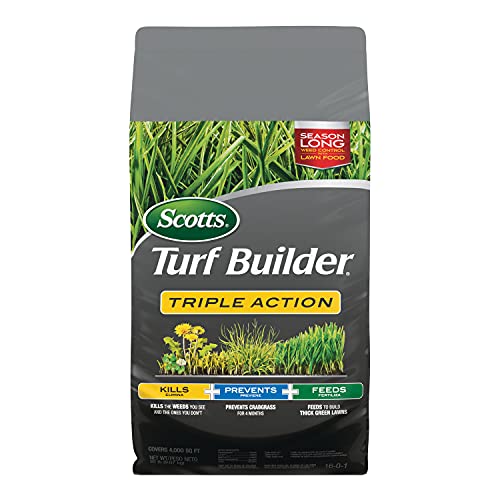
Triple Action earns the top spot because it matches what a lawn actually needs in spring. Coming out of winter, cool-season grass wants a feed to green up and thicken, dandelions and clover are waking up, and crabgrass seed is about to germinate in the warming soil. A plain fertilizer handles only the first of those. Triple Action delivers the feed, a post-emergent that kills the broadleaf weeds already showing, and a pre-emergent barrier that stops crabgrass for up to four months — the whole spring job in one application.
The timing is the catch, and it is the same for any crabgrass product: it must go down before the soil at a 2-inch depth reaches about 55°F, because a pre-emergent works on seeds that have not yet sprouted. A reliable natural cue is forsythia finishing its bloom. Applied at the right moment on an established cool-season lawn, this is the single most efficient spring purchase you can make.
Consensus Score ████████░░ 8.6 — built from an average of 4.4 stars across 9,362 verified owner ratings.
The honest weaknesses: it is for established lawns only — the pre-emergent will stop new grass seed from germinating too, so never use it where you plan to seed, and it is not for warm-season lawns being renovated. If you are seeding this spring, use a starter fertilizer instead and read our timing guidance below.
Check price on Amazon → (paid link)
The Ranked Field
Best for feeding the lawn while stopping crabgrass and killing spring weeds
- Feeds, prevents crabgrass and kills listed weeds
- Crabgrass prevention for up to 4 months
- For established cool-season lawns
- Apply when soil hits ~55°F
Why buy it: spring is a three-job season — feed, prevent crabgrass, and knock back dandelions — and this does all three in one pass at exactly the right time of year.

Best for a simple, reliable spring green-up on any grass
- High-nitrogen quick green-up
- All grass types
- Covers about 5,000 sq ft
- Slow-release nitrogen blend
Why buy it: if your lawn has no weed problem, the cleanest spring choice is a straight feed — this is the proven, foolproof green-up in a bag.

Best for steady, burn-proof feeding through the spring
- Slow-release organic nitrogen
- Contains iron for deep green
- Non-burning, safe in warm spells
- Covers about 2,500 sq ft
Why buy it: the slow-release nitrogen feeds evenly for weeks instead of a fast surge, and it will not burn the lawn if spring turns hot — the safest feed here.

Best for a professional-grade balanced spring feed
- Balanced 16-4-8 NPK with micros
- Fine particle spreads evenly
- Humic DG for soil health
- Covers about 5,000 sq ft
Why buy it: the balanced NPK plus humic acid feeds the grass and the soil biology, giving a fuller, more resilient spring result than nitrogen alone.

Best for a fast, even green-up sprayed on with a hose
- Hose-end liquid for fast uptake
- Seaweed and fish for micronutrients
- Even coverage, no spreader needed
- Covers up to 3,200 sq ft
Why buy it: foliar liquid greens up faster than granules, which makes it the quickest way to wake a dull lawn at the very start of spring.

Best for a family- and pet-safe organic spring feed
- Organic slow-release nitrogen
- Safe for kids and pets after application
- Feeds soil microbes
- Covers about 5,000 sq ft
Why buy it: a genuinely organic feed that greens the lawn while building the soil, and it is safe for children and pets to use the lawn soon after.

Quick Comparison
| Product | Best for | Rating | Price | Buy |
|---|---|---|---|---|
| Scotts Turf Builder Triple Action | Best Overall for Spring | — | Check (paid link) | |
| Scotts Turf Builder Lawn Food, 12.5 lb | Best Straight Spring Food | — | Check (paid link) | |
| Milorganite 6-4-0 Slow-Release Nitrogen Fertilizer, 32 lb | Best Slow-Release | — | Check (paid link) | |
| The Andersons PGF Complete 16-4-8 with Humic DG | Best Premium Balanced | — | Check (paid link) | |
| Simple Lawn Solutions Advanced 16-4-8 Liquid Lawn Food, 32 oz | Best Liquid Quick Green | — | Check (paid link) | |
| Espoma Organic Lawn Food 18-0-3, 20 lb | Best Organic | — | Check (paid link) |
How We Rank
We do not buy, test or physically handle these products. We rank on aggregated owner ratings weighted by review volume, fit for the spring job (feeding, crabgrass prevention, weed control), burn risk and ease of correct application, and recurring complaints in critical reviews such as burning, uneven spread and clumping. NPK and coverage are read from the label. Prices were current at the time of writing. Full method on how we rank.
The Spring Fertilizers, Reviewed
1. Scotts Turf Builder Triple Action — Best Overall for Spring
Covered above. What owners praise: doing feed, crabgrass prevention and weed-kill in one pass, and clear spring results. What owners complain about: you cannot seed after using it, and it needs correct timing to work. The efficient spring choice for an established, weed-prone lawn.
2. Scotts Turf Builder Lawn Food — Best Straight Spring Food
The foolproof green-up for a lawn with no weed problem: a proven high-nitrogen feed that works on any grass type. What owners praise: reliable green-up, easy spreading, and value. What owners complain about: it can burn if over-applied or not watered in. The clean choice when you just want to feed.
3. Milorganite 6-4-0 — Best Slow-Release
The safest feed here: slow-release organic nitrogen with iron for a deep green, and it simply will not burn even in a warm spell. What owners praise: the non-burning formula, the iron green-up, and the value. What owners complain about: lower coverage per bag and a mild odour on application. Ideal for steady, worry-free spring feeding.
4. The Andersons PGF Complete 16-4-8 — Best Premium Balanced
A professional-grade balanced feed with humic acid that nourishes the soil biology as well as the grass, spreading evenly thanks to its fine particle size. What owners praise: the balanced result, even spread, and soil-health benefits. What owners complain about: the price and the fine particles needing a well-calibrated spreader. The premium pick for a fuller spring lawn.
5. Simple Lawn Solutions 16-4-8 Liquid — Best Liquid Quick Green
A hose-end liquid that the grass takes up through the leaf, greening a dull lawn faster than granules at the very start of spring. What owners praise: the fast green-up, even coverage, and no spreader needed. What owners complain about: it feeds for a shorter window than slow-release granules. The quickest way to wake a lawn.
6. Espoma Organic Lawn Food 18-0-3 — Best Organic
A genuinely organic slow-release feed that greens the lawn while building the soil, safe for kids and pets to use the lawn soon after. What owners praise: the organic formula, family safety, and steady feeding. What owners complain about: it greens up more slowly than synthetic feeds. The pick for an organic program.

What Owners Actually Complain About
Spring feeding mistakes are predictable. Burning the lawn is the biggest, and it comes from over-applying a fast synthetic fertilizer or not watering it in — the fix is to follow the coverage rate exactly, or choose a non-burning slow-release like Milorganite. Crabgrass coming up anyway is almost always a timing failure: the pre-emergent went down after the soil had already passed 55°F, too late to stop germinating seed. Uneven green streaks come from a miscalibrated or overlapping spreader pass; spread at half rate in two perpendicular passes for even coverage. And feeding too early pushes soft growth that weeds exploit — feed when the grass is actively growing. How long results take is covered in how long fertilizer takes to work.
Timing Spring Feeding by Soil Temperature
The calendar lies; soil temperature tells the truth. Crabgrass germinates as soil at a 2-inch depth warms through about 55°F, so a crabgrass preventer must be down before then — in the South that can be February, in the North it can be April or May. Grass itself starts actively growing around the same soil temperature, which is why the two jobs pair naturally. For a straight feed with no preventer, wait a little longer, until the lawn is green and has had its first mow or two, so you are feeding grass that can use the nitrogen — Penn State Extension generally puts cool-season nitrogen applications in mid- to late spring and again in late summer or early fall. Warm-season lawns — Bermuda, Zoysia, St. Augustine — break the rule: hold off until they have fully greened in late spring before feeding hard, in keeping with EPA guidance to time fertilizer to the period of maximum uptake and growth for the climate. The season-by-season plan is in the lawn care calendar, and if you are seeding rather than feeding, see the best time of year to plant grass seed.
The Verdict
For spring, the best fertilizer is Scotts Turf Builder Triple Action, because it feeds, prevents crabgrass and kills weeds in one pass at exactly the season those jobs come due — just get it down before the soil hits 55°F. Feed a clean lawn with straight Turf Builder Lawn Food, play it safe in a warm spring with Milorganite, or go organic with Espoma. Time it to soil temperature, follow the coverage rate, and do not seed where you have used a crabgrass preventer. Check price on Amazon → (paid link)