 Garden

Affiliate Disclosure
Some links on this page are affiliate links. As an Amazon Associate, we earn from qualifying purchases — at no extra cost to you. We do not buy, test, or physically handle the products we cover; our rankings come from aggregated owner reviews, ratings and expert consensus. Commissions never change our verdicts. How we rank · full disclosure.
The short answer: the best robot lawn mower for a typical suburban quarter-acre is the WORX Landroid M WR147 — the most-owned robot mower in the US, with a deep review base and a price that does not require a second mortgage. If the buried perimeter wire is what has put you off, the wire-free Segway Navimow i210 AWD sets boundaries in the app and climbs 45 percent slopes. For half an acre on a wired boundary, the Landroid L WR150 is the same platform scaled up.
We do not buy, install, or physically handle any mower. These rankings come from aggregated owner reviews, star ratings, review volume and expert consensus — see how we rank. For conventional cordless machines, see best battery powered lawn mower, and the full field lives in best lawn mower.
Top Picks at a Glance

Our #1 Pick: WORX Landroid M WR147
Robot mowers are a category where the safest recommendation is the one with the most owners, and in the US that is the Landroid M. It covers a quarter-acre, ships with the boundary wire and pegs, runs on the same 20V Power Share batteries as the rest of the WORX range, and is supported by a parts supply and a service path that newer entrants simply do not have yet. When a blade disc cracks or a wheel motor fails in year three, that matters more than a spec sheet.
What owners consistently praise is the outcome rather than the machine. The lawn stops having a mowing day. Because it takes a few millimetres off every day or two, the grass is never long and the clippings are too fine to see, which returns nitrogen to the soil continuously. Reviewers with dense cool-season lawns describe visible thickening over a season, and that is a real, repeatable effect of frequent light cutting rather than marketing.
The complaints are equally consistent, and you should take them seriously. Installation is the worst part. Laying and pegging a boundary wire around a yard with beds, trees and a path takes most owners a full weekend, and a wire break later is fiddly to trace. It struggles at edges — every robot mower leaves a strip along walls and fences that you still have to trim. And wet grass and steep spots strand it, with owners reporting recovery trips into the yard to unstick it after heavy dew. If your lawn is steep, awkwardly shaped or heavily interrupted, budget for frustration.
Consensus Score ████████░░░░ 8.0
Check price on Amazon → (paid link)
The Ranked Field
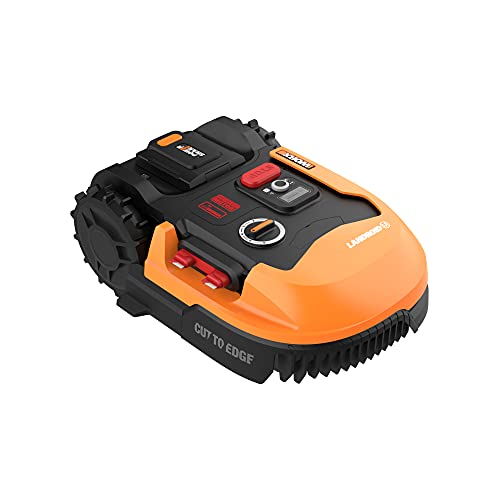
Best for typical suburban lots up to 10,890 sq ft with a simple boundary
- Covers up to 1/4 acre / 10,890 sq ft
- Boundary wire included in the kit
- 20V Power Share battery and charger
- App scheduling with rain delay
Why buy it: the most-owned robot mower in the US at a price that is not absurd, and the review base is deep enough to trust.

Best for complex yards where burying a perimeter wire is the dealbreaker
- No perimeter wire — NRTK satellite plus vision
- All-wheel drive handles 45% slopes
- Cutting height 2 to 3.6 inches
- 5.1Ah battery, covers about 0.25 acre
Why buy it: you set virtual boundaries in the app instead of trenching wire around the whole yard, which is the whole reason people hesitate.

Best for larger lots up to 21,780 sq ft that still suit a wired boundary
- Covers up to 1/2 acre / 21,780 sq ft
- Cut-to-edge design reduces trimming
- 20V Power Share battery platform
- Handles 20 degree slopes
Why buy it: the same proven Landroid platform scaled to a genuinely large lawn, without stepping up to satellite-navigation prices.

Best for owners who want systematic stripe mowing rather than random patterns
- Wire-free RTK plus vision navigation
- Systematic mowing in parallel lines
- Multi-zone management and anti-theft
- Rated 54 dB — quiet enough for evenings
Why buy it: it mows in tidy parallel passes like a person would, instead of the random bouncing that makes cheaper robots look untidy.

Best for yards with pets, kids toys, hoses and objects that move around
- No perimeter wire — AI vision plus RTK cloud
- Covers up to 1/2 acre
- Handles 30% slopes, auto mapping
- App control with automatic boundary learning
Why buy it: camera-based obstacle avoidance is the feature that stops a robot mower shredding a garden hose at 6am.

Best for small city lots up to 5,445 sq ft
- Covers up to 1/8 acre / 5,445 sq ft
- Boundary wire and 2.0Ah battery included
- Compact enough for tight gardens
- App scheduling and rain sensing
Why buy it: the cheapest way into robot mowing that still comes from a brand with a real service network and parts supply.
Quick Comparison
| Product | Best for | Rating | Price | Buy |
|---|---|---|---|---|
| WORX Landroid M WR147 Robotic Mower (1/4 Acre) | Best Overall | — | Check (paid link) | |
| Segway Navimow i210 AWD Robot Mower (0.25 Acre) | Best Wire-Free | — | Check (paid link) | |
| WORX Landroid L WR150 Robotic Mower (1/2 Acre) | Best for Half-Acre Yards | — | Check (paid link) | |
| Segway Navimow H1500N-VF Robot Mower (0.37 Acre) | Best Navigation | — | Check (paid link) | |
| WORX Landroid Vision Cloud WR320 (1/2 Acre) | Best AI Obstacle Avoidance | — | Check (paid link) | |
| WORX Landroid S WR165 Robotic Mower (1/8 Acre) | Best Small-Yard Pick | — | Check (paid link) |
Wired or Wire-Free? The Decision That Matters Most
Everything else about robot mowers is a detail compared with this one choice.
| Boundary wire | Wire-free (RTK / vision) | |
|---|---|---|
| Setup | A weekend pegging or burying wire | One guided perimeter drive in the app |
| Changing the layout | Re-lay the wire | Edit a virtual boundary |
| Failure mode | Wire breaks; tracing it is tedious | Satellite signal loss under dense tree cover |
| Price | Lower | Typically 50 to 100 percent more |
| Best for | Open, simple lawns with a stable layout | Complex yards, tree-light lots, frequent changes |
The honest summary from the review record: wire is cheaper and more reliable once installed, wire-free is dramatically less painful to set up and adjust, and heavy tree canopy is the one condition where wire still wins outright because satellite positioning degrades under it.
The Mowers, Reviewed
1. WORX Landroid M WR147 — Best Overall
Covered above. Owners praise: consistent lawn appearance, quiet running, shared 20V battery platform, sensible price, app scheduling with rain delay. Owners complain about: wire installation time, edge strips left untrimmed, getting stuck on damp slopes, and occasional Wi-Fi connectivity drops in the app.
2. Segway Navimow i210 AWD — Best Wire-Free
The model that makes wire-free mowing affordable rather than aspirational. All-wheel drive is the standout: rated to 45 percent grade, it handles ground that strands wired competitors, and owners with banked lawns single that out. Cutting height adjusts from 2 to 3.6 inches, which is high enough for warm-season grasses that other robots cut too short — in line with Penn State Extension's baseline of 2 inches or above for most lawns. Owners praise: app-based boundary setup, slope performance, quiet operation, and auto mapping. Owners complain about: reduced accuracy under dense tree canopy, an antenna that needs a clear sky view, and a coverage figure of about 0.15 to 0.25 acre that some found optimistic in complex yards.
3. WORX Landroid L WR150 — Best for Half-Acre Yards
The same proven wired platform stretched to 21,780 sq ft, and the sensible choice for a large but simple lawn where satellite pricing is hard to justify. The cut-to-edge design shortens the strip you still have to trim, without eliminating it. Owners praise: coverage for the money, reliability once installed, battery sharing with WORX tools. Owners complain about: a proportionally longer wire install, a 20 degree slope limit that rules out steeper sections, and long total mowing times on a genuinely half-acre lot.
4. Segway Navimow H1500N-VF — Best Navigation
The model for people who care what the lawn looks like as well as how long it is. RTK plus vision lets it mow in systematic parallel passes rather than the random-bounce pattern most robots use, so you get stripes instead of a uniform scuff. Multi-zone management handles a front and back yard as separate areas, and anti-theft locking matters on a machine left outdoors. Owners praise: tidy striped finish, zone management, a 54 dB noise level — well below the roughly 85 dB threshold at which OSHA says hearing damage can begin — quiet enough to run in the evening, and reliable return-to-base. Owners complain about: price, the same tree-canopy signal issue as its siblings, and firmware updates that occasionally reset schedules.
5. WORX Landroid Vision Cloud WR320 — Best AI Obstacle Avoidance
The Vision line replaces the wire with a camera that identifies grass and non-grass, backed by RTK cloud positioning. The practical benefit shows up in reviews from households with dogs, children or a habitually abandoned garden hose: it sees and steers around objects rather than nudging them. Handles 30 percent slopes and maps automatically. Owners praise: obstacle avoidance, no wire to lay, half-acre coverage, automatic boundary learning. Owners complain about: occasional confusion where lawn meets mulch of a similar color, camera performance in low light and heavy rain, and a premium price for a first-generation approach.
6. WORX Landroid S WR165 — Best Small-Yard Pick
The entry point, covering 5,445 sq ft, which is a genuinely typical city lot. Same app, same battery platform, same wire installation but far less of it. Owners praise: price, compact size, easy scheduling, and the fact that a small yard is where robot mowing works best. Owners complain about: limited coverage that some discovered too late, edge trimming still being needed, and slower progress through anything that grew tall while they were away.
What Owners Actually Complain About
Robot mower reviews are unusually consistent about their grievances. Installation is first for every wired model — wire laying takes longer than the manual suggests, and a break in year two is genuinely irritating to find. Edge strips are second and universal: no robot cuts flush to a wall or fence, so you still own a string trimmer. Getting stuck is third, most often on wet slopes, in narrow passages between beds, or on a stray branch. Connectivity is fourth, with app dropouts and firmware updates that reset schedules appearing across all brands. And blade replacement is a running cost people underestimate — the small pivoting blades are cheap but need changing every one to three months in normal use. None of these are dealbreakers, but all of them are ownership realities rather than surprises.

How to Choose a Robot Mower
Measure the lawn first, and buy a model rated for at least 25 percent more than that. Rated coverage assumes an open rectangle; beds, trees and narrow passages cost real capacity. Then check three things in order. Slope — find the steepest part of your lawn and compare it with the rating, because this is the single most common cause of an unhappy owner. Tree canopy — dense overhead cover degrades RTK positioning, so a wired model may genuinely be the better choice under mature trees. Layout stability — if you change beds and borders often, wire-free saves you re-laying wire each time.
Finally, be honest about what the machine does not do. You will still need a trimmer for the edges — see best string trimmer — and you will still need to feed the lawn, which the best lawn fertilizer guide covers. A robot mower replaces mowing, not lawn care.
How We Rank Robot Mowers
We never buy or physically handle the products on this site. We read the owner-review record at scale, and here we weighted four things heavily. Reliability past season one, because first-week reviews of robot mowers are uniformly delighted and tell you nothing. Getting-stuck reports, which is the complaint most predictive of a mower being abandoned. Setup difficulty as described by owners rather than by the manual. And parts and service availability, which decides whether a $1,000 machine is repairable in year three. Prices in this category move fast; the complaint pattern does not.
The Verdict
For most American suburban lawns, the WORX Landroid M WR147 is the robot mower the owner-review record supports most strongly — proven, supported and sensibly priced. If wire installation is the barrier, pay the premium for the Segway Navimow i210 AWD, which also climbs ground the wired models will not. Choose the Landroid L WR150 for a large simple lawn, and the Landroid S WR165 for a small city lot.
Next: compare with a conventional cordless machine in best battery powered lawn mower, sort your edges with best lawn edger, or set cutting height properly with mowing height by grass type.