 Garden

Affiliate Disclosure
Some links on this page are affiliate links. As an Amazon Associate, we earn from qualifying purchases — at no extra cost to you. We do not buy, test, or physically handle the products we cover; our rankings come from aggregated owner reviews, ratings and expert consensus. Commissions never change our verdicts. How we rank · full disclosure.
The short answer: mow when the grass is one-third taller than your target height, not on a fixed day. For a lawn kept at 3 inches, that means cutting when it reaches about 4.5 inches. In practice: every 4 to 5 days in peak spring growth, every 7 to 10 days in normal conditions, every 10 to 14 days in summer heat, and every 2 to 3 weeks in late fall.
Weekly mowing is a habit built around Saturdays, not around grass. It happens to be correct for a few weeks each spring and is wrong for most of the rest of the year — too infrequent during the May surge and unnecessary through a hot, dry August.
We never buy or physically handle the equipment we rank; the mower recommendations elsewhere on this site come from aggregated owner reviews and expert consensus, described in how we rank. The whole routine is mapped at the lawn care hub.
The One-Third Rule Is the Whole Answer
Never remove more than one-third of the grass blade in a single pass. That is the rule every extension service, turf program and experienced groundskeeper repeats, and it works because of how grass stores energy. The leaf blade is the plant’s solar panel. Take a third and the plant barely notices. Take half or more and it has to draw on root reserves to rebuild leaf tissue, which stops root growth cold for days or weeks.
Repeat that scalping every week and you get the classic struggling lawn: shallow roots, thin turf, bare patches that open in the first heat wave, and crabgrass moving into every gap. It is not a fertilizer problem or a seed problem. It is a mowing problem, and it is free to fix.
The rule converts directly into a trigger height:
| Target height | Mow when it reaches | Typical lawns |
|---|---|---|
| 1.5 in | 2.25 in | Bermuda, zoysia kept short |
| 2 in | 3 in | Centipede, higher-cut Bermuda |
| 2.5 in | 3.75 in | Kentucky bluegrass, perennial rye |
| 3 in | 4.5 in | Tall fescue, St. Augustine |
| 3.5 in | 5.25 in | Tall fescue in summer, shaded lawns |
| 4 in | 6 in | Tall fescue at maximum, deep shade |
Which target height belongs to your grass is not a matter of taste — cool-season and warm-season grasses want genuinely different numbers, and the full set is in mowing height by grass type.
How Fast Grass Actually Grows
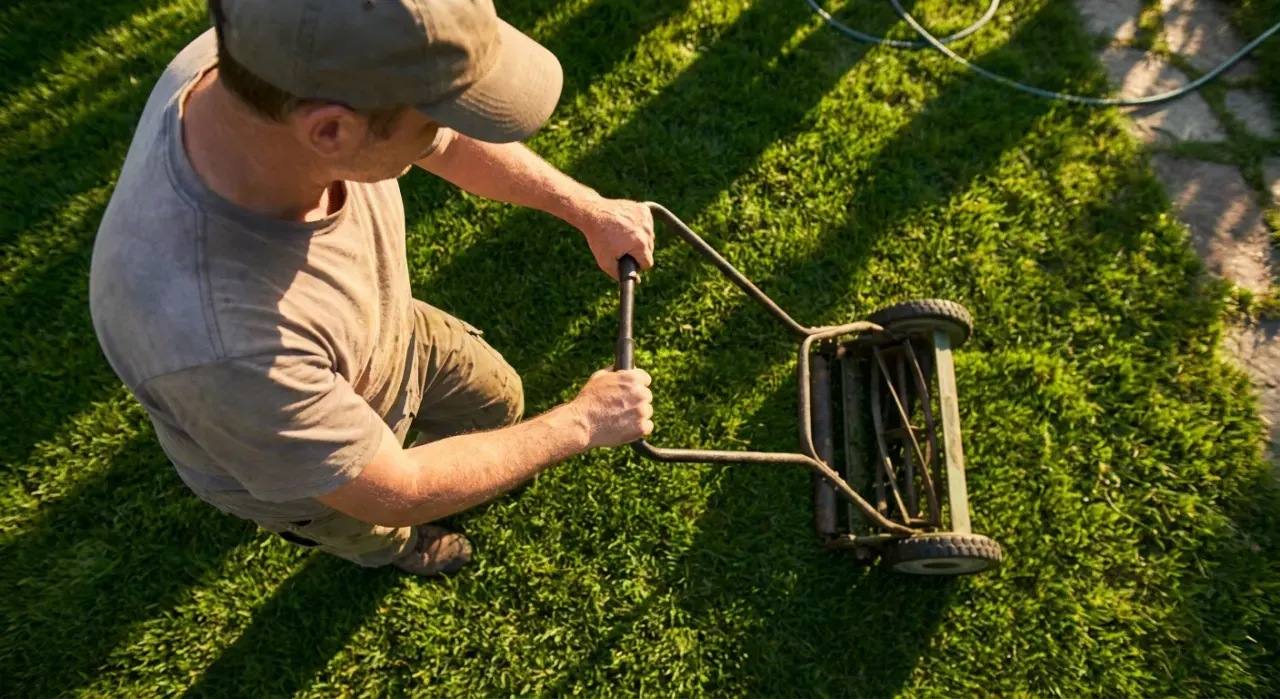
Growth rate is driven by soil temperature, moisture and nitrogen, and it varies by a factor of five or more across a single season. That is why one interval cannot cover the year.
Cool-season lawns — tall fescue, Kentucky bluegrass, perennial ryegrass, fine fescue — do their fastest growing when soil sits around 60 to 75°F, which means April into early June and again in September and October. In those windows a lawn can put on an inch in four days and needs cutting twice a week if you are holding a low target height. From late June through August, once air temperatures stay above the mid-80s, growth slows sharply and may stop altogether during drought; two weeks between cuts is normal and healthy.
Warm-season lawns — Bermuda, zoysia, St. Augustine, centipede — are the mirror image. They barely move until soil warms past 65°F, then grow hardest through the heat of July and August, when Bermuda kept at 1.5 inches genuinely needs cutting every 4 to 5 days. They slow in October and go dormant after the first hard frost, at which point mowing stops until spring green-up.
| Month | Cool-season interval | Warm-season interval |
|---|---|---|
| March | 10 to 14 days | Dormant, no mowing |
| April | 5 to 7 days | 10 to 14 days at green-up |
| May | 4 to 6 days | 7 to 10 days |
| June | 7 days | 5 to 7 days |
| July to August | 10 to 14 days | 4 to 6 days |
| September | 5 to 7 days | 7 to 10 days |
| October | 7 to 10 days | 10 to 14 days |
| November | 14 to 21 days, then stop | Dormant |
Two things push these intervals shorter than the table suggests: recent rain and recent fertilizer. A heavy nitrogen application in April can double growth for three weeks, which is one reason spring feeding on cool-season grass is best kept light. The month-by-month version of all of this, including feeding and seeding, is in the lawn care calendar.
When the Lawn Gets Away From You
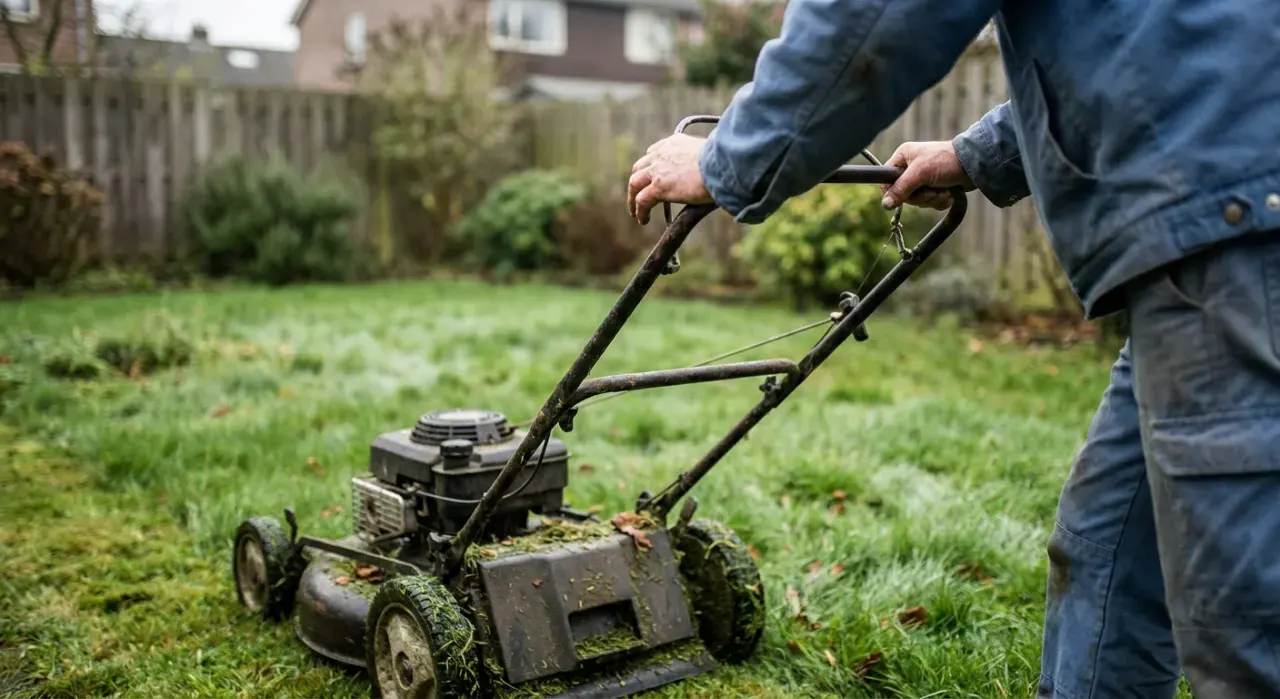
Rain, vacations and broken mowers happen. If you come home to grass at 8 inches and your target is 3, do not cut it to 3 in one pass — you will remove more than half the blade, leave a straw-colored lawn that looks dead for two weeks, and expose bare soil to a summer of weed seed.
Step it down instead. Raise the deck to its highest setting, take the first cut at around 5.5 inches, wait three to four days, cut at 4.25, wait again, then reach 3. Three passes over about a week gets you back to target without ever breaking the one-third rule. Bag or rake the clippings on the first pass, because long clippings settle in mats thick enough to smother the turf underneath.
If the grass is also wet, wait. Wet grass tears rather than cuts, clogs the deck, clumps on the lawn and compacts soft ground under the wheels. A discharge chute packed with wet clippings is also the single most common reason people reach into a running mower, which is how most mower injuries happen. Let it dry.
A Sharp Blade Changes the Result More Than a New Mower
A dull blade tears the leaf instead of slicing it. The torn tip dries out and turns whitish-brown within a day, which is why a freshly mowed lawn sometimes looks hazy and pale rather than green. The wound also stays open longer, giving fungal disease an easier entry, and the extra drag loads the engine or motor so a gas mower bogs and a battery mower loses runtime.
Sharpen or replace the blade roughly every 20 to 25 hours of mowing, which for most yards is once at the start of the season and once mid-season. Reviewers repeatedly mention that a mower they had written off as underpowered transformed after a replacement blade costing well under $20 — worth trying before shopping. If the machine really is the limiting factor, the ranked field is in best lawn mowers, with hill and large-yard options in best self-propelled mowers.
Leave the Clippings
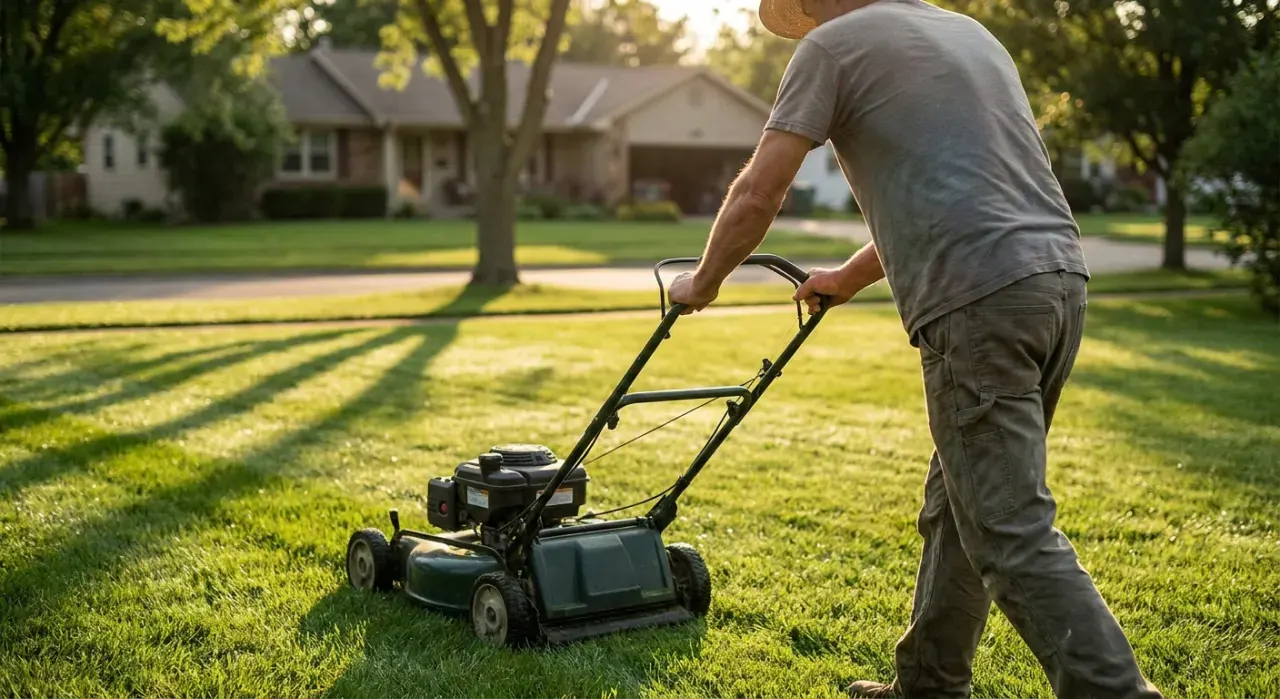
Mulching clippings back into the lawn returns nitrogen, phosphorus and potassium that you would otherwise buy in a bag. Clippings are roughly 4 percent nitrogen by dry weight, and over a season a mulched lawn recycles the rough equivalent of one full fertilizer application.
The persistent myth is that clippings cause thatch. They do not. Thatch is a layer of undecomposed roots, rhizomes and stems, and it builds from overfeeding, overwatering and compacted soil — not from leaf tissue, which is mostly water and breaks down within weeks. If your lawn feels spongy underfoot, the cause is worth diagnosing properly in dethatching vs aerating.
Bag only in three situations: the lawn has an active fungal disease you do not want to spread, the grass got long enough that clippings would fall in smothering clumps, or you want the material for the compost pile, where fresh clippings are one of the most useful nitrogen sources you can get.
The Details That Separate a Good Cut From a Great One
- Change direction every mow. Cutting the same line every week trains grass to lean and compacts wheel tracks. Alternate between north-south, east-west and the two diagonals.
- Mow in the evening or late morning when the lawn is dry but not in peak heat. Cutting at 2pm on a 95°F day stresses grass that is already struggling.
- Slow down in thick growth. Ground speed, not engine size, is usually what causes a ragged cut and clumping.
- Raise the deck a half-inch for summer. Taller grass shades the soil, keeps root zones cooler and reduces water demand measurably.
- Do not mow a drought-dormant lawn. Brown, crisp cool-season grass in August is not dead — it is conserving. Traffic and mowing during dormancy is what turns it into a bare patch.
Mowing height and watering depth work together: a lawn cut tall and watered deeply, roughly an inch a week in one or two soakings, needs mowing less often in summer and recovers faster from heat than one cut short and watered daily. The numbers are in how much to water a lawn. If the thin patches persist through a full season of good mowing, the fix is overseeding in early fall rather than more fertilizer.