 Garden

Affiliate Disclosure
Some links on this page are affiliate links. As an Amazon Associate, we earn from qualifying purchases — at no extra cost to you. We do not buy, test, or physically handle the products we cover; our rankings come from aggregated owner reviews, ratings and expert consensus. Commissions never change our verdicts. How we rank · full disclosure.
The short answer: cool-season grasses are cut tall and warm-season grasses are cut short. Tall fescue 3 to 4 in · Kentucky bluegrass 2.5 to 3.5 in · perennial ryegrass 2 to 3 in · fine fescue 2.5 to 4 in. On the warm side, common Bermuda 1 to 2 in · zoysia 1 to 2 in · centipede 1.5 to 2 in · St. Augustine 3 to 4 in. Whatever the number, never remove more than a third of the blade in one pass.
Height is the highest-leverage free decision in lawn care. It sets root depth, water demand, weed pressure and how well the lawn survives August — and most American lawns are cut a full inch shorter than the species wants.
We never buy or physically handle the equipment we rank; recommendations elsewhere on the site come from aggregated owner reviews and expert consensus, described in how we rank. The full routine is at the lawn care hub.
The Chart
Cool-season grasses — the North and transition zone
| Grass | Normal height | Summer height | Mow when it reaches | Notes |
|---|---|---|---|---|
| Tall fescue | 3 to 4 in | 3.5 to 4 in | 4.5 to 5.25 in | The most heat-tolerant cool-season grass; deep roots reward height |
| Kentucky bluegrass | 2.5 to 3.5 in | 3 to 3.5 in | 3.75 to 5 in | Spreads by rhizomes and self-repairs; suffers below 2 in |
| Perennial ryegrass | 2 to 3 in | 2.5 to 3 in | 3 to 4.5 in | Fastest to germinate; tough leaf, keep the blade sharp |
| Fine fescue (creeping red, chewings, hard) | 2.5 to 4 in | 3 to 4 in | 3.75 to 6 in | Best shade tolerance; often left unmowed in no-mow blends |
Warm-season grasses — the South and Southwest
| Grass | Normal height | Mow when it reaches | Notes |
|---|---|---|---|
| Common Bermuda | 1 to 2 in | 1.5 to 3 in | Full sun only; rotary mower fine at 1.5 in and up |
| Hybrid Bermuda | 0.5 to 1.5 in | 0.75 to 2 in | Below about 1 in a reel mower is genuinely needed |
| Zoysia | 1 to 2 in | 1.5 to 3 in | Dense and stiff; dulls blades faster than any other lawn grass |
| St. Augustine (standard) | 3 to 4 in | 4.5 to 5.25 in | The warm-season exception — cutting it short thins it badly |
| St. Augustine (dwarf cultivars) | 2 to 2.5 in | 3 to 3.75 in | Semi-dwarf types tolerate lower cutting than standard |
| Centipede | 1.5 to 2 in | 2.25 to 3 in | Low-input grass; over-feeding is its main killer |
| Bahiagrass | 3 to 4 in | 4.5 to 5.25 in | Coarse and tough; seed heads outpace leaf growth |
| Buffalograss | 2 to 3 in | 3 to 4.5 in | Native prairie grass; also fine left unmowed |
Pick the middle of the range if you are unsure, and pick the top of the range if your lawn is shaded, on sandy soil, or in a region with hot summers. There is no home lawn that suffers from being cut a half-inch taller than the book says.

The One-Third Rule Sits On Top of Everything
Whatever height you choose, never cut more than one-third of the blade in a single pass. Grass makes its food in the leaf; removing half or more forces the plant to spend root reserves rebuilding, and root growth stops while it does. That is why the chart lists a trigger height alongside the target: a lawn held at 3 inches gets mowed at 4.5, not whenever the weekend arrives.
The rule also decides how often you mow, and the interval swings from four days in peak growth to three weeks in late fall. The seasonal breakdown is in how often to mow.
Why Taller Is Almost Always Better
Root depth roughly tracks shoot height. A tall fescue lawn held at 4 inches will typically root several inches deeper than the same lawn held at 2, which means it reaches soil moisture that a scalped lawn cannot and rides out a two-week dry spell that would brown out its neighbor.
Height also shades the soil surface. Shaded soil runs measurably cooler, loses less water to evaporation and stays hospitable to roots through a heat wave. And it starves weed seed: crabgrass germination is triggered by light reaching bare soil, so a dense canopy at 3.5 inches suppresses far more crabgrass than any amount of pre-emergent applied to a lawn cut at 1.5.
The trade-offs are real but small. Taller grass can look shaggier between cuts, holds dew longer in humid regions which slightly raises disease pressure, and needs a mower that can handle the growth without clumping. None of that outweighs the root system.
When Short Is Correct
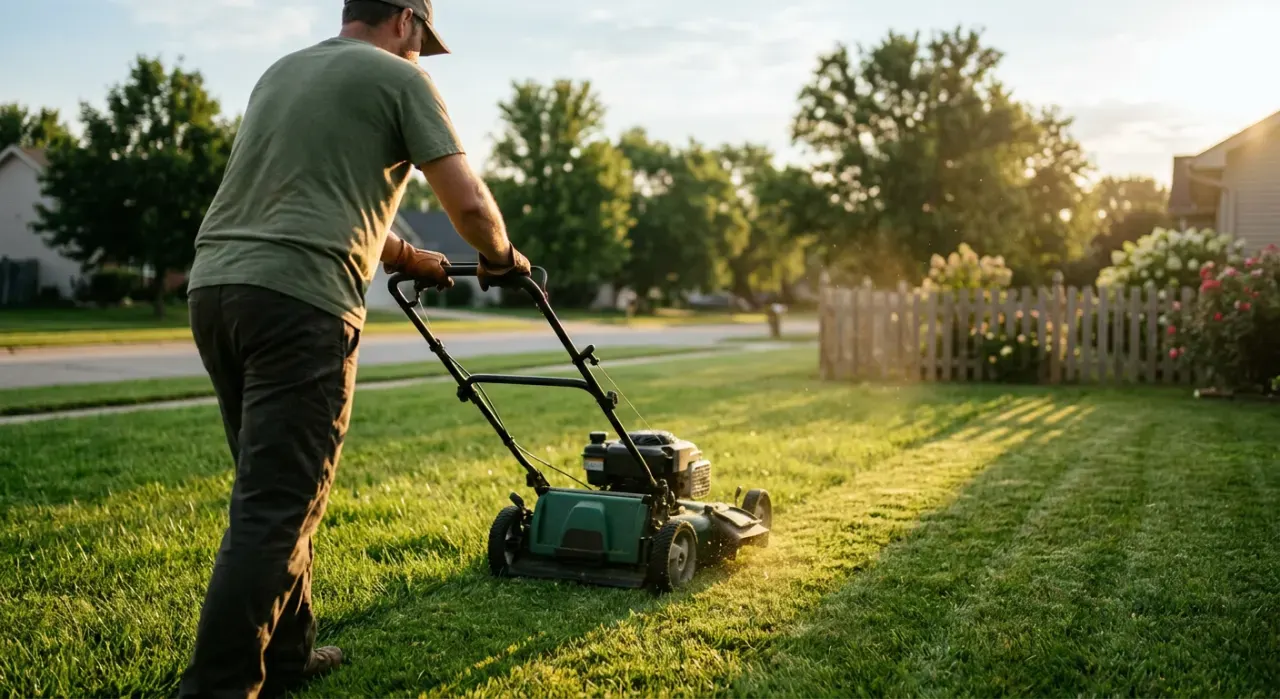
Short cutting is not wrong — it is species-specific. Hybrid Bermuda, zoysia and creeping bentgrass evolved or were bred to grow horizontally from stolons and rhizomes, and they thicken when cut low because low mowing encourages lateral spread rather than vertical growth. Cut those grasses tall and they get puffy, thatchy and stemmy.
The catch is that low cutting demands more of everything else. Below about 1 inch a rotary mower starts scalping every high spot on the lawn, so a reel mower becomes necessary, and reel mowers demand a level surface and frequent cutting. Low-cut lawns also need more water, more feeding and more attention to thatch. If that is not the lawn you want, keep Bermuda at 1.5 to 2 inches, where a standard rotary mower does a genuinely good job.
The Transition Zone Problem
Across the middle band of the country — Virginia to Kansas, Tennessee to southern Missouri — both grass families struggle, and mixed neighborhoods are common. This is where mowing height goes most badly wrong: someone with tall fescue watches a neighbor cut Bermuda at 1.5 inches, matches it, and thins their lawn out within a season.
Identify what you have before you set the deck. Tall fescue grows in clumps with wide, coarse, dark green blades and prominent veins, and it stays green into December. Bermuda has fine gray-green blades, spreads aggressively by above-ground runners you can see crossing sidewalk edges, and goes fully straw-brown after the first hard frost. Zoysia is fine-bladed like Bermuda but noticeably stiff underfoot and slower to spread. St. Augustine has unmistakably broad, flat, folded blades and thick stolons that lie on the surface.
If your lawn is a thin mix and you want to commit to one, fall is the moment for cool-season and late spring for warm-season — see how to overseed a lawn and the blends compared in best grass seed.
Setting the Deck Accurately
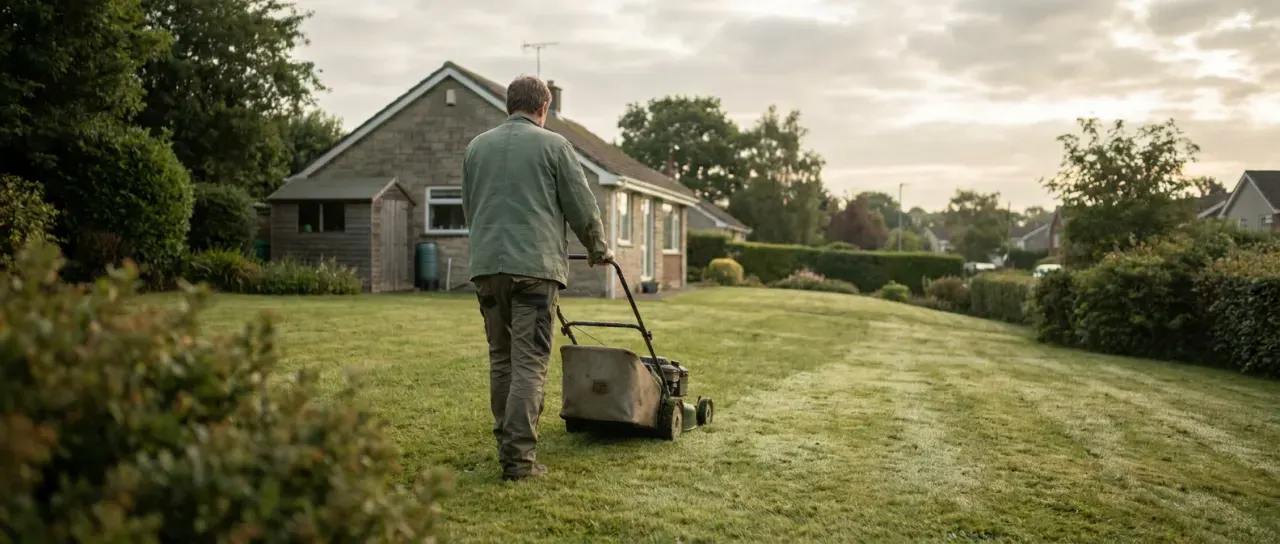
Deck labels are approximations. Position 4 on one mower is 2.75 inches and on another 3.25, and tire pressure, wheel wear and a full grass bag all shift the real number. Measure once and note it.
- Park the mower on a flat, hard, level surface — a driveway or garage floor, never the lawn.
- Disconnect the spark plug wire on a gas mower, or remove the battery and safety key on a battery mower.
- Set the deck to the position you think you want.
- Measure from the hard surface to the cutting edge of the blade tip. Rotate the blade and check the other tip too — a bent blade reads differently on each side and cuts unevenly.
- Adjust until the measurement matches your target, then write down which numbered position that is.
Two more mechanical points matter as much as the setting. A dull blade tears rather than slices, leaving a whitish-brown haze across the lawn a day after mowing, so sharpen every 20 to 25 hours of use — zoysia and Bermuda dull blades fastest. And a mower with enough deck lift and airflow to stand tall grass up before cutting it gives a visibly cleaner result at 3.5 to 4 inches; owners of larger yards consistently report that this is where cheaper machines show their limits. The ranked field is in best lawn mowers.
Adjusting Through the Season
Spring first cut: start at your normal height, not lower. The old advice to scalp cool-season lawns in early spring does more harm than good; it exposes soil right as crabgrass is germinating. Warm-season lawns are the exception — a single low cut at spring green-up to remove dead winter growth helps them warm up and green faster.
Midsummer: raise cool-season grasses a half-inch to an inch. Leave warm-season grasses where they are and mow more often, because summer is their growing season.
Fall: bring cool-season heights back down gradually, and take the last one or two cuts of the year a half-inch lower than normal so long grass does not mat down under snow and invite snow mold. Never do that as one hard cut.
The month-by-month version of all of this, for both grass families side by side, is in the lawn care calendar. And because mowing height and watering depth work together, pair this with how much to water a lawn — a lawn cut tall and watered deeply is the whole low-effort formula.