 Garden


Affiliate Disclosure
Some links on this page are affiliate links. As an Amazon Associate, we earn from qualifying purchases — at no extra cost to you. We do not buy, test, or physically handle the products we cover; our rankings come from aggregated owner reviews, ratings and expert consensus. Commissions never change our verdicts. How we rank · full disclosure.
The verdict in 90 seconds
Scotts Turf Builder Triple Action works well and it is unusually easy to use wrong. It kills established broadleaf weeds, lays down a crabgrass barrier and feeds the lawn in one pass, which is genuinely convenient in early spring. But it must go onto wet grass, it must be timed to soil temperature, it rules out seeding for about four months, and it will damage St. Augustine and several other southern grasses. The consensus in the owner record is that people who followed those four rules are happy and people who did not are not.
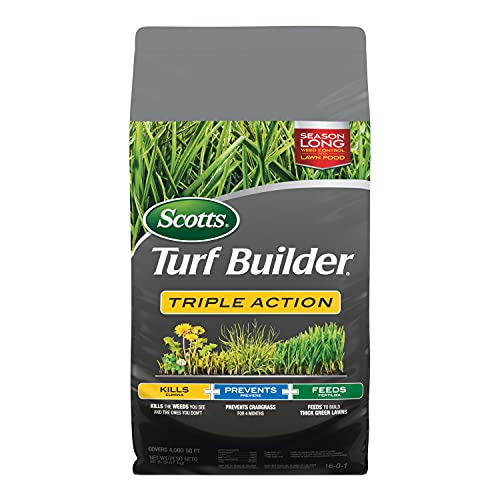
Best for a cool-season lawn with broadleaf weeds that also needs a spring crabgrass barrier
- Kills dandelion, clover and chickweed while feeding the lawn
- Prevents crabgrass and other grassy weeds for up to four months
- Granular — applied with a rotary or drop spreader
- Not for use on St. Augustine, centipede, bahia, carpetgrass or dichondra
Why buy it: it collapses three separate spring applications into one pass, which is the only reason most people ever get all three done.

What owners consistently praise
It kills the weeds it claims to. Dandelion, clover, chickweed and the general broadleaf population are the recurring success story. Owners report visible curling within a few days and collapse over one to two weeks, with a second application sometimes needed for mature clover. On a lawn that has been neglected for a season the visual change is dramatic.
Crabgrass prevention that shows up in summer. This is the part people judge in July rather than April. Owners who applied at the right soil temperature consistently report far less crabgrass than the previous year, which is the real payoff of the product.
One pass instead of three. The honest appeal. Feeding, weed control and pre-emergent are three separate jobs with three separate timings, and most homeowners realistically complete one of them. Combining them means the crabgrass barrier actually goes down.
Green-up. The fertilizer component produces the deep color change in one to two weeks that Scotts is known for, and owners describe the lawn thickening enough to crowd out the weeds that come next.

What owners actually complain about
Failed weed control from dry application. The dominant negative theme. Spread onto a dry lawn, the granules never adhere to the weed leaves, and the owner concludes the product does not work. It is a labeling and expectation problem more than a formulation one, but it produces a great many one and two-star reviews.
Damage to the wrong grass type. The most serious complaint, and irreversible. Owners in Florida, coastal Texas and the Gulf states report thinning or dead patches after applying to St. Augustine or centipedegrass. The exclusion is on the bag; it is not on the front of it.
Striping and burn. Overlapping spreader passes, an incorrect setting or application in heat produce yellow lines that persist for weeks. Owners repeatedly recommend spreading at half rate in two perpendicular passes to even it out.
The seeding lockout. A recurring frustration is discovering after application that the lawn cannot be overseeded for months. Bare patches then stay bare through the season, which is exactly the opposite of what most people wanted.
Timing that is genuinely hard to get right. Apply too early and the barrier weakens before crabgrass germinates; apply too late and it is already up. Owners describe this as the difference between a great result and no result at all, with nothing on the packaging to help beyond a general season reference.
Coverage and bag confusion. Bag sizes are sold by coverage area rather than by weight in the product name, and owners regularly report buying too little for their yard or misreading which size they received.
Dust and handling. A minority mention fine dust when pouring, and the general caution about keeping pets and children off treated areas until the lawn has been watered in and dried.
Who it suits, and who should buy something else
Buy it if you have a cool-season lawn with a genuine weed problem, you are applying in early spring, and you have no plans to seed this year.
Buy plain lawn food instead if you intend to seed or your weeds are already under control — see our Scotts Turf Builder Lawn Food review, which has no herbicide and no seeding restriction.
Buy a starter fertilizer and seed instead if the real problem is thin turf. Thick grass suppresses weeds better than any herbicide — start with how to overseed a lawn and our best grass seed picks.
Use a liquid spot treatment instead if you have scattered weeds rather than a carpet of them — liquid vs granular explains where each format wins. The full field is ranked in our best lawn fertilizer guide and the seasonal best lawn fertilizer for spring.

Specifications
| Spec | Scotts Turf Builder Triple Action |
|---|---|
| Product type | Granular weed and feed with pre-emergent |
| Actions | Kills broadleaf weeds, prevents crabgrass, feeds turf |
| Prevention window | Up to about 4 months of crabgrass control |
| Application | To wet grass, then no watering for about 24 hours |
| Spreader | Rotary or drop; setting printed on the bag |
| Timing | Early spring, before soil reaches the mid-50s°F |
| Seeding | Wait roughly 4 months after application |
| Not for use on | St. Augustine, centipede, bahia, carpetgrass, dichondra |
| Reapplication | Generally no more than twice per year |
| Pets and children | Keep off until watered in and fully dry |
The bottom line
This is a competent product with a narrow set of conditions attached, and the owner rating reflects how many people meet them. Check your grass type against the exclusion list, watch local soil temperatures rather than the calendar, spread it onto a dewy lawn, and do not plan to seed afterwards. Do all four and it will do exactly what the bag says. Skip any one of them and you will be writing one of the negative reviews.
Check price on Amazon → (paid link)
Next: get the timing right with when to apply lawn fertilizer, set expectations in how long lawn fertilizer takes to work, plan the year in the lawn care calendar, or start from the lawn care hub.