 Garden

Affiliate Disclosure
Some links on this page are affiliate links. As an Amazon Associate, we earn from qualifying purchases — at no extra cost to you. We do not buy, test, or physically handle the products we cover; our rankings come from aggregated owner reviews, ratings and expert consensus. Commissions never change our verdicts. How we rank · full disclosure.
For a driveway, flow rate beats pressure and the surface cleaner beats both. Concrete is a large-area job, and cleaning speed is pressure multiplied by flow — so the machine that finishes first is the one moving the most water, not the one with the biggest number on the carton. And however powerful the machine, cleaning a slab with a wand leaves overlapping arcs that are effectively permanent. An $80 surface cleaner attachment changes the result more than $200 of extra PSI ever will.
Top Picks at a Glance

Why the attachment matters more than the machine
The single most common complaint after a first attempt at a driveway is striping — a slab covered in pale overlapping arcs where the wand passed, darker in between. It is not a sign of a weak machine. It happens because a wand's intensity depends on how far the tip is from the surface and at what angle, and no one can hold that constant while walking backward across sixty feet of concrete.
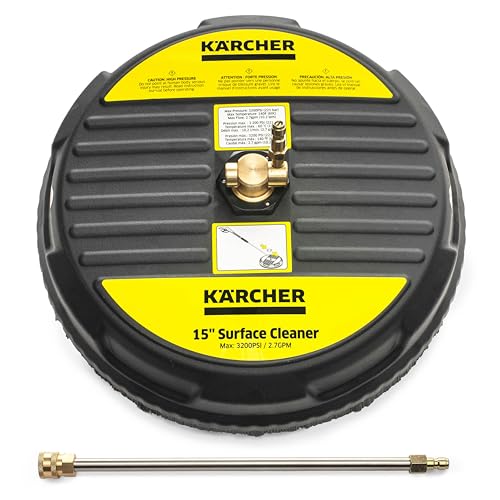
A surface cleaner removes the variable. Two jets rotate under a shroud at a fixed height, sweeping a full circle so every square inch gets the same treatment, and the shroud keeps the slurry off the garage door and off you. It is roughly four times faster than wand work on open concrete, and the finish is even.
The one rule is sizing. A surface cleaner needs enough flow to spin its jets at working speed; starve it and it turns slowly, cleans unevenly and defeats the purpose.
| Machine flow | Surface cleaner size | Typical machine | Notes |
|---|---|---|---|
| 1.2–1.6 GPM | Not recommended | Entry electrics | Not enough flow to drive one properly |
| 1.7–2.0 GPM | 12 inches | ePX3500, WPX3400e | Slower, but even and stripe-free |
| 2.3–3.0 GPM | 14–16 inches | WPX3200, WPX3400 | The sweet spot for a domestic driveway |
| 3.5–4.0 GPM | 20 inches | Prosumer gas | Heavy and genuinely tiring to steer |
| 4.0+ GPM | 20–30 inches | Commercial | Contractor territory |
Our #1 Pick: Westinghouse WPX3400
At 3400 PSI and 2.6 GPM this produces roughly 8,840 cleaning units, which is close to the top of what a homeowner-grade machine offers and, more usefully, comfortably above the flow threshold that keeps a 15-inch surface cleaner spinning properly. That combination is the whole argument: enough water to run the attachment that makes a driveway look right.
The ownership record is consistent about the strengths — genuine speed across large areas of concrete, wheels that survive gravel and a curb, and the freedom of no cord on a long drive. It is equally consistent about the costs, and they are the ordinary costs of an engine rather than faults in this machine. It is loud. It needs an oil change and fuel stabiliser. It is a pull-start after winter storage, and owners who skipped the stabiliser say so in their reviews. It must never be run in a garage or any enclosed space, because a small engine produces carbon monoxide fast enough to be lethal.
If your driveway is short, none of this is worth accepting — go electric. If it is a two-car drive plus a path and an apron, this is the machine that turns a weekend job into a morning one.
Check price on Amazon → (paid link)
The Ranked Field

Best for a two-car driveway plus paths, done in a morning rather than a day
- 3400 PSI at 2.6 GPM — about 8,840 cleaning units
- Enough flow to drive a 15-inch surface cleaner properly
- Axial cam pump with a 212cc engine
- 12-inch never-flat wheels that handle gravel and a curb
Why buy it: concrete is a volume job, not a pressure job. At 2.6 GPM this has the flow to keep a full-size surface cleaner spinning at working speed, which is what separates an even finish from a striped one.
Best for the single upgrade that most changes how a driveway turns out
- Two rotating jets under a shroud, at a fixed standoff distance
- Covers 15 inches per pass instead of a few inches of wand fan
- Splash shroud keeps the slurry off you and the garage door
- Needs roughly 2.5 GPM or more to spin at full speed
Why buy it: wand striping is the number one complaint about driveway cleaning and it is a geometry problem, not a power problem. A surface cleaner holds a constant height and overlaps its own passes, which is the only practical way to get an even slab.

Best for nearly all of the WPX3400 for meaningfully less money
- 3200 PSI at 2.5 GPM — about 8,000 cleaning units
- Still comfortably drives a 15-inch surface cleaner
- Onboard soap tank and five quick-connect nozzles
- One of the deepest owner-review records in the gas class
Why buy it: about 9% behind the WPX3400 in real throughput for a noticeably lower price, and it clears the flow threshold a full-size surface cleaner needs. For most driveways this is the honest buy.
Best for driveway-grade output without fuel, exhaust or pull-starting
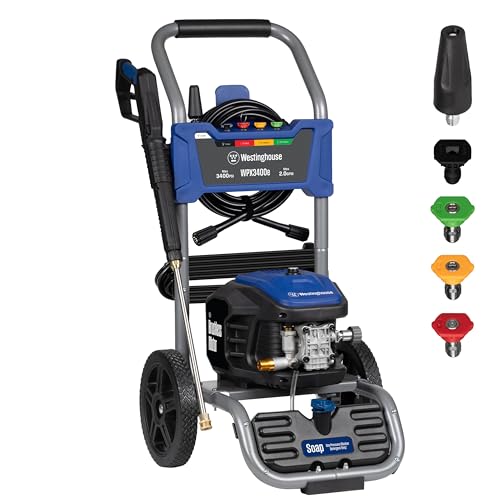
- 3400 max PSI at 2.0 max GPM — about 6,800 cleaning units
- Brushless motor, the most durable electric configuration
- Enough flow for a 12- to 14-inch surface cleaner
- Starts instantly, no oil changes, no winter fuel routine
Why buy it: the first electric class with genuinely driveway-capable flow. It sits between the 1.76 GPM electrics and the gas machines, and for a suburban drive it removes the main reason people put up with an engine.

Best for buyers who expect to still own the machine in ten years
- 3400 PSI at 2.5 GPM with a Simpson CRX engine
- Welded steel frame rather than moulded plastic
- 25-foot MorFlex hose that stays supple in the cold
- Serviceable pump with replaceable parts
Why buy it: driveway work is the hardest duty a domestic machine sees — long runs, grit, and a surface cleaner loading the pump continuously. A frame and pump you can actually service is what turns that into a decade of use.

Best for a short drive or a single parking pad, on a budget
- 2500 max PSI at 1.76 max GPM — about 4,400 cleaning units
- Induction motor, which is what lasts at this price
- Pair it with a 12-inch surface cleaner, not a 15-inch one
- Onboard soap tank for degreaser
Why buy it: it will clean concrete — it just takes longer, and it needs a smaller surface cleaner to spin properly. On a short drive that trade is entirely reasonable; on a hundred feet of it, it is not.

Quick Comparison
| Product | Best for | Rating | Price | Buy |
|---|---|---|---|---|
| Westinghouse WPX3400 Gas Pressure Washer, 3400 PSI, 2.6 GPM | Best Overall for Driveways | — | Check (paid link) | |
| Kärcher 15-Inch Pressure Washer Surface Cleaner, for 2600–3200 PSI Machines | Buy This Before You Buy More PSI | — | Check (paid link) | |
| Westinghouse WPX3200 Gas Pressure Washer, 3200 PSI, 2.5 GPM | Best Value Gas | — | Check (paid link) | |
| Westinghouse WPX3400e Electric Pressure Washer, 3400 Max PSI, 2.0 Max GPM, Brushless Motor | Best Electric for Concrete | — | Check (paid link) | |
| Simpson Clean Machine 3400 PSI Gas Pressure Washer, 2.5 GPM, CRX Engine | Best Build Quality | — | Check (paid link) | |
| Westinghouse ePX3500 Electric Pressure Washer, 2500 Max PSI, 1.76 Max GPM, Induction Motor | Best Budget Option | — | Check (paid link) |
Match the pressure to what the driveway is made of
"Driveway" covers four quite different materials, and the pressure that cleans one damages another. This is where most irreversible damage comes from.
| Surface | Working pressure | Tool | What goes wrong |
|---|---|---|---|
| Sound poured concrete | 2,500–3,500 PSI | Surface cleaner | Wand striping |
| Older or spalling concrete | 1,500–2,500 PSI | Surface cleaner, wide tip | Eroding paste, exposing aggregate |
| Exposed aggregate | 1,500–2,000 PSI | 40° tip, kept moving | Loosening stones permanently |
| Brick or concrete pavers | 1,500–2,500 PSI | Surface cleaner, then re-sand | Blowing out joint sand; pavers shift |
| Asphalt / blacktop | Under 1,500 PSI | 25–40° tip, detergent led | Stripping the bitumen binder |
| Sealed decorative concrete | Under 1,500 PSI | 40° tip | Peeling and clouding the sealer |
Two of these deserve emphasis. Asphalt is soft, and the jet that cleans concrete strips the binder holding blacktop together, leaving a loose, gravelly patch. Use low pressure and let detergent do the work. Pavers lose their joint sand — plan on re-sanding with polymeric sand afterward, which is a normal part of the job rather than a repair.
The sequence that gets a clean slab
- Clear and sweep. Loose grit under a surface cleaner scratches, and leaves clog the shroud.
- Pre-treat the oil and the black patches. Apply degreaser through the soap nozzle, five to ten minutes of dwell, brush the worst of it. See best pressure washer soap.
- Wet down and protect plantings along the edges, before and after.
- Run the surface cleaner in overlapping straight passes, roughly a third overlap, at a steady walking pace. Do not pause — a stationary surface cleaner marks the slab.
- Wand the edges and expansion joints with a 25° tip that the shroud cannot reach.
- Rinse the whole slab in one direction with a 40° tip to carry the slurry off before it dries and leaves a film.
- Let it dry fully, then seal if you intend to. Concrete needs to be genuinely dry, not merely surface-dry.
Oil stains need chemistry rather than pressure, and blasting them usually makes them look worse — the full method is in how to remove oil stains from a driveway.
What owners actually complain about
Striping. The defining driveway complaint, and it is a wand problem. A surface cleaner solves it; nothing else reliably does.
Weight and steering. A 20-inch surface cleaner on a long drive is genuinely tiring, and several owners of large units say they went back to a 15-inch for exactly this reason.
Pumps cracked by frost. The most expensive avoidable failure in the category. Water left in a pump through a hard freeze splits the head, and the machine that worked in October produces nothing in April. Drain it and run pump-saver through before storage.
Underestimating the water bill and the runoff. A 2.6 GPM machine run for two hours moves over 300 gallons. Storm drains discharge untreated — the EPA's stormwater guidance is explicit that runoff reaches streams and lakes as-is, and many municipalities restrict discharging wash water into them. Steer the rinse onto lawn or gravel where soil can filter it.
Safety
Two hazards deserve stating plainly. Injection injury: a high-pressure stream can drive water and grit under the skin through a puncture that looks trivial and is a surgical emergency. A 2023 study in Hand drawing on the CPSC's national injury surveillance system estimated 15,307 high-pressure injection hand injuries in US emergency departments between 2012 and 2021, roughly 90% of them from pressure washers. Never brace a hand near the tip, wear closed shoes and eye protection, and fit the red 0° nozzle almost never. Carbon monoxide: a gas pressure washer must run outdoors, well away from open windows and doors, and never in a garage even with the door up.
How we rank
We do not buy, run or test these machines. Rankings are built from aggregated owner ratings across the most-owned driveway-capable pressure washers, weighted toward long-ownership reviews where pump and engine failures surface, and cross-checked against published specifications. For driveways specifically, four things carry the weight: flow rate, because it sets both throughput and whether a surface cleaner will spin properly; real cleaning units rather than the PSI badge; durability under sustained load, since concrete work is the hardest duty a domestic machine sees; and attachment compatibility, because the surface cleaner is where the result actually comes from. Prices were checked at the time of writing. Full method: how we rank.
The verdict
For a full-size driveway the Westinghouse WPX3400 paired with a 15-inch surface cleaner is the combination that finishes the job in a morning and leaves an even slab. The WPX3200 gives up very little for less money. If you would rather not own an engine, the WPX3400e is the first electric with enough flow to be taken seriously on concrete. And on a short drive, the ePX3500 with a 12-inch cleaner does the job perfectly well — it just takes longer. Whatever you buy, buy the surface cleaner with it. Check price on Amazon → (paid link)
More from this hub: leaf blowers & yard cleanup · best pressure washer · best pressure washer for patios · best budget pressure washer · how we rank.