 Garden


Affiliate Disclosure
Some links on this page are affiliate links. As an Amazon Associate, we earn from qualifying purchases — at no extra cost to you. We do not buy, test, or physically handle the products we cover; our rankings come from aggregated owner reviews, ratings and expert consensus. Commissions never change our verdicts. How we rank · full disclosure.
A patio wants less pressure than a driveway, not more. That is the single most useful thing to know before buying. A patio is a mix of materials — pavers with sand joints, brick, natural stone, mortar, a composite or timber edge, and furniture — and the softest of them sets the ceiling for the whole space. A 2,300 to 2,500 PSI electric with a wide tip does every part of it comfortably; a 3,400 PSI gas machine mostly buys you the ability to do damage faster. Spend the difference on a correctly sized surface cleaner and a decent detergent instead.
Top Picks at a Glance

Our #1 Pick: Westinghouse ePX3500
At 2500 max PSI and 1.76 max GPM this sits at the top of the useful range for patio work rather than beyond it. About 4,400 cleaning units is enough to strip a winter of green off paving at a walking pace, and the wide-tip pressures you will actually use are well inside what stone, mortar and sand joints tolerate.
The reason it ranks first rather than the cheaper ePX3100 is the motor. It uses an induction motor rather than the universal motor fitted to most machines at this price, and the ownership record reflects it consistently: quieter operation, a machine that does not get hot on a long session, and — the point of the whole exercise — longer life. Universal motors are where budget electrics die.
The recurring complaints are the ordinary ones for the class and worth knowing. It is heavier than the cheaper models, the power cord is short enough that most owners end up on an outdoor-rated extension, and it costs meaningfully more than the ePX3100 for a difference in cleaning speed you will not feel. That last point is real: buy this for the motor, not for the 200 extra PSI.
Check price on Amazon → (paid link)
The Ranked Field

Best for a mixed patio of concrete, pavers and furniture, used every season
- 2500 max PSI at 1.76 max GPM — about 4,400 cleaning units
- Induction motor, which is what actually lasts
- Runs quieter and cooler than a universal-motor machine
- Onboard soap tank and a wide anti-tip base
Why buy it: a patio is the job electric machines were made for: enclosed, close to an outlet, and full of surfaces that punish too much pressure. This has the flow to work quickly and the motor to keep doing it for years.

Best for the same job for less, if you use it a few times a year
- 2300 max PSI at 1.76 max GPM — about 4,050 cleaning units
- Identical flow to the ePX3500, so nearly the same working speed
- Soap tank, four nozzles and an upright storage body
- Universal motor rather than induction
Why buy it: the flow rate is what sets cleaning speed, and it is identical to the machine above. You are giving up motor longevity rather than capability, which on a machine used three times a year is a reasonable trade.
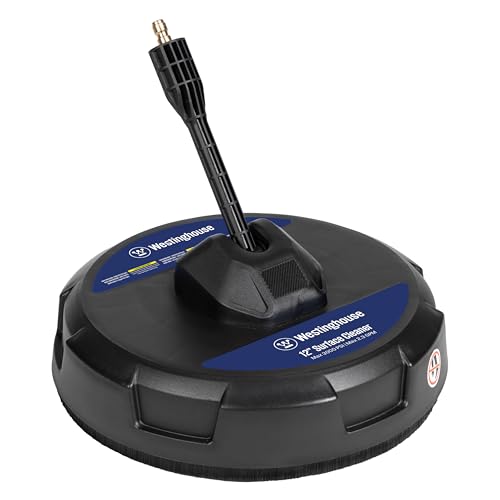
Best for getting an even finish on a paved patio instead of wand stripes
- 12 inches — sized for the 1.7–2.0 GPM flow of an electric machine
- Two rotating jets under a splash shroud at a fixed height
- 1/4-inch quick connect
- Small enough to work between planters and furniture
Why buy it: the 15-inch cleaners sold for gas machines starve on an electric and turn too slowly. A 12-inch head spins properly at 1.76 GPM, which is the difference between an even patio and a striped one.

Best for buyers who want the machine with the deepest ownership record in America
- 2030 max PSI at 1.76 GPM
- Two separate detergent tanks — useful when a patio needs two chemistries
- Five nozzles including the black soap tip
- Spare parts available everywhere
Why buy it: the twin tanks genuinely earn their place on patio work, letting you keep a wood cleaner and a hard-surface cleaner loaded at once instead of flushing between them.
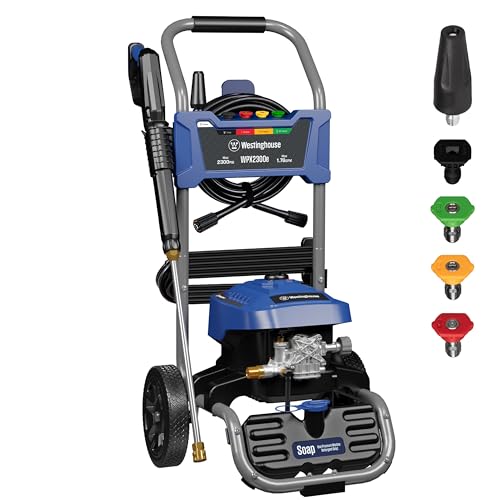
Best for terraces, courtyards and anywhere close to neighbors
- Induction motor — noticeably quieter than a universal one
- 2300 max PSI at 1.76 max GPM
- Onboard soap tank and quick-connect nozzles
- Thinner owner-review record than the ePX range, stated plainly
Why buy it: noise is the real constraint on an urban patio, where the machine is running a few feet from a wall and a neighbor. An induction motor is the only meaningful lever on that, and it is why this is here.

Best for patio sets, chair frames, grills and planters as much as the paving
- 2100 max PSI at 1.76 max GPM
- Foam cannon included — far better dwell on vertical and awkward surfaces
- Turbo nozzle for spot work on stubborn paving
- Compact body for a small patio store
Why buy it: furniture is half of most patio cleaning and it is the half a plain fan tip does badly. Thick foam that clings to a chair frame for five minutes does more than another 400 PSI ever will.
Quick Comparison
| Product | Best for | Rating | Price | Buy |
|---|---|---|---|---|
| Westinghouse ePX3500 Electric Pressure Washer, 2500 Max PSI, 1.76 Max GPM, Induction Motor | Best Overall for Patios | — | Check (paid link) | |
| Westinghouse ePX3100 Electric Pressure Washer, 2300 Max PSI, 1.76 Max GPM | Best Value | — | Check (paid link) | |
| Westinghouse PWSC12 12-Inch Pressure Washer Surface Cleaner Attachment, 3000 Max PSI | The Attachment That Changes the Result | — | Check (paid link) | |
| Sun Joe SPX3000 Electric Pressure Washer, 2030 Max PSI, 1.76 GPM | Best-Understood Machine | — | Check (paid link) | |
| Westinghouse WPX2300e Electric Pressure Washer, 2300 Max PSI, 1.76 Max GPM, Induction Motor | Quietest | — | Check (paid link) | |
| Westinghouse ePX3050 Electric Pressure Washer, 2100 Max PSI, 1.76 Max GPM, with Foam Cannon and Turbo Nozzle | Best Kit for Furniture | — | Check (paid link) |
Pressure by patio material
The reason patios go wrong is that people use one setting across five materials. Work out which is the softest thing in the space and let it set your ceiling.
| Material | Working pressure | Nozzle | What goes wrong |
|---|---|---|---|
| Concrete pavers | 1,500–2,500 PSI | 25° or 12-inch surface cleaner | Joint sand blown out; pavers shift |
| Clay brick | 1,500–2,000 PSI | 25° | Eroding soft mortar joints |
| Sandstone / limestone | Under 1,500 PSI | 40° | Pitting and permanent lightening |
| Slate and flagstone | 1,000–1,800 PSI | 40° | Delaminating layers; opening bedding |
| Poured concrete slab | 2,000–3,000 PSI | Surface cleaner | Wand striping |
| Timber decking | 500–1,200 PSI | 40°, with the grain | Raised grain, permanently furred |
| Composite decking | Manufacturer limit only | Fan tip, 8+ inches back | Surface damage; warranty voided |
| Patio furniture | Under 1,500 PSI | 40° or foam cannon | Stripping powder coat and fabric |
Composite decking deserves the specific note because the limits are set by brand and stated in writing. Trex's own care and cleaning guidance permits a pressure washer of no more than 3,100 PSI with a fan tip and soap on its Transcend, Enhance and Select ranges, requires the tip to stay at least eight inches from the surface, and does not recommend pressure washing early-generation Trex at all — with damage from pressure washing excluded from warranty. Other brands cap far lower. Find your own manufacturer's sheet before you point anything at it.
Why a 12-inch surface cleaner, not a 15-inch one
Surface cleaners are the fix for striping — two jets rotating under a shroud at a fixed height, overlapping their own passes so every square inch gets the same treatment. But they only work if the machine can spin them at working speed, and that is a flow question rather than a pressure one.
The 14- and 15-inch heads sold alongside gas machines expect roughly 2.5 GPM. Fit one to a 1.76 GPM electric and it turns sluggishly, cleans unevenly and leaves you worse off than the wand. A 12-inch head is sized for electric flow, spins properly, and has the side benefit of fitting between planters and table legs where a bigger one cannot go. Our driveway guide has the full sizing table if you are also doing a slab.
The order that gets a patio clean
- Clear the furniture and sweep — loose grit under a surface cleaner scratches paving.
- Pull the weeds out of the joints first. Water drives them deeper and washes seed across the whole patio.
- Pre-wet the surrounding planting, and rinse it again at the end. Dilution is the entire defense.
- Apply an oxygenated cleaner through the black soap nozzle and let it dwell five to ten minutes without drying. Moss and black algae are biological and this is what removes them properly — see best pressure washer soap.
- Agitate the worst areas with a stiff brush. Ten seconds of brushing beats a thousand PSI.
- Clean in overlapping straight passes with the surface cleaner, keeping it moving. A stationary head marks the paving.
- Wand the edges and steps with a 25° tip where the shroud cannot reach.
- Rinse in one direction toward the drainage point so the slurry leaves rather than dries in place.
- Re-sand the joints once the paving is dry, with polymeric sand if the patio takes traffic.
Oil stains under a grill or a table need chemistry rather than pressure, and blasting them usually makes them look worse — the method is in how to remove oil stains from a driveway. Detergent technique, which is where most patio results are won or lost, is in how to use soap in a pressure washer.

What owners actually complain about
Joint sand everywhere. The most common patio-specific surprise. It is not a fault; it is physics, and re-sanding is part of the job.
Striping and etch marks. Caused by a narrow tip held too close, or by pausing with a surface cleaner. Both are permanent for practical purposes.
Short cords. Universal across electric machines. Use an outdoor-rated 12-gauge extension and keep it as short as it will go — an undersized lead causes a voltage drop that leaves the motor struggling.
Pumps cracked over winter. The most expensive avoidable failure in the category, and a patio machine stored in an unheated shed is squarely in the firing line. Drain the pump and run pump-saver through it before the first freeze — see how long pressure washers last.
Safety
Patios put you close to windows, doors, furniture and often other people, which makes two things matter more than usual. First, never aim a wand at a person or a pet, and never brace a hand in front of the tip to steady it. A high-pressure jet can inject water and grit under the skin through a puncture that looks trivial and is a surgical emergency; a 2023 study in Hand using the CPSC's national injury surveillance data estimated 15,307 high-pressure injection hand injuries in US emergency departments between 2012 and 2021, roughly 90% of them from pressure washers. Second, wear eye protection — enclosed spaces bounce grit straight back at you. Plug an electric machine into a GFCI-protected outlet, and treat the red 0° nozzle as one you never fit on a patio.
How we rank
We do not buy, run or test these machines. Rankings come from aggregated owner ratings across the most-owned patio-suitable pressure washers, weighted toward long-ownership reviews where motor and pump failures surface, and cross-checked against published specifications and manufacturer care guidance for the surfaces involved. For patios specifically, four things carry the weight: appropriate pressure, since excess is a liability rather than a benefit here; flow rate, which sets working speed and decides what size surface cleaner will spin; noise and motor type, because patios are close to houses and neighbors; and attachment fit, as the surface cleaner is where an even finish comes from. Prices were checked at the time of writing. Full method: how we rank.
The verdict
The Westinghouse ePX3500 is the patio machine to buy if you will use it every season — the induction motor is the part that justifies the price. Take the ePX3100 if you will use it three times a year and would rather keep the difference. Add a 12-inch surface cleaner whatever you choose, because that is what decides whether the paving looks evenly clean or covered in arcs. And resist the urge to buy more pressure: on a patio, the extra is a risk to stone, mortar and joints rather than a shortcut. Check price on Amazon → (paid link)
More from this hub: leaf blowers & yard cleanup · best pressure washer · best budget pressure washer · best pressure washer soap · how we rank.