 Garden


Affiliate Disclosure
Some links on this page are affiliate links. As an Amazon Associate, we earn from qualifying purchases — at no extra cost to you. We do not buy, test, or physically handle the products we cover; our rankings come from aggregated owner reviews, ratings and expert consensus. Commissions never change our verdicts. How we rank · full disclosure.
Before you buy one: check your machine's flow rate, not its pressure. A wet sandblasting head is a venturi — it uses the energy of the water leaving the nozzle to suck abrasive up a hose. On a gas machine at 2.5 GPM there is plenty of energy to do that. On a standard 1.76 GPM household electric there frequently is not, and the attachment spits water while the sand sits in the bucket. That single mismatch explains the bulk of the one-star reviews in this category, and it is why the whole field rates unusually low.
The second thing to know is about the abrasive rather than the hardware. NIOSH has recommended against using silica sand as a blasting abrasive since 1974, and the United Kingdom banned it in 1949. Wet blasting reduces the dust; it does not make crystalline silica safe. The right move is to buy a non-silica media — aluminum oxide, garnet, crushed glass or slag — and treat the respirator as mandatory rather than optional.
Top Picks at a Glance

Will it work on your machine?
| Your machine | Flow | Realistic result |
|---|---|---|
| Battery or cordless unit | Under 0.6 GPM | Will not draw abrasive at all |
| Compact electric, 1500–1700 PSI | 1.2 GPM | Will not work reliably; do not buy |
| Standard electric, 2000–2500 PSI | 1.76 GPM | Marginal — works on some kits, poorly on others |
| Brushless electric, 3000–3400 PSI | 2.0 GPM | Generally works; slower than gas |
| Gas, 3000–3400 PSI | 2.4–2.6 GPM | Works properly; this is the design point |
| Gas, 4000 PSI and up | 3.5–4.0 GPM | Works well; nozzle wear is rapid |
If you are in the top three rows, the honest recommendation is not a better kit — it is a different plan. Chemical paint stripper, a wire cup on an angle grinder, or a rented dry blast pot will all do more for you than an attachment that cannot lift its media.
Our #1 Pick: M MINGLE Sandblasting Kit
Judged within a category that rates poorly, this is the kit with the best owner record. The reasons owners give are consistent and unglamorous: the ceramic nozzle is decent quality, spare tips are in the box, and the suction assembly primes more readily than the cheapest competition.
That last point is the one that decides satisfaction. Every wet blast head is fundamentally the same venturi, and the difference between one that works and one that does not is how well the internal geometry and the foot filter are made. Owners on gas machines report it drawing media steadily and cutting rust off trailer frames and farm gates at a useful rate. Owners on 1.76 GPM electrics report the same marginal behavior they would get from any kit, which is a machine problem rather than a product problem.
Treat the nozzle as a consumable. A hard job will visibly wear a ceramic tip within a couple of hours, and a worn tip changes the spray pattern and kills the suction — buy spares at the same time.
Check price on Amazon → (paid link)
The Ranked Field

Best for a homeowner with a gas machine and a genuine rust or paint job
- 1/4-inch quick connect that fits most consumer and prosumer wands
- Ceramic nozzle plus replacement tips in the box
- Suction hose with a foot filter for the abrasive container
- Rated well above any machine a homeowner will pair it with
Why buy it: the highest-rated kit in a category that rates poorly overall — the ceramic nozzle and included spares are what separate it from the crowd, because the nozzle is the part that wears out.

Best for working away from the abrasive bucket without dragging it along
- 18-foot suction hose, roughly double the usual length
- Ceramic nozzle with replacements included
- Brass and stainless fittings
- 1/4-inch quick connect
Why buy it: the standard 8 to 10 foot suction hose keeps you tethered to a bucket you keep kicking over — eighteen feet is the practical upgrade in this category.

Best for buyers who want the kit with the deepest owner-review record
- Ceramic nozzle with spare tips
- Suction hose and foot filter included
- 1/4-inch quick connect
- The largest body of owner reviews in the category
Why buy it: a middling rating with a very large review base tells you more than a perfect rating on fifty reviews — and what it tells you is that this category disappoints a lot of buyers.

Best for a one-off job where the kit does not need to survive a decade
- Basic wet blast head with a ceramic tip
- Suction hose with filter
- 1/4-inch quick connect
- Replacement nozzles widely available
Why buy it: honest, cheap, and adequate if you accept that the ceramic nozzle is a consumable and the whole kit is close to disposable.
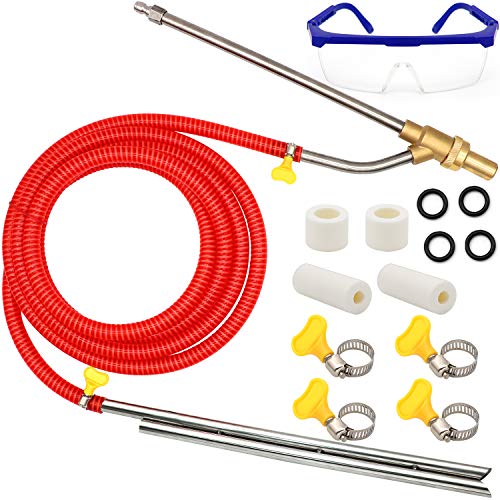
Best for nobody in particular — included because it is heavily bought
- Standard wet blast head and suction hose
- Ceramic nozzle
- 1/4-inch quick connect
- The lowest owner rating of the widely-owned kits
Why buy it: it is here for completeness rather than recommendation — the rating is the lowest in the field and the complaints are about the abrasive refusing to draw at all.

Best for the abrasive you should actually be feeding the kit
- Aluminum oxide rather than crystalline silica
- Medium #80 grade for rust and paint on steel
- Recyclable through several passes when dry-blasting
- Cuts faster than sand at the same pressure
Why buy it: the single most important decision on this page — swapping silica sand for a non-silica abrasive removes the one genuinely serious health hazard in the whole exercise.
Quick Comparison
| Product | Best for | Rating | Price | Buy |
|---|---|---|---|---|
| M MINGLE Pressure Washer Sandblasting Kit, 1/4" Quick Connect, 5000 PSI Wet Sand Blaster | Best Overall | — | Check (paid link) | |
| Tool Daily Pressure Washer Sandblasting Kit, Wet Sand Blaster, 5000 PSI, 18 FT Suction Hose | Best Reach | — | Check (paid link) | |
| Selkie Pressure Washer Sandblasting Kit, Wet Abrasive Sandblaster Attachment with Replacement Nozzles | Most Owned | — | Check (paid link) | |
| Tool Daily Pressure Washer Sandblasting Kit, Wet Sand Blaster Attachment, Water Sand Blaster | Best Value | — | Check (paid link) | |
| Pressure Washer Sandblasting Kit, 5000 PSI Wet Sandblaster Attachment, Power Washer Sandblaster | The One to Think Twice About | — | Check (paid link) | |
| #80 Aluminum Oxide, 8 lbs, Medium Sand Blasting Abrasive Media | Buy This Instead of Sand | — | Check (paid link) |
The silica problem, stated plainly
Abrasive blasting with sand produces respirable crystalline silica, and inhaling it causes silicosis — an irreversible, progressive scarring of the lungs — as well as increased risk of lung cancer, COPD and kidney disease. This is not a marginal or disputed hazard. NIOSH first recommended prohibiting silica sand as a blasting abrasive in 1974, and its abrasive blasting guidance lists substitutes including corundum, glass beads, pumice, slag, steel grit and walnut shell. The United Kingdom outlawed sand in abrasive blasting in 1949. Despite all of that, silica sand remains the most-used blasting abrasive in the United States.
Wet blasting genuinely helps — suppressing the dust is the entire reason these attachments exist — but it does not eliminate the exposure. Material comes off the surface, the spray drifts and dries, and what settles on your clothes goes airborne again when you move. OSHA regulates the exposure under its respirable crystalline silica standard for construction, 29 CFR 1926.1153, and while a homeowner is not an OSHA employer, your lungs do not know that.
What to do about it: use a non-silica abrasive, wear a properly fitted respirator rated for particulates rather than a dust mask, cover your skin, wear sealed goggles, work outdoors and upwind, keep other people and pets well clear, and change out of your clothes before going inside. If you are stripping paint on anything built before 1978, assume lead and read up on lead-safe practice before you start — blasting is one of the most effective ways to aerosolise it.
How We Rank
We do not buy or run these attachments. Rankings come from aggregated owner ratings across the most-owned wet sandblasting kits, weighted toward reviews that state which machine the kit was paired with, and cross-checked against published specifications and occupational-health guidance. Four things carry the weight: whether it primes and draws reliably, which is what the negative reviews are almost entirely about; nozzle quality and whether spares are included, since the tip is a consumable; suction hose length, because a short one tethers you to a bucket; and fitting compatibility with common consumer wands. Prices were checked at the time of writing. Full method: how we rank.

The Field, Reviewed
1. M MINGLE Sandblasting Kit — Best Overall
Covered above. Owners praise: reliable priming on adequate machines, ceramic nozzle quality, and included spares. Owners gripe about: nozzle wear on hard jobs, and the same underpowered-machine failure that affects the whole category. Check price (paid link).
2. Tool Daily 18 FT Suction Hose Kit — Best Reach
The same basic head with roughly double the standard suction hose, which sounds trivial and is not. Eighteen feet lets you leave the abrasive container in one place and work around a trailer or a gate without dragging or tipping it.
Owners praise: the hose length, brass and stainless fittings, and easy nozzle replacement. Owners gripe about: the longer hose being harder to prime, and needing a taller container to keep the foot filter submerged in media. Check price (paid link).
3. Selkie Sandblasting Kit — Most Owned
The kit with the largest review base in the category, and a rating that sits below four stars. That combination is informative: it is not a bad product so much as a product a great many people bought without checking their machine's flow rate.
Owners praise: price, included spare nozzles, and results on rusty steel when paired with a gas washer. Owners gripe about: no suction at all on smaller electrics, and a foot filter that clogs with slightly damp media. Check price (paid link).
4. Tool Daily Wet Sand Blaster — Best Value
The cheapest of the kits we would actually point someone at. Basic, adequate, and priced so a single-project purchase makes sense.
Owners praise: price, simple assembly, widely available replacement tips. Owners gripe about: a short suction hose and a nozzle that wears faster than the better kits. Check price (paid link).
5. Generic 5000 PSI Kit — The One to Think Twice About
Included because it sells in volume, not because we recommend it. It carries the lowest owner rating among the widely-bought kits, and the complaints cluster on the fundamental failure — media that will not draw.
Owners praise: the price, and that it works acceptably on a large gas machine. Owners gripe about: failing to siphon, inconsistent build between batches, and thin fittings. Check price (paid link).
6. #80 Aluminum Oxide Media — Buy This Instead of Sand
The most important line item on the page. Aluminum oxide is harder and cuts faster than silica sand at the same pressure, and it removes the respirable-silica hazard entirely. A #80 medium grade suits rust and paint on steel; go coarser for heavy scale, finer for a light key before painting.
Owners praise: cutting speed against sand, consistent grading, and low dust for an abrasive. Owners gripe about: cost per pound compared with a bag of sand, and how quickly wet blasting consumes it since it cannot be recovered. Check price (paid link).
What Owners Actually Complain About
"It won't pick up the sand." Overwhelmingly the top complaint, and usually a machine that lacks the flow rather than a defective kit. Check GPM first.
Damp or wrong media. Abrasive must be bone dry and correctly graded. Play sand fails on both counts and bridges in the hose within seconds.
Nozzle wear. Ceramic tips are consumables and a hard job eats one in a couple of hours. Buy spares with the kit.
Consumption rate. Wet blasting uses media fast and you cannot recover it out of the slurry. Owners routinely underestimate how many bags a job takes.
Surface damage. Blasting soft brick, old mortar or timber removes material permanently and quickly. Test somewhere invisible every single time.
Safety, twice over
This attachment combines two hazards that are individually serious. The abrasive side needs a fitted particulate respirator, sealed goggles, gloves and covered skin, and it needs a non-silica media. The pressure side is the machine itself: a high-pressure jet can drive water and grit under the skin through a puncture that looks trivial and is a surgical emergency, and the CPSC has warned that power washers can cause serious injuries. A blast head carries abrasive as well as water, so it is meaningfully worse than a plain nozzle. Never point one at anyone, never brace a hand near the tip, and keep bystanders out of the area entirely.
The Verdict
If you have a gas pressure washer at 2.5 GPM or more and a genuinely rusty steel object to strip, buy the M MINGLE kit, buy spare nozzles, and buy aluminum oxide rather than sand. If you have a standard household electric, the honest recommendation is to skip this category — the attachment will frustrate you and the money is better spent on chemical stripper, an angle grinder with a wire cup, or a day's rental of a proper blast pot. And whichever route you take, wear the respirator. This is the one job on this site where the safety advice is not a formality. Check price on Amazon → (paid link)
More from this hub: leaf blowers & yard cleanup · best pressure washer · best pressure washer gun · removing rust stains from concrete · how we rank.