 Garden


Affiliate Disclosure
Some links on this page are affiliate links. As an Amazon Associate, we earn from qualifying purchases — at no extra cost to you. We do not buy, test, or physically handle the products we cover; our rankings come from aggregated owner reviews, ratings and expert consensus. Commissions never change our verdicts. How we rank · full disclosure.
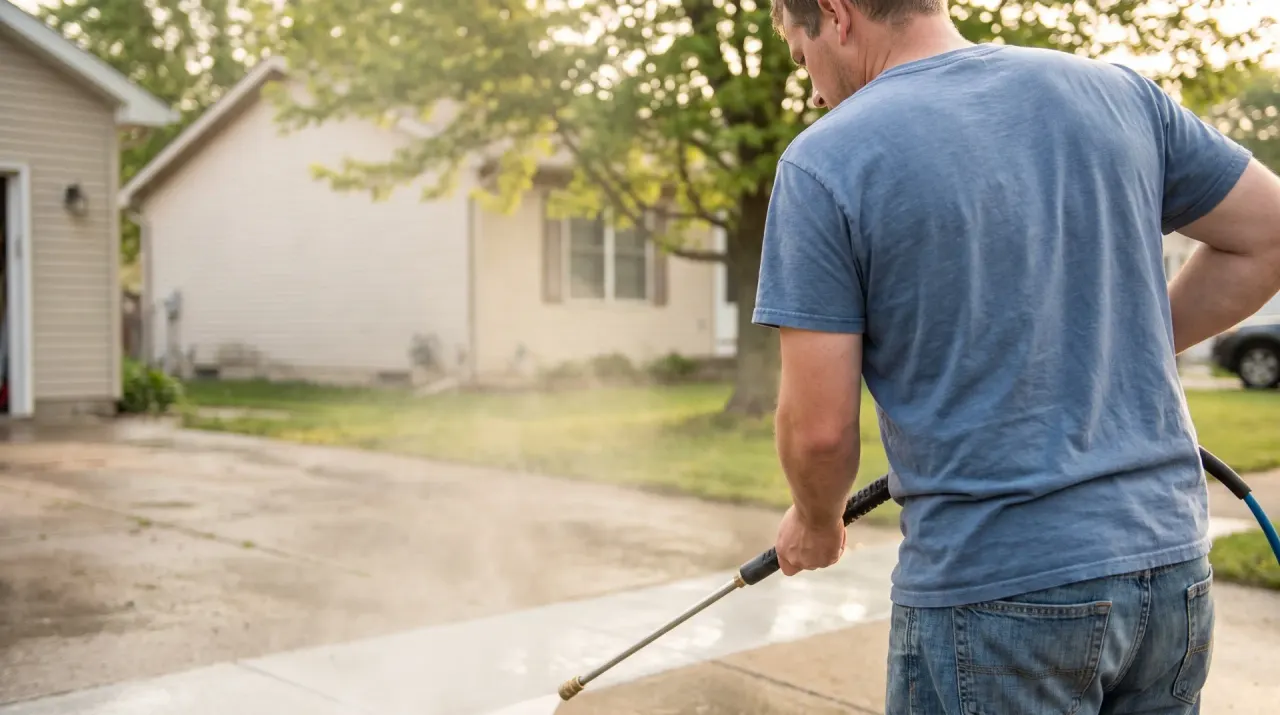
Buy the size that matches your machine's flow rate, not the size that matches your driveway. A surface cleaner works by splitting your washer's entire water flow between two rotating jets. Widen the head and the same water has to cover more ground, so the bar turns more slowly and each jet arrives with less energy at a longer standoff. Go too wide and you get the classic failure: visible arcs, stripes and patches that need a second pass with the wand, which defeats the point.
The working rule is about 5 to 6 inches of cleaning path per GPM. That puts a 1.76 GPM electric on a 12-inch head, a 2.5 GPM gas homeowner machine on 14 to 16 inches, and the 20- and 24-inch heads squarely in contractor territory at 3.5 to 4 GPM. Nearly every one-star review in this category is somebody who bought a 20-inch cleaner for an electric washer.
Top Picks at a Glance
The Sizing Table
| Your machine | GPM | Right head size | What happens if you go bigger |
|---|---|---|---|
| Budget electric | 1.1–1.4 | Not recommended | The bar barely turns; buy a turbo nozzle instead |
| Good electric | 1.6–1.9 | 12 inch | 15 inch spins slowly and leaves arcs |
| Gas homeowner | 2.3–2.6 | 14–16 inch | 20 inch loses energy and stripes badly |
| Large gas | 3.0–3.5 | 16–20 inch | 24 inch works but slowly |
| Commercial | 4.0+ | 20–24 inch | Fine — this is what those heads are for |
The second specification to check is the pressure rating. Your cleaner should be rated above your machine's maximum PSI, not at it. The part that fails when it is not is the swivel bearing at the top of the rotating bar, and once that weeps you get water running down the wand onto your hands for the rest of the job.
Our #1 Pick: Kärcher 15-Inch Surface Cleaner
The Kärcher 15-inch is the most-owned surface cleaner in the United States, and it happens to be the size that matches the most common homeowner setup — a gas machine somewhere between 2.3 and 2.6 GPM. That alignment is why it works so well for so many people, and why the owner record is as strong as it is.
What owners describe consistently is the thing that sells this category: a driveway that took ninety minutes of striping with a wand is done in twenty-five minutes with an even finish, using markedly less water because the jets are always at the right standoff instead of waving about. The splash skirt is more useful than it looks — it keeps the slurry from spraying up the garage door and down your legs.
The honest limitations. It is rated for 2600 to 3200 PSI machines, so it is not the right choice on a 4000 PSI unit. On a 1.76 GPM electric it will turn, but slowly enough that you will see arcs unless you walk very deliberately — that is the 12-inch head's job, not this one's. And like every surface cleaner, the swivel is the wear item; owners who get years out of one flush it with clean water after use and store it indoors.
Check price on Amazon → (paid link)
The Ranked Field
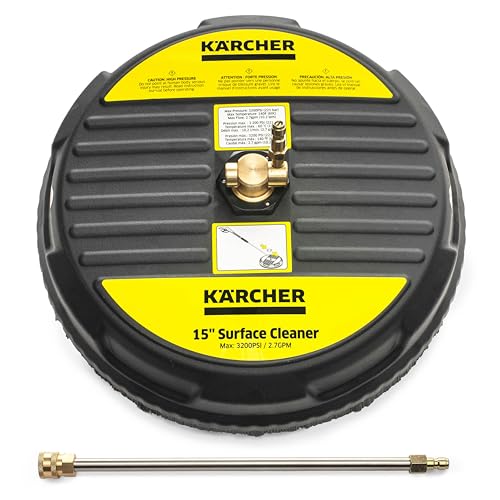
Best for gas machines in the 2.3 to 2.6 GPM range — the commonest homeowner setup
- 15-inch cleaning path with a dual-jet rotating bar
- Rated for 2600 to 3200 PSI machines
- Splash skirt that keeps slurry off siding and shoes
- Standard 1/4-inch quick connect
Why buy it: the most-owned surface cleaner in the country and the size that actually matches a homeowner gas washer, which is where most people get this purchase wrong.
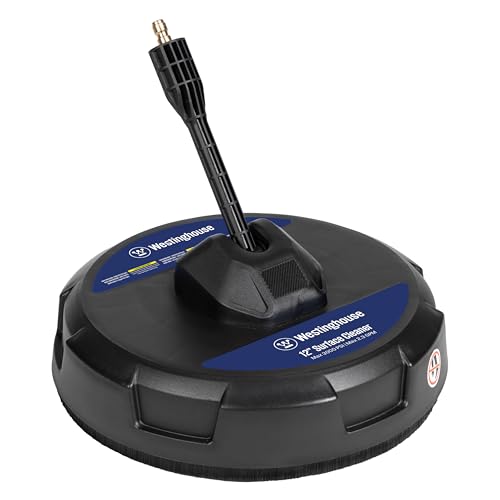
Best for electric washers at 1.6 to 2.0 GPM that choke a bigger head
- 12-inch path sized for lower-flow machines
- Rated to 3000 max PSI
- Two-jet rotating bar with a low-profile skirt
- 1/4-inch quick connect, fits gas and electric
Why buy it: the honest choice for a 1.76 GPM electric — a 15-inch head on that machine spins slowly and leaves arcs, and this one does not.

Best for gas machines at 2.5 GPM and up, where a wider path pays for itself
- 16.5-inch stainless housing rated to 4400 PSI
- Dual-jet rotating bar on a serviceable swivel
- Four caster wheels for even height across the path
- Fits standard 1/4-inch quick connect wands
Why buy it: the highest owner rating in the whole category, and the stainless housing is the part that decides whether a surface cleaner survives five seasons on concrete.
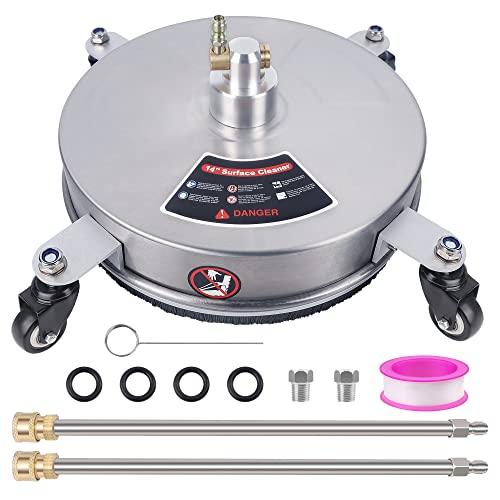
Best for a first surface cleaner on a 2.0 to 2.5 GPM machine
- 14-inch stainless housing with four wheels
- Two rotating jets, 1/4-inch quick connect
- Ships with extension wands in most bundles
- Sized between the 12-inch and 15-inch classes
Why buy it: the size that suits the widest range of consumer machines, at a price that makes trying a surface cleaner an easy decision rather than a commitment.
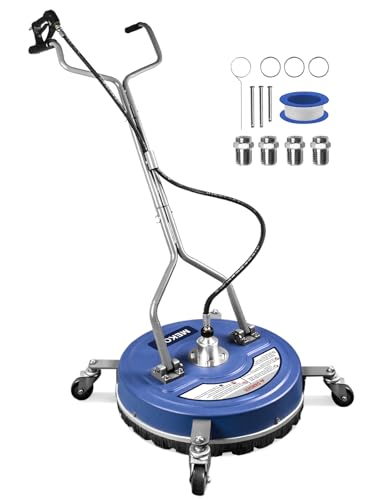
Best for gas machines at 3.5 GPM and above, and long driveways
- 20-inch path with a dual handle for control
- Rated to 4500 PSI
- Stainless housing with a heavy swivel
- Designed around 3.5 to 4 GPM commercial flow
Why buy it: a 20-inch head covers about 78% more ground per pass than a 15-inch one — but only if your machine has the flow to spin it, which is the whole trick with sizing.
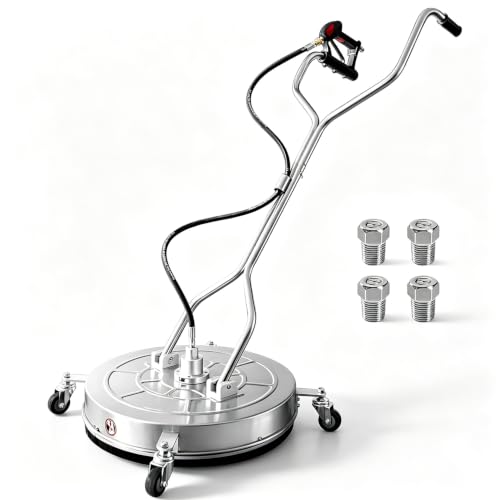
Best for contractors, parking pads and anyone running 4 GPM or more
- 24-inch cleaning path, dual-handle frame
- Stainless housing with four heavy casters
- Built for high-flow commercial machines
- 1/4-inch quick connect with extension wands
Why buy it: genuinely fast on big concrete — and genuinely useless on anything under about 4 GPM, where it turns into a heavy thing that leaves stripes.
Quick Comparison
| Product | Best for | Rating | Price | Buy |
|---|---|---|---|---|
| Kärcher 15-Inch Pressure Washer Surface Cleaner, for 2600–3200 PSI | Best Overall | — | Check (paid link) | |
| Westinghouse PWSC12 12-Inch Surface Cleaner Attachment, 3000 Max PSI | Best for Electric Machines | — | Check (paid link) | |
| Westinghouse Universal 16.5-Inch Surface Cleaner, Stainless Steel, 4400 PSI | Highest Rated | — | Check (paid link) | |
| Biswing 14-Inch Pressure Washer Surface Cleaner with 4 Wheels, Stainless Steel | Best Value | — | Check (paid link) | |
| MEKOH 20-Inch Heavy-Duty Surface Cleaner with Wheels, 4500 PSI | Best Heavy-Duty | — | Check (paid link) | |
| JANZ 24-Inch Surface Cleaner with Dual Handle and 4 Wheels, Stainless Steel | Best Large-Area | — | Check (paid link) |
What a Surface Cleaner Is and Is Not For
| Surface | Surface cleaner? | Notes |
|---|---|---|
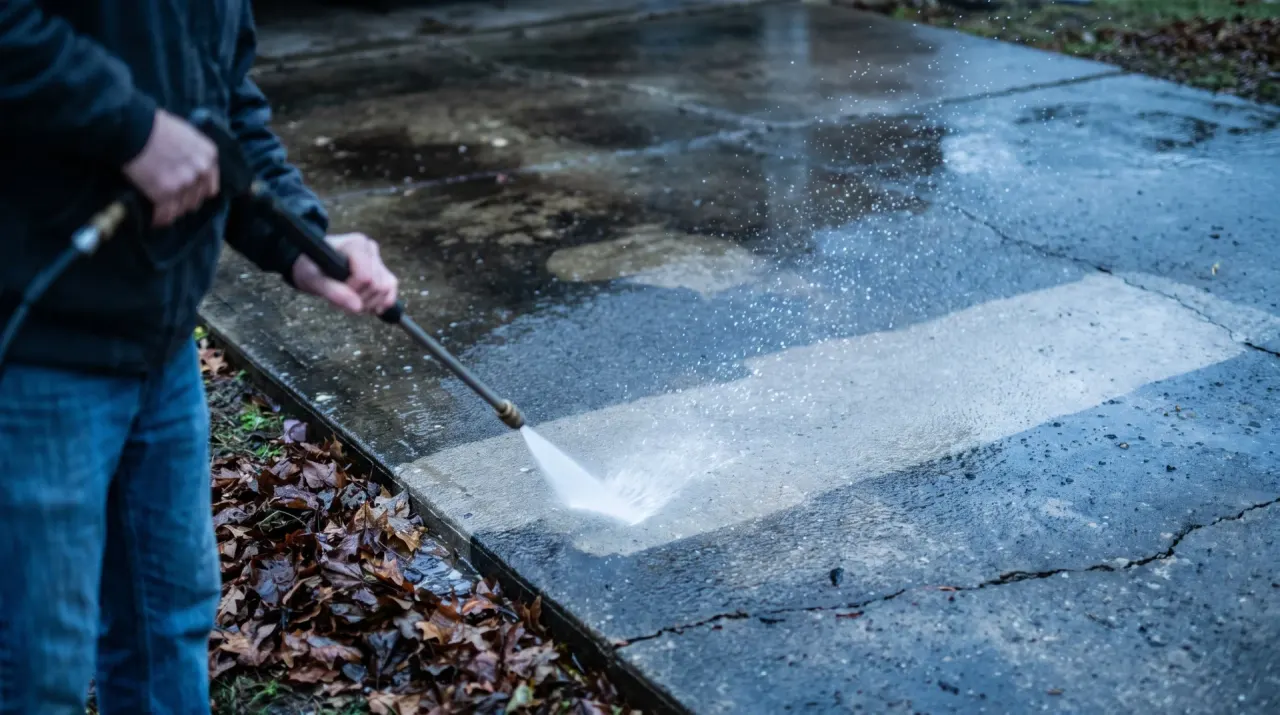
| Concrete driveway, garage floor | Yes — ideal | The job it exists for. Even finish, no stripes. |
| Paver patio | Yes, carefully | Will lift jointing sand; plan to re-sand afterward. |
| Stamped or colored concrete | Cautiously | Test first; sealers and color hardeners can be stripped. |
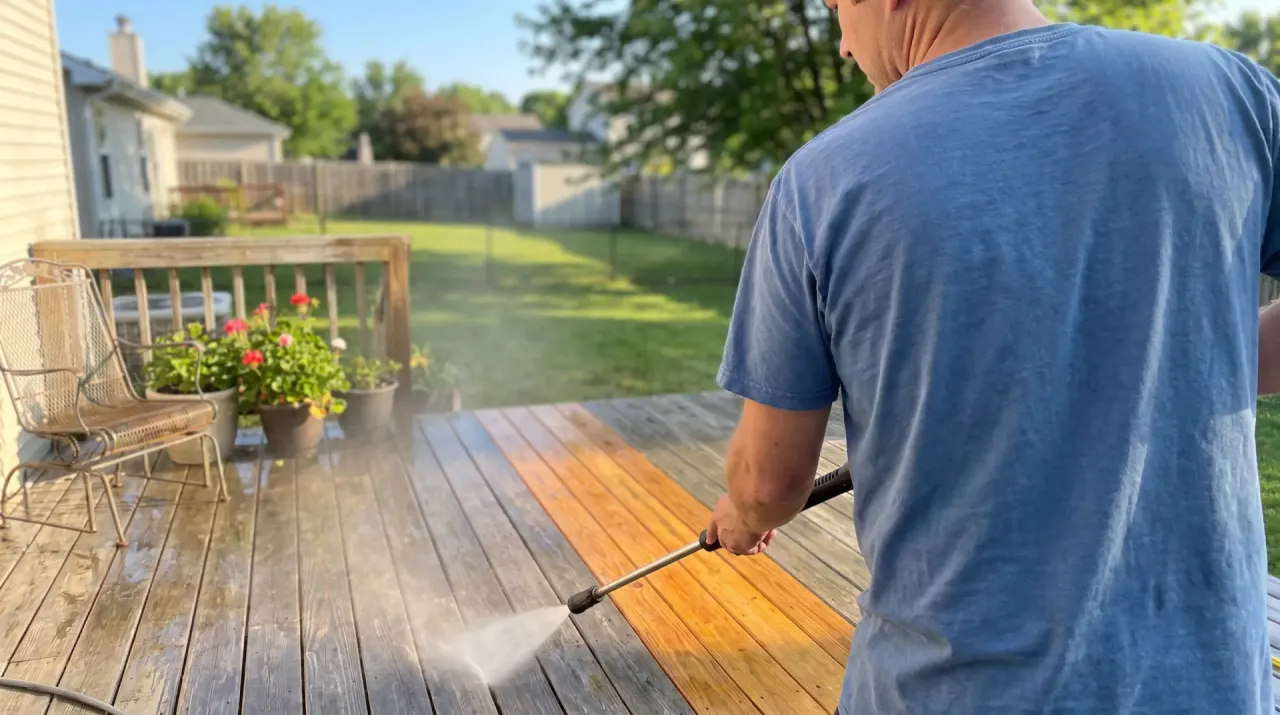
| Wood deck | Generally no | Only below about 1200 PSI, and expect to test a board first. |
| Composite decking | Check the maker | Most set a pressure limit; exceeding it voids warranty. |
| Asphalt driveway | No | High pressure erodes the binder and pits the surface. |
| Siding, fences, vehicles | No | Vertical surfaces need a wand and a 25° or 40° nozzle. |
Using One Without Leaving Marks
- Sweep and pre-treat first. A surface cleaner shifts grime, not oil. Degrease stains and apply a concrete cleaner with the soap nozzle, and let it dwell five to ten minutes.
- Start it off the surface. Squeeze the trigger with the head just past the edge, let the bar come up to speed, then walk it on.
- Overlap each pass by about a third. Underlapping is what produces the faint parallel lines people mistake for a defective unit.
- Walk at a steady, slow pace — roughly one foot every two seconds on stained concrete. Speed is what causes arcs.
- Work in one consistent direction across the whole slab. Changing direction halfway shows up in raking light.
- Rinse the edges with the wand. A round head cannot reach a wall or a step edge; budget five minutes for it.
- Flush the cleaner with clean water and store it dry. Grit left in the swivel is what kills them.
Safety
A surface cleaner is safer than a bare wand because the jets are enclosed and pointed at the ground, but the machine behind it is not. The CDC's pressure washer safety guidance and Mississippi State University Extension's safety bulletin both stress the same point: a high-pressure stream can penetrate skin, and the resulting injection injury is a surgical emergency that looks like a trivial puncture. Never tip a running surface cleaner onto its side to see the jets. Before you unscrew a nozzle or open any fitting, shut the machine down, disconnect the water supply, and squeeze the trigger to bleed the pressure trapped in the hose. If it is a gas machine, remember it is also producing carbon monoxide and must stay fully outdoors.
How We Rank
We do not buy or use these attachments. Rankings come from aggregated owner ratings across the most-owned surface cleaners, weighted toward reviews written after a full season where swivel leaks and bearing wear appear, and cross-checked against published pressure ratings and path widths. Four things carry weight: housing material, since stainless survives where painted steel rusts at the skirt; swivel quality, which is the component that ends most of these units; realistic flow matching, because a head sized for a machine nobody owns is a bad product regardless of its rating; and fitment, meaning whether the quick connect and any extension wands are standard. Prices were checked at the time of writing. Full method: how we rank.
The Field, Reviewed
1. Kärcher 15-Inch — Best Overall
Covered above. Owners praise: the time saved on a driveway, an even finish with no wand stripes, and a splash skirt that actually contains the slurry. Owners gripe about: swivel leaks in the second or third season, disappointing results on machines below 2 GPM, and a pressure ceiling that rules out big gas units. Check price (paid link).
2. Westinghouse PWSC12 12-Inch — Best for Electric Machines
The one to buy if your washer is electric. A 12-inch path lets a 1.76 GPM machine spin the bar fast enough to overlap properly, which no 15-inch head will do at that flow.
Owners praise: that it works properly on an electric where bigger heads did not, light weight, and easy storage. Owners gripe about: the narrow path making a big driveway a long job, and a plastic top housing that feels less substantial than the stainless competition. Check price (paid link).
3. Westinghouse Universal 16.5-Inch — Highest Rated
The strongest owner rating in the entire category, and a 4400 PSI ceiling that gives real headroom over any homeowner gas machine. The stainless housing is the meaningful difference against cheaper 16-inch heads.
Owners praise: build quality, the pressure headroom, and a wider path that still spins properly at 2.5 GPM. Owners gripe about: weight compared with the 14-inch class, and a price at the top of the homeowner band. Check price (paid link).
4. Biswing 14-Inch — Best Value
The size that fits the broadest range of machines, at the price that makes this an easy first purchase. Fourteen inches is a sensible compromise for anything from a strong electric to a mid gas unit.
Owners praise: value, four wheels that hold a consistent height, and stainless construction at a budget price. Owners gripe about: jets that need clearing more often than the premium heads, and casters that pick up grit. Check price (paid link).
5. MEKOH 20-Inch — Best Heavy-Duty
A serious head for a serious machine. At 3.5 GPM and up it covers ground fast, and the dual handle makes it controllable rather than something you fight.
Owners praise: speed on large slabs, a robust swivel, and the 4500 PSI rating. Owners gripe about: weight, and — predictably — poor results from buyers who fitted it to a 2.5 GPM machine. Check price (paid link).
6. JANZ 24-Inch — Best Large-Area
Contractor width. On a 4 GPM machine it is genuinely transformative on a parking pad or a long commercial walkway; on anything smaller it is a heavy thing that stripes.
Owners praise: coverage per pass, the dual-handle frame, and stainless build. Owners gripe about: the weight over expansion joints, the price, and needing a machine most homeowners do not have. Check price (paid link).
What Owners Actually Complain About
Stripes and arcs. Almost always an oversized head for the machine's flow, or a partly blocked jet. Check the nozzles before you conclude the unit is faulty.
The swivel leaking. The universal wear point. Water running down the wand means the bearing seal has gone; replacement swivel kits exist and are cheaper than a new cleaner.
Wheels clogging. Small casters collect wet grit and stop rolling, which changes the standoff and shows as uneven cleaning. Rinse them at the end of each job.
It will not reach the edges. Inherent to a round housing. Every job needs a wand pass along walls, steps and expansion joints.
Pavers losing their sand. Not a fault — high-pressure water lifts jointing sand out of paver joints. Plan on re-sanding, or use lower pressure.
The Verdict
Match the head to your GPM and this is one of the highest-satisfaction purchases in the whole pressure-washing category. On a typical 2.5 GPM gas machine buy the Kärcher 15-inch, or the Westinghouse 16.5-inch if you want stainless and pressure headroom. On a 1.76 GPM electric buy the Westinghouse 12-inch and ignore everything larger. Save the 20- and 24-inch heads for machines running 3.5 GPM or more, where they earn their keep. Check price on Amazon → (paid link)
More from this hub: leaf blowers & yard cleanup · best pressure washer · best gas pressure washer · what is soft washing · how we rank.