 Garden


Affiliate Disclosure
Some links on this page are affiliate links. As an Amazon Associate, we earn from qualifying purchases — at no extra cost to you. We do not buy, test, or physically handle the products we cover; our rankings come from aggregated owner reviews, ratings and expert consensus. Commissions never change our verdicts. How we rank · full disclosure.
You cannot order a finished pressure washing trailer the way you order a pressure washer. Complete rigs are built by regional fabricators and pressure-washing supply houses, sold locally because they ship as freight on their own wheels, and configured around a specific kind of work — hot or cold, tank size, how many reels, what chemical setup. Nobody boxes one up.
What you can buy is every component, and that is what most small operators do: a used utility trailer, a 4 GPM machine bolted to the deck, a buffer tank, a reel and a surface cleaner. This page is an honest build list rather than a product ranking dressed up as one, with the parts that matter, the parts people skip, and the legal items that catch new operators out.
The Core Components

The Build, In the Order It Matters
Spend in this sequence. Each item below buys less capability per dollar than the one above it.
- The machine. Four GPM minimum, triplex plunger pump, an engine with a national parts network. This is not the place to save money — see our commercial pressure washer rankings for the full field.
- The buffer tank. The component new operators most often skip and most often regret. A 100 to 325 gallon poly tank with a float valve fills from the client's spigot at whatever rate it manages, while the pump draws steadily by gravity. Without it, a marginal tap will destroy your pump.
- The trailer. A used 5x8 single-axle carries a modest cold-water setup. Move to a 6x10 or 6x12 tandem once the tank grows past about 150 gallons.
- Hose and a reel. A hundred feet of 3/8-inch hose on a crank reel. Coiling charged hose by hand at the end of every job is what makes people quit.
- A surface cleaner. The accessory that turns a rig into a business. On a 4 GPM machine a 20-inch head is the right size — see the surface cleaner sizing guide.
- Chemical handling. A downstream injector, a dedicated soap line, and drums secured so they cannot shift in transit.
- Everything else. Ladders, extension wands, a generator if you run 12-volt pumps, and lockable storage.
The Components, Reviewed

Best for the heart of a first pressure-washing trailer
- 4200 PSI at 4.0 GPM — enough to drive a 20-inch surface cleaner
- Honda GX390 with parts availability in every US county
- AAA triplex plunger pump, rebuildable rather than disposable
- Welded steel frame that bolts down to a deck
Why buy it: the machine most small wash businesses build their first rig around, because the Honda and the triplex pump are the two components you cannot economise on.

Best for a second machine, or a rig built before the work is proven
- 4400 PSI at 4.2 GPM
- Triplex plunger pump at a notably low price point
- Steel frame, five quick-connect nozzles
- Several hundred dollars below the Honda-engined alternatives
Why buy it: a genuine 4+ GPM triplex machine for well under Honda money — the compromise is the engine and the service network, not the pump.

Best for the single upgrade that changes how a rig feels to work from
- Holds 100 ft of 3/8-inch or 150 ft of 1/4-inch hose
- Rated to 4000 PSI with a swivel inlet
- Heavy steel frame that bolts to a deck or wall
- Manual crank rewind
Why buy it: coiling 100 feet of charged hose by hand at the end of every job is what makes people quit; a reel is not a luxury item on a working rig.

Best for reaching a back yard or a second-story elevation without moving the truck
- 100 feet of 3/8-inch high-tensile wire-braided hose
- Rated to 4800 PSI, with 3/8-inch quick connects
- Non-marking cover that will not streak a client driveway
- Full-flow bore that suits 4 GPM machines
Why buy it: a 3/8-inch bore is the detail that matters at 4 GPM — a 1/4-inch hose that long strangles the flow and costs you pressure at the gun.

Best for the first 50 feet off the reel, where abrasion is worst
- 3/8-inch bore rated to 4500 PSI, 140°F maximum
- Heavy abrasion-resistant cover
- Quick-connect fittings
- Built for commercial daily use
Why buy it: commercial hose is a consumable and the cheap ones fail at the crimp — this is the class of hose that survives being dragged over concrete every day.
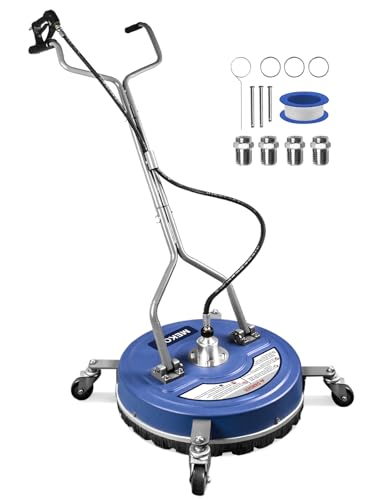
Best for flatwork production — the accessory that pays the rig off
- 20-inch cleaning path with a dual handle
- Rated to 4500 PSI, sized for 3.5 to 4 GPM machines
- Stainless housing with a heavy swivel
- Four casters for consistent standoff
Why buy it: a 20-inch head covers about 78% more ground per pass than a 15-inch one, which is the difference between one job a day and two.
Quick Comparison
| Product | Best for | Rating | Price | Buy |
|---|---|---|---|---|
| Simpson PS4240 PowerShot Gas Pressure Washer, Honda GX390, 4200 PSI at 4.0 GPM | Best Machine for a Rig | — | Check (paid link) | |
| Westinghouse WPX4400 Gas Pressure Washer, 4400 PSI and 4.2 GPM | Best Budget Rig Machine | — | Check (paid link) | |
| M MINGLE Pressure Washer Hose Reel, 100 ft x 3/8 in or 150 ft x 1/4 in, 4000 PSI | Best Hose Reel | — | Check (paid link) | |
| POHIR Pressure Washer Hose 100 ft, 3/8-Inch Quick Connect, Wire Braided, 4800 PSI | Best Long Hose | — | Check (paid link) | |
| Simpson Monster 50 ft, 3/8-Inch, 4500 PSI Cold Water Pressure Washer Hose | Best Heavy-Duty Hose | — | Check (paid link) | |
| MEKOH 20-Inch Heavy-Duty Pressure Washer Surface Cleaner with Wheels, 4500 PSI | Best Surface Cleaner for a Rig | — | Check (paid link) |
Water Is the Constraint, Not Power
A 4 GPM pump needs 4 gallons per minute at its inlet, continuously, or it cavitates — draws air, hammers, loses prime and cooks its own seals. That is the single most common way a new rig destroys an expensive pump in its first month.
- Test the tap before you quote. Time how long the client's spigot takes to fill a 5-gallon bucket through your own hose. Under 60 seconds is 5 GPM and fine. Over 90 seconds and you are running on the tank.
- Size the tank to the job, not to the trailer. At 4 GPM, a 100-gallon tank is 25 minutes of continuous trigger time with no refill at all.
- Weight matters more than volume. Water is about 8.34 pounds per gallon: a 200-gallon tank is roughly 1,670 pounds. Check the trailer's GVWR and your vehicle's tow rating, and baffle or strap the tank so it cannot surge.
- Fill hose, not garden hose. Use 3/4-inch or larger to the tank, and keep the run short.
If a machine on a rig starts hunting and pulsing, water supply is the first place to look, not the unloader — the ordered checklist is in why a pressure washer surges.
Hose Bore: The Detail That Costs You Pressure
At 4 GPM, hose diameter is not a preference. A 1/4-inch hose is fine at 2.5 GPM and 50 feet; run 100 feet of it at 4 GPM and the friction loss shows up as noticeably lower pressure at the gun. Step up to 3/8-inch for any long run on a commercial machine, and accept that it is heavier and stiffer — that is the trade.
| Machine flow | Up to 50 ft | 50–100 ft | Over 100 ft |
|---|---|---|---|
| 2.0–2.5 GPM | 1/4 inch | 1/4 inch | 3/8 inch |
| 3.0–3.5 GPM | 1/4 or 3/8 | 3/8 inch | 3/8 inch |
| 4.0 GPM+ | 3/8 inch | 3/8 inch | 3/8 inch |
Also check the hose's temperature rating if you ever add a hot-water unit. Cold-water hose is typically rated to 140°F and will fail on a 200°F burner circuit.
What It Costs to Build
| Item | Typical cost | Notes |
|---|---|---|
| Used utility trailer, 5x8 to 6x12 | $1,000–2,000 | Check the deck, bearings and lights before anything else |
| 4 GPM cold-water machine | $900–1,500 | Triplex pump, commercial engine |
| Buffer tank 100–325 gal + float valve | $400–900 | Poly tank, plumbing, straps |
| Hose reel and 100 ft of 3/8-inch hose | $250–500 | Two reels if you also run a chemical line |
| 20-inch surface cleaner and nozzles | $200–400 | The accessory that pays the rig off |
| Chemical injector, drums, containment | $200–600 | Varies a lot by the work you take on |
| Cold-water rig, total | $3,500–7,000 | Turnkey from a fabricator: $8,000–12,000 |
| Hot-water skid instead | +$4,000–9,000 | Only if a signed contract needs it |
Figures as of mid-2026 and genuinely regional. A skid mounted in a truck bed is the cheaper first step and is what a lot of operators run for their first year — it costs nothing in trailer, registration or parking, and it converts to a trailer build later.
The Parts People Miss
Wash water. Runoff from commercial work reaching a storm drain is a regulated discharge under the EPA's NPDES stormwater program, and many cities layer their own ordinances on top requiring containment mats and vacuum recovery for parking lots, fleet washing and degreaser work. The fine lands on the contractor, not the property owner.
Trailer legalities. Registration, plates, lighting, safety chains and brake requirements above certain weights are set by your state DMV and differ meaningfully from one state to the next. Check the GVWR against your tow vehicle's rating with the tank full, not empty.
Insurance. General liability is normally the minimum a commercial client will accept, and a rig with a tank and a trailer usually needs its own coverage rather than riding on a personal auto policy.
California engines. The CARB small off-road engine program has ended new sales of most gasoline small engines in the state, which affects what you can buy new there even though existing machines remain legal to operate.
All of the above is general information rather than legal advice — check your own state and city, because these rules genuinely differ by county.

Safety on a Rig
Two hazards scale up with the machine. A 4 GPM machine at 4000 PSI produces a stream that will cause a serious high-pressure injection injury — a small puncture that drives water and debris under the skin and is a surgical emergency. Both the CDC's pressure washer safety guidance and Mississippi State University Extension's safety bulletin stress that the visible wound understates the damage badly, and MSU specifically warns against working from ladders because the kickback will move you.
Before opening any fitting anywhere on the rig — swapping a reel, chasing a leak, changing a nozzle — kill the engine, close the tank valve, and squeeze the trigger until flow stops. A hundred feet of charged 3/8-inch hose stores a lot of energy after the engine is off. And the engine must never run inside a trailer, a garage or an enclosed bay: carbon monoxide accumulates fast and the CPSC continues to record deaths in spaces people believed were ventilated. If the rig is enclosed, the machine gets pulled out or the exhaust gets ducted properly.
How We Rank
We do not buy, build or operate these rigs. Component picks come from aggregated owner ratings across the most-owned machines, reels, hoses and surface cleaners used in commercial work, weighted toward reviews written after sustained use, and cross-checked against published pressure, flow and bore specifications. Four things carry weight: flow matching, since undersized hose and supply are the failure mode this whole category suffers from; serviceability, because a rig component that cannot be repaired is a day of lost work; durability under daily abrasion, which is what separates commercial hose and reels from consumer ones; and pressure headroom, since every part should be rated above the machine, not at it. Prices were checked at the time of writing. Full method: how we rank.
What Owners Actually Complain About
Undersized water supply. The number one destroyer of new commercial pumps. Buy the tank at the same time as the machine, not a season later.
Hose bore too small. A hundred feet of 1/4-inch hose on a 4 GPM machine reads as "the machine is weak" and is actually friction loss.
Reel failures. Cheap reels bind, and the swivel is the part that leaks. Buy a reel rated above your machine's pressure.
Freight damage. Commercial machines ship palletised at 150 to 250 pounds and arrive dented more often than small parcels. Photograph the pallet before signing.
Weight surprises. Operators discover mid-build that a full tank puts them over their trailer's GVWR. Do that arithmetic before you buy the tank.
The Verdict
Build rather than buy, and build in order. The Simpson PS4240 is the machine most first rigs are built around because the Honda GX390 and the triplex pump are the two things you genuinely cannot economise on, with the Westinghouse WPX4400 as the budget route if the work is not yet proven. Then spend on the buffer tank before anything else, run 3/8-inch hose on a proper reel, and add a 20-inch surface cleaner, which is the item that turns the rig into a business. And check your city's stormwater ordinance before you quote the first job. Check price on Amazon → (paid link)
More from this hub: leaf blowers & yard cleanup · best commercial pressure washer · best gas pressure washer · best surface cleaner · how we rank.