 Garden

Affiliate Disclosure
Some links on this page are affiliate links. As an Amazon Associate, we earn from qualifying purchases — at no extra cost to you. We do not buy, test, or physically handle the products we cover; our rankings come from aggregated owner reviews, ratings and expert consensus. Commissions never change our verdicts. How we rank · full disclosure.
Yes — a pressure washer will damage concrete, and it will damage a car, in specific and entirely avoidable ways. On concrete the failure is erosion of the cement paste at the surface, which exposes the sand and aggregate beneath and leaves a permanently rougher, lighter patch. On a car it is clear coat lifted at the edge of an existing chip, badges and trim loosened, and water driven past seals. In both cases the cause is almost never the machine's rating. It is a narrow nozzle held too close, held still, or held at an inconsistent distance.
Below is what actually goes wrong on each surface, the pressures and tips that prevent it, and the one situation on concrete where you should not use a pressure washer at all.
How Concrete Actually Gets Damaged
A finished concrete slab has a thin layer of cement paste at the surface, with sand and coarse aggregate below it. That paste layer is what gives concrete its smooth, uniform appearance, and it is measured in fractions of an inch. Erode it and you expose what is underneath — permanently.
| Damage | What causes it | Reversible? |
|---|---|---|
| Etching — a rough, lighter mark | Narrow tip held close; pausing in one place | No |
| Zebra striping across a driveway | Inconsistent wand height and poor overlap | Usually — re-clean the whole slab evenly |
| Exposed aggregate patches | Sustained high pressure on soft or young concrete | No — resurfacing only |
| Joint sand washed out of pavers | Any narrow tip aimed into a joint | Yes — re-sand and re-compact |
| Mortar blown out of brick or block | Narrow tip on old lime mortar | Repointing required |
| Surface dusting on a new pour | Washing before the slab has cured | No |
| Accelerated scaling on damaged concrete | Pressure on a surface already spalled by freeze-thaw | No — it removes loose material and more |
The distinction worth internalising: striping is a technique problem and usually fixable; etching is a material loss and is not. That is why the standoff distance matters more than the machine you own.
Never Pressure Wash Concrete Under 28 Days Old
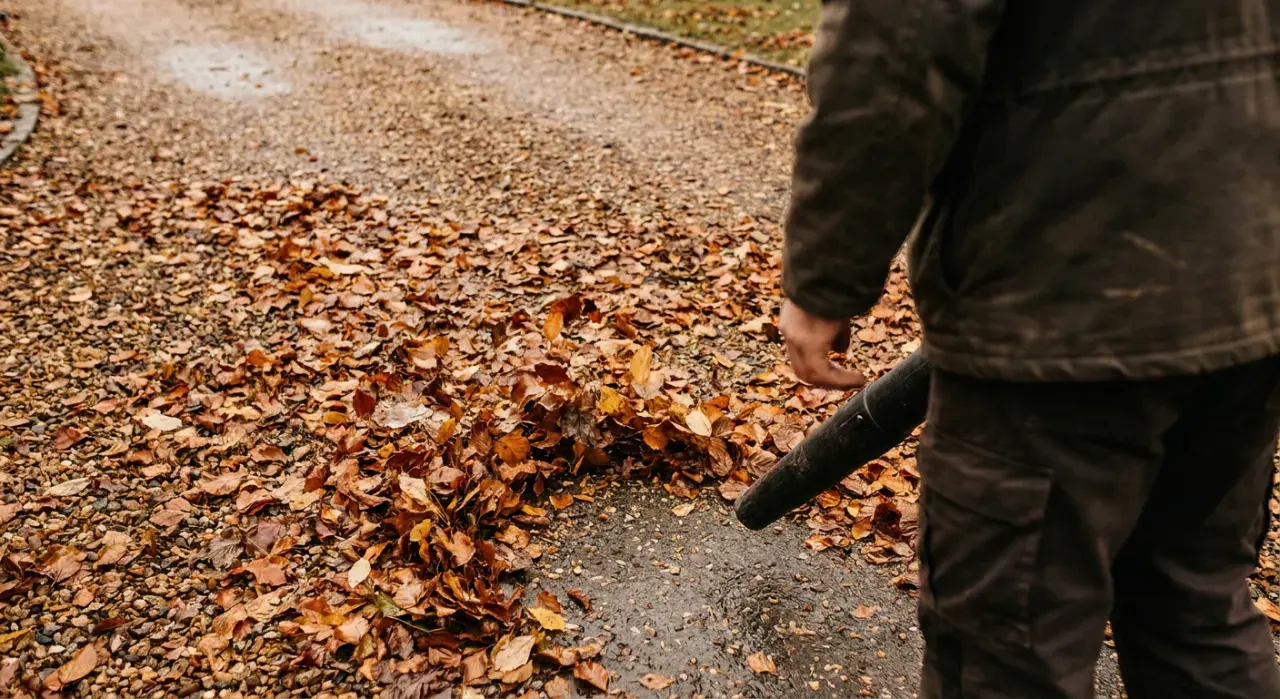
This is the one hard rule on this page. Concrete is conventionally specified to reach its design compressive strength at 28 days — that is the standard test age used throughout American Concrete Institute practice — and the surface paste is the slowest part to develop. Wash a slab before then and you strip fines from a surface that has not finished hardening, leaving it permanently rough and prone to dusting.
Two related waits:
- Sealed concrete: allow at least 30 days after sealing before pressure washing, so the sealer has fully cured. Washing a green sealer clouds or peels it.
- Cold-weather pours: strength gain slows substantially below about 50°F, so a slab poured in late autumn may need considerably longer than 28 days. When in doubt, ask whoever poured it.
Concrete that is already scaling or spalling from freeze-thaw damage is the other case to leave alone. Pressure will remove the loose material and then keep going into sound paste, and the result looks worse than what you started with.
Doing It Without Damage
- Use a 25° green tip, or better, a surface cleaner. Never 0° or 15° on decorative or stamped concrete.
- Start at three feet and close in gradually. Distance is a finer pressure control than the nozzle.
- Never pause. A stationary jet marks concrete in under two seconds.
- Overlap each pass by about half, and keep the wand at a constant height and angle.
- Pre-treat with a concrete detergent and let it dwell five to ten minutes without drying. Chemistry removes what pressure would have to erode the surface to reach.
- Test an inconspicuous corner first. If the texture changes rather than just the color, back off.
Two accessories do most of the work here — a fixed-height surface cleaner and a full set of color-coded tips so the right angle is always available.
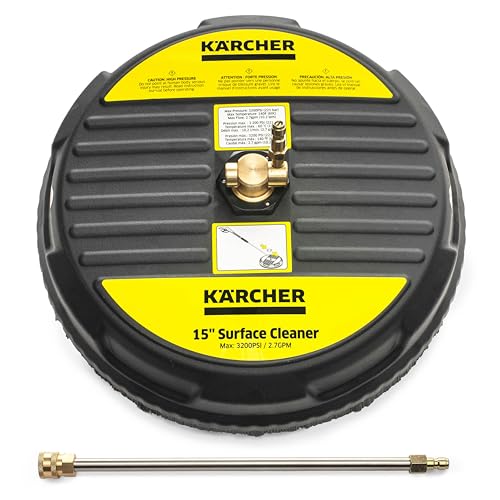
Best for driveways, patios and sidewalks cleaned evenly instead of in stripes
- Two spinning jets enclosed under a splash guard
- Covers a 15-inch swath in a single pass
- Holds a fixed standoff distance automatically
- Standard 1/4-inch quick-connect
Why buy it: the enclosed housing holds the jets at a constant height and angle, which is exactly what a hand-held wand cannot do — and inconsistent height is what produces zebra stripes.

Best for having the right angle on hand instead of using whatever is fitted
- 0°, 15°, 25°, 40° and soap tips, color-coded to convention
- Standard 1/4-inch quick-connect
- Rated to 4000 PSI at 2.5 GPM
- Hardened stainless orifices
Why buy it: almost every case of pressure washer damage traces back to the wrong tip being on the wand because it was the one already fitted — a twelve dollar set removes that excuse.
Can a Pressure Washer Damage a Car?
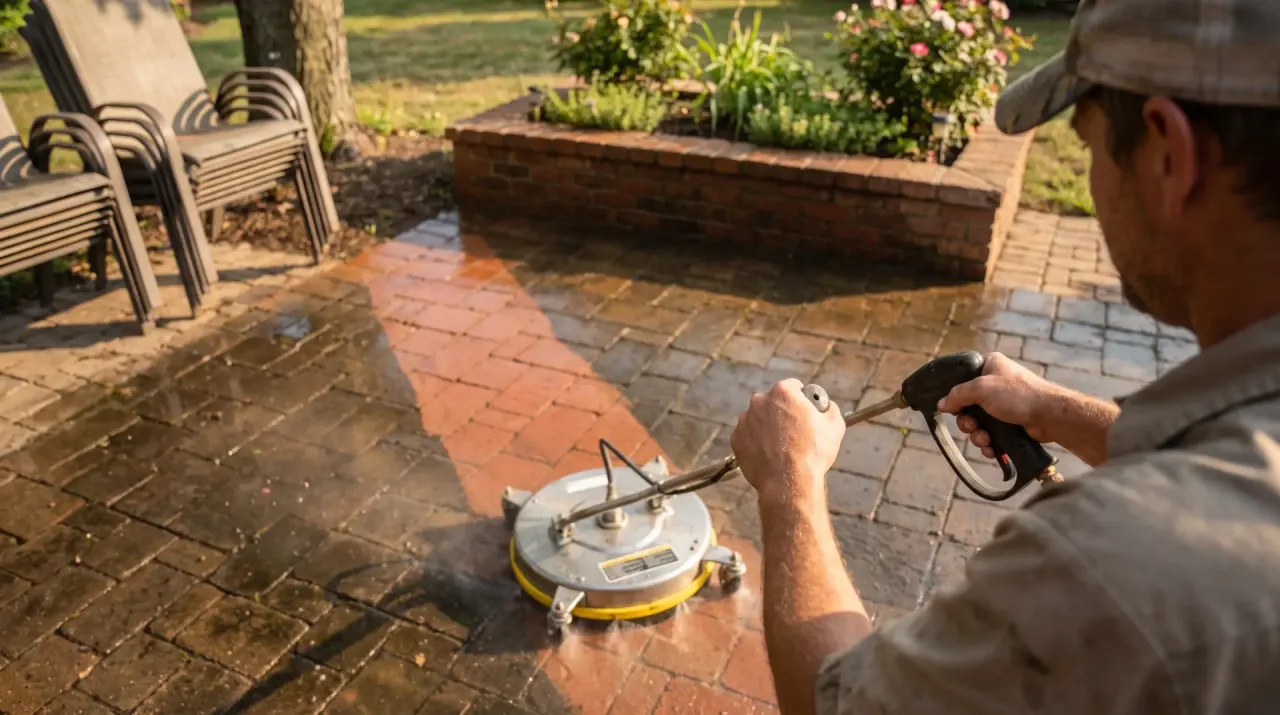
Yes, and the surprising part is that sound factory paint is not usually the weak point. Modern automotive clear coat tolerates a sensible pressure washer perfectly well at a sane distance. What fails first is everything attached to the paint, and any place where the coating has already been breached.
| What gets damaged | How | How to avoid it |
|---|---|---|
| Clear coat at a stone chip | Spraying edge-on lifts the coating outward from the chip | 40° tip, 3 ft, never aim into a chip or scratch |
| Badges, emblems and trim | They are adhesive-bonded, not fastened | Never point a narrow tip at them; rinse past, not at |
| Window and door seals | Water driven past the gasket into the door | Spray downward and across, never into a seal edge |
| Aftermarket paint and touch-ups | Thinner and less well bonded than factory finish | Hand wash repaired panels |
| Vinyl wraps and decals | Edges lift, then peel back | Approach from the middle outward, low pressure |
| Wheel wells and undertrays | Clips break; water reaches connectors | Moderate pressure, no narrow tips underneath |
| Convertible tops and fabric | Water forced through stitching; coating stripped | Under 1000 PSI, wide tip, well back |
| Engine bay electrics | Water past connector seals | Do not pressure wash an engine bay at all |
The safe recipe for a car is unglamorous and reliable: 1200 to 1900 PSI, a 40° white tip, at least three feet back, working top to bottom, with a foam cannon doing the actual cleaning. Never fit a turbo or rotary nozzle near paint — the spinning jet is a 0° stream in disguise. And never fit the red 0° tip on a vehicle for any reason.
One more, because it is expensive and rarely mentioned: do not aim a narrow tip at a wheel bearing seal, a trailer hub, or the seams of an outboard cowling if you are washing a boat rig too. Water past a seal there is a failure that shows up on the highway rather than in the driveway.
Safe Pressure by Surface
| Surface | Working pressure | Nozzle | Risk if you get it wrong |
|---|---|---|---|
| Sound concrete driveway | 2500–3500 PSI | 25° or surface cleaner | Striping, etching |
| Stamped or decorative concrete | 1500–2500 PSI | 40° | Removing the color hardener |
| Concrete under 28 days old | Do not wash | — | Permanent surface dusting |
| Pavers with sand joints | 1500–2500 PSI | 25°, never into the joint | Joint sand loss and settling |
| Brick with old lime mortar | 1500–2000 PSI | 25°, well back | Blown mortar joints; repointing |
| Car, sound factory paint | 1200–1900 PSI | 40°, 3 ft back | Lifted clear coat at chips |
| Car with existing chips or respray | Hand wash | — | Peeling outward from the damage |
| Boat gel coat | 1200–2000 PSI | 40°, 2–3 ft back | Chalking and permanent dulling |

One Safety Note
Whatever you are cleaning, the stream can penetrate skin. A high-pressure injection injury forces water, grit and bacteria into the tissue underneath through a puncture that looks trivial, and the clinical literature on hand high-pressure injuries treats these as surgical emergencies precisely because the visible wound badly understates the internal damage. Never point a wand at a person, never brace a hand in front of the tip to steady it, wear closed shoes and eye protection because grit ricochets off concrete, and treat the red 0° nozzle as one you essentially never fit — it is the tip most often involved both in injuries and in the surface damage this page is about. More in pressure washer safety tips.
Where to Go Next
How to use a pressure washer covers the full technique, nozzle-by-surface, including detergent dwell time. If you are still buying, the best pressure washers explains why cleaning units matter more than the PSI badge, and the electric rankings cover the machines most households should be looking at. For boats specifically, best pressure washer for boats deals with gel coat, which is softer again than car paint. Everything sits under the leaf blowers and yard cleanup hub.
We never buy or physically run the machines we write about — this guidance comes from aggregated owner reports, manufacturer documentation and published industry practice. Method: how we rank.