 Garden

Affiliate Disclosure
Some links on this page are affiliate links. As an Amazon Associate, we earn from qualifying purchases — at no extra cost to you. We do not buy, test, or physically handle the products we cover; our rankings come from aggregated owner reviews, ratings and expert consensus. Commissions never change our verdicts. How we rank · full disclosure.
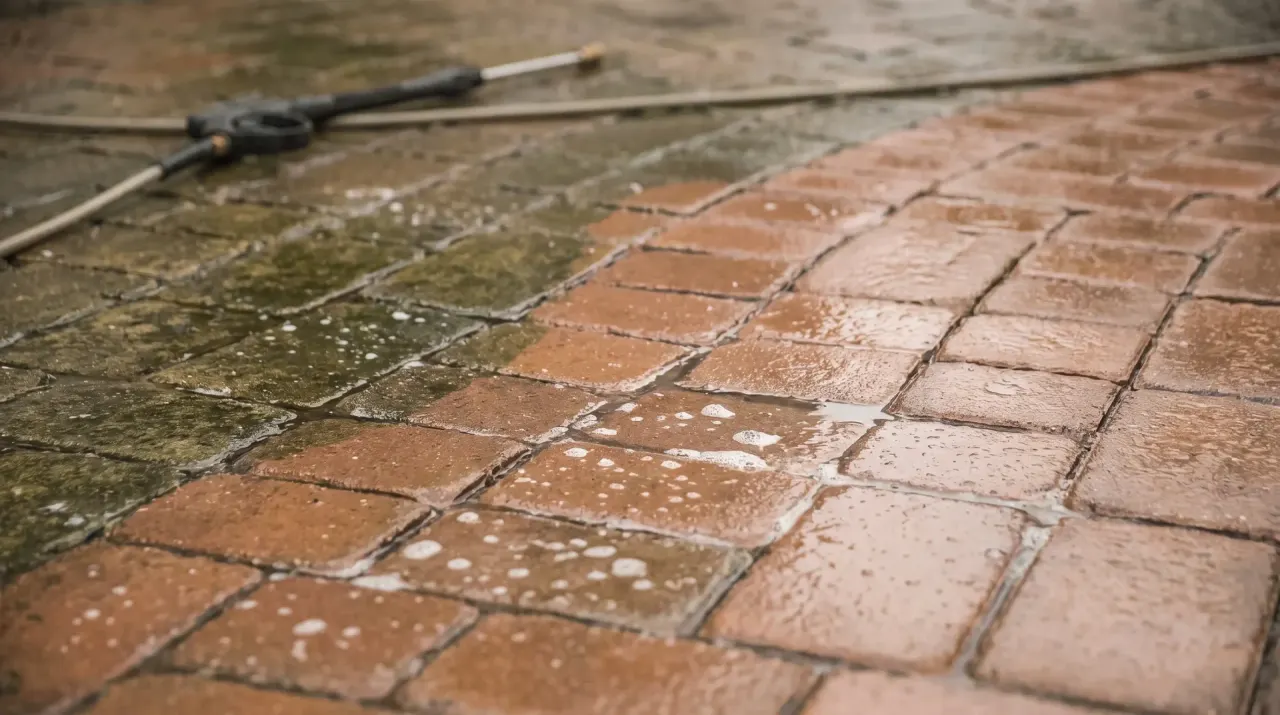
Sweep, pre-treat the stains, apply a patio cleaner and let it dwell 5 to 10 minutes, then clean at 1,500 to 2,500 PSI with a rotating surface cleaner — and expect to re-sand the joints when you finish. The single thing that separates a good paver job from a bad one is keeping the jet out of the joints. Direct a 25-degree tip into a sand joint and it is gone in about two seconds, and the sand is what holds the whole patio together.
Identify the Material First
"Patio" covers half a dozen materials with very different tolerances, and getting this wrong is how people permanently damage a surface they were only trying to clean.
| Surface | Working pressure | Tool | The specific risk |
|---|---|---|---|
| Concrete pavers | 1,500–2,500 PSI | Surface cleaner | Blowing out joint sand |
| Poured concrete patio | 2,500–3,000 PSI | Surface cleaner | Wand stripes if done freehand |
| Stamped or colored concrete | 1,200–2,000 PSI | 40° tip only | Stripping the color layer and sealer |
| Clay brick | 1,200–2,000 PSI | 25° tip at distance | Taking the fired face off older brick |
| Flagstone and natural stone | 800–1,500 PSI | 40° tip | Pitting soft stone; eroding mortar joints |
| Travertine | Below 1,200 PSI | 40° tip, or brush | Opening the natural voids permanently |
| Slate | Below 1,200 PSI | 40° tip | Delaminating the layers |
If you are unsure what you have, test in a corner that furniture normally covers, start with the widest tip and the longest standoff, and work in only if nothing changes.

The Joint Sand Problem
This is the part of the job people learn the hard way. Interlocking pavers are not held down by adhesive — they are held by the sand packed into every joint, which transfers load between units and turns loose blocks into a rigid surface. Take the sand out and the pavers begin to rock, water washes the bedding layer out from underneath, and the patio starts to dip and shift within a season.
Two ways to handle it, and only one of them works properly:
Minimize loss, then re-sand. Use a surface cleaner rather than the wand, keep the jet from ever pointing straight down into a joint, and accept that you will still lose the top layer. Then sweep in fresh polymeric sand at the end, mist it to activate per the label, and let it cure. This is the correct approach.
Hope for the best. Common, and it is why so many washed patios develop uneven, rocking pavers within a year or two.
Polymeric sand is worth the small premium over plain jointing sand: it binds when wetted, resists washout, and substantially slows weed and ant activity in the joints. Follow the activation instructions exactly — under-watering leaves it powdery, over-watering washes the binder out and leaves a haze on the paver faces.
The Sequence
- Clear and sweep thoroughly. Furniture, planters and the grill off. Sweep out leaf litter and pull any weeds growing in the joints — pressure will remove the tops and leave the roots.
- Pre-treat the specific stains. Grease and barbecue drips get a degreaser and 15 to 30 minutes of dwell. Rust gets an oxalic-acid remover, tested in a corner first. Do this before any general washing.
- Wet the surroundings and cover plants. Patio cleaners are hard on foliage, and patios are usually ringed by beds.
- Apply cleaner through the soap nozzle. A concrete and patio cleaner such as Simple Green Oxy Solve Concrete and Driveway cleaner (paid link) handles both dirt and the organic growth. Work from the low side upward so runoff does not streak dry stone.
- Dwell 5 to 10 minutes without letting it dry. Agitate heavy moss with a stiff brush.
- Clean with a surface cleaner in slow overlapping passes. A 15-inch rotating surface cleaner (paid link) keeps distance constant, covers a full swath and — critically on pavers — never points a concentrated jet down into a joint. Overlap each pass by a third.
- Edge with the wand at a shallow angle. Against walls, steps and borders, switch to a 25-degree tip and hold it at a low angle so the stream sweeps across the joints rather than into them.
- Rinse everything off before it dries, then rinse the plants you covered.
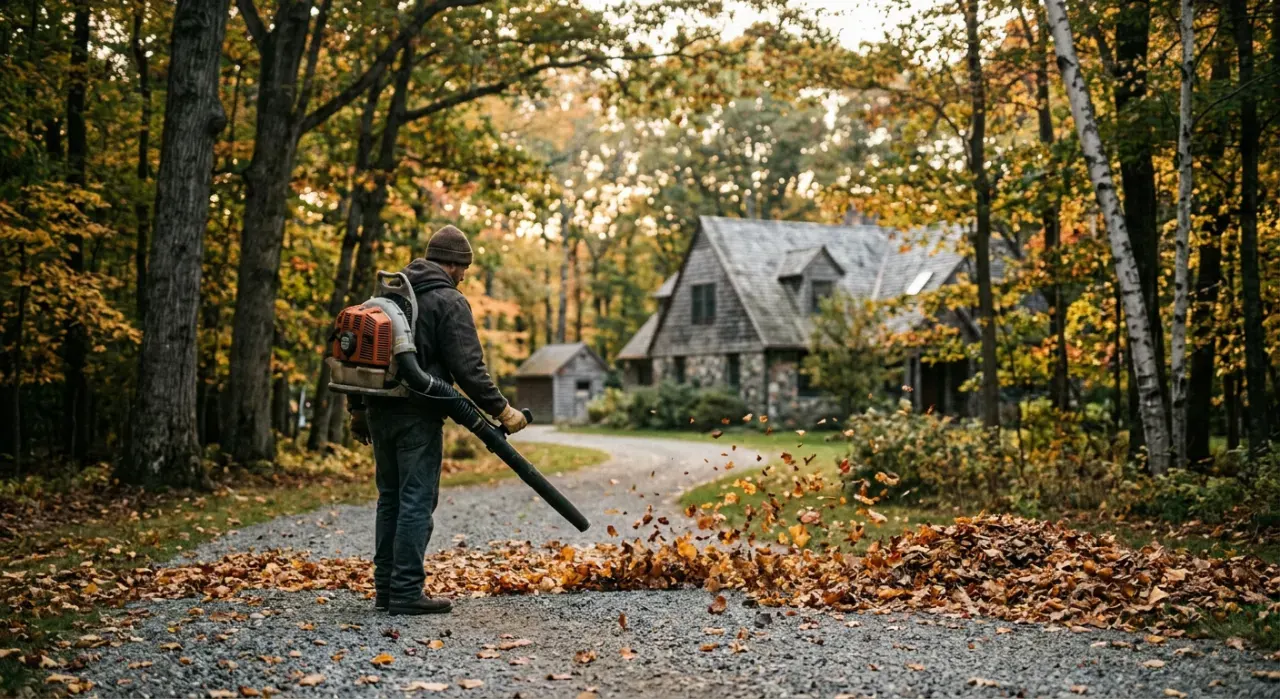
- Let it dry, then re-sand. Wait until the joints are dry — usually 24 to 48 hours — then sweep in polymeric sand, remove every grain from the paver faces with a leaf blower on low, and activate with a fine mist per the label.
Patio Stains That Need More Than Pressure
Efflorescence — the white powdery bloom on new concrete pavers — is mineral salt migrating out of the paver, not dirt. Pressure will not remove it and may drive it back in. It usually weathers off over the first year or two; if you want it gone sooner, an efflorescence remover formulated for pavers is the correct product.
Leaf and berry tannin leaves brown shadow stains that survive general cleaning. An oxygenated cleaner with a long dwell time is the answer, sometimes twice.
Barbecue grease soaks into porous pavers. Degreaser, dwell, agitate, repeat. A poultice left overnight pulls out what remains.
Moss in the joints tends to come back fast because the joints hold moisture. Kill it chemically, re-sand with polymeric sand, and address the shade or drainage that made the spot damp.
Safety
Patios put you on a slippery, uneven, chemical-covered surface, often with steps and a drop at the edge. Footing is the first hazard.
The second is the stream. A high-pressure injection injury forces water and grit under the skin through a puncture that can look like nothing — a small mark, very little bleeding — while causing severe damage underneath. The clinical review of hand high-pressure injuries reports amputation in roughly 30 to 40 percent of injection cases, mostly because the visible wound is so unimpressive that people wait. Wear closed shoes — feet are the common site on horizontal work — wear eye protection, never brace a hand near the tip, and treat the 0-degree red nozzle as one you essentially never fit. If a jet breaks the skin, go to an emergency department and say "high-pressure injection injury".
What Machine You Need
A 2,000 PSI electric with a surface cleaner sized to its flow rate does a patio well. Pressure is not the constraint here — joint sand is — so a 3,400 PSI gas machine buys you speed on a large area and nothing else. Match the surface cleaner head to the machine: 14 to 15 inches for 2.0 to 3.0 GPM, larger only if you have the flow to drive it. The full field is in the best pressure washers, and the same technique scaled up is in how to clean a driveway with a pressure washer.
More from this hub: leaf blowers & yard cleanup · pressure washing a deck · pressure washing a house · best pressure washer hose · how we rank.