 Garden

Affiliate Disclosure
Some links on this page are affiliate links. As an Amazon Associate, we earn from qualifying purchases — at no extra cost to you. We do not buy, test, or physically handle the products we cover; our rankings come from aggregated owner reviews, ratings and expert consensus. Commissions never change our verdicts. How we rank · full disclosure.
Do not pressure wash an asphalt shingle roof. The Asphalt Roofing Manufacturers Association could not be plainer about it: "DO NOT use a power washer or any type of brush or broom to clean algae from the roof surface. High-pressure washing systems are likely to damage asphalt roofing." The stream strips the mineral granules embedded in the shingle surface, and those granules are the roof's ultraviolet protection and part of its fire rating. The roof comes up clean and comes down years of service life. The correct method is soft washing — low pressure plus a cleaning solution and dwell time — and for most homeowners the correct place to do it from is the ground, or from a contractor's invoice.
Why pressure washing destroys a shingle roof
An asphalt shingle is a fiberglass mat, saturated with asphalt, with a layer of ceramic-coated mineral granules pressed into the top surface while the asphalt is still soft. Those granules are not decoration. They shield the asphalt from ultraviolet light, which is what makes asphalt brittle and crack, and they carry the shingle's fire rating. A shingle that has lost its granules is on a countdown.
The granules also come off, slowly, throughout the roof's normal life — that is the grit you find in the gutters. A pressure washer does in one pass what a decade of weather does. The damage is invisible from the driveway on the day, which is precisely why people keep doing it and why the failures show up three or four years later as premature curling and cracking.
Two secondary harms matter as much. Water driven upward under the shingle courses goes past the laps and into the deck, because shingles shed water down, not up. And on an older roof the pressure lifts sealant strips that took a summer of heat to bond, leaving the field open to wind uplift.
The warranty problem
Shingle warranties exclude damage from improper maintenance, and because the industry's own technical guidance names power washing as improper, granule-loss claims on a pressure-washed roof are simple for a manufacturer to decline. Some manufacturers go further and specify an approved cleaning method in the warranty document itself. Read yours before anyone touches the roof. It is a five-minute job that can be worth the price of a roof.
The risk nobody quotes for
This is the part that gets skipped. Roof work puts you at height, on a slope, on a surface that becomes slick the moment cleaning solution touches it. ARMA warns directly that "this solution application and rinse process will make the roof slippery," and advises to "always work from a ladder and/or walkboards to avoid direct contact with the roof surface" where possible.
Add a pressure washer and it gets worse rather than better, because a wand pushes back against you continuously and the load changes abruptly when the fan catches a ridge or a vent. Falls from ladders are a serious category on their own: CDC's report on occupational ladder fall injuries in the United States counted 113 work-related deaths and roughly 34,000 emergency-department-treated injuries in one year, among professionals. Operating a running wand from a ladder is the one rule in this whole category with no exception in it.
The correct method: soft washing, step by step
Soft washing applies a biocide at garden-hose pressure, lets it work, and rinses gently. It kills the organism instead of knocking off the visible layer, which is why the result lasts two to four years rather than one season. Full background is in our guide to what soft washing is.
- Pick the weather. Overcast, still, above 50°F, no rain forecast for at least 24 hours. Sun dries the solution before it works and wind puts it on your neighbor's car.
- Protect the landscaping first. Soak every plant and the soil around the house with plain water, keep them wet through the job, and rinse again afterwards. Sodium hypochlorite kills foliage on contact and is not selective. ARMA's guidance is to "apply it carefully to avoid damage to other parts of the building and the surrounding landscape."
- Mix the solution. ARMA describes a mix of liquid household bleach (sodium hypochlorite) and water, and notes that "directions for mixing solutions of these ingredients may vary among shingle manufacturers and depend on the amount of discoloration" — so check your manufacturer's own instruction first. A pre-blended no-rinse roof product is the simpler homeowner route.
- Apply at low pressure, working downward. Pump sprayer, battery sprayer, or a pressure washer fitted with the black low-pressure soap nozzle only. Start at the ridge and work down so the solution runs with the shingle laps, never up under them. Cover evenly; do not scrub.
- Let it dwell. ARMA specifies leaving the solution "for at least 15 minutes but no more than 20 minutes." Longer is not better — a solution allowed to dry on the surface leaves residue and stops working.
- Rinse gently. ARMA: rinse "by gently spraying the surface with water." A garden hose is the right tool. If you use a pressure washer, it stays on the soap or 40° tip and you keep the wand well back.
- Flush the gutters and the beds. Runoff carries concentrated solution and dead organic matter into both. Rinse everything through before you pack up.
Three ways to do it without getting on the roof
- No-rinse chemistry from a pump sprayer. Products designed to be applied once and left to work with rain remove the rinse trip entirely, which is the trip that puts you back on a wet, slippery roof. Results appear over weeks, not the same afternoon — that patience is the trade.
- A hose-end applicator. Screws onto a garden hose, mixes as it sprays, and reaches a single-story roof from the ground on a still day. The least equipment and the least risk.
- A telescoping wand for the edge work. For gutters, fascia, soffits and the first few feet of eave, a 24-foot pole from a standing position beats a ladder. Fit the low-pressure soap tip and keep it off the shingle field.
If your roof is steep, two stories, tile, or carries thick moss rather than surface algae, hire it out. That is not caution for its own sake — it is the same conclusion the manufacturers' association reaches.
What each roof material will tolerate
| Roof | Pressure washing? | Correct method |
|---|---|---|
| Asphalt shingle | No | Soft wash only — pressure strips granules |
| Wood shake or cedar | No | Soft wash with an oxygen-based cleaner; pressure furs and splits the grain |
| Clay or concrete tile | Low pressure, with care | Tiles are strong but brittle underfoot and mortar washes out — walking on them is the bigger risk |
| Standing-seam metal | Low to moderate | Soft wash to protect the coating; never a narrow tip near seams or fasteners |
| Slate | No | Soft wash only, and only by someone who works on slate — cracked slates leak immediately |
| Flat membrane (EPDM, TPO) | No | Low-pressure wash; a narrow tip will open a seam |
If you are going to use the pressure washer anyway
We would rather you did not, and if you do, these are the constraints that keep the damage survivable:
- Black soap nozzle only, or 40° white at the very most. Never 0°, 15° or a turbo tip on any roof.
- Under 500 PSI at the surface. If your machine has no pressure adjustment, distance is your control — stand well back.
- Always spray downward, with the laps, never up under a shingle course.
- Never from a ladder while the wand is live, and never on a roof already wet with solution.
- Never on a roof more than about ten years old. Older shingles have already lost granules and lifted seals.
- Assume the warranty is gone. Decide whether you accept that before you start, not after.
Tools and Materials

Best for applying a soft-wash solution at genuinely low pressure
- 4-gallon chemical-resistant poly tank and seals
- Padded straps and waist belt for a full tank at height
- 3-stage filtration to stop nozzle clogging
- Adjustable cone and fan nozzles for even coverage
Why buy it: a roof needs solution and dwell time, not force — a pump sprayer applies exactly what the shingle can take, and it costs a fraction of the damage a pressure washer does in one pass.
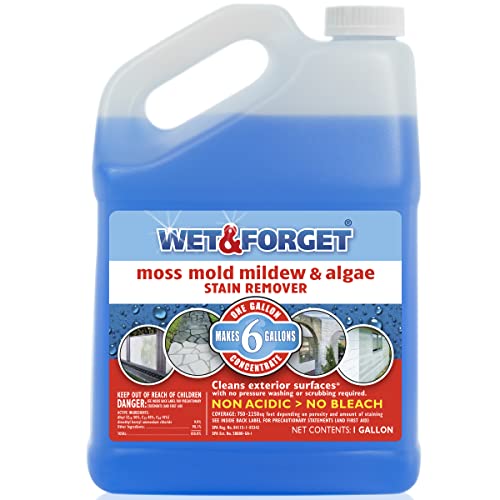
Best for gradual, no-rinse treatment of roof algae streaking
- Bleach-free and phosphate-free concentrate
- Applied once and left to work with rain and weather
- No rinsing and no scrubbing required
- Dilutes 5:1, so a jug covers a large roof
Why buy it: the no-rinse approach removes the single most dangerous part of roof cleaning — going back up onto a wet, freshly treated roof to rinse it. Results appear over weeks rather than the same afternoon.

Best for reaching a low roof edge, gutters and soffits without a ladder
- Extends to 24 feet from a standing position on the ground
- Curved wands for gutter and under-eave angles
- Belt support to carry the pole load
- Quick-connect tips including a low-pressure soap nozzle
Why buy it: the honest use for this on a roof job is gutters, fascia and the first few feet of eave — fitted with the black low-pressure tip only. It is a ladder substitute, not a license to blast shingles.
Stopping it coming back
The black streaking on North American roofs is almost always Gloeocapsa magma, a cyanobacterium that feeds on the limestone filler in asphalt shingles and colonizes shaded, damp, north-facing slopes first. Cleaning removes it; it will return. Two things slow that down: cutting back overhanging branches so the roof dries after rain, and fitting zinc or copper strips near the ridge, which release trace metal ions with every rainfall and inhibit regrowth on the courses below. Algae-resistant shingles do the same thing by embedding copper granules in the surface, which is worth specifying at your next re-roof.
Keeping the gutters clear matters too, because a gutter full of wet debris keeps the lower courses damp for days after rain. Our gutter guard picks cover that end of the job.
The short version
Pressure washing a shingle roof is a fast way to make it look better and a fast way to shorten its life, and the industry body that represents the people who make the shingles says so in capital letters. Soft wash instead: solution, dwell, gentle rinse. Do it from the ground if you can, and hire it out if the roof is steep, tall or heavily mossed. If you want the machine for the surfaces it is genuinely good at, our pressure washer rankings and how to pressure wash a house cover the jobs where pressure is the right answer.
More from this hub: leaf blowers & yard cleanup · best pressure washer for roof cleaning · what is soft washing · pressure washer safety tips · how to pressure wash vinyl siding · how we rank.