 Garden

Affiliate Disclosure
Some links on this page are affiliate links. As an Amazon Associate, we earn from qualifying purchases — at no extra cost to you. We do not buy, test, or physically handle the products we cover; our rankings come from aggregated owner reviews, ratings and expert consensus. Commissions never change our verdicts. How we rank · full disclosure.
Degrease first, then poultice. A pressure washer is the last step, not the first. Oil on concrete is not a surface problem — concrete is porous, and within hours capillary action has pulled the oil below the surface where no amount of soap and pressure can reach it. The method that works is to strip the grime on top with an alkaline degreaser, then apply a poultice: an absorbent powder carrying a solvent, spread thick over the stain and left to dry so that as the solvent evaporates it pulls the dissolved oil back up out of the pores. Fresh spills usually vanish; stains measured in years often leave a shadow.
Why the obvious approach fails
Every instinct says to attack an oil stain with a strong detergent and a pressure washer. It is the wrong sequence, and the reason is physical rather than chemical. Concrete is roughly 8 to 20 percent air by volume in its cement paste, a network of interconnected capillaries fine enough to wick liquid downward against gravity. Motor oil is thin, it wets those pores readily, and on unsealed concrete it is measurably below the surface within a day.
So when you blast the slab, you clean the layer of dust and rubber sitting on top of the stain. The stain itself is beneath that, and stripping the cover often makes it look worse — a common and entirely predictable complaint after a first attempt. Worse, water carries fine surface oil sideways and downward under pressure, spreading the halo.
The correct order runs the other way: chemistry, dwell time, agitation, and only then water.
Fresh spills: the first hour matters more than anything else
If the oil is still wet, you are in the easiest situation you will ever be in, and speed is worth more than product choice.
- Cover it with an absorbent immediately. Clay-based cat litter, oil-dry granules, sawdust or even a thick layer of cornstarch. Do not wipe — wiping spreads it and presses it in.
- Grind the absorbent in underfoot with a rigid shoe or a brick, which increases contact and speeds the pull.
- Leave it 30 to 60 minutes, then sweep up and dispose of it as solid waste.
- Repeat once with fresh absorbent if the granules came up saturated.
- Degrease the remaining shadow with a strong alkaline cleaner, a stiff nylon brush and 10 minutes of dwell time before rinsing.
Handled this way, most fresh spills leave nothing behind. The stains people struggle with are the ones that were left overnight.
Which method matches your stain
| Stain age | Method that works | Realistic outcome | Time |
|---|---|---|---|
| Still wet | Absorbent, then degreaser | Complete removal | 1–2 hours |
| A few days | Degreaser, agitation, hot rinse | Usually complete | Half a day |
| Weeks to a few months | Degrease, then one or two poultice cycles | Faint or invisible | 2–4 days |
| A year or more | Poultice, repeated; or microbial treatment | Substantially lighter, often a shadow | 1–3 weeks |
| Years, on old porous concrete | Poultice repeatedly, then accept, grind or resurface | Rarely disappears | Open-ended |
The poultice: how it actually works, step by step
A poultice reverses the process that created the problem. The solvent dissolves the oil in the pores; the absorbent powder holds a reservoir of that solvent against the surface; and as the solvent evaporates upward through the powder, capillary action carries the dissolved oil with it. The oil ends up in the powder, and you sweep the powder away.
- Clean and dry the area first. Degrease the surrounding grime and let the slab dry fully — a wet slab has its capillaries already occupied by water and the poultice cannot pull.
- Mix to peanut-butter consistency. A commercial product comes ready to mix. A homemade version is an absorbent powder — diatomaceous earth, hydrated lime, powdered clay or plain cat litter crushed fine — mixed with a solvent. Acetone, lacquer thinner or mineral spirits work; so does a grease-cutting dish detergent for lighter stains.
- Spread it about a quarter-inch thick and extend it an inch or two past the visible edge of the stain, because the oil has spread further underground than it shows on top.
- Cover with plastic sheeting taped at the edges for the first 12 to 24 hours to slow evaporation and give the solvent time to work. Then remove the plastic and let it dry to a hard crust — usually another 24 hours.
- Sweep or scrape it up and dispose of it as solid waste. Do not hose it into the street.
- Repeat. Two or three cycles on a deep stain is normal. Each one lightens it further, with diminishing returns.

What to use
Three products cover almost every version of this job. We do not buy or use these ourselves — the assessments below come from the aggregated owner-review record and from published product chemistry. Full method: how we rank.

Best for a dark stain that has been there for months or years
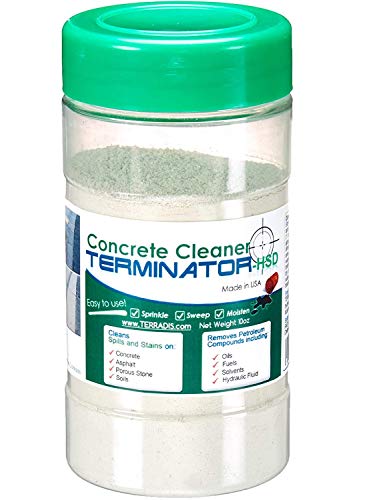
- Poultice chemistry — it draws oil back up out of the pores rather than washing the top
- Brush on, let it dry to a crust, sweep off
- Works on garage floors, driveways, pavers and unsealed concrete
- Repeat applications are expected on deep stains, not a sign of failure
Why buy it: the only class of product that addresses the actual problem. Detergents clean the surface; a poultice reverses the capillary action that pulled the oil down in the first place, which is why it is the method that finally shifts an old stain.
Best for a large or deep stain when you are not in a hurry
- Microbes digest the hydrocarbons rather than dissolving them
- Needs warmth and repeated wetting — it stops working below roughly 50°F
- Typical timeline is days to weeks, not minutes
- Leaves nothing to rinse into a storm drain
Why buy it: the approach that produces the least runoff, because the oil is broken down in place instead of being flushed somewhere else. Owners who follow the wetting schedule report the best results; those who apply it dry and walk away report the worst.
Best for fresh spills, general grime, and the pre-clean before any poultice
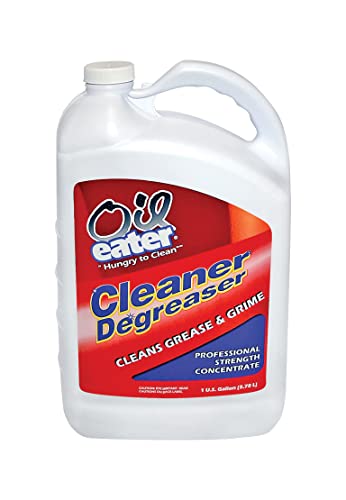
- Water-based alkaline concentrate — dilutes far down for general cleaning
- No solvent smell and no acid, so it will not etch concrete
- Also handles engine parts, tools and shop floors
- Needs agitation with a stiff brush to do its best work
Why buy it: a degreaser is what you want for anything still on the surface, and stripping the surface grime first is what lets a poultice reach the stain underneath. Skipping this step is the most common reason a poultice underperforms.
The microbial option, and its one hard requirement
Bioremediation products seed the stain with hydrocarbon-eating microbes that digest the oil into carbon dioxide and water. It is genuinely elegant, produces no runoff to manage, and works on stains that poultices only lighten. It also has a requirement that owners routinely miss: the microbes are alive, and they need warmth and moisture to stay that way.
In practice that means applying it to a damp surface, misting it again every day or two, keeping it out of freezing weather, and waiting. Below roughly 50°F activity slows to almost nothing. Reviews of these products split sharply along exactly this line — patient owners in mild weather report striking results, and owners who applied it dry in November report none.
Where the pressure washer finally comes in
Once the chemistry has done its work, a pressure washer is the right tool for the rinse and for the general dinginess around the stain. Three things make the difference between an even result and a driveway covered in wand stripes.
Use a surface cleaner, not the wand. A rotating surface cleaner holds a constant standoff distance and overlaps its own passes, which is the only practical way to get a uniform finish across a large slab. Wand work on concrete leaves visible arcs that are effectively permanent until the whole slab weathers back.
Match the pressure to the concrete. Sound concrete takes 2,500 to 3,500 PSI. Older, spalling or exposed-aggregate slabs need less, because the pressure that cleans them also removes the paste holding the aggregate. Our driveway pressure washer picks covers what that means when choosing a machine, and best pressure washer explains why flow rate matters more than the PSI on the box.
Let detergent dwell before you rinse. Apply the degreaser through the low-pressure soap nozzle, give it five to ten minutes without letting it dry, agitate the worst areas with a brush, then rinse. Applying and immediately blasting wastes the chemical entirely — see how to use soap in a pressure washer.
Chemical and injury safety, briefly and seriously
Never mix bleach with an acid or with ammonia. Chlorine bleach plus muriatic acid, vinegar, or many rust and concrete cleaners releases chlorine gas; bleach plus ammonia releases chloramine. Both have killed people in ordinary domestic settings. Bleach is also useless on oil — it oxidizes organic discoloration such as algae and mold, and does nothing to a hydrocarbon.
Treat muriatic acid as a last resort. It removes the stain by dissolving the concrete surface, leaving a lighter, rougher, more absorbent patch that will stain again faster. If you use it: chemical-splash goggles, acid gloves, long sleeves, outdoors with air moving, acid into water and never the reverse, and a baking-soda neutralizing wash afterward.
Respect the pressure washer itself. A high-pressure stream can inject water and debris under the skin through a puncture that looks trivial and is a surgical emergency. A 2023 study in Hand using the CPSC's National Electronic Injury Surveillance System estimated 15,307 high-pressure injection hand injuries in US emergency departments between 2012 and 2021, with pressure washers accounting for about 90% of them. Never brace a hand near the tip, never aim at a person, wear closed shoes and eye protection, and if a jet breaks skin say the words "high-pressure injection injury" at the emergency room.
Where the water goes
Storm drains do not lead to a treatment plant. The EPA's stormwater best-management guidance is blunt that runoff reaches streams, lakes and coastal water untreated, and its vehicle washing fact sheet notes that detergent-laden wash water carries nutrients, metals and hydrocarbons straight into that path. Many municipalities prohibit discharging cleaning wastewater to a storm drain outright.
The practical version for a driveway: dam the low edge with a rolled towel, steer the rinse onto lawn or gravel so soil can filter it, use the least water the job allows, and bag the spent absorbent or dried poultice as solid waste.
Preventing the next one
Sealing is the whole answer. A penetrating silane or siloxane sealer soaks in and lines the capillaries so oil sits on top long enough to be wiped up, and it does not change the look of the slab. A film-forming acrylic gives a stronger barrier and a slight sheen but needs recoating every two to three years and can go slippery when wet. Seal only once the concrete is fully dry and, on new work, only after the standard 28-day cure. A drip tray or a scrap of cardboard under a leaking vehicle costs nothing and prevents the entire problem.
More from this hub: leaf blowers & yard cleanup · best pressure washer · best pressure washer soap · best pressure washer for driveways · how we rank.