 Garden


Affiliate Disclosure
Some links on this page are affiliate links. As an Amazon Associate, we earn from qualifying purchases — at no extra cost to you. We do not buy, test, or physically handle the products we cover; our rankings come from aggregated owner reviews, ratings and expert consensus. Commissions never change our verdicts. How we rank · full disclosure.
The hazard that sends pressure washer users to surgery is not the one people expect. It is not electrocution and it is not a fall — it is a high-pressure injection injury, in which the stream penetrates skin through a puncture that looks trivial and forces water, grit and bacteria deep into the tissue. Clinical reviews describe these wounds as appearing benign at first presentation while the internal zone of injury extends far beyond what is visible, carrying real risk of infection, compartment syndrome and limb loss.
That is the headline. The rest of this page covers the other four hazards that matter, in the order they actually occur, and the specific handling rules that prevent them.
1. High-Pressure Injection Injury
A domestic pressure washer at 2000 PSI through a narrow tip delivers enough energy at close range to break skin. What makes these injuries dangerous is the mismatch between how they look and what they are. The StatPearls clinical review of hand high-pressure injuries notes that they "appear to be benign puncture wounds at initial presentation" while the injected material and the resulting swelling raise the risk of infection, ischaemia, compartment syndrome and limb loss — and that the injury zone can extend from a fingertip well up the arm.
People delay because there is little bleeding and moderate pain, and delay is precisely what worsens the outcome. The rules:
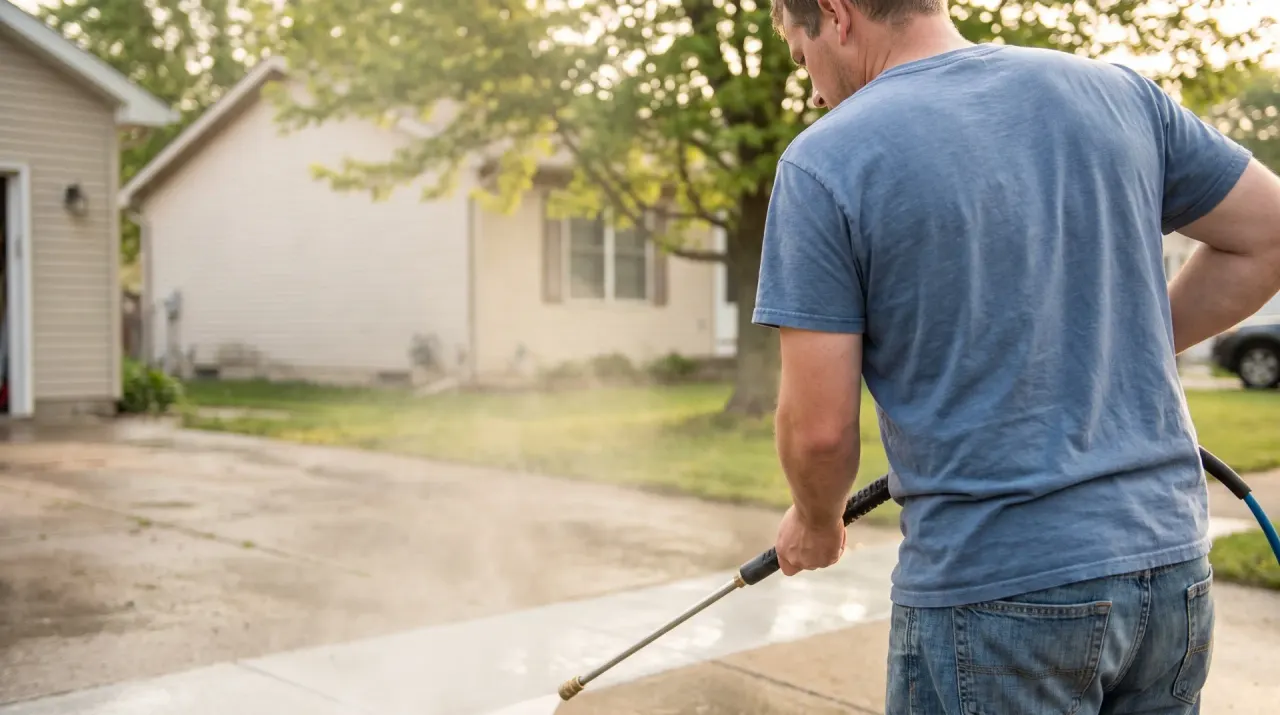
- Never point a wand at a person or an animal, including at your own feet or hands, even briefly and even "off".
- Never steady the spray with a hand in front of the tip. This is how most injuries happen — the wand kicks, the hand is already in the line of fire.
- Never test the pressure against your fingers or wave a hand through the stream.
- Never poke a blocked nozzle with the machine running. Shut down, bleed the pressure, then clear it with the pin supplied.
- Wear closed shoes. Feet are the second most common injection site, because people spray down at concrete and the stream ricochets.
- If a jet breaks the skin, go to an emergency department immediately and say the words "high-pressure injection injury". Do not clean it and wait.
2. The Red 0° Nozzle
Every nozzle risk on a pressure washer collapses into a single decision about one tip. The red 0° nozzle concentrates the full output of the machine into a jet the width of a pencil lead. It is the tip most often involved in injection injuries, and it is also the one that gouges concrete, furs deck boards, strips paint and blows mortar out of joints.
It also solves no household problem. Green 25° handles concrete, brick and general grime. White 40° handles vehicles, siding, painted surfaces and windows. The black soap tip applies detergent. Yellow 15° covers genuinely stubborn grime on sound hard surfaces. There is no domestic job whose correct answer is 0°.
| Nozzle | Risk level | Use it for |
|---|---|---|
| Red 0° | Highest — remove it from the holder | Nothing domestic |
| Yellow 15° | High on soft materials | Ground-in grime on sound concrete only |
| Green 25° | Moderate — the sensible default | Concrete, brick, patios, furniture |
| White 40° | Low | Vehicles, siding, paint, windows, decking |
| Black soap | Lowest | Applying detergent at low pressure |
Two mechanical rules go with this. Always engage the trigger safety catch when you are not spraying, and always tug a freshly fitted quick-connect tip to confirm it has locked — an unseated nozzle becomes a projectile the moment the trigger is pulled.
3. Electric Shock, and the 2026 Recall Wave
An electric pressure washer is a 13 to 15 amp appliance you operate while standing in water. That is why an integral ground-fault circuit interrupter, moulded into the power cord within about a foot of the plug, is not optional equipment.
Through 2026 the Consumer Product Safety Commission issued an unusually long run of recalls and stop-use warnings against imported electric pressure washers sold through online marketplaces, all for the same defect: no integral GFCI, creating what the Commission described as a serious risk of injury or death from shock and electrocution. This hazard has a long history — the CPSC's 1983 pressure washer warning followed at least eight reported fatalities, including a three-year-old killed by contact with a machine his father was using.
Practical rules:
- Check for the GFCI module and test it before every use. Press TEST — the machine should cut out — then RESET.
- Never plug into an unprotected indoor outlet via a window. Use a GFCI-protected outdoor receptacle.
- Avoid extension cords. If you must, use an outdoor-rated 12-gauge cord no longer than 25 feet, and keep the connection off wet ground.
- Never spray outlets, meters, service entries, light fixtures or AC condensers.
- Do not use a machine whose cord, plug or GFCI module is damaged, and never repair one with tape.
4. Carbon Monoxide from Gas Machines
Gas pressure washers carry the same hazard as portable generators, and it kills the same way. Small gasoline engines produce carbon monoxide in concentrations that are lethal in enclosed or partly enclosed air, and CO is colorless, odourless and gives no warning before symptoms — headache, dizziness, nausea, confusion — begin. By the time someone recognises what is happening they are often already impaired.
The rule has no qualifications: run gas pressure washers outdoors only. Not in a garage with the door open. Not in a carport, a shed, a basement, a breezeway or a partly enclosed patio. Keep the machine well away from open doors, windows and air intakes, because exhaust drifts. The CDC and the CPSC's carbon monoxide center both treat small-engine CO as a leading cause of accidental poisoning death in the home.
Two related points. Refuel only when the engine is cold, because a hot muffler ignites spilled fuel. And wear hearing protection: gas washers commonly exceed 90 dBA at the operator's position, and NIOSH sets its recommended exposure limit at 85 dBA over an eight-hour day, with permissible exposure time halving for every 3 dB above that.
5. Ladders, Recoil and Roofs
Never operate a pressure washer from a ladder. The wand produces continuous recoil, and when the stream catches an edge the reaction force changes abruptly — the exact condition that puts people off ladders. There is no technique that makes this safe, and no amount of experience that compensates for it.
Use a telescoping extension lance from the ground, hire one for the day, or hire a contractor with proper access equipment. For roofs, the correct method is usually not pressure at all: soft washing, which applies a cleaning solution at low pressure, removes algae without stripping the protective granules from asphalt shingles. Pressure washing a shingle roof shortens its life measurably and often voids the manufacturer's warranty.

6. Detergents, Runoff and Old Paint
Never mix cleaning chemicals, and specifically never combine a chlorine-based cleaner with anything containing ammonia or acid — the reaction produces toxic gas. Use products formulated for pressure washers; household cleaners can foam enough to damage the pump, and some are simply not designed to be aerosolised.
Do not pressure wash surfaces painted before 1978 without testing for lead. Blasting old paint aerosolises it and spreads chips across the yard, which is a genuine exposure risk for children and for soil. Assessment and abatement are regulated activities in the US.
Think about where the runoff goes. Wash water carrying detergent, oil, paint residue or algaecide that reaches a storm drain is a discharge, regulated in most municipalities under the EPA's municipal stormwater program. Rules are jurisdiction-specific — check locally. In practice, route runoff onto grass or gravel where soil can filter it rather than down a driveway into a gutter, and choose Safer Choice-certified products where a suitable one exists.
The Two-Minute Pre-Use Checklist
- Eye protection on, closed shoes on, hearing protection if it is gas.
- Children and pets indoors or well clear, not "supervised nearby".
- Water fully on; pump purged with the nozzle off until the flow is steady.
- GFCI tested and reset (electric), or the machine positioned outdoors well clear of openings (gas).
- Correct nozzle fitted and tugged to confirm it is locked; red 0° left in the drawer.
- Trigger safety catch engaged until you are ready to spray.
- Feet planted, both hands on the gun, nothing to trip over behind you.
Where to Go Next
How to use a pressure washer covers technique, nozzle choice and detergent dwell time in detail. How to start a pressure washer covers the start sequence, including the trigger-held step that most people miss. If you are still choosing a machine, the electric rankings flag the GFCI check explicitly, and can a pressure washer damage concrete deals with the surfaces most often ruined. Everything sits under the leaf blowers and yard cleanup hub.
This page is drawn from published clinical literature, CPSC recall and warning notices, and federal safety guidance — not from first-hand use. We never buy or run the machines we write about. Method: how we rank.