 Garden


Affiliate Disclosure
Some links on this page are affiliate links. As an Amazon Associate, we earn from qualifying purchases — at no extra cost to you. We do not buy, test, or physically handle the products we cover; our rankings come from aggregated owner reviews, ratings and expert consensus. Commissions never change our verdicts. How we rank · full disclosure.
A pressure washer that surges or pulses is nearly always being starved of water, not falling apart. The pump is trying to move more water than the supply is delivering, so it draws down, loses prime for an instant, catches again and repeats — which you feel at the wand as a rhythmic pulse. Check three things before anything else: the spigot is fully open, the supply hose is not kinked or too long, and the inlet filter screen where the garden hose connects is clean. That fixes most cases in five minutes and costs nothing. If the supply is genuinely fine, the next suspects in order are a partly blocked nozzle, a sticking unloader valve, and finally worn pump valves.
We never buy, test or physically handle the products we mention; recommendations come from aggregated owner reviews and published guidance, described in how we rank. More at the leaf blowers and yard cleanup hub.
First: is it the engine or the water?
Surging, pulsing, hunting and stuttering all get described the same way in a search box, but they are two entirely different faults and separating them takes ten seconds.
Start the machine and listen with the trigger released. If the engine note itself rises and falls — revving up, dropping back, hunting in a slow rhythm — that is an engine problem. On a small four-stroke it is almost always a lean condition caused by stale fuel or varnish in the carburetor's main jet, and the pump has nothing to do with it. Drain the fuel, refill with fresh gasoline, and if it persists, clean or replace the carburetor. Electric machines have no governor, so this failure mode does not exist on them.
If the engine holds a steady note and the surging only appears once you squeeze the trigger, the fault is in the water path. That is what the rest of this page is about.
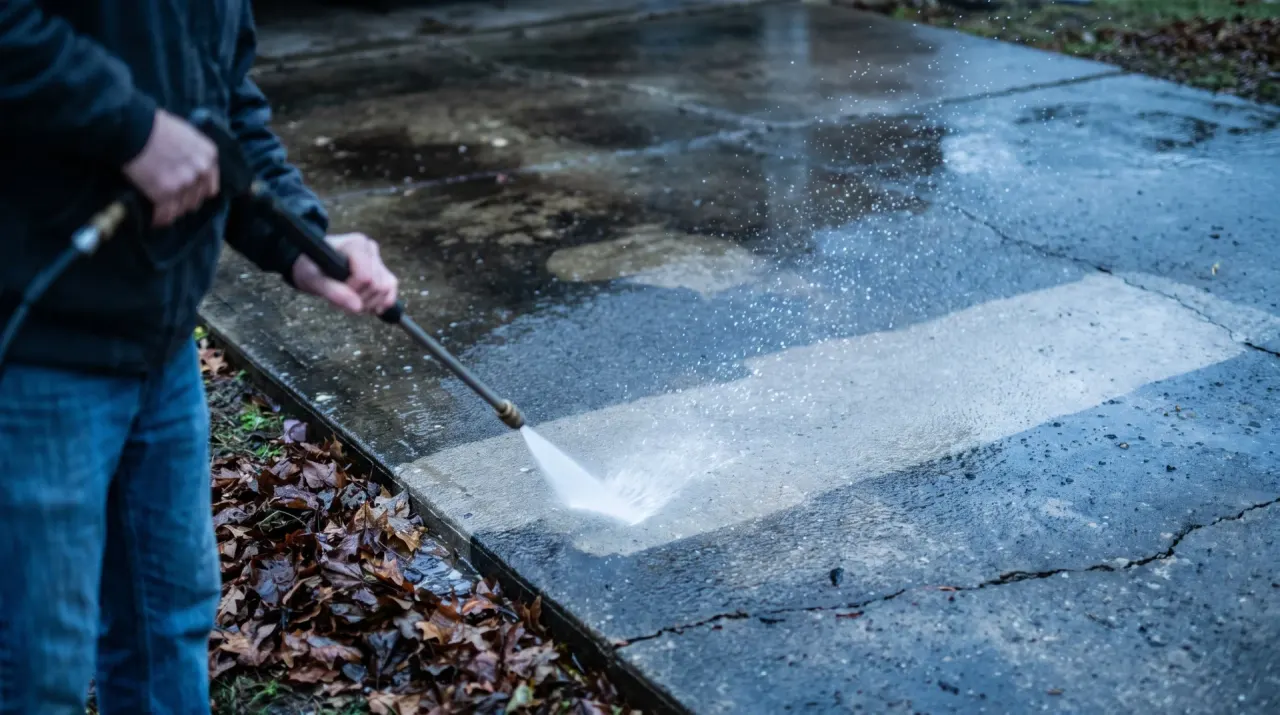
The ordered checklist, cheapest first
Work down this list in order. Each step is cheaper and likelier than the one below it, and it is genuinely common to solve this at step one.
1. Water supply — free, and the most likely cause
Your pump needs its rated flow delivered continuously. A 2.5 GPM machine fed 2.0 GPM will pulse, every time, no matter how new it is.
- Open the spigot all the way. Half-open is the single commonest cause.
- Straighten the supply hose and look for a kink behind the reel or under a wheel.
- Use 3/4-inch hose, not 5/8, and keep it under about 50 feet. Long, narrow hose is a real restriction at these flow rates.
- Time a bucket. Fill a 5-gallon bucket from the spigot with the hose attached. Under 60 seconds is 5 GPM and plenty. Over 90 seconds and the supply itself is the problem — you need a different tap, a shorter hose, or a buffer tank.
- Check the inlet filter screen. This is the small mesh screen inside the pump's water inlet, behind the garden hose connection. It clogs with sediment and rubber shavings from the hose washer, and almost nobody knows it exists. Pull it out with needle-nose pliers, rinse it, refit it.
2. Air in the system — free
A pump that was started dry, or refitted after a hose change, can hold air. With the machine off and the water on, squeeze the trigger and let water run through the wand for 30 to 60 seconds until it comes out in a steady stream with no spitting. Then start the machine. Purging is part of the starting procedure on most machines and skipping it is a routine cause of a first-run pulse.
3. Nozzle — free, or a few dollars
A partly blocked tip raises pressure until the unloader opens, which reads at the wand as cycling. A worn-out tip does the opposite and lets pressure fall away.
- Swap to a different nozzle. If the pulsing stops, the first tip is the fault.
- Clear the blocked one from the outlet side with the wire tip cleaner that came with the machine, or a paperclip, then flush it backwards.
- Tips wear. A set that has done several seasons on gritty water is a legitimate replacement item — a standard 1/4-inch quick-connect tip set (paid link) costs less than a bottle of detergent and rules the nozzle out permanently.
4. Hose, gun and quick connects — free to check
A pinhole in the high-pressure hose, a worn O-ring at a quick connect, or a leaking trigger gun all bleed pressure and can produce a cycling feel. Run the machine and walk the length of the hose looking for a fine spray. Replace any O-ring that looks flattened — they cost pennies and are the most-overlooked wear item on the machine.
5. Unloader valve — $25 to $60
If the supply, nozzle and hose are all good, this is the next suspect and the one most people arrive here looking for. It has its own section below.
6. Pump inlet and discharge valves — $20 to $40
Inside the pump head are small check valves that open and close on every stroke. Grit lodges under a seat, or the valve wears, and one cylinder stops contributing — which produces a pulse in time with the pump rather than a slow cycle. On a serviceable pump these come out with a socket and are sold as a kit. On a sealed axial pump they usually are not serviceable at all.
7. The pump itself — $80 to $150, or a new machine
Worn plungers, failed seals or a pump that was frozen over winter. This is where the repair-or-replace decision gets made, and the answer depends entirely on what kind of machine you own.
What is an unloader valve, and how do you know yours is bad?
The unloader valve is the component that decides where water goes when you let go of the trigger. With the trigger held, water leaves through the nozzle. Release it and pressure spikes instantly — at which point the unloader opens and diverts the whole flow into a bypass loop back to the pump inlet. Without it, releasing the trigger would either burst the hose or stall the pump. It is a spring-loaded piston, usually sitting on top of the pump head with a brass adjustment knob, and after the pump seals it is the most common mechanical failure on a pressure washer.
| Symptom | What it means | Fix |
|---|---|---|
| Slow cycle: pressure builds, fades, returns over 1–2 seconds | Piston sticking on grit or a swollen O-ring | Strip, clean, new O-ring kit |
| No pressure at all, water just flows | Valve stuck open — everything is going round the bypass | Clean or replace the unloader |
| Trigger very hard to pull; hose jerks on release | Valve stuck closed; pressure has nowhere to go | Replace — this one is a burst risk |
| Total-stop motor cycles on and off with trigger released | Bypass leaking past the seat | New O-rings, or a new unloader |
| Pressure fine cold, drops as the machine warms | Bypass heat cooking the seals | Stop idling on bypass; check pump condition |
| Fast rhythmic pulse, several a second | Not the unloader — water starvation or pump valves | Go back to step 1 |
Do not just crank the adjustment knob up. Turning the unloader clockwise raises system pressure, which is tempting when pressure feels low, and it is how people destroy pumps and hoses. If the machine was making rated pressure last season and is not now, something is worn or blocked — raising the setting masks it and loads the whole system past its design point.
Replacement unloaders are standard parts. The Annovi Reverberi VRT3 series is what a great many US machines use from the factory: the blue-spring VRT3-250 (paid link) suits homeowner machines up to about 3650 PSI, and the black-spring VRT3-310 (paid link) covers higher-pressure units. Match the spring to your machine's rated pressure, not to the highest number available — an over-strong spring will not open when it should.
The habit that causes most of these failures
When you release the trigger, the water goes round the bypass loop and has nowhere to shed heat. In an axial cam pump — which is what nearly every machine under about $600 uses — recirculating water can reach scalding temperatures within a couple of minutes and start cooking the pump seals and the unloader O-rings. The damage is cumulative and invisible until the machine starts surging.
The rule is simple and it will double the life of a homeowner pump: if you are going to stop for more than about a minute, shut the machine off. Not idling, off. A very large share of "the pump failed in its second season" reviews describe a machine left running while the owner moved a ladder, taped a window or answered the door.
When to stop repairing and buy a new machine
This is the part most troubleshooting guides avoid, and it is the question you actually want answered.
| Your machine | Repair worth it? | Reasoning |
|---|---|---|
| Electric under ~$200, sealed pump | Usually no | Parts rarely sold separately; a pump costs most of a new machine |
| Electric $200–450, induction or brushless | Unloader and seals yes; whole pump marginal | The motor is the valuable part and it normally outlives the pump |
| Gas homeowner, axial pump | Yes | A $100 replacement pump against a $400 machine is clear arithmetic |
| Gas with a triplex pump | Always | Seal and valve kits are stock items; these pumps are designed to be rebuilt |
| Any machine that was frozen | Pump replacement, not repair | Freezing cracks the pump housing; seals will not fix a crack |
For a gas machine with an axial pump, a direct replacement is the sensible fix — an OEM Technologies 3400 PSI horizontal-shaft pump kit (paid link) fits a large share of 3/4-inch shaft machines and takes about half an hour with basic tools. Measure your shaft diameter and orientation first: horizontal 3/4-inch and vertical 7/8-inch are the two common patterns and they are not interchangeable.
If the machine is beyond sensible repair, our pressure washer picks and gas machine rankings cover the field, and the honest advice on the way out is that pump longevity is far more about how you store and run the machine than about what you paid for it.
Preventing it happening again
- Never run the pump dry, even for a few seconds. Water on before the machine starts, always.
- Never idle on bypass for more than a minute.
- Winterise properly. A frozen pump is a dead pump, and pump antifreeze costs a few dollars — see how to store a pressure washer.
- Rinse the inlet screen every few uses. Two minutes, and it prevents the commonest cause on this page.
- Change the pump oil on any machine that has a fill plug, at the interval in the manual. Most homeowners never do this once.
- Use fresh fuel on gas machines. Stale gasoline causes the engine-side surge that gets mistaken for a pump fault.
More from this hub: leaf blowers & yard cleanup · best pressure washer · best gas pressure washer · storing a pressure washer · how we rank.