 Garden


Affiliate Disclosure
Some links on this page are affiliate links. As an Amazon Associate, we earn from qualifying purchases — at no extra cost to you. We do not buy, test, or physically handle the products we cover; our rankings come from aggregated owner reviews, ratings and expert consensus. Commissions never change our verdicts. How we rank · full disclosure.
There is exactly one real difference: a true power washer heats its water, and a pressure washer does not. That distinction is genuine in the commercial cleaning trade. It is also almost entirely irrelevant to anyone shopping for a machine to clean a driveway, because virtually every unit sold to homeowners — regardless of whether the box says "pressure washer", "power washer" or "power cleaner" — is a cold-water pressure washer. The two words are used interchangeably in consumer retail, and no regulator or standards body requires otherwise.
So the practical answer to "which should I buy" is not a choice between two categories. It is a choice about flow rate, motor type and nozzles, inside one category that has been given two names.
The Difference That Is Real
In the commercial world, a hot-water machine is a substantially different piece of equipment. It carries a burner coil, a fuel tank or gas supply, a thermostat and a flue, and it typically weighs several hundred pounds. Manufacturers in that market — the ones certified through the Cleaning Equipment Trade Association — separate their catalogues into cold-water and hot-water lines and price them accordingly. A hot-water unit generally starts around two thousand dollars and runs well beyond ten.
Nobody is selling that to a homeowner alongside garden hoses. When a $180 machine is labeled a "power washer", the word carries no technical meaning at all.

Cold Water vs Hot Water, Honestly Compared
| Cold water ("pressure washer") | Hot water ("power washer") | |
|---|---|---|
| What it is | Pump, motor or engine, cold feed | Same, plus a burner and heat exchanger |
| Typical price | $120–$600 | $2,000–$12,000 |
| Weight | 20–70 lb | 250–900 lb |
| Where you buy it | Any hardware store or marketplace | Industrial cleaning suppliers |
| Real advantage | Cost, size, no fuel for the burner | Grease, oil, fat and wax dissolve far faster |
| Typical user | Homeowners, painters, deck contractors | Fleet yards, food plants, kitchens, farms |
| Available to homeowners? | Yes, everywhere | Rentals only, realistically |
What Heat Actually Does — and When You Need It
Heat is not extra force. It is chemistry. Warming water lowers the viscosity of fats, oils and waxes and accelerates the reaction between detergent and soil, which is why a hot-water machine strips a grease-soaked workshop floor in a fraction of the time a cold one takes. It has almost no advantage on inorganic dirt, and it does nothing whatsoever for moss, algae or mildew that a suitable cleaner would not do better.
Run through the jobs a household actually has, and heat earns its place on roughly one of them:
| The job | Does heat help? | What actually solves it |
|---|---|---|
| Algae and green film on a fence | No | Sodium hypochlorite or an oxygenated deck cleaner, with dwell time |
| Dirt and cobwebs on vinyl siding | No | 40° tip, house-wash detergent, spray downward |
| Concrete driveway grime | Marginally | Flow rate and a surface cleaner attachment |
| Old motor oil on a garage floor | Yes, substantially | Degreaser plus heat — this is the genuine hot-water case |
| Road film and bugs on a car | No | Foam cannon, dwell, 40° rinse |
| Grease around a commercial kitchen door | Yes | Hire a hot-water unit or a contractor |
| Moss between patio pavers | No | 25° tip, then re-sand the joints |
If your one real problem is the garage floor, the honest advice is to hire a hot-water machine for a day rather than build a purchase around it — and to read what the consumer "hot water" market actually contains before you spend money on something that is not what it appears to be.

Do Not Pour Hot Water Into a Cold-Water Machine
This comes up constantly and it is a reliable way to kill a pump. Consumer cold-water machines generally specify a maximum inlet temperature around 100 to 104°F, because the pump seals, valves and plastic manifold are not rated above it. Feeding hot tap water in softens the seals, can distort plastic components, and voids the warranty. Machines that genuinely accept a warm feed say so explicitly in the manual and state the limit; if yours does not, assume cold only.
The same caution applies to hoses. A hose sold as rated for hot water does not make a cold-water machine hot-water capable — the hose was never the limiting component.
What to Buy Instead of Worrying About the Name
Ignore the word on the carton and compare four things.
- Flow rate (GPM) first. Water volume removes what pressure loosens. Almost every consumer electric is 1.76 GPM; gas machines run 2.3 to 2.6. That gap is the single biggest determinant of how long a driveway takes.
- Motor or engine type second. Induction and brushless electric motors outlast universal ones by years. On gas, a serviceable pump matters more than the engine badge.
- Pressure third. Anything from 1900 to 2500 PSI handles household work with the right nozzle. Above that you are buying speed on concrete, not capability.
- Accessories fourth. A surface cleaner and a decent detergent change results more than a 300 PSI upgrade does.
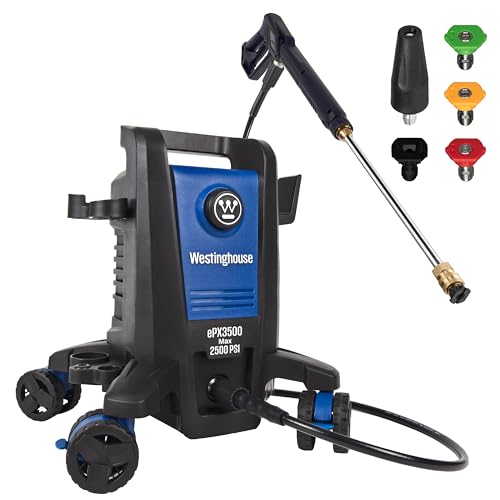
Best for decks, siding, patios, fences and cars around a normal house
- 2500 max PSI at 1.76 max GPM
- Induction motor rather than a universal motor
- Five quick-connect nozzles and an onboard soap tank
- Integral GFCI on the power cord
Why buy it: whatever the listing calls it, this is a cold-water machine — and for household surfaces cold water plus the right detergent does essentially everything heat would.

Best for long driveways, farm buildings and sites with no outdoor outlet
- 3200 PSI at 2.5 GPM — about 8,000 cleaning units
- Axial cam pump, 212cc engine
- Five quick-connect nozzles plus a soap applicator
- Never-flat wheels and onboard storage
Why buy it: if you are chasing the throughput people imagine a "power washer" delivers, this is where it actually comes from — flow rate, not heat.
One Safety Note That Applies to Both
Whatever the machine is called, the stream from a narrow nozzle can break skin. A high-pressure injection injury forces water and debris into the tissue underneath through a puncture that looks trivial, and the clinical literature — including the StatPearls review of hand high-pressure injuries — treats these as surgical emergencies precisely because the visible wound understates the internal damage. Never aim a wand at a person, never steady the spray with a hand in front of the tip, and treat the red 0° nozzle as one you essentially never fit. Full detail in pressure washer safety tips.
The Short Answer
If a retailer offers you a "pressure washer" and a "power washer" at similar prices, they are selling you the same kind of machine twice. Compare the flow rate, the motor and the nozzle set, buy the one with better numbers on those, and spend the difference on a surface cleaner. The only time the distinction matters is when you genuinely need heat — and if you do, you are looking at a rental or a contractor, not a shelf in a hardware store.
More from this hub: leaf blowers & yard cleanup · best pressure washer · best electric pressure washer · how to use a pressure washer · how we rank.
We never buy or physically run the machines we rank; every verdict is drawn from aggregated owner reviews and published specifications.