 Garden


Affiliate Disclosure
Some links on this page are affiliate links. As an Amazon Associate, we earn from qualifying purchases — at no extra cost to you. We do not buy, test, or physically handle the products we cover; our rankings come from aggregated owner reviews, ratings and expert consensus. Commissions never change our verdicts. How we rank · full disclosure.
A gas pressure washer takes two different oils, and they are not interchangeable. The engine takes SAE 30 above roughly 40°F or SAE 10W-30 for wider temperatures, API SJ or later, with a capacity usually around half a US quart. The pump — if it is serviceable at all — takes a non-detergent pump oil, and most consumer pumps are sealed for life with no fill point. An electric machine has no engine oil at all. Putting engine oil in a pump crankcase is the mistake worth avoiding, and the reason is specific rather than fussy.
Why there are two oils
Engine oil is detergent oil, and that is a deliberate design choice. Detergent and dispersant additives hold soot, combustion by-products and water in suspension so they stay circulating until the filter or the next oil change removes them. In an engine that is exactly right: you want contaminants carried away from the bearings rather than settling on them.
A pump crankcase has no filter and a different enemy. The failure mode that matters is water working past a plunger seal into the oil, and the design response is the opposite one — you want a non-detergent oil that lets water separate out, so it collects visibly at the bottom and turns the sight glass milky where you can see it. Detergent oil emulsifies that water instead, keeping it dispersed, invisible and in contact with the bearing surfaces.
So the rule is straightforward: detergent oil in the engine, non-detergent oil in the pump, and never the other way round.

What goes where
| Component | Oil | Typical capacity | Interval |
|---|---|---|---|
| Gas engine, above 40°F | SAE 30, API SJ or later | ~0.5 US quart | First 5 hrs, then 50 hrs or annually |
| Gas engine, wide temperature range | SAE 10W-30 | ~0.5 US quart | Same |
| Gas engine, cold climate | Synthetic 5W-30, if permitted | ~0.5 US quart | Same |
| Serviceable axial pump | Non-detergent SAE 30 or branded pump oil | ~5–14 fl oz | First 50 hrs, then ~200–300 hrs |
| Triplex pump | Manufacturer-specified pump oil | ~10–20 fl oz | First 50 hrs, then ~300 hrs or annually |
| Sealed axial pump | None — filled for life | — | Never |
| Electric motor | None | — | Never |
Every figure above is a general pattern rather than your machine's specification. Two manuals govern a gas pressure washer — the engine manufacturer's and the pump or machine manufacturer's — and where they differ from a rule of thumb, they win.
The engine oil, in detail
Small four-stroke engines used on pressure washers are conventional splash- or pump-lubricated units with no oil filter, which is why the change interval is short in hours even though the total quantity is tiny. Straight SAE 30 is the traditional specification and remains the right answer for warm-weather use; 10W-30 is the safer general choice if the machine might be used on a cold morning, because a 30-weight oil is stiff below about 40°F and slow to reach the top end at start-up.
Overfilling is the common error, and it is easy because the capacity is so small. Around half a quart means a standard quart bottle contains two changes, and pouring "until it looks right" typically puts in too much. Excess oil gets whipped by the crank, aerates, and pushes past seals — the symptoms are smoking, oil at the air filter, and sometimes a low-oil sensor behaving strangely. Check on level ground, with the engine cool, filling to the top of the threads on a plug-type fill or to the upper dipstick mark.
Change it at the end of the season, not the start. Used oil is mildly acidic and leaving it in a crankcase for six months of storage is worse than draining it. Drain while the engine is still warm so the oil flows and carries suspended debris with it.
Dispose of it properly. Used motor oil goes to an auto parts store or municipal recycling point that takes it, never down a drain, into a storm sewer or onto the ground. A single quart contaminates a very large volume of water, which is precisely why every collection point takes it free.

The pump oil, and whether yours has any
Before buying pump oil, establish whether your pump can take it. Look for a fill plug, a dipstick or a small round sight glass on the pump body. If there is none — and on most consumer machines there is none — the pump is sealed and filled for life. There is nothing to add, nothing to change, and no maintenance interval. That is a design decision, not an oversight, and it is part of why sealed axial pumps are replaced rather than rebuilt when they wear out.
If your pump does have a fill point, the manual will specify either a branded pump oil or plain non-detergent SAE 30. Manufacturer-branded pump oils are common on triplex pumps and are worth using where specified, because viscosity requirements vary and some crankcases want a particular grade. Where the manual simply says "non-detergent SAE 30", finding it is harder than it sounds: nearly everything on a modern shelf is detergent oil, and you have to look for a bottle that says non-detergent explicitly.
Filling is usually done to the middle of the sight glass, not to the top. Overfilled pump crankcases build pressure and push oil past the seals, which is how you turn a maintenance job into a leak. The difference between the two pump designs, and why one is serviceable at all, is covered in axial vs triplex pumps.
The two bottles worth owning
We do not buy or use these ourselves; the notes below draw on the aggregated owner-review record and published specifications. Full method: how we rank.

Best for a triplex or serviceable axial pump crankcase
- Non-detergent formulation intended for pump crankcases
- One liter covers several changes on a typical pump
- Correct viscosity range for common pressure washer pumps
- Pours cleanly, which matters on a pump with a small fill port
Why buy it: pump crankcases want an oil that lets water settle out rather than one that holds it in suspension. That is the opposite of what engine oil is designed to do, and it is the single reason not to reach for the bottle already on the shelf.
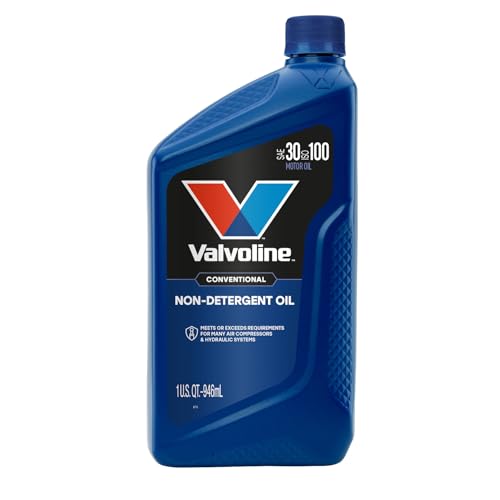
Best for pumps whose manual specifies plain non-detergent 30-weight
- Non-detergent SAE 30 — the specification many axial pumps call for
- Widely available and inexpensive
- Straight weight rather than multigrade
- Check the manual: some pumps require a branded pump oil instead
Why buy it: a lot of manuals simply say non-detergent SAE 30, and finding genuinely non-detergent oil is harder than it sounds because almost everything on a modern shelf is detergent oil. This is the plain version those manuals mean.

Reading the oil
Both crankcases tell you things, and it is worth knowing how to read them.
| What you see | What it means | What to do |
|---|---|---|
| Milky or coffee-colored pump oil | Water past a seal | Change it; if it recurs, reseal or replace the pump |
| Engine oil above the full mark | Overfilled — or fuel dilution | Drain to level; if it smells of gasoline, suspect the carburetor |
| Very black engine oil after one season | Normal on a small engine with no filter | Change on schedule |
| Metallic glitter in pump oil | Bearing or plunger wear | Rebuild or replace the pump |
| Oil weeping from the pump body | Crankcase seal failing | Serviceable pumps take a seal kit; sealed ones do not |
The oil job that matters more than the oil
Worth saying plainly: for most owners, the pump fluid that actually decides how long the machine lasts is not oil at all. It is pump-saver antifreeze, put through the pump before the first hard freeze. Frost cracks more consumer pump heads than wear ever does, and unlike an oil change it is a failure with no repair. If you only do one piece of maintenance a year, do that one — see how long pressure washers last.
The other seasonal job on a gas machine is the fuel, not the oil: stale gasoline varnishing a carburetor causes far more no-starts than anything in the crankcase. That sequence is in pressure washer won't start.
The short version
- Engine: SAE 30 in warm weather, 10W-30 generally, API SJ or later. Roughly half a quart. Change after the first five hours, then annually.
- Pump, if it has a fill point: non-detergent pump oil, to the middle of the sight glass, roughly annually.
- Pump, if it has no fill point: nothing. It is sealed.
- Electric machine: no oil anywhere.
- Never put detergent engine oil in a pump crankcase, and never guess the capacity from the bottle.
More from this hub: leaf blowers & yard cleanup · axial vs triplex pump · pressure washer no pressure · best pressure washer · how we rank.