 Garden

Affiliate Disclosure
Some links on this page are affiliate links. As an Amazon Associate, we earn from qualifying purchases — at no extra cost to you. We do not buy, test, or physically handle the products we cover; our rankings come from aggregated owner reviews, ratings and expert consensus. Commissions never change our verdicts. How we rank · full disclosure.
A countertop electric pizza oven is a genuinely useful appliance with a genuinely lower ceiling than an outdoor one, and both halves of that sentence matter. The best of them reach around 700°F. A gas outdoor oven reaches 900 to 950°F. That gap is not marketing — it is a household 120V circuit against a propane burner, and it decides what kind of pizza comes out.
What you get in exchange is everything an outdoor oven cannot offer: it works in an apartment, it works in February, it plugs into a kitchen outlet, there is no tank to refill and no ash to shovel, and it does not require you to stand outside in the dark turning a pie every twenty seconds. For a great many households that is the better trade, and we would rather rank these honestly on their own terms than pretend they compete with a Roccbox.
Top Picks at a Glance
The Temperature Ceiling, Explained
Almost every disappointed review in this category traces back to one expectation. Here is why the physics does not bend.
Neapolitan pizza needs a floor around 750 to 900°F. At that heat the pie bakes in 60 to 90 seconds — fast enough that the water in the dough turns to steam and puffs the rim before the crust has time to dry out, and hot enough to leave the leopard-spotted char that defines the style. Ooni's own guidance on making a first pizza puts the window at 750 to 850°F for exactly this reason.
A countertop oven on a standard 15-amp household circuit has roughly 1,800 watts to work with. The best of them claim 700 to 800°F and deliver something closer to 600 to 700°F at the stone, which means a three-to-six-minute bake. Over three minutes the crust dries as it cooks, so you get an excellent crisp pizza — closer to a very good New York slice than to Naples.
| Oven type | Realistic stone temp | Bake time | Crust result | Indoors? |
|---|---|---|---|---|
| Gas outdoor oven | 850–950°F | 60–90 sec | Puffed rim, leopard spotting | No |
| Wood-fired outdoor oven | 750–900°F | 60–120 sec | Puffed rim, char, smoke note | No |
| High-heat countertop electric | 600–700°F | 3–6 min | Crisp, browned, minimal puff | Yes |
| Multi-use countertop clamshell | 450–550°F | 6–12 min | Baked rather than blistered | Yes |
| Kitchen oven with a steel or stone | 500–550°F | 7–12 min | Good with a preheated steel | Yes |
Read that table once and the category makes sense. If your goal is Neapolitan pizza, no countertop oven will get you there and you want an outdoor pizza oven. If your goal is much better pizza than your kitchen oven makes, faster, without heating the house, a countertop oven is exactly right.
Who Should Buy One
- Apartment and condo residents. No balcony, no propane permitted, no space for an outdoor oven. This is the only category that works.
- Anyone in a real winter. An outdoor oven in January is a commitment. A countertop oven does not care what month it is.
- Households that eat a lot of frozen pizza. A stone-floored countertop oven crisps a frozen base far better than a conventional oven, in a fraction of the time and energy.
- Anyone who wants better pizza without a learning curve. At three to six minutes per bake you have time to think. No peel launch under pressure, no turning every twenty seconds.
- Small households. Heating a full wall oven for one 12-inch pizza is genuinely wasteful.
And who should not: anyone chasing a true Neapolitan crust, anyone feeding six people at once from a 12-inch floor, and anyone with no permanent space for a single-purpose appliance. If you make pizza three times a year, a pizza steel in your existing oven is the smarter purchase.
Our #1 Pick: Ninja Artisan MO201
The Artisan is the highest-rated oven in this category and it earns that by pushing right up against the physical limit of a household circuit. At 700°F it sits above the practical threshold where a crust starts to puff and blister rather than simply bake dry — and that difference between roughly 600°F and 700°F is more visible in the finished pizza than the number suggests.
The independent top and bottom heat is the other genuinely useful part. Most of the complaints about cheap countertop ovens are about balance: a base that is pale while the cheese is already browning, or the reverse. Being able to bias the heat means you can adapt to a thin crust, a loaded pie or a frozen pizza rather than accepting one fixed profile.
Three minutes for a 12-inch pizza is fast enough to feed a family in sequence without anyone's food going cold, and the five functions mean it also does flatbreads, reheating and roasting — which matters when counter space is the scarce resource in a kitchen.
Two honest caveats. Twelve inches is the hard limit and there is no getting around it. And like every high-heat countertop oven it exhausts genuinely hot air, so it needs the clearance the manual specifies and it should not live tucked under a cabinet.
Check price on Amazon → (paid link)
The Ranked Field

Best for the closest a countertop oven gets to a real pizzeria bake
- Reaches 700°F — at the top of what a 120V countertop oven can do
- Bakes a 12-inch pizza in about three minutes
- Five functions including bake, roast and reheat
- Stone-effect cooking surface with independent top and bottom heat
Why buy it: the highest-rated countertop pizza oven here, and 700°F is the meaningful threshold — below about 600°F you are baking pizza, above it you start getting the puff and the spotting people actually want.

Best for high heat at the lowest sensible price, with the largest owner base
- Claimed 800°F ceramic stone temperature
- Bakes a 12-inch pizza in roughly six minutes
- Analog dial control, minimal to learn
- Compact clamshell body
Why buy it: by far the biggest ownership record in the category, which means its failure modes are documented by an enormous number of long-term users rather than a handful of early reviewers.

Best for a kitchen where a door and a contained oven matter
- Fully enclosed with a door rather than an open clamshell
- Reaches roughly 700°F
- Removable stone and crumb management
- Multiple crust presets
Why buy it: an enclosed chamber holds heat far better than an open one, which is exactly why the second and third pizzas from this style come out closer to the first.

Best for a small kitchen where one appliance has to justify its shelf space
- 1440W with a 12-inch nonstick pan as well as pizza function
- Also handles quesadillas, flatbreads, eggs and reheating
- Lower ceiling than dedicated high-heat ovens
- Compact clamshell design
Why buy it: the honest pick for a small kitchen — it will not produce a Neapolitan crust, but it will get used several times a week rather than living in a cupboard.
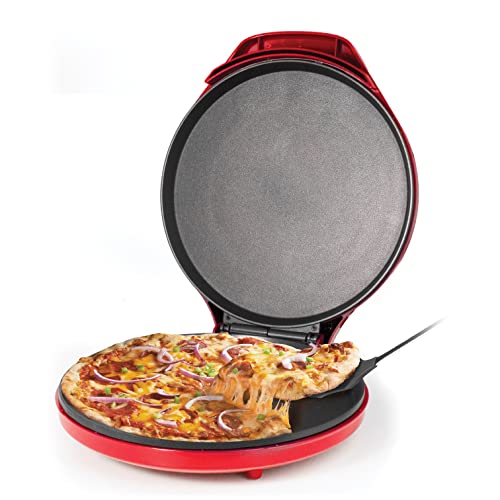
Best for frozen and homemade pizza on a genuinely tight budget
- 1440W clamshell with a nonstick griddle surface
- Doubles as an indoor grill and griddle
- Very small footprint and quick to heat
- Substantially lower peak temperature than dedicated pizza ovens
Why buy it: a huge and long-standing owner base at a fraction of the price — it is not a pizza oven in the high-heat sense, and it is genuinely useful for what it is.

Best for frozen pizza, evenly, without heating the kitchen
- Rotating tray with independent upper and lower heating elements
- Purpose-built for frozen pizza rather than fresh dough
- Uses far less energy than a full oven
- Auto shut-off timer
Why buy it: the most-owned and highest-rated appliance in this whole space, and it is honest about its job — this is frozen-pizza equipment, not a Neapolitan oven, and it does that job better than a wall oven does.
Quick Comparison
| Product | Best for | Rating | Price | Buy |
|---|---|---|---|---|
| Ninja Artisan Pizza Oven, 12-Inch Pizza in 3 Minutes, 700°F, 5-in-1, Gray, MO201 | Best Overall | — | Check (paid link) | |
| PIEZANO 12-Inch Electric Pizza Oven, Indoor Countertop Pizza Maker, Heats to 800°F | Most Owned | — | Check (paid link) | |
| Cuisinart Indoor Pizza Oven, Bakes 12-Inch Pizzas in Minutes, Countertop Electric | Best Enclosed | — | Check (paid link) | |
| Chefman Everything Maker & Pizza Oven, 1440W Countertop Electric Pizza Maker with Nonstick Pan | Best Multi-Use | — | Check (paid link) | |
| Betty Crocker Pizza Maker Plus, 12-Inch Indoor Grill, 1440W, BC-2958CR | Best Budget | — | Check (paid link) | |
| Presto 03430 Pizzazz Plus Rotating Pizza Oven | Best for Frozen Pizza | — | Check (paid link) |
Getting the Best Out of One
- Preheat properly, and longer than you think. The indicator light says the element is up to temperature; the stone is not. Give it a full ten to fifteen minutes after the light and the first pizza will be dramatically better than if you launch at the beep.
- Use less sauce and fewer toppings than you would in a home oven. High heat and a short bake cannot drive off moisture. A wet, overloaded pizza produces a soggy center in any high-heat oven, and this is the most common self-inflicted disappointment.
- Roll or stretch thin. These ovens reward a thin base. A thick crust in a three-minute bake browns outside before the middle sets.
- Semolina or coarse flour on the peel, not oil. Oil fries the base; semolina lets it slide.
- Let the stone recover between pizzas. Two to three minutes. Launching straight onto a stone that just gave its heat to a cold pizza gives you a pale base and a confusing result.
- Fresh mozzarella needs draining. Pat it dry and tear rather than slice. This applies to any pizza oven but it shows fastest in a short bake.
Cleaning
The routine is the same as any stone-floored oven and it is mostly heat rather than chemicals. Run the oven at full temperature for twenty to thirty minutes and most spilled cheese and topping debris carbonizes to ash. Let it cool fully, then brush the ash out with a dry brush and wipe the interior surfaces with a barely damp cloth.
Never use soap or detergent on a cooking stone — it is porous and it will absorb the taste, which then transfers to your food. And never put water on a hot stone or wash a warm one: the rapid temperature change is exactly how stones crack, and thermal shock is the most common cause of a cracked stone in any pizza oven. Dark staining on a stone is normal seasoning, not dirt, and it does not need removing. More detail in how to clean a pizza oven.
Safety Indoors
The real safety advantage of this category is worth stating plainly: an electric oven produces no carbon monoxide, which is why it can be used indoors at all. Every wood, charcoal, pellet and propane oven produces CO — a gas with no smell, color or taste — and the NFPA's carbon monoxide guidance and CPSC Carbon Monoxide Information Center are unambiguous that fuel-burning appliances belong outdoors. If someone suggests bringing an outdoor pizza oven inside for the winter, the answer is no, and this category is the correct alternative.
Electric ovens still need respect. Leave the clearance the manual specifies on every side and above — these run hundreds of degrees hotter than a toaster oven and exhaust hot air, so an under-cabinet position is often explicitly prohibited. Use it on a heat-resistant surface, keep towels, paper and plastic away, plug it directly into a wall outlet rather than a light-duty extension cord given the current draw, and do not leave it running unattended. The US Fire Administration's cooking fire prevention guidance is worth a read given that cooking is the leading cause of home fires.
How We Rank
We do not buy or cook on these ovens. Rankings come from aggregated owner ratings across the most-owned countertop electric pizza ovens on the US market, weighted toward reviews written after several months of regular use. Four things carry the weight: realistic peak stone temperature rather than the number on the box, since it determines what kind of crust is achievable; heat balance and recovery, because pale bases and burnt tops are the dominant complaint; honest positioning — whether a product is sold as what it is rather than as a Neapolitan oven; and practical living-with-it factors, meaning footprint, cleaning access and how hot the outside gets. Prices were checked at the time of writing. Full method: how we rank.
The Field, Reviewed
1. Ninja Artisan MO201 — Best Overall
Covered above. Owners praise: a genuinely fast three-minute bake, crust results noticeably better than a kitchen oven, independent top and bottom control, and useful additional functions. Owners gripe about: the 12-inch limit, hot exhaust needing real clearance, a large footprint for a single-purpose appliance, and price against cheaper clamshells. Check price (paid link).
2. PIEZANO — Most Owned
The category's volume leader by a wide margin, and that has real value: its behavior over years is documented by an enormous number of owners rather than a handful of early adopters. The claimed 800°F stone is optimistic, but it is genuinely in the high-heat tier.
Owners praise: price for the temperature, simple analog operation, crisp bases, and a compact footprint. Owners gripe about: uneven heat requiring the pizza to be rotated mid-bake, a rating that sits below the premium models, variable build quality between units, and a stone that is awkward to clean. Check price (paid link).
3. Cuisinart Indoor Pizza Oven — Best Enclosed
An enclosed chamber with a door rather than an open clamshell, which is a meaningful engineering difference — a closed box holds heat, so the second and third pizzas come out closer to the first.
Owners praise: consistency across consecutive pizzas, presets that work, and a contained design that feels safer around children. Owners gripe about: a longer preheat than open designs, a substantial footprint, and price relative to the temperature it reaches. Check price (paid link).
4. Chefman Everything Maker — Best Multi-Use
Not a high-heat pizza oven and not pretending to be. It is a 1440W clamshell with a nonstick pan that does pizza along with flatbreads, quesadillas, eggs and reheating. In a small kitchen, an appliance used four times a week beats one used monthly.
Owners praise: versatility, genuinely small footprint, quick heat-up, and easy cleaning of a nonstick surface. Owners gripe about: a much lower ceiling so pizza is baked rather than blistered, no stone so the base is less crisp, and that it is a multi-cooker rather than a pizza specialist. Check price (paid link).
5. Betty Crocker Pizza Maker Plus — Best Budget
A long-standing, very widely owned clamshell at a price that makes the whole debate academic. It is an indoor grill and griddle that does pizza rather than a pizza oven, and its owner rating is strong precisely because it is honest about that.
Owners praise: price, small size, speed for frozen and thin pizzas, and dual use as a griddle. Owners gripe about: a low peak temperature so there is no char or puff, a nonstick surface rather than a stone, and a 12-inch limit. Check price (paid link).
6. Presto 03430 Pizzazz Plus — Best for Frozen Pizza
The most-owned and among the highest-rated appliances in this entire space, and it is not really a pizza oven — it is a rotating tray with independent upper and lower elements, purpose-built for frozen pizza. That rotation solves the specific problem frozen pizza has in a static oven, which is one side cooking faster than the other.
Owners praise: genuinely even results on frozen pizza, far less energy than a wall oven, no kitchen heat-up, and an auto shut-off that means you can walk away. Owners gripe about: that it is not for fresh dough, that it takes 15 to 25 minutes rather than three, storage awkwardness, and that the tray is fragile if mishandled. Check price (paid link).
What Owners Actually Complain About
"It is not like a real pizzeria." The dominant critical theme, and largely an expectation problem. At 600 to 700°F a pizza bakes in minutes rather than seconds, and that is a different crust. Buy knowing which one you are getting.
Pale base, browned top. Usually launching before the stone is up to temperature, or a base loaded too wet. Preheat ten to fifteen minutes past the indicator light and go lighter on the sauce.
It exhausts a lot of heat. Real, and under-communicated. These are not toaster ovens and they should not be tucked under a cabinet unless the manual explicitly allows it.
The stone is hard to clean. Also real. The answer is heat rather than scrubbing — run it hot, let it cool, brush out the ash. Never soap a stone, and never wash it warm.
Twelve inches, always. Nearly every model in the category is capped at a 12-inch pizza, so feeding a group means baking in sequence.
The Verdict
Buy for what you will actually cook. If you want the best crust a household outlet can produce, the Ninja Artisan MO201 is the pick, because 700°F is where a countertop oven starts producing puff and spotting rather than just browning. If you want that high-heat experience for half the price and want the safest bet on longevity, the Piezano has the biggest owner base by a distance. If frozen pizza is the honest use case, the Presto Pizzazz is better at that job than any of them and costs a fraction. And if you want genuine Neapolitan pizza, stop shopping in this category — you want a gas outdoor pizza oven, and no indoor appliance will substitute. Check price on Amazon → (paid link)
More from this hub: Outdoor Living & Grills · Best pizza oven · Best outdoor pizza oven · How to clean a pizza oven · Are outdoor pizza ovens worth it? · How we rank.