 Garden
Affiliate Disclosure
Some links on this page are affiliate links. As an Amazon Associate, we earn from qualifying purchases — at no extra cost to you. We do not buy, test, or physically handle the products we cover; our rankings come from aggregated owner reviews, ratings and expert consensus. Commissions never change our verdicts. How we rank · full disclosure.
Two decisions account for almost all buyer regret with an outdoor pizza oven, and neither is the brand. The first is stone size, because a 12-inch oven makes a personal pizza and a 16-inch one makes a family pizza. The second is fuel, because gas ovens get used and wood ovens get admired. Settle those two and the shortlist writes itself.
Everything else — peak temperature claims, chimney design, the number of accessories in the box — is secondary. Every oven here reaches a temperature that will cook a Neapolitan pizza in ninety seconds. What differs is how big it is, how much effort it takes to get there, and whether it is still that hot when the fourth pizza goes in.
Top Picks at a Glance
Decision One: Twelve Inches or Sixteen
This is the complaint that runs most consistently through owner reviews across every brand, and it is entirely predictable in advance.
A 12-inch stone holds a pizza of roughly 10 to 11 inches once you allow clearance to slide a turning peel in beside it. That is one personal pizza per bake. Because the pie sits close to both side walls, it picks up heat unevenly and needs turning sooner and more often. And if four people are waiting, you are running a small production line for twenty minutes.
A 16-inch stone takes a genuinely full-size pizza, leaves room to work the peel, and forgives a launch that lands slightly off-center or slightly oval. It also carries more thermal mass, which is why temperature recovers faster between pies. You pay for it in footprint, weight, fuel per session, and a slightly longer preheat.
| Stone | Realistic pizza | Pies per 30 min | Preheat | Best for |
|---|---|---|---|---|
| 12 inch | 10–11 inch | 6–10 small | 15–20 min gas | Couples, balconies, portability |
| 14 inch | 12–13 inch | 6–9 | ~20 min gas | Middle ground, less common |
| 16 inch | 14–15 inch | 6–8 full size | 20–25 min gas | Families, entertaining, easier turns |
Decision Two: Gas or Wood
Be honest with yourself here, because the ownership record is unambiguous: gas ovens get used far more often than wood ovens do, and the ovens people abandon are overwhelmingly wood-only.
Gas is a knob. Fifteen to twenty minutes to temperature, a steady floor while you cook, no fire to build, no ash to shovel, no soot on the stone or the window. That low friction is what makes a Tuesday pizza plausible, and it is why the owners still firing an oven in year three tend to be gas owners.
Wood gives you the flavor, the flame rolling across the dome, the smell, and the ritual — none of which are trivial, and all of which are the actual reason many people want a pizza oven at all. It also gives you a live fire to manage: small pieces of kiln-dried hardwood fed every few minutes, a floor temperature that drifts, hot spots that demand faster turning, and considerably more failed pizzas in the first month.
Multi-fuel ovens take both, and the pattern worth knowing is that owners who buy both burners use the oven noticeably more than owners who stay wood-only. Buying a multi-fuel oven and then never buying the gas burner is a common and self-defeating decision. Full comparison in gas vs wood pizza oven, and the wood-fired field specifically in best wood-fired pizza oven.
Our #1 Pick: Ooni Koda 16
The Koda 16 wins on the two decisions that matter. It has a 16-inch stone, which removes the most common regret in the category, and it runs on propane, which removes the most common reason ovens stop being used.
The specific engineering worth noting is the L-shaped burner. Most single-burner ovens run a flame up one side, which means one edge of the pizza cooks much faster and turning becomes urgent. The L wraps around the back, so heat arrives across the rear of the stone rather than along one wall, and the result is a more even bake with less frantic peel work. For someone learning, that is a real advantage.
Setup is unfold the legs, connect the regulator, turn the knob. Roughly twenty minutes later the stone is at 900°F and a pizza cooks in about sixty seconds. There is nothing to assemble and essentially nothing to learn about the oven itself — all the learning is in the dough and the launch, which is where it should be.
Two honest caveats. The open front means it loses heat in cold or windy weather, so a windbreak matters more than owners expect in shoulder season. And having no door limits its usefulness for roasting, where an enclosed oven like the Karu or the Ninja is more versatile.
Check price on Amazon → (paid link)
The Ranked Field

Best for a household that wants full-size pizzas and the shortest path to dinner
- 16-inch cordierite stone — full-size pizza, room for the peel
- L-shaped burner spreads heat across the back rather than up one side
- Roughly 950°F in about 20 minutes on one knob
- No door, no assembly beyond unfolding the legs
Why buy it: the 16-inch floor is the upgrade owners most often say they wish they had bought first, and gas ignition is the single factor that best predicts whether a pizza oven is still in use two summers later.

Best for somewhere the oven has to move — a deck, a campsite, a friend’s yard
- Thick insulated body under a safe-to-touch silicone skin
- Roughly 950°F; gas burner included, wood burner sold separately
- Retractable stand and a built-in thermometer
- Holds temperature across consecutive bakes better than thin-walled ovens
Why buy it: the highest-rated oven in the category, and the one whose insulation means the fourth pizza bakes like the first — which is what actually separates good ovens from merely hot ones.
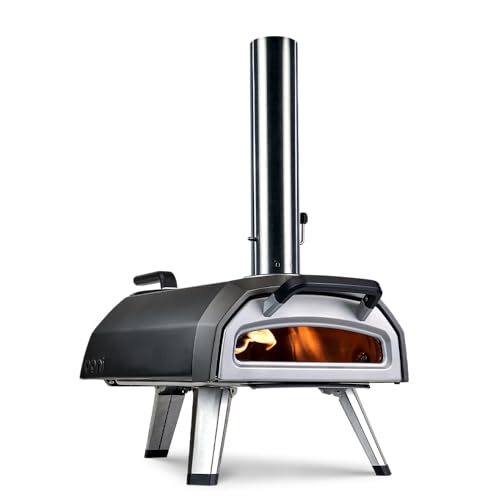
Best for the buyer who genuinely wants live fire and the flavor it gives
- Burns wood or charcoal; propane burner available separately
- Integrated digital thermometer reading stone temperature
- Improved air flow over the original Karu for a cleaner burn
- Hinged door with a viewing window and a chimney damper
Why buy it: the current best expression of a portable wood-fired oven — the integrated stone thermometer alone removes the biggest source of wood-firing frustration, which is not knowing what the floor is actually doing.

Best for a 16-inch stone at roughly half the price of the name brands
- 16-inch stone floor in the budget tier
- Wood-fired as supplied; gas burner sold separately
- Stainless body with chimney and folding legs
- Claimed peak stone temperatures above 900°F
Why buy it: if the 12-versus-16-inch decision is the one that matters most and the budget does not stretch to a Koda 16, this is the honest compromise — you give up insulation, not floor size.

Best for trying live-fire pizza before committing real money
- Two-layer chamber design with a stone floor
- Ships with a pizza peel and a waterproof cover
- Wood or charcoal fired
- Removable parts for cleaning
Why buy it: the cheapest way into a real wood fire with a usable stone — thin-walled and fussy about temperature, but honest about what it is and rated well enough by its owners to recommend as a trial.

Best for a patio with an outdoor outlet and no appetite for tanks or firewood
- Electric — plugs into a standard outdoor outlet, no tank, no ash
- Reaches 700°F with a wood-pellet smoke box for flavor
- Eight functions including bake, roast, air fry and proof
- Enclosed with a door and a digital controller
Why buy it: a lower ceiling than gas, and far more likely to be used on a Wednesday — which for a lot of households is the specification that actually decides the value.
Quick Comparison
| Product | Best for | Rating | Price | Buy |
|---|---|---|---|---|
| Ooni Koda 16 Propane Gas Pizza Oven, 16-Inch | Best Overall | — | Check (paid link) | |
| Gozney Roccbox Outdoor Pizza Oven, Portable, Gas & Wood Fired, Black | Best Portable | — | Check (paid link) | |
| Ooni Karu 2 Multi-Fuel Outdoor Pizza Oven, Wood and Gas, with Stone and Thermometer | Best Wood-Fired | — | Check (paid link) | |
| BIG HORN OUTDOORS 16-Inch Multi-Fuel Outdoor Pizza Oven, Wood-Fired and Gas Compatible | Best Large Budget | — | Check (paid link) | |
| Outdoor Pizza Oven Wood Fired, 2-Layer, with Stone, Peel and Cover | Best Cheap Wood-Fired | — | Check (paid link) | |
| Ninja Woodfire Outdoor Oven & Smoker, 8-in-1, Heats to 700°F, Terracotta Red, OO101 | Best No-Fuel-Hassle | — | Check (paid link) |
Where the Oven Goes
Placement is not an afterthought with an appliance that runs three hundred degrees hotter than a grill.
- Open air, above all else. The exhaust has to rise into open sky. Not a gazebo with a solid roof, not under a patio umbrella, not a screened porch.
- Non-combustible, stable surface. Masonry, stone, a steel cart or the manufacturer's own stand. Not a plastic table, not a resin patio set, not a wooden picnic table without protection.
- Clear of the house by the manufacturer's stated distance or more. Siding melts, eaves and soffits scorch, and vinyl in particular deforms at temperatures a pizza oven reaches easily at close range. Our grill clearance guide applies here with more margin, not less.
- Nothing overhead. Low branches above a wood-fired chimney are a genuine fire risk, and so is a fabric awning.
- Out of the prevailing wind if possible. Wind steals heat from open-front ovens and pushes flame unevenly in wood ovens. A wall or a solid fence a few feet away, downwind, makes a measurable difference.
- Room to work. You need a landing surface within arm's reach for the loaded peel, the toppings and the finished pizzas. Trying to manage all that off one small side shelf is how pizzas end up on the patio.
Safety: Carbon Monoxide and Clearance
Every wood, charcoal, pellet and propane oven produces carbon monoxide — no smell, no color, no taste. That combination is exactly why it harms people who believed they were being sensible. The NFPA's carbon monoxide guidance and the CPSC Carbon Monoxide Information Center are consistent on fuel-burning appliances: they belong outdoors, in open air, full stop.
- Never indoors. Not a kitchen, not a sunroom, not briefly to preheat.
- Never in a garage, even with the door open. An open door does not make a garage outdoors.
- Never under a low, enclosed or unventilated cover — solid-roof pergola, panelled gazebo, patio umbrella, screened enclosure. Rising exhaust needs somewhere to go.
- Never bring a warm oven inside to cool. It can still be off-gassing.
- Keep combustibles away. Fuel bags, paper, cardboard pizza boxes and towels do not belong within arm's reach of a 900°F appliance.
- Have a working CO alarm in the house as a baseline, and treat headache, nausea or dizziness during outdoor cooking as a reason to move away from the oven and into fresh air.
General outdoor cooking fire safety is covered in NFPA's grilling safety guidance and the US Fire Administration's cooking fire prevention page.
A Note on Indoor Countertop Ovens
Indoor electric countertop pizza ovens are a different product with a genuinely lower ceiling — around 700 to 800°F against 900 to 950°F for a gas outdoor oven — and we do not rank them alongside these. At 900°F a Neapolitan pizza bakes in sixty to ninety seconds and chars in a way a 700°F oven cannot reproduce over four minutes. That does not make countertop ovens bad; it makes them a good answer to a different question, namely how to make excellent pizza in an apartment in February. We cover them separately in best countertop pizza oven.
How We Rank
We do not buy, fire or cook on these ovens. Rankings come from aggregated owner ratings across the most-owned outdoor pizza ovens on the US market, weighted toward reviews written after a full season rather than a first weekend. Four things carry the weight: usable floor size, because the 12-versus-16-inch decision generates more regret than anything else; heat recovery between pizzas, the specification nobody prints and the one that separates a good oven from a hot one; friction, since the effort between deciding to eat pizza and eating it predicts whether the oven keeps being used; and durability across seasons, particularly stone cracking and enclosure warping. Prices were checked at the time of writing. Full method: how we rank.
The Field, Reviewed
1. Ooni Koda 16 — Best Overall
Covered above. Owners praise: genuinely full-size pizzas, an even bake from the L-shaped burner, a twenty-minute preheat, and nothing to assemble or learn. Owners gripe about: heat loss through the open front in cold or windy weather, no door so roasting is limited, propane consumption on long sessions, and awkward storage once you own it. Check price (paid link).
2. Gozney Roccbox — Best Portable
The highest-rated oven in the category and the most genuinely insulated portable here. Thin stainless ovens get hot quickly and then sag the moment a cold pizza goes in; the Roccbox carries real mass and holds its floor temperature across consecutive bakes.
Owners praise: heat retention across multiple pizzas, a build that feels like equipment, the safe-to-touch silicone skin with people around, and gas ignition. Owners gripe about: weight for something called portable, a mouth that feels tight with a 12-inch pie, the wood burner being a separate purchase, and the price. Check price (paid link).
3. Ooni Karu 2 — Best Wood-Fired
The pick if live fire is the point rather than a nice-to-have. The integrated digital thermometer reading actual stone temperature addresses the biggest source of wood-firing frustration, which is guessing at the floor while the dome gauge tells you something else entirely.
Owners praise: real wood flavor, better air flow and a cleaner burn than the original Karu, the stone thermometer, and the door and damper giving genuine control. Owners gripe about: constant small feeding to hold temperature, soot on the window, ash cleanup after every session, a thinner review record than the older models, and the gas burner costing extra. Check price (paid link).
4. BIG HORN 16-Inch Multi-Fuel — Best Large Budget
If the 12-versus-16 decision is what matters most and the budget will not stretch to a Koda 16, this is the sensible compromise: you give up insulation and refinement, not floor size.
Owners praise: a 16-inch stone at half the price of the premium brands, high peak temperature, and multi-fuel flexibility. Owners gripe about: thinner walls that lose temperature between pizzas, uneven heat requiring more frequent turning, assembly quality, and occasional stone cracking. Check price (paid link).
5. Two-Layer Wood-Fired Outdoor Oven — Best Cheap Wood-Fired
The cheapest way to find out whether managing a live fire is something you enjoy. It ships with a peel and a cover, which is more than some premium ovens do, and its owner rating holds up well enough for the price bracket to recommend it as a trial rather than a destination.
Owners praise: the price, that it comes with the accessories you need to start, and that it genuinely reaches pizza temperature. Owners gripe about: thin construction and poor heat retention, temperature that swings while cooking, fit and finish, and that it needs constant feeding. Check price (paid link).
6. Ninja Woodfire Outdoor Oven — Best No-Fuel-Hassle
Electric, outdoor-rated, 700°F, and a pellet smoke box for wood flavor. The ceiling is lower than gas and the bake is longer, so the crust is very good rather than Neapolitan. In exchange there is no tank, no fire, no ash, and no reason not to use it on a weeknight.
Owners praise: how often it actually gets used, eight genuinely useful cooking functions, and smoke flavor from the pellet box. Owners gripe about: the lower temperature ceiling, needing an outdoor outlet, and a large footprint. Check price (paid link).
What Owners Actually Complain About
Twelve inches is smaller than it sounds. Allowing peel clearance, a 12-inch stone gives a 10 to 11 inch pizza. Owners feeding families raise this constantly.
Temperature drops after the second pizza. Thin-walled ovens heat quickly and then cannot recover. If you plan to feed a crowd, buy thermal mass rather than a bigger number on the box.
Cracked stones. Almost always thermal shock — a stone that absorbed rain over winter and was then hit with a fast preheat, or water thrown on a hot stone to clean it. Let stones heat and cool with the oven, keep the oven covered, and never wash a hot stone.
Wind ruins an open-front oven. Genuine and under-discussed. Position matters, and a solid fence or wall downwind helps more than owners expect.
The first pizzas were disasters. Universal and not the oven's fault. Ooni's own guidance on launching a pizza is worth reading before the first session; the technique is a pocket of air under the dough and one decisive shimmy.
The Verdict
Get the size right first: 16 inches if you are cooking for more than two people, and the Ooni Koda 16 is the cleanest expression of that with gas simplicity on top. If the oven has to move or you want the best heat retention in a portable, take the Gozney Roccbox. If live fire is genuinely the reason you want an oven, the Ooni Karu 2 is the current best wood-fired portable — and buy the gas burner too, because you will use it. On a budget, a BIG HORN 16 keeps the floor size and gives up the insulation. Whatever you choose: open air, non-combustible surface, well clear of the house, and never in a garage. Check price on Amazon → (paid link)
More from this hub: Outdoor Living & Grills · Best pizza oven · Best wood-fired pizza oven · How to use an outdoor pizza oven · How to clean a pizza oven · How we rank.