 Garden

Affiliate Disclosure
Some links on this page are affiliate links. As an Amazon Associate, we earn from qualifying purchases — at no extra cost to you. We do not buy, test, or physically handle the products we cover; our rankings come from aggregated owner reviews, ratings and expert consensus. Commissions never change our verdicts. How we rank · full disclosure.
A grill cover is the highest-return $30 in outdoor cooking, and the most common way people accidentally rust a grill. Both of those are true at once. A grill kept covered routinely lasts twice as long as the same grill left bare, because rust starts at fasteners, firebox seams and burner tubes rather than on the shiny lid. But a cover put over a warm or wet grill traps that moisture against the steel and holds it there for a week — which does more damage than rain that drains and dries.
So this page is about two things: which covers actually survive a few seasons, and how to use one without causing the problem you bought it to prevent.
Top Picks at a Glance
Fit Is the Whole Product
Covers are a commodity — coated polyester, a hem, some straps — and the thing that separates a good purchase from a bad one is almost always dimensions rather than fabric. Measure three numbers before you buy:
- Width at the widest point, with the side shelves in their normal position. Folded shelves change this by a foot or more.
- Depth front to back, including the lid handle and any rear shelf.
- Height from the ground to the top of the closed lid.
Then buy 2 to 4 inches of slack in each dimension. Tighter than that and you will fight it on every time; looser and the cover becomes a sail, water pools in the slack on top, and it works its way off in the first storm.
| Grill | Typical cover size | Shape notes |
|---|---|---|
| 2-burner gas cart | 32–44 in wide | Rectangular; often oversold at 58 in |
| 3-burner gas cart | 55–58 in wide | Rectangular; the default size band |
| 4–6 burner with side burner | 62–70 in wide | Measure with the side burner lid down |
| 22-inch charcoal kettle | Kettle-specific | Dome and tripod legs; needs a drawstring |
| Kamado in a nest | Kamado-specific | Tall dome; generic covers do not reach |
| 36-inch griddle | Griddle-specific | Must clear the hood and both shelves |
| Pellet grill | Model-specific | Hopper and chimney break the rectangle |
Our #1 Pick: Grillman 58-inch Heavy Duty
In a category where the products are genuinely similar, ownership depth is the most useful signal available, and the Grillman 58-inch has more of it than anything else on the market. That volume means the failure modes are well documented rather than guessed at.
What owners consistently report is that it does the basic job for two to three seasons in ordinary weather: it sheds rain, it does not shrink, the padded handles make it manageable alone, and the hem straps hold it in wind that lifts unstrapped covers off. The vents matter more than they look — they let the pressure equalize in a gust instead of ballooning the cover, and they let some of the moisture that inevitably gets underneath escape.
The recurring criticisms are honest and worth knowing. In strong year-round sun, the inner waterproof coating begins to peel somewhere in the second or third summer, which is the normal end-of-life for a cover in this price band; the fabric outlasts the coating. Sizing complaints are common and almost always a measurement problem — 58 inches is a three-to-four-burner size and it is far too big for a two-burner cart, where it will flap and pool. And like every cover here, it will hold moisture against a grill that was covered while warm.
If you want a cover to last longer than three summers, the Unicook 65-inch uses noticeably heavier fabric and rates higher for it. If you have a kettle, a griddle or a pellet grill, none of the rectangular covers is the right answer — buy the shaped one.
Check price on Amazon → (paid link)
The Ranked Field

Best for the standard 3 to 4-burner gas grill on an open patio
- 58 x 24 x 48 in, fitting most three and four-burner carts
- Waterproof coated polyester with a UV-resistant finish
- Padded handles and adjustable hem straps
- Air vents to reduce condensation and wind lift
Why buy it: the most-owned grill cover in America by a wide margin, which in a category this generic is the most useful signal there is.
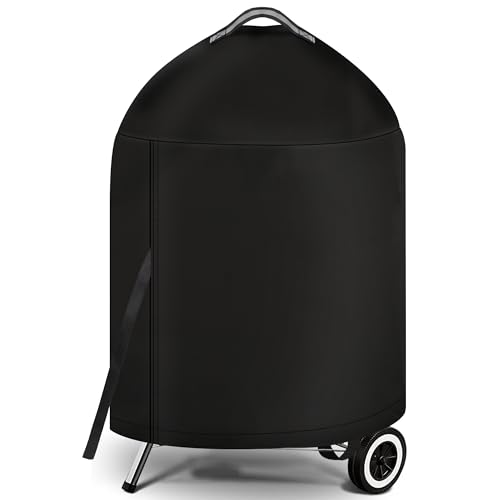
Best for a 22-inch kettle, where a rectangular cover simply does not fit
- Shaped for the dome and tripod legs of a 22-inch kettle
- Waterproof coated fabric with taped seams
- Elastic hem plus a drawstring for wind
- Fits kettles with and without an ash catcher
Why buy it: kettles are the grill most often left uncovered because generic covers billow off them — a shaped cover with a drawstring actually stays on.

Best for large grills, harsh sun and anyone replacing a cover every year
- 65 x 24 x 48 in for large carts and grills with side burners
- Heavier fabric with a fade-resistant coating
- Wide hem with click-close straps
- Handles on both sides for one-person fitting
Why buy it: the highest-rated cover with a genuinely deep owner record — the heavier fabric is what separates a cover that lasts three summers from one that shreds in one.

Best for a 36-inch griddle station, which rusts faster than any grill if left bare
- Cut for a 36-inch griddle including hood and side shelves
- Weather-resistant coated fabric
- Velcro closures at the leg cutouts
- Vented to release trapped moisture
Why buy it: a bare steel griddle plate is the single most rust-prone surface in outdoor cooking, and this is the highest-rated cover in the entire category.

Best for a pellet grill, where the hopper and controller must stay dry
- Full-length cut that reaches the base of the legs
- Shaped around the hopper and chimney
- Heavy coated fabric with a hem strap
- Made for the specific grill footprint rather than a size band
Why buy it: pellet grills have electronics and a hopper full of moisture-sensitive fuel, so cover fit matters more here than on any other cooker.

Best for two-burner grills, portables and balcony setups
- 32 x 20 x 38 in for compact carts and two-burner grills
- Waterproof fabric with sealed seams
- Padded handles and adjustable straps
- Storage bag included
Why buy it: small grills are usually sold covers that are far too big, and an oversized cover flaps, holds water and blows away — fit is the whole product here.
Quick Comparison
| Product | Best for | Rating | Price | Buy |
|---|---|---|---|---|
| Grillman Heavy Duty Grill Cover, 58 inch, Waterproof and Rip-Resistant | Best Overall | — | Check (paid link) | |
| iCOVER Grill Cover for 22-Inch Charcoal Kettle Grills, Heavy Duty Waterproof | Best for Kettle Grills | — | Check (paid link) | |
| Unicook Heavy Duty Waterproof Gas Grill Cover, 65-inch, Fade Resistant | Best Heavy Duty | — | Check (paid link) | |
| 36-inch Griddle Cover, Weather Resistant, Fits 36 in Griddles with Hood | Best for Flat-Top Griddles | — | Check (paid link) | |
| Traeger BAC380 Full-Length Grill Cover for Pro 34 Series | Best for Pellet Grills | — | Check (paid link) | |
| SunPatio 2-Burner Gas Grill Cover, 32 inch, Heavy Duty Waterproof | Best Small | — | Check (paid link) |
Fabric, Denier and What Actually Fails
Cover fabric is specified in denier — 300D, 600D, 1000D — which measures the thickness of the yarn rather than the waterproofing. Heavier denier means better tear and abrasion resistance, which matters if a cover rubs a brick wall or gets dragged over a corner. For most patios, 300D is adequate and 600D is the sensible upgrade; 1000D is for genuinely harsh exposure.
But the part that fails is almost never the fabric. It is the coating — a PVC or polyurethane layer laminated to the inside, which is what makes the cover waterproof. Ultraviolet light breaks it down from the outside in, and after two or three summers you find it flaking off in the hand and the cover starts wetting through. That is why UV resistance, not waterproof rating, is the specification that predicts a cover's life in Arizona or Florida, and why a cover on a shaded north-facing patio can easily last twice as long as the same cover in full sun.
Two features worth paying for: vents, which cut both wind lift and trapped condensation, and straps or a drawstring hem, without which a cover in an exposed yard ends up in the neighbor's garden.
How a Cover Causes Rust — and How to Avoid It
The mechanism is simple. Steel corrodes when moisture stays in contact with it. Rain on an uncovered grill runs off and evaporates within hours. Moisture under a cover — from a warm grill, a wet lid, or condensation on a cold night — has nowhere to go, and it sits against the metal for days. That is why some owners genuinely find a covered grill rustier than an uncovered one.
The rules that prevent it:
- Let the grill cool completely. A warm grill under a cover generates its own condensation, and hot metal can also melt the cover.
- Cover dry, not wet. If the grill is wet from rain or washing, leave it until it dries.
- Buy vented. Vents let trapped humidity out and stop the cover ballooning in wind.
- Air it out. Pull the cover off on a dry day every few weeks, especially in a humid climate.
- Never use a plastic tarp. Tarps do not breathe at all and are the fastest way to rust a grill.
- Empty the grease tray and ash catcher first. Wet ash is corrosive and eats a charcoal bowl from the inside over a winter.
Winter Storage
Covering matters most in winter, because freeze-thaw cycles push water into seams and fasteners and open them up. Before the first freeze: clean the grates, empty the grease tray or ash catcher, wipe the interior, and coat cast iron grates lightly with oil. Our winterizing guide covers the whole routine.
For gas grills, disconnect the propane tank before storage and store the tank outdoors, upright, and never in a garage, shed or basement — a leaking tank in an enclosed space collects propane at floor level, because it is heavier than air. If you move the grill under a roof for winter, that roof must not be an enclosed space you ever light the grill in: charcoal and propane both produce carbon monoxide, which the CPSC describes as colorless and odorless, and every year people are killed by a grill brought into a garage out of the weather. Storage is fine; lighting it there is not. See leaving a propane tank outside in winter.
How We Rank
We do not buy or test these covers. Rankings come from aggregated owner ratings across the most-owned models in the category — one of the deepest review pools on this site — weighted toward reviews written after a full year outdoors, where coating failure and UV degradation appear. Four things carry the weight: fit accuracy against the stated dimensions, since sizing drives the majority of complaints; fabric weight and coating durability, which determine whether a cover lasts one summer or four; wind retention, meaning straps, drawstrings and vents; and shape appropriateness, because kettles, kamados, griddles and pellet grills all need cut-to-shape covers rather than a rectangle. Prices were checked at the time of writing. Full method: how we rank.
What Owners Actually Complain About
Sizing. The overwhelming majority of one-star reviews in this category are fit problems, and most are measurement problems. Measure the three dimensions before you order.
Coating peeling in year two or three. Universal, and mostly a UV story. A shaded grill's cover lasts far longer than the same cover in full sun.
Wind. Unstrapped covers do not stay on. Straps or a drawstring hem are worth paying for in any exposed yard.
Water pooling on top. Happens when a cover is too large for the grill, leaving a slack basin on the lid. Another argument for fit over "one size fits most".
Mildew smell. Trapped moisture, every time. Vents, dry covering and occasional airing solve it.
The Verdict
For a standard three or four-burner gas grill, buy the Grillman 58-inch and expect two to three seasons; pay up for the Unicook 65-inch if your grill lives in full sun and you would rather buy once. If you own a kettle, a griddle or a pellet grill, do not compromise on a rectangle — the shaped kettle, griddle and pellet covers above exist because generic covers billow off those shapes and trap water on them. And whatever you buy, cover the grill cool and dry, or the cover becomes the problem. Check price on Amazon → (paid link)
More from this hub: outdoor living & grills · best gas grill cover · best patio furniture covers · winterizing your grill and patio · best grill brush · how we rank.