 Garden

Affiliate Disclosure
Some links on this page are affiliate links. As an Amazon Associate, we earn from qualifying purchases — at no extra cost to you. We do not buy, test, or physically handle the products we cover; our rankings come from aggregated owner reviews, ratings and expert consensus. Commissions never change our verdicts. How we rank · full disclosure.
Before you compare BTUs, answer one question: is there anything above your patio? If there is open sky, a propane standing heater is the efficient, obvious choice. If there is a roof, a solid pergola cover, a balcony above, or any enclosure at all, propane is off the table entirely and you are buying electric infrared. That single fact decides more patio heater purchases than any spec on this page, and most roundups bury it in a footnote.
The reason is carbon monoxide. Every propane heater burns fuel and produces CO, which the CPSC Carbon Monoxide Information Center describes as colorless and odorless — there is no smell, no irritation, no warning before symptoms start. Standing propane heaters are labeled outdoor-use-only for exactly this reason, and a covered patio is not outdoors.
Top Picks at a Glance
The Four Types, and Who Each One Suits
| Type | Output | Warms | Safe under a roof? | Typical price |
|---|---|---|---|---|
| Standing propane (mushroom) | 40,000–50,000 BTU | 15–20 ft circle | No | $150–$250 |
| Pyramid / flame tube propane | 40,000–50,000 BTU | 10–15 ft circle | No | $220–$320 |
| Tabletop propane | 10,000–12,000 BTU | One table | No | $80–$130 |
| Electric infrared | 1,500–3,000W | Line of sight, 6–12 ft | Yes | $100–$250 |
Two things in that table surprise people. The pyramid heaters look like they should throw more heat than a mushroom top and generally throw less, because the flame column radiates outward from a narrow tube rather than being spread by a wide reflector. And electric infrared numbers look small until you understand that infrared heats you rather than the air around you, which is why it works in wind that renders a propane heater almost useless.
Our #1 Pick: Amazon Basics 46,000 BTU Standing Heater
It is the most-owned patio heater on Amazon by a substantial margin, and in a category where design differences between brands are small, that ownership depth is the most useful information available. The build is the standard commercial pattern — a steel post over a tank-holding base, a burner under a wide reflector — and 46,000 BTU is the output most restaurants use on a sidewalk table.
Owners consistently report that it does the job it claims: a meaningful temperature lift for a seating group in still air, roughly nine hours from a 20 lb tank at full output, and an anti-tilt switch that actually works. Wheels are more useful than they sound, because a heater with a full tank in the base is heavy and awkward, and heaters that are hard to move end up left out in the rain.
The recurring complaints are consistent across the whole category rather than specific to this unit. Assembly is long — reckon on an hour with two people and a socket set, and expect at least one poorly aligned hole. Pilot lights that will not stay lit are the number one functional complaint, and in most cases the cause is a thermocouple that is not seated in the flame or a new tank's excess-flow valve tripping because the valve was opened too fast; open the tank slowly, a quarter turn at a time. Rust appears within a season if it is left uncovered, particularly around the base and the reflector fasteners.
And the honest limitation of every propane standing heater: wind ruins it. These heat air, and moving air takes that heat away. In a breezy yard, an electric infrared unit aimed at the seating area does more with a quarter of the energy.
Check price on Amazon → (paid link)
The Ranked Field

Best for the standard mushroom-top heater for an open patio or deck
- 46,000 BTU covering roughly a 9-foot radius
- Anti-tilt shut-off switch and a thermocoupled pilot
- Wheels for moving a heavy unit alone
- Runs on a standard 20 lb propane tank concealed in the base
Why buy it: the most-owned patio heater on Amazon by a wide margin, which is why we can talk about how these age rather than how they are advertised.

Best for windy yards and anywhere a toppling heater is the real worry
- Weighted sand box in the base for a much lower center of gravity
- 50,000 BTU with a double-layer stainless burner
- Integrated table ring for drinks
- Anti-tilt switch and a piezo ignition
Why buy it: the sand box is the feature to shop for — a standing heater with an empty base is genuinely easy to blow over, and this design fixes the problem rather than warning about it.

Best for a roofed porch, pergola or garage bay where propane must never be used
- 3000W electric infrared with no combustion and no exhaust
- Wall or ceiling mount keeps the floor clear
- Remote control with multiple heat levels
- IP65 rated for outdoor exposure
Why buy it: the only category here that is safe under a roof — electric infrared produces no carbon monoxide at all, which is the entire reason it exists.
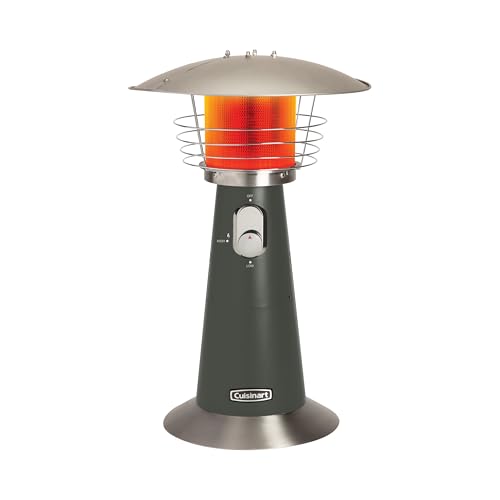
Best for a small balcony or a four-person table rather than a whole patio
- 11,000 BTU sized for a table, not an area
- Runs on 1 lb disposable canisters or an adapter hose
- Anti-tilt shut-off switch
- Light enough to carry inside for storage
Why buy it: honest about what it is — it warms the people at the table, not the yard, and that is exactly what most small balconies actually need.

Best for patios where the heater is also part of the scene
- Visible dancing flame inside a quartz glass tube
- 48,000 BTU with a wheeled base
- Weather cover included in the box
- Anti-tilt switch and a safety shut-off valve
Why buy it: the flame tube is genuinely nicer to sit near than a mushroom top, and owners rate it well — just know that a glass column is a fragile thing in a windy yard.
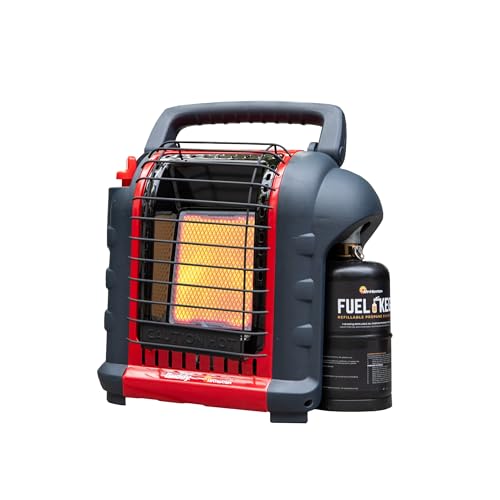
Best for a workshop, a screened structure or a spot where you need heat right beside you
- 4,000 or 9,000 BTU radiant output from 1 lb canisters
- Oxygen Depletion Sensor and a tip-over shut-off
- Certified for use in enclosed spaces where most propane heaters are not
- Folding handle, weighs about 10 lb
Why buy it: the highest-rated propane heater in this whole field, and the only one here designed with an oxygen depletion sensor — read the safety section below before you assume that makes any other heater safe indoors.

Quick Comparison
| Product | Best for | Rating | Price | Buy |
|---|---|---|---|---|
| Amazon Basics 46,000 BTU Commercial Outdoor Propane Patio Heater with Wheels | Best Overall | — | Check (paid link) | |
| EAST OAK 50,000 BTU Patio Heater with Sand Box Base and Table Design | Best Stability | — | Check (paid link) | |
| Dr. Infrared Heater DR-239 3000W Infrared Patio Heater, Wall or Ceiling Mount | Best for Covered Patios | — | Check (paid link) | |
| Cuisinart Tabletop Patio Heater, 11,000 BTU with Anti-Tilt Safety Switch | Best Tabletop | — | Check (paid link) | |
| Pamapic 48,000 BTU Pyramid Patio Heater with Quartz Glass Flame Tube and Cover | Best Looking | — | Check (paid link) | |
| Mr. Heater 9,000 BTU Portable Buddy Radiant Propane Heater with Oxygen Depletion Sensor | Best Small-Space Radiant | — | Check (paid link) |
The Safety Section: Read This Before Buying
Propane heaters are outdoor appliances. Never operate a standing, pyramid or tabletop propane patio heater inside a garage, a screened porch, an enclosed gazebo, a tent, a camper, or under a solid patio roof. Combustion produces carbon monoxide continuously, and enclosed or partly enclosed spaces let it accumulate. Leaked propane compounds the problem: it is heavier than air and pools at floor level rather than dispersing.
Clearances matter and are specified per model. Manufacturers of standing propane heaters typically require on the order of 3 feet of clearance above the reflector and around 2 feet to the sides, but the figure that governs is the one printed in your own manual and on the label. That clearance is a fire requirement, not a suggestion — awnings, umbrella canopies, string lights and overhanging branches all sit inside it.
Anti-tilt is not the same as stable. A tip-over switch cuts the gas when the heater falls; it does not stop the heater falling. Standing heaters are tall and light until the tank is fitted, and a gust can put one over. Fill a sand-box base if your model has one, keep the tank in the base rather than beside it, and bring the unit in or lay it down before a storm.
One heater on this list is different, and the distinction matters. The Mr. Heater Portable Buddy is built with an Oxygen Depletion Sensor and is certified for use in enclosed spaces that other propane heaters are not — that is a specific engineering certification on that specific product, and it does not transfer to anything else here. Do not read "some propane heaters are indoor-safe" as "my patio heater is probably fine." It is not.
Check for leaks every season. Brush soapy water on the hose and connections with the tank open; bubbles mean a leak. Replace cracked or hardened hoses rather than taping them, and store the tank outdoors and upright — see storing a propane tank outside in winter.
What It Costs to Run
A 20 lb propane tank holds roughly 430,000 BTU of usable energy. Divide by the burner rating and you get run time: about 9 hours on a 46,000 BTU heater, about 8.5 on a 50,000 BTU unit, and around 39 hours on an 11,000 BTU tabletop. At about $20 a refill in 2026, that is roughly $2.20 an hour on a big standing heater and about $0.50 an hour on a tabletop.
A 3,000W electric infrared heater draws 3 kilowatt-hours per hour. At the 2026 US residential average of roughly 17 cents per kWh, that is about $0.51 an hour — noticeably cheaper, though it heats a smaller, more directional zone. Rates vary widely by state, so check your own bill before treating that as a general rule.

How We Rank
We do not buy or test these heaters. Rankings come from aggregated owner ratings across the most-owned models in the category, weighted toward reviews from owners past their first winter where rust, pilot reliability and wind stability show up, and cross-checked against published output and clearance specifications. Four things carry the weight: safety design, including anti-tilt switches, base weighting and whether the type is appropriate for the buyer's space at all; real heat delivered rather than headline BTUs, since reflector design and heating method matter more than the number; weather durability, because these live outdoors and rust is the top long-term complaint; and stability in wind. Prices were checked at the time of writing. Full method: how we rank.
What Owners Actually Complain About
Pilot lights that will not stay lit. The most common functional complaint across every brand. Usual causes: opening the tank valve too fast and tripping its excess-flow protection, a thermocouple not sitting in the pilot flame, or wind. Open the tank slowly and shield the pilot while lighting.
Assembly. An hour, two people, and misaligned holes are the standard experience. Several owners recommend loosely fitting every bolt before tightening any of them.
Rust within a season. Near-universal on units left uncovered. A cover is a $25 purchase that adds years — the same logic as a grill cover.
Less heat than expected. Usually wind, sometimes an unrealistic expectation of what any heater does in open air. Nothing warms a whole yard.
Wobble and tipping. The complaint that matters most. Weighted or sand-filled bases are the fix, and they are worth paying for.
The Verdict
If your patio has open sky above it, buy the Amazon Basics 46,000 BTU standing heater — it is the deepest owner record in the category and it does what a patio heater is supposed to do. If your yard is windy or you have children and pets moving around it, pay the extra for the EAST OAK with a sand-filled base. If there is a roof, a pergola cover or a balcony above your seating, do not buy propane at all: the Dr. Infrared mounted electric unit is the correct and only safe answer. And for a single small balcony table, the Cuisinart tabletop is enough. Check price on Amazon → (paid link)
More from this hub: outdoor living & grills · best fire pits · best smokeless fire pits · hanging outdoor string lights · storing patio furniture in winter · how we rank.