 Garden
Affiliate Disclosure
Some links on this page are affiliate links. As an Amazon Associate, we earn from qualifying purchases — at no extra cost to you. We do not buy, test, or physically handle the products we cover; our rankings come from aggregated owner reviews, ratings and expert consensus. Commissions never change our verdicts. How we rank · full disclosure.
The short version: the best pool thermometer for most owners is the Inkbird IBS-P01R wireless set — a floating sensor that transmits to a receiver indoors, so the temperature is a glance rather than a walk. The reason that matters is behavioural: people check a wireless thermometer daily and a floating one occasionally, and a temperature you actually track is what tells you whether your heater is worth running. If you want simplicity, the Aquatix Pro floating thermometer costs a fraction as much and has nothing to break.
This is a small purchase with a larger effect than it looks. Knowing the water temperature is how you decide whether to run a heater, whether a solar cover is earning its keep, and whether the pool is warm enough that chlorine is being consumed faster than usual — warm water eats sanitizer, and the CDC floor of at least 1 ppm free chlorine still has to hold. If you are heating, read it alongside best above-ground pool heater and best pool solar cover. Everything else is at the pools and spas hub.
Top Picks at a Glance

Our #1 Pick: Inkbird IBS-P01R Wireless Pool Thermometer
The argument for a wireless thermometer is not accuracy — a five-dollar floating tube is accurate enough. It is that a number you can see from the kitchen gets looked at, and a number that requires walking to the pool and squinting at a scale does not. Once you are actually watching the temperature daily, you start noticing things: how much a solar cover holds overnight, how quickly a cloudy week undoes a heater, whether running the pump during the day is warming the water or cooling it.
Consensus Score ████████░░ 8.2 — owners consistently report it changing how often they check, not just how they check
Practically, a floating sensor sits in the pool and transmits to a small receiver you keep indoors, with a quoted range around 300 ft. It reads across a very wide span in either Fahrenheit or Celsius, the sensor is IPX7 rated, and the same unit works in a spa, a pond or a hot tub. There is an optional gateway that adds internet access and alerts, sold separately, if you want the temperature on your phone from away.
It is worth being clear about placement, because it affects the reading more than the instrument does. Tether the sensor away from a return jet — water coming out of a heater is not the temperature of the pool — and if possible somewhere that is not in blazing direct sun all afternoon, since the top few inches of a sunlit pool run warmer than the body of water beneath.
The recurring criticisms are consistent. Signal dropouts are the most common, and the quoted 300 ft assumes line of sight — a house wall or a metal shed cuts it sharply, and owners with the receiver on the far side of the house report it losing connection. Battery life in the sensor is reported as shorter than expected, and the batteries are not included. Water ingress into the sensor after a season or two appears in a meaningful number of reviews. The receiver display is described as small. And a few owners report readings drifting a degree or two from a reference thermometer.
Check price on Amazon → (paid link)
Best Pool Thermometers 2026: The Ranked Field
Best for checking the water temperature from indoors before deciding to swim
- Floating sensor transmits to an indoor receiver up to about 300 ft
- Reads roughly -40 to 158°F in Fahrenheit or Celsius
- IPX7 rated floating sensor
- Works in pools, spas, ponds and hot tubs
Why buy it: knowing the temperature without walking outside is the difference between checking it daily and checking it never.
Best for a simple, accurate reading with nothing to charge or pair
- Large easy-read scale in Fahrenheit and Celsius
- Shatter-resistant casing with a tether string
- No batteries, nothing to fail electronically
- Suits pools, spas, hot tubs, aquariums and ponds
Why buy it: with no battery and no electronics there is nothing to go wrong, which is why these outlive every digital model on the market.

Best for reading an exact number rather than estimating between marks
- Oversized dual-sided LCD readable from either direction
- Legible from several inches below the surface
- Digital readout removes scale-reading guesswork
- Floats upright with a tether point
Why buy it: a dual-sided screen means you can read it from the deck without fishing it out and turning it around.

Best for families, and pools where a thermometer takes a beating
- Shatter-resistant casing with non-toxic fill
- Large numbers in Fahrenheit and Celsius
- Tether included so it can be tied to a ladder
- About 9 in. tall and hard to lose in a big pool
Why buy it: it is visible from the far end of the pool and survives being thrown around, which no slim floating tube does.

Best for a spare, or a second thermometer for a spa or kids pool
- Reads roughly 20 to 120°F
- Floating duck body with a string tether
- Easy-read dual-scale display
- Works in pools, baths, spas, hot tubs and ponds
Why buy it: cheap enough to buy two, which matters because the most common thermometer failure is simply losing it.
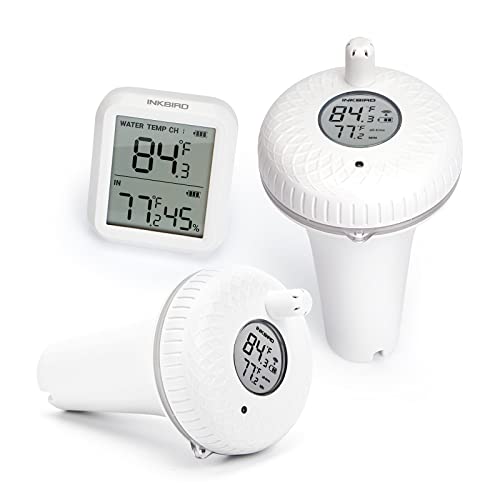
Best for monitoring a pool and a hot tub from one indoor display
- Two floating sensors paired to a single receiver
- Both readings shown on one indoor screen
- Second-generation wireless design
- Suits pool plus spa, or pool plus bath water
Why buy it: one receiver covering two bodies of water saves buying and charging a second complete system.

Quick Comparison
| Product | Best for | Rating | Price | Buy |
|---|---|---|---|---|
| Inkbird IBS-P01R Wireless Pool Thermometer and Receiver Set | Best Overall | — | Check (paid link) | |
| Aquatix Pro Large Floating Pool Thermometer with String | Best Value | — | Check (paid link) | |
| GAME Floating Digital Pool Thermometer | Best Digital Floating | — | Check (paid link) | |
| GAME Derby Duck Spa and Pool Thermometer | Most Durable Classic | — | Check (paid link) | |
| Duck Thermometer Pool Floating Submersible Water Thermometer | Best Budget | — | Check (paid link) | |
| INKBIRD 2 Wireless Pool Thermometers with Wireless Receiver Set | Best for Pool and Spa Together | — | Check (paid link) |
How We Rank
We do not buy or physically handle these thermometers. Rankings come from aggregating star ratings and review volume across large owner-review sets, weighting recent reviews above older ones, checking stated measurement ranges, ingress-protection ratings, transmission distances and display specifications against manufacturer documentation, and reading negative reviews closely. In this category the negative reviews are dominated by two failure modes — water getting into digital units and signal problems on wireless ones — and both are genuinely predictive of long-term satisfaction.
Four factors set the order. Whether the design encourages regular use, since an unread thermometer has no value. Durability, weighted heavily because this is a device that lives outdoors in water and sunlight. Readability, from the deck rather than from arm's length. And owner satisfaction, weighted by review volume and read across multiple seasons rather than first impressions. Prices were checked at the time of writing. Full method: how we rank.
The Thermometers, Reviewed
1. Inkbird IBS-P01R — Best Overall
Covered above. Consensus Score ████████░░ 8.2. Strengths: an indoor receiver so the reading is always to hand; around 300 ft of quoted range; a very wide measurement span in either scale; IPX7 floating sensor; and it works equally well in a spa or pond. Recurring complaints: signal dropouts through walls and at distance; shorter than expected battery life with batteries not supplied; water ingress into the sensor after a season or two; a small receiver display; and occasional drift against a reference reading.
2. Aquatix Pro Large Floating Thermometer — Best Value
The honest counterweight to everything electronic. A large, clearly marked floating thermometer in a shatter-resistant casing with a tether string, no batteries, and nothing that can fail except the casing itself. It reads both scales, it works in a spa or a pond just as well as a pool, and it costs less than a bag of shock.
Consensus Score ████████░░ 8.0 — very well rated, with fragility the main criticism
Recurring complaints: despite the shatter-resistant claim, owners report the casing cracking when it is dropped on concrete or trapped against a skimmer. Several describe the liquid column separating after a hot season in direct sun. The string tether is frequently described as too short. And the small print on the scale is hard to read from the deck compared with a digital display.
3. GAME Floating Digital Pool Thermometer — Best Digital Floating
The middle ground: a digital readout without a wireless system to maintain. Its distinguishing feature is a large dual-sided LCD, which means you can read it from wherever you happen to be standing rather than fishing it out and rotating it. The screen stays legible from a few inches below the surface, which is where a floating thermometer usually sits.
Consensus Score ███████░░░ 7.3 — decent ratings, undermined by seal reliability
Recurring complaints: water ingress is the dominant one, with a meaningful number of owners reporting condensation behind the screen or outright failure within a season or two. Battery replacement is described as difficult or impossible on some units. The display washes out in bright direct sun. And several reviewers report readings that drift after water gets in.
4. GAME Derby Duck — Most Durable Classic
Easy to dismiss and genuinely well made. The shatter-resistant body with non-toxic fill survives being thrown, dropped and generally abused in a way slim glass-tube thermometers do not, it is about 9 in. tall so you can see it from the far end of the pool, and the numbers are large enough to read without picking it up. It has been sold for many years, which in this category counts for something.
Consensus Score ████████░░ 8.1 — consistently high ratings over a very long sales history
Recurring complaints: owners report it floating on its side in a breeze, which makes it awkward to read. The tether attachment is described as weak and prone to pulling out. Colours fade noticeably after a season or two in strong sun. And several reviewers note it is bulky enough to get stuck in a skimmer throat.
5. Duck Thermometer Pool Floating — Best Budget
The cheap spare. It reads roughly 20 to 120°F on a dual scale, floats upright with a string tether, and works in a bath, a spa, a pond or a kids pool as readily as a swimming pool. Its real virtue is price: the most common way a pool thermometer fails is by disappearing, and one cheap enough to buy in pairs solves that.
Consensus Score ███████░░░ 7.4 — good ratings for the money, with build quality the trade-off
Recurring complaints: build quality is the theme — thin plastic, tethers that detach, and casings that crack. Owners report accuracy varying by a couple of degrees between units. The scale markings are small. And several reviewers describe it tipping over and floating face-down.
6. INKBIRD 2 Wireless Thermometers with Receiver — Best for Pool and Spa
Two floating sensors paired to one indoor receiver, showing both readings on a single screen. If you have a pool and a hot tub — or a pool and a separate kids pool you actually care about the temperature of — this is considerably cheaper and tidier than two complete wireless systems, and it saves a second receiver cluttering the kitchen.
Consensus Score ███████░░░ 7.9 — well rated, inheriting the strengths and the flaws of the single unit
Recurring complaints: the same range and dropout problems apply, and with two sensors there are two chances of losing signal. Owners report pairing being fiddly to set up initially. Battery drain across two sensors doubles the maintenance. And several reviewers note the receiver display becomes cramped showing two readings.

How to Choose a Pool Thermometer
Decide whether you want the reading indoors, because that is the only significant functional difference in this category. A wireless set costs several times more than a floating thermometer and is not meaningfully more accurate — what it buys is the fact that you will look at it. If you walk past the pool several times a day anyway, a floating thermometer is genuinely enough.
Prefer simple construction if the thermometer lives outdoors year-round. The consistent finding across owner reviews is that electronics in water fail: seals leak, batteries corrode, screens fog. A liquid-filled floating thermometer in a robust casing has none of those failure modes and routinely outlasts digital units by years. If you buy digital, expect to replace it more often and budget accordingly.
Get the placement right, because it affects the number more than the product does. Tether the thermometer away from return jets, since water leaving a heater is not the temperature of the pool. Keep it out of the shallowest, sunniest corner if you can, because the top few inches in direct sun can read several degrees above the body of the water. And tether it somewhere it will not be pulled into the skimmer, which is where thermometers go to be destroyed. If you are reading a spa rather than a pool, the number that matters is the ceiling: the CPSC warns against water above 104°F.
Finally, treat it as a seasonal device. Bring it indoors over winter rather than leaving it to freeze into an ice sheet on the cover — freezing is a common cause of cracked casings and separated liquid columns. Take batteries out of digital units in storage so they cannot leak. And if you have children, remember that a floating duck-shaped thermometer looks exactly like a pool toy: it should be tethered out of reach and children should never be encouraged to retrieve it from the water.
What Owners Actually Complain About
Water ingress into digital units is the single most common complaint in this category. Condensation behind the screen, then a dead or drifting display, generally within one or two seasons. It affects every digital brand to some degree and is the strongest practical argument for a simple liquid thermometer.
Wireless signal dropouts is the equivalent complaint on the connected models. The quoted transmission distances assume clear line of sight, and a house wall between sensor and receiver can cut real range by more than half. Moving the receiver to a window facing the pool solves most cases.
Broken tethers and lost thermometers generate more reviews than anything else across the cheap models. Attachment points pull out, strings are supplied too short to reach a ladder rail, and the thermometer ends up in the skimmer or at the bottom of the pool.
Cracked casings follow from the same cause — a thermometer that is not tethered gets stepped on, dropped or frozen. And sun-faded scales and separated columns appear in second-season reviews of every liquid-filled model left outdoors year-round.
The Verdict
For most pools the Inkbird IBS-P01R is the thermometer to buy, because a reading you can see from indoors is a reading you will actually use — and the two-sensor Inkbird set is the version to get if you have a spa as well. If you would rather own something with nothing to fail, the Aquatix Pro floating thermometer is accurate, cheap and will still be working in five years, and the GAME Derby Duck is the tougher, more visible version of the same idea. Buy the GAME digital floating model only if you want an exact number without a wireless system, and accept that the seal is its weak point. And whatever you choose, tether it.
Check price on Amazon → (paid link)
Next: act on what it tells you with best above-ground pool heater, hold the heat overnight using best pool solar cover, read how long does it take to heat a pool 10 degrees, or set a spa properly with what temperature should a hot tub be set to.